
Working up a Storm
By complete chance, Scott MacCallum visited the Riverside Stadium a couple of days after one of the most momentous matches in the history of Durham County Cricket Club. He met the man perfectly suited to dealing with the highs and lows of professional groundsmanship.
Working up a Storm
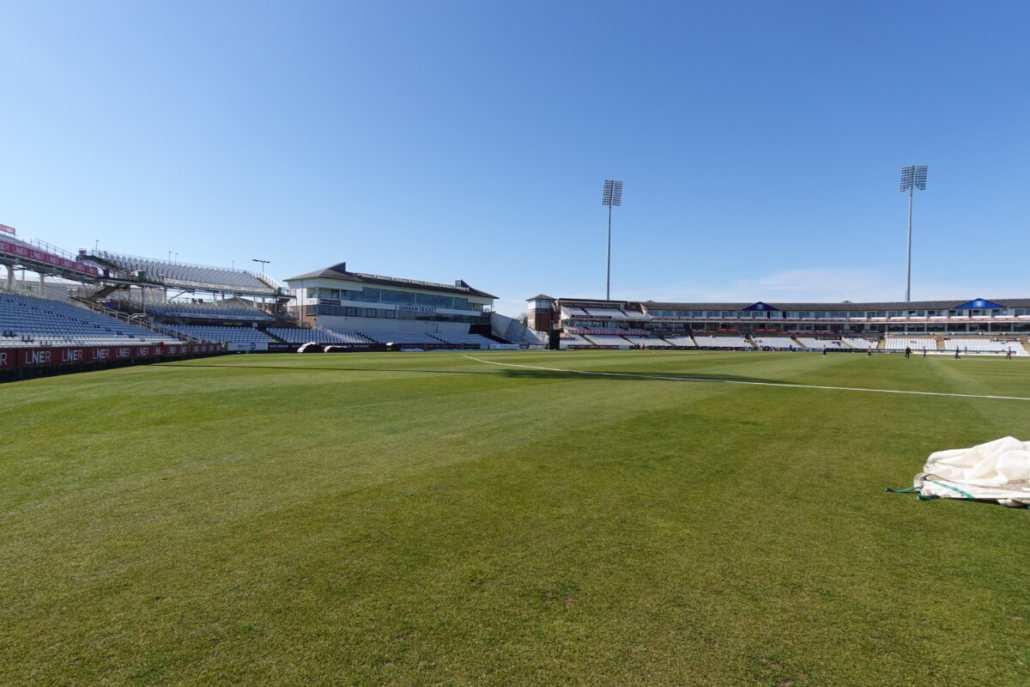
It’s 10am on the first Tuesday after Easter at an extremely sunny and warm Riverside Stadium, in Chester-leStreet, and Vic Demain, Head Groundsman, is there to greet me – his usual relaxed and friendly self.
However, a mere 48 hours earlier, during the first four-day game of the new season against Kent, things had been markedly different. And it was all down to Storm Dave.
In his long career as a volunteer groundsman, a professional groundsman and now Head Groundsman at a Test venue for the past 11 years, thanks to Dave, the Sunday had been the most traumatic day of Vic’s career. “The first two days were fine and we had got well into the match,” recalled Vic.
“We knew that there was a threat of some weather coming in and there was actually an amber wind warning for Saturday night, but that wasn’t particularly unusual as we have a lot of wind up here.
“We’ve had storms come in before and come out of them pretty much unscathed. But this was excessive,” said Vic, of the 70mph-plus winds which hammered the area in the early hours on Sunday morning – a level which is officially classified as Violent Storm Force.
“I knew it was going to be bad, as could hear it through the night, and when I opened my bedroom curtains I saw that the standard rose in the front garden had snapped in half. So that was a bad start.”
Not really knowing what to expect but fearing that it would be something unpleasant Vic walked through a little cut in the grandstands so that he could take a look.
“Before we left on the Saturday evening we had completely covered the square and put as many pins into the ground sheets as we could, as well as adding as many weighted bags as we could lay our hands on.”
However, even having seen the fate of his poor rose, it couldn’t have prepared him for the scene that faced him as he looked out over the outfield.
“Everything had disappeared off the ground. It has just gone. One of the roll-on covers had blown all the way to the east side of the ground, and another had actually flipped over and flown into the stand. The scaffolding at the far end of the ground was completely ruined,” said Vic explaining that the regular practice was to secure it by tying it the sight screens.
“There was just damage everywhere,” he said reflecting on the carnage that faced him.
With the match at the half way stage, and with Durham holding the edge, the fact that the pitch had been left to the vagaries of the accompanying rain meant that there was no chance of any play on the Sunday, even if Vic and his team had been able to make the ground safe.
“In a way we got unlucky because what had happened was that we had put the roll on covers on the pitch itself, and then attached the ground sheets on either side.
“The sheet that was attached at the pavilion end of the ground would have been the first one that blew off because the wind was coming in from the southwest. The wind got under it, curled it up and everything went. In a way it acted like a sail.
Working up a Storm
“In pulling that sheet off, all the water that had collected was deposited on one end of the pitch.”
Vic and his team worked their socks off to make the ground, and pitch, safe and it is quite remarkable, and a tribute to all involved, that the match wasn’t abandoned and the final day of play went ahead.
“Luckily, the wind wasn’t as strong on Sunday, but there was still a good breeze which dried the top off. It was still touch and go whether we were going to be able to play on Monday but as it turned out the pitch didn’t offer any assistance to either side,” said Vic.
“However, having lost the day there wasn’t time for Durham to force a win and the match ended in a draw.”
As is increasingly common, the armchair experts, fueled by the font of knowledge that is the internet, were out in force. Vic’s thick skin came to his protection when he read that if only he and his team had taken advice from some of the staff at the bigger grounds in the country they would have been able to cope a lot better.
“When you have to deal with something like Storm Dave you just wish people were a little bit more understanding. This person seemed to be implying that, because we lost a day’s play, there must be a reason, and that reason was because the ground staff weren’t good enough.
“In fact, the opposite is the case and if it hadn’t been for the wonderful work of the team no play would have been possible and the match would have been abandoned.”
The other side of the coin was also on full display, however, and from a source much closer to home.
“On Sunday afternoon, I got a phone call from Gary (Barwell) at Edgbaston, who also had a game going on. He said, ‘Look Vic, I’ve seen what’s happened and if you need it, I’m more than happy to send one of my lads up with some spare sheeting – whatever you need to help you out. I know it’s three hours in a van, but we’ll do it’,” said Vic, on the comradeship that exists within the groundsmanship fraternity.
That camaraderie was also evident with Vic’s tribute to Lords Grounds Manager, Karl McDermott, on being named the GMA Grounds Manager of the Year in March – an accolade that was afforded to Vic himself in 2017, when he became the first cricket Grounds Manager to be honoured.
“I was really pleased for Karl because his story is similar to mine. I started as a volunteer groundsman and worked my way up, while Karl came over from Ireland, and also worked his way up to where he is now.
“Not only has he continued the work that Mick Hunt did for 50 years, at what I believe is the best cricket ground in the world, he has taken it to the next level with some of the new techniques that he has introduced.
“He has also done fantastic things for cricket groundsmanship as a whole and has been great in promoting the industry,” said Vic, with a warmth which gave the comments all the greater meaning.
Being a southerner Vic has adapted well to life in the north east, and has become a lover of the area’s countryside and coastline during his time at the most northerly test match ground in the world.
“When I think about growing grass, which is essentially what we’re trying to do, here we are in early April and it still hasn’t started growing yet. If I run a mower across the square, it takes nothing off. Whereas down south it’ll be growing well by now.
“Indeed, if I go down south in mid February the daffodils are already out. It’ll be three weeks later before the daffodils come out here. To me that is a good indicator of the growing conditions – three weeks behind.”
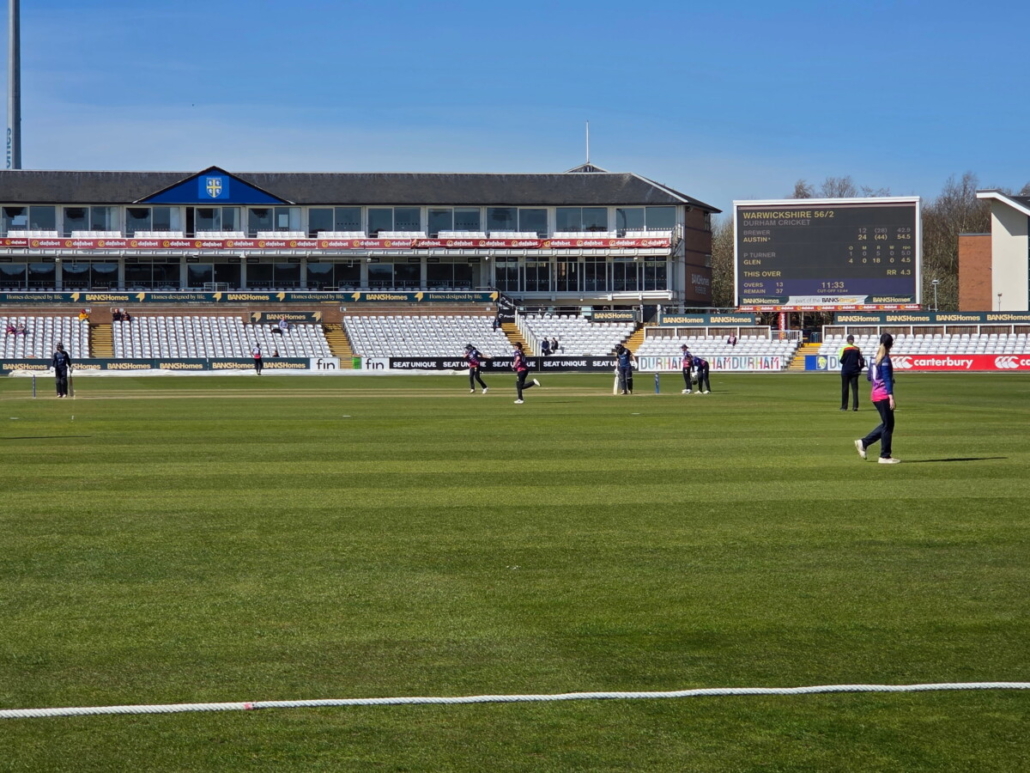
As I gaze out on the pitch from the vantage point of the scorer’s box there is a women’s friendly between Durham and Warwickshire underway and the pitch and outfield look immaculate – even taking into account the traumas of the previous few days.
I compliment Vic, but what does my layman’s opinion matter? “To be honest, it still looks a little yellow to me,” was his more critical view.
Working up a Storm
Vic has some interesting views on one of the perpetual headaches that impacts all groundsmanship and greenkeeping – poor pay and attracting younger people into the industry.
“You try to persuade a 16 or 17 year old who might be considering this industry. I’ll say to him, ‘I want you to think about this. If we’ve got a four day game starting on Saturday, you’ll be working full days on Saturday, Sunday, Monday and Tuesday. Then, the next Friday, we might have a Twenty20 match, which means an eight o’clock in the morning start, through to ten o’clock at night.’ Well, it’s Friday night, he’s a young lad and he really wants to be down the pub with his mates.”
In a major difference to golf greenkeeping, when many good players see greenkeeping as a great way of involving themselves in the game, with opportunities to play once the work has been finished, cricket is the opposite.
“The number of people that I’ve interviewed and they say to me that they are really keen on cricket – perhaps they play for the county under 17s. I have to ask them how they’d feel about not playing on a Saturday or Sunday because they’d be working. I’d need them to work and they’d want to be playing. It’s not possible to do both.”
It keeps a long list of potential cricket groundsman away from the career.
The advent of women’s professional cricket – Durham was selected as a Tier 1 professional team from 2025 – has increased the workload on the Durham team, while talks are on-going about the possibility of the Riverside also hosting 100 cricket.
“All this extra cricket that we’ve got now with the women, and the juniors joining the men, and we’ve got no extra pitches. It means that the pitches are having to be repaired and brought back for reuse a lot more than they ever used to.”
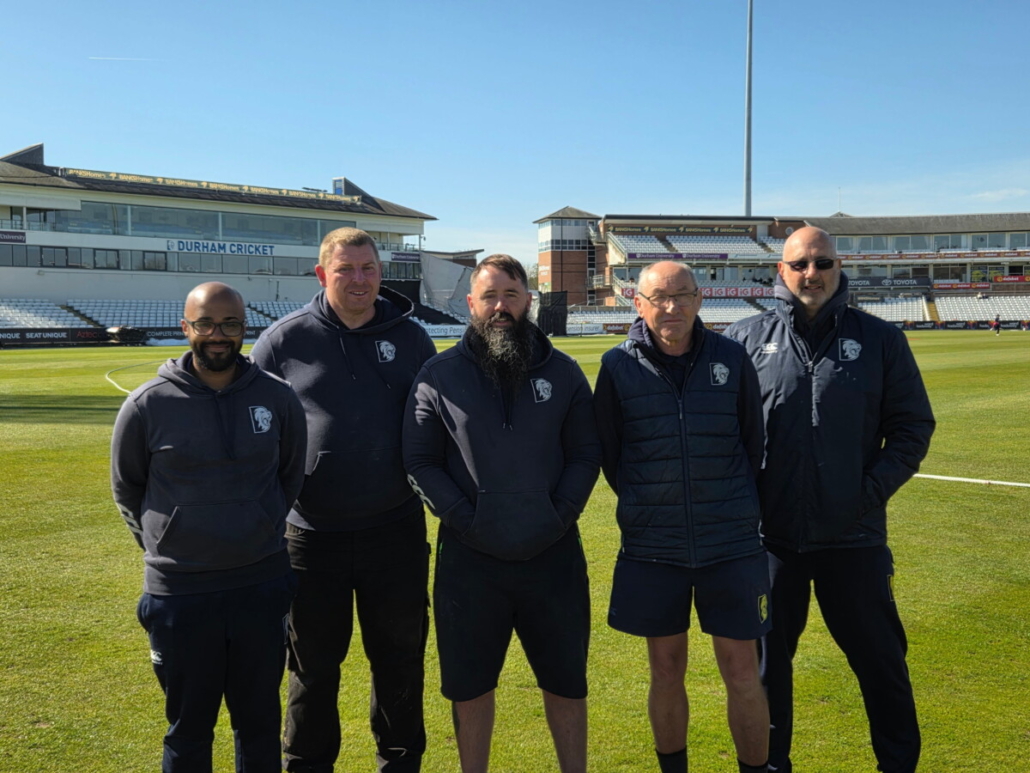
Vic is delighted with the team he has at his disposal. He has his Deputy Head Groundsman Mark Patterson, who also looks after the Nursery Ground; Ben Hall, Barry Boustead and John Bland with Barry and John both joined Vic from nearby Durham School, within the last five years.
“We’ve also got a young lad coming over from Australia in a couple of weeks time. He was with us last season for the summer and we’re delighted that he’s coming back. He works in Perth on the major Test grounds. So, it means that we’ll be five full time and one seasonal for this year.”
Hopefully they won’t be visited by any more Storm Daves over the coming season and that all the stress and excitement can be limited to that one Sunday in the opening game of the season.
I know Vic and the team certainly hope so.