
Turf News is the perfect place for professionals working within the UK’s vibrant turf industry – keeping you up-to-date with topical news, latest market developments and much more across all areas of the industry.
NEWS ARTICLES

Another Two GreenFields Pitches for Top Club Charlton Athletic

After the successful installation of their stadium and training pitches, top English football club Charlton Athletic F.C. has once again selected GreenFields for two more 3G pitches, both at their training ground.

Work is now underway on the new pitches which form part of Phase II of the multi-million pound development at Charlton’s Academy. The four-phased development of the training facilities began in 2015 and once completed will provide facilities to benefit Charlton Athletic, Charlton Athletic Community Trust, Charlton Athletic Women’s Team, Footscray Rugby Club and the local community.

The redevelopment which is being fully funded by the football club will also include new changing rooms, classrooms, a consultation area, increased parking and an access road.

Charlton Athletic CEO Katrien Meire commented on the ongoing developments: “The improvements to the training ground will benefit the club and the local community for many decades to come.”

GreenFields attended the official launch of Phase II of the development at the beginning of March along with Eltham MP Clive Efford, Leader of the Royal Borough of Greenwich Cllr Denise Hyland along with Charlton Athletic and Footscray Rugby Club representatives.

GreenFields UK Sales Manager, Colin Lyons said: “We are extremely proud that Charlton have once again selected us for the next stage of their redevelopments. To be part of such an impactful project for both the community and professional sport fits in with the very ethos of GreenFields as a company.”

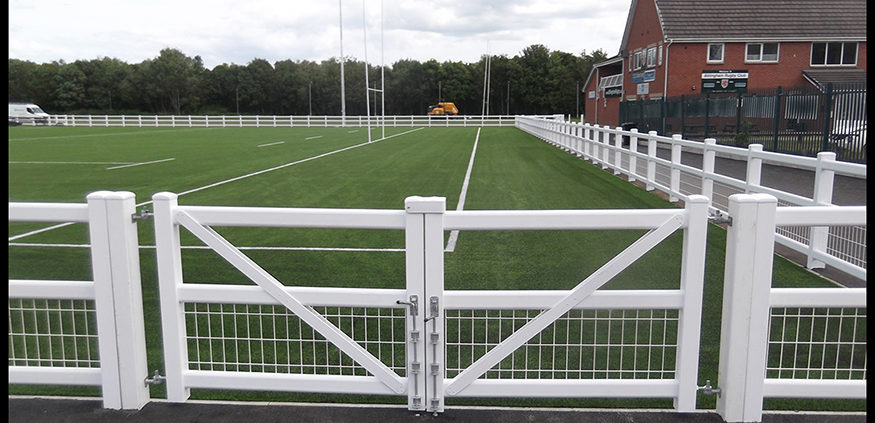
During Phase I where GreenFields installed two 3G state-of-the-art woven MX pitches, the club used Footscray Rugby Clubs facilities. As part of Phase II of the project, GreenFields are installing a new 3G pitch for the rugby club. Club Chairman, Andy De Lord said: “At a time when rugby clubs are struggling to develop and get players in, the facilities will help us to attract the people who want to get involved in rugby.”

The new 3G pitches and access road (also being developed by GreenFields) are expected to be complete by September of this year.

Pink Spider seen on Mountain slopes in switzerland

Pohled Czech Republic (28 April 2017) It was enough to have arachnologists around the globe in a state of high tension when a giant pink Spider was seen on the mountain pastures in the canton of Obwalden in Switzerland.

However, it was not some previously undiscovered species, but a Spider 2 remote-controlled mower that was being used by a local contractor to maintain the grassed slopes on local farms in the Swiss alps.

His partner’s favourite colour is pink and, where possible, all his farm contracting equipment is painted pink, the plastic coverings for his silage bales are pink, the bells around the cows’ necks are pink and he wears pink shorts during the summer months.

Lubor Hladik, international sales manager at Dvorak, the manufacturers of Spider machines explained,

“We took an enquiry from our Swiss distributor for a Spider 2, but unusually they wanted it painted bright pink; we later discovered that it was the customer’s partner who is obsessed with the colour and it needed to match other equipment on the farm. As the customer is always right, we found the correct colour pigment and fulfilled their request. We’ve produced Spiders in black livery previously, for the Daytona Speedway track in the USA, but never in pink. That was a first!”

About Dvorak

The Dvorak – svahove sekacky Ltd. was founded on July 1, 2004 by Lubomír Dvořák. The patent protected radio controlled Spider slope mower is the principal product of the company. The revolutionary design of the Spider product range created a new sector into the groundscare market when introduced in 2004. During the past 13 years the product portfolio has expanded and a sales network now covers over 40 countries around the world.

Spider mowers can be used in multiple applications on golf courses; local authority open spaces; national, regional and local parks; water and river management; roads, rail and highways; waste management sites, airports and military installations; power generation utilities; vineyards and orchards; national heritage sites; skiing and sport resorts; motor sport arenas and solar farms.

High performance seed for Principality Stadium

As the National stadium of Wales the Principality stadium has to play host not only the country’s rugby team, but also its football, while in the “non grass” season it plays host to a range of different events from rock and pop concerts to speedway and monster trucks. The grounds team led by Head Groundsman Lee Evans now face the additional challenge of hosting one of the most prestigious events in football – The Champions League Final! 

Such high demands call for an equally high performance turf surface which is why Lee uses Johnsons Premier pitch and Johnsons 4 turf for his overseeding program. Johnsons is the first choice for many of the country’s leading sports stadia.

The New Solution For Sports Turf Surface Drainage

Rigby Taylor Ltd and Ground Water Dynamics (GWD) offer sports turf surfaces a revolutionary new vertical drainage system.
Already, GWD has secured some blue-chip clients including:

  • Ascot Racecourse
  • Silverstone Race Circuit
  • Fulham Football Club
  • Edgbaston Cricket Ground
  • East Midlands Airport

GWD is suitable for all soil types and provides the opportunity to manage surface water run-off, nuisance groundwater and localised flooding. Most importantly, rainfall can be dealt with at “source” with no requirement to link up with storm-drains or sewers – a feature which is becoming more prominent as planning authorities struggle with outdated public assets.

Features:
* Requires no external energy source,
* Creates very little disruption during installation
* Is environmentally sustainable.

Why GWD?
Firstly, this system is totally different from anything else currently being offered to the industry.

The system is installed by drilling bore-holes up to 12 metres deep with minimal disruption and does not require trenches or major earth works. “An Energy-Passive Ground-Water Recharge Pump (EGRP) system enables rain water to be
captured ‘at source’ instead of simply moving the problem to another area explains Joe O’Meara, Director of Groundworks Dynamics, “ or worse still to a sewerage plant where clean water is processed as effluent at significant cost,” Each bore-hole is no more than 90mm in diameter and, after the insertion of the EGRP device, the bore-hole is top dressed with a root zone mix.

Most of the installations to date have involved installing in areas on a retrofit basis, where other drainage solutions have failed. However, GWD is now getting involved in the project design
stage as, following a test drilling day where we measure infiltration rates, we areable to produce calculations showing how much rain water can be dealt with, and how to design an EGRP system which is bespoke to the clients drainage requirements.

Certain soil types, comprised of horizontal layers of clay & silt, can offer limited drainage capacity resulting in heavily saturated playing surfaces and localised ponding. Groundwater Dynamics’ EGRP system addresses this problem by inserting thesystem vertically into the ground and, once activated, the unique five-chamber design with its mild vacuum connects these horizontal layers of soil and attracts groundwater laterally towards the device before taking it down to lower unsaturated
strata and away from problem areas .

While the system costs approximately 15-20 per cent more than conventional drainage, it requires no maintenance and the system has a life span of over 25 years.

Another advantage is that clients can choose to spread the cost of installation over a number of years – where GWD returns each year to continue installing until the works are complete and the problem solved.

Gary Barwell. Head Groundsman at Edgbaston CC, has experienced first hand the benefits that can be had from installing a Groundwater Dynamics system, he commented:
“The system was installed during May 2013, within the timescales agreed in preparation for the ICC Champions Trophy. The playing surface was not damaged in anyway; this was prerequisite of the install and is a major positive for sports
surface drainage, as other systems would have meant huge disruption.

In terms of performance, any doubts I had about the system were immediately dispelled. We had two heavy rain spells in May where 12mm fell in the day and in June a further 14mm fell in half an hour. On both occasions the area flooded but normally it would have rendered the ground unplayable the following day. However with the GWD installation, the standing water and flooding was gone within hours and left the ground completely dry. This was an excellent results as it enabled the
teams scheduled to practice to use the facility the next day.”

Barenbrug Launches Wildflower Advice Guide

Grass expert, Barenbrug UK, has launched a new wildflowers advice guide alongside a refreshed range of 14 wildflower mixtures.

The free guide provides practical information—for landscapers and local authorities—on evaluating soil fertility, planning for sowing, maintenance tips, and choosing the right mixture for your environment.

Around 15,000 hectares of unimproved grassland are believed to remain nationwide. This figure is now on the increase as more and more public open spaces, gardens and road verges are being established, to provide a habitat for wildlife and protect the unique botanical identity of the UK.

Each Barenbrug mixture caters for the highly precise needs of specific environments, for instance: Hedgerow and Woodland Edge, Short Flowers and Coastal. Bees and Butterflies, for example, contains only flower varieties listed on the RHS Perfect for Pollinators list.

TRENDS IN WILDFLOWERS

Commenting on wildflowers trends, Barenbrug Wildflower expert, Luke Hunt says:

“Working with key merchants in the industry, we’ve noted two strong trends. Sustainability… to improve the natural habitat of wildlife. And quick to establish, high impact colour. Think: vibrant swathes of colour at the London Olympics. These non-native annuals—such as California Poppy and Cosmos—are incredibly easy to grow, provide a quick hit of colour and are cheaper than bedding plants. That’s why local authorities are increasingly relying on wildflowers to brighten up public open spaces and embankments. We’re also seeing increased interest from agriculture and golf courses.”

To order a free copy of the guide, or to speak to a wildflowers expert, call Barenbrug on 01359 272000, email info@baruk.co.uk or visit www.barenbrug.co.uk.