Fleetwood Announce New Groundsman

Fleetwood announce new groundsman – Fleetwood Town have promoted Nick Hyndman to the role of head groundsman after the departure of long-serving groundsman Dale Frith.

The club announced Frith’s departure to PSD Agronomy as a senior consultant earlier this month with his deputy Hyndman gaining a promotion and officially taking over the reins on June 1.

Hyndman has been with the club for over six years and has progressed from part-time groundsman through to his new role under the tutorship of Frith.

Hyndman said: “I feel like learning under Dale has put me in a great position to keep up the standards and continue the great work he and the team have done.

“I’ve watched the club grow around me in the last six and a half years. Previously the pitches were looked after by contractors but now we have a superb ground at Highbury and unbelievable facility at Poolfoot Farm.”

And Frith says Hyndman deserves the opportunity to follow in his footsteps. He said: “I’m really pleased for Nick. I’m sure he will continue on the work that we have been doing. He deserves the opportunity and the chance to do it. I’m confident he will flourish in the role.”

In further changes to the department Liam Scott-Rattray will fill Hyndman’s position as deputy head groundsman, Oliver Vincent moves to an assistant groundsman role alongside Ashley Roche, with Cameron Chisholm one of two apprentice groundsmen. Another apprentice will be appointed in the coming days.

To read the original article from Blackpool Gazette, click here

Rigby Taylor delivers a first-class course at Alfreton GC

Rigby Taylor delivers a first-class course at Alfreton GC – “We’re only an 11-hole course – we’d love to be able to expand – but we think we’ve got the best small course in Derbyshire!”

Head greenkeeper Andy Fenn doesn’t hold back when describing Alfreton Golf Club and while he admits that his is a biased view, visitors to the course undoubtedly also agree with his sentiments.

Aged 59, Andy has been at the established (since 1892) traditional parkland course for almost 20 years, after a lifetime in volunteer groundsmanship that began in his late 20s as a player at his local cricket club then part-time at Alfreton Town FC before joining the golf club as assistant head greenkeeper. He was appointed head greenkeeper in November 2015.

“Before I joined the club I would play here so I knew the course,” says Andy. After he took over the lead role, it is fair to say that the course has continually progressed – “and with the initial greens team of two full-time and one part-timer becoming three full-timers, including myself, we’ve been able to drive up standards on the course”.

He’s done this by not only applying all those years of experience and by rethinking the maintenance regime, but also by marrying the team’s extensive skills set with top-of-the-range amenity supplies from Rigby Taylor, the company at the forefront of supplying innovative products for the successful management and maintenance of turf surfaces.

“Throughout,” he adds, “our actions have been ably supported by the committee and the greens chairman, Roger Foster.”

For example, Andy has instigated changes to the cutting regime with the mowers now in action on every weekday, as well as cutting once over each weekend, with the greens (Rigby Taylor R1 fescue and bent mix) being maintained at 7 mm high in winter and 4 mm in summer, while the tees (R9 ultra-fine rye) are kept at 15 mm and fairways at 20 mm. Two John Deere 220Hs are used as pedestrian greens mowers; and three Ransomes mowers (a Duplex 2, a Fairway 305 and an AR522) are applied to other areas.

Rigby Taylor’s R seed range is pre-treated with Germin-8 – a unique treatment of a cocktail of speciality penetrating surfactants, nutrients, sugars and mycorrhizae to stimulate and support accelerated germination and emergence.

“We have in place a stringent routine of aeration and scarifying, to minimise thatch levels,” Andy continues. “On a clay-based site such as ours, there’s no rigid timetable for aeration. Also, it is weather dependent so we can’t aerate even if it is slightly too wet – and we have to time it for when the conditions are right, normally spiking to four inches deep then applying around 40 tonnes of sand.”

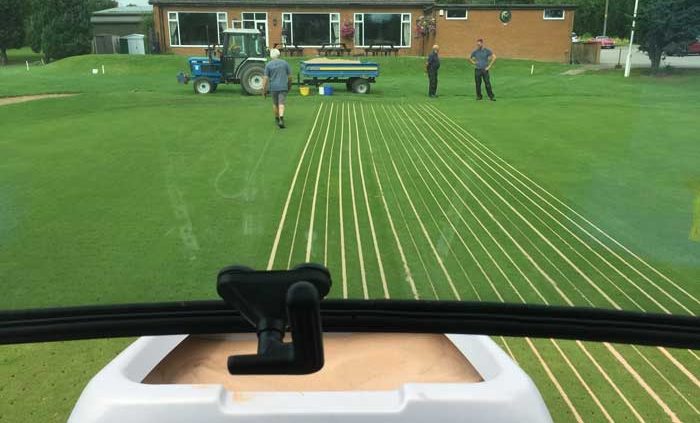
This on a course where the greens were gravel-banded 20 years ago and last year were slitted/sand-banded. “We did nine greens in a day-and-a-half,” he says.

Andy confirms that the use of Rigby Taylor products continues to play a key role in the way the course is presented and how it plays.

“We’ve been dealing with Rigby Taylor for a number of years and we adopt a wide-ranging programme including fertilisers such as Microlite Activ8 conventional release granules, as well as chemical treatments that include the Fusion, Foremost and Rayzor fungicides, TriMate stress relief and recovery agent, and the Breaker Biolinks wetting agent.

“These are not the cheapest products on the market but in my view they certainly represent excellent value for money. They give us the results we need and, of course, the local sales representative Mark Robinson also provides a lot of back up and support.”

He adds: “We take soil samples every year and with Mark we establish an annual programme of treatments. There’s no doubt that the course has improved because of this. I believe that it’s all about striking the right balance between nitrogen and biostimulants for turf health, and achieving a consistent playability with no peaks and troughs in the way the course plays or in the presentation of the turf.

“With regard to the latter, our use of Rigby Taylor’s Magnet Dynamite chelated iron gives excellent results in terms of turf colour, and the company’s Spike potassium-silica treatment is used for ‘standing up’ the turf.

“This is exactly what we need because our members expect to be able to use a first-class course all year round. We have to deliver that.”

Andy and his team also have to contend with the 4,000 or so trees on the site: “Working closely with the Forestry Commission, it is an ongoing task to sort out the trees that are affecting the course. We are taking a much more critical view of how trees are affecting or could affect the greens.”

With a background in cricket and football, he also highlights that “grass science is transferrable, especially in terms of the fertilisers used and the diseases faced”, but he admits that golf course maintenance is probably the most testing “since there are variable surfaces to be maintained simultaneously”.


Upkeep Of City Of Culture’s Green Spaces Entrusted To Toro

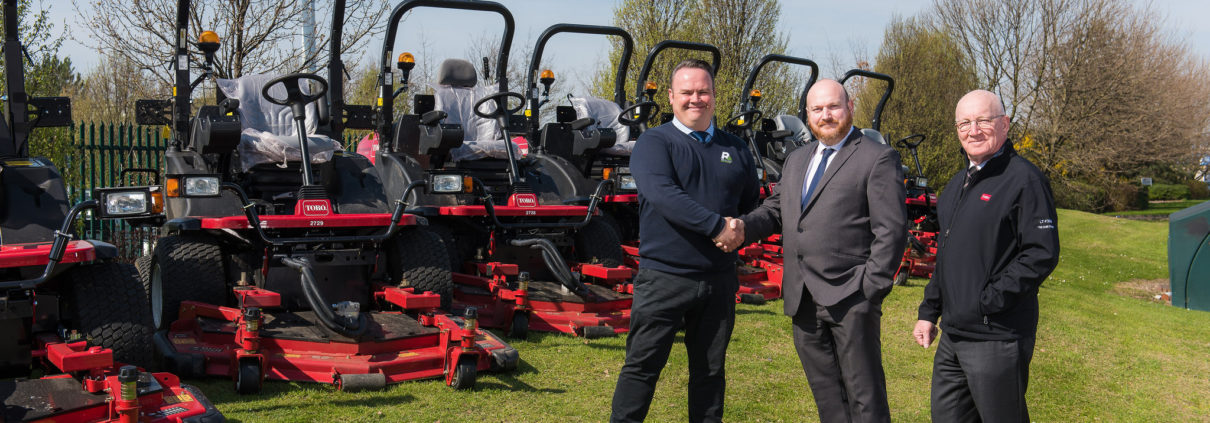
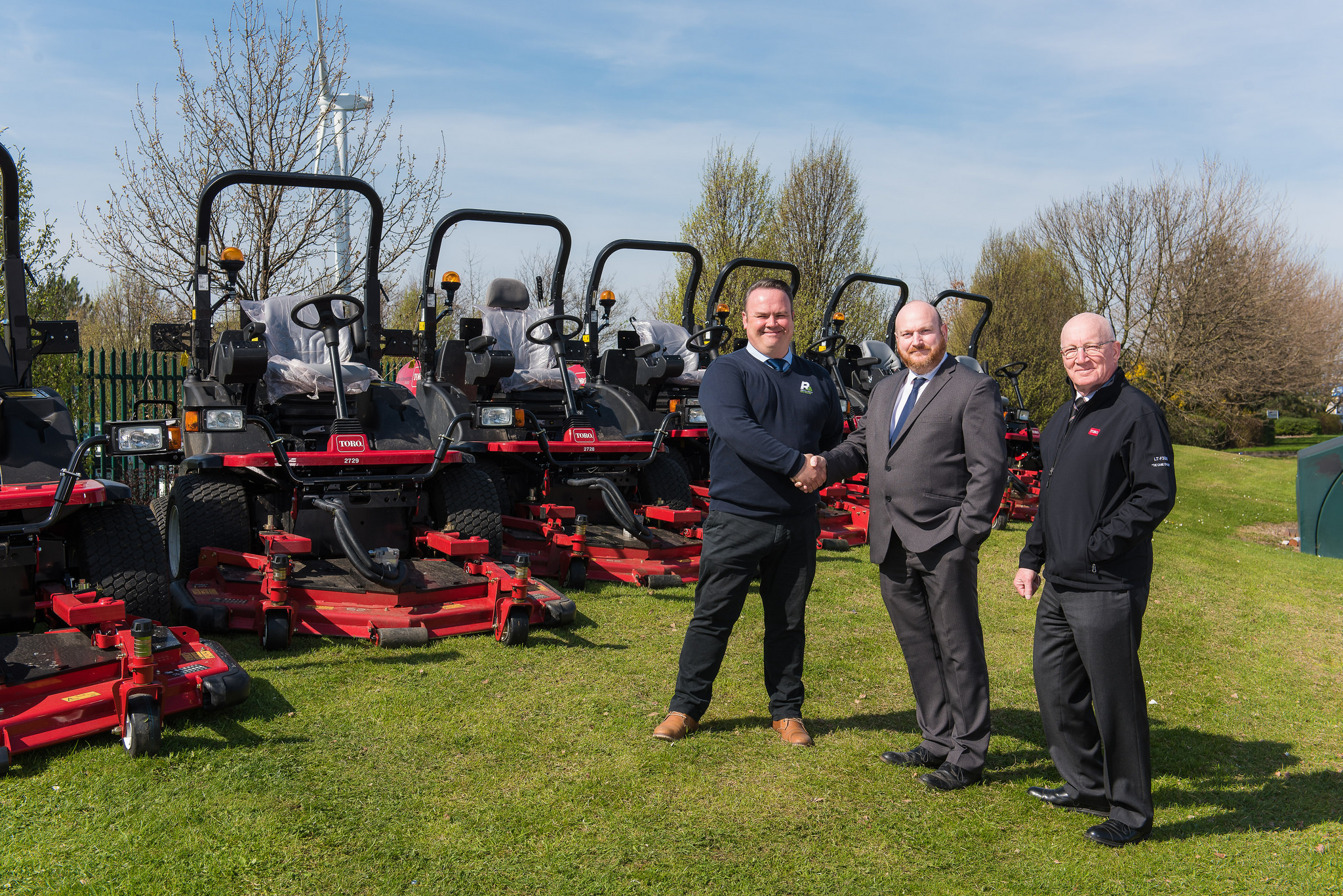
Upkeep Of City Of Culture’s Green Spaces Entrusted To Toro – Kingstown Works Limited (KWL) based in Kingston upon Hull, this year’s City of Culture, has recently invested in seven Toro Groundsmaster 3400 out-front rotary mowers to be operated by its largest client Hull City Council. The seven machines will play a key role in keeping the green spaces of the city in the best possible condition during this all-important year. 

Upkeep Of City Of Culture's Green Spaces Entrusted To Toro

In a tender process, completed by Russell Groundcare, via the Yorkshire Purchasing Organisation, Toro achieved the best results for price, capability and delivery, and it isn’t for the first time. KWL is an existing Toro customer and the acquisition is part of a replacement programme for older Toro triple mowers coming out of service.

The decision for KWL to purchase rotary mowers is a move away from traditionally opting for cylinder mowers to maintain the city’s parks, sports fields, horticultural areas and municipalities. And the reason for this says Garry Middleton, business unit leader at KWL Fleet, is down to a rotary mower’s ability to work on longer grass at a higher output rate with ease.

He says: “Our client needed to marginally extend periods between cutting and, based on this, required a machine that could cope with cutting longer grass while still providing a good finish, which the Groundsmaster is more than capable of. Russell Groundcare and Toro performed well in the tender process as our experience of working with both has always been a good one: the service from Russell and indeed Reesink Turfcare [UK distributor of Toro] is excellent and the rate of cut and quality from Toro prove outstanding.”

In terms of the machines’ capabilities, such an important consideration in the tender process, it’s easy to see why the GM3400 scored so highly. Constructed from high-strength seven gauge welded steel, 33 per-cent thicker and 75 percent stronger than ordinary ten gauge commercial steel, the GM3400 is robust and tough. A Kubota four-cylinder diesel engine, delivering 26.5 kW (35.5hp), means it’s powerful with a high performance rate, too.

With a tilting operator platform, large opening engine cover and easy-to-remove access panels, maintenance is unrestricted. Within minutes, an operator or service technician can achieve direct access, reducing daily check and cleaning times as well as service maintenance downtime. The GM3400 also benefits from low maintenance costs and a high 15.5mph transport mode to ensure fast logistics between sites, all of which increases uptime, minimises costs and improves productivity.

And when it comes to the final result you have, says Garry, a “decent trim, clean finish and a good turn rate around trees and other obstacles. While purchase price is of course a major factor, we always consider the anticipated operational and maintenance costs and, given that the Toro retains a good residual value, this also forms an important consideration as part of our overall costing.”

So, what impact does Hull being the UK’s City of Culture have on Garry and the team’s work? Garry says: “Expectations haven’t changed in terms of the results our client quite rightly wants for the public and open spaces of Hull, which require a quality finish, but with all eyes on the City this year that does add a bit of extra pressure! Having a brand new Toro fleet means we can rest assured that the quality and consistency of cut will be delivered.”

Westcountry Golf Academy Has Pro-Active Maintenance Approach

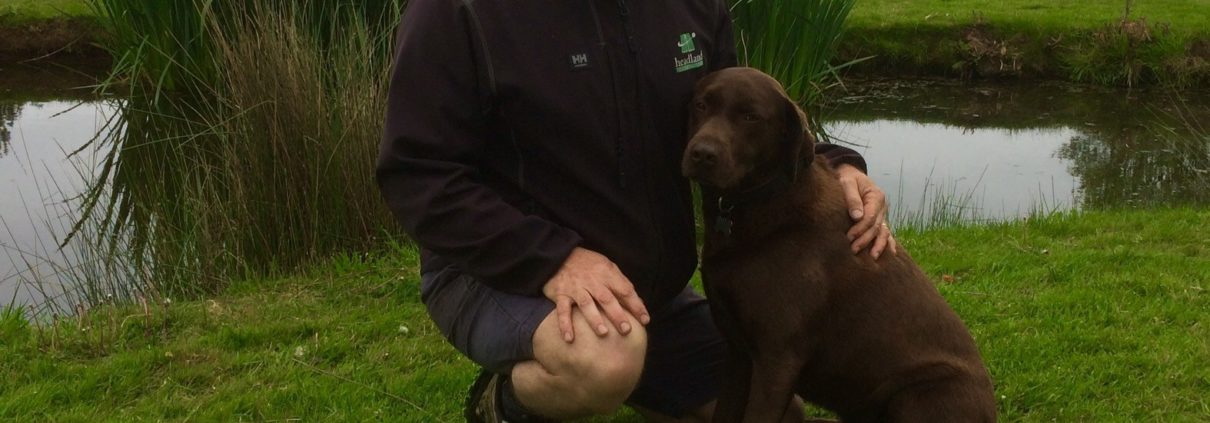
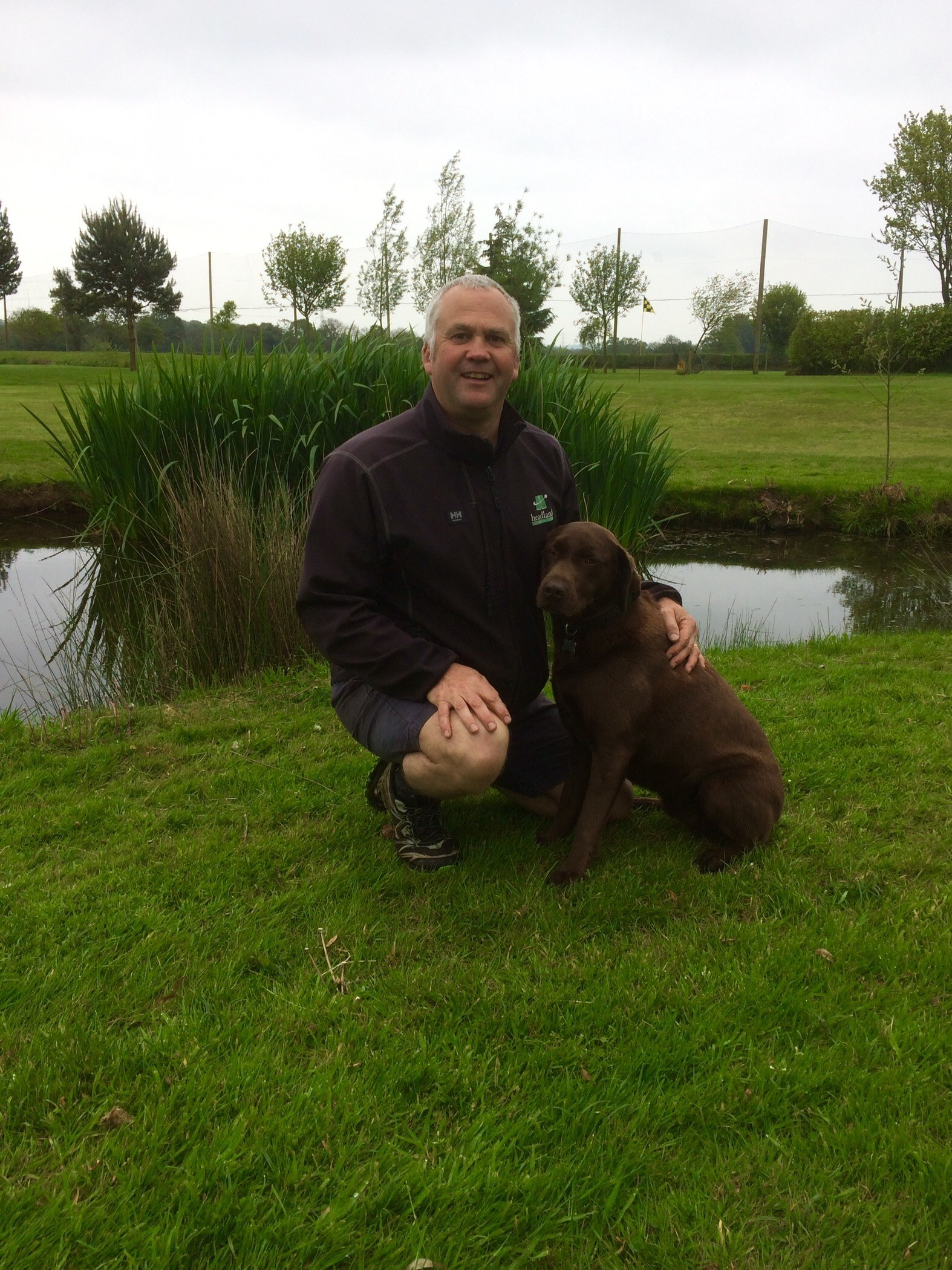
Westcountry Golf Academy now has pro-active maintenance approach with help from Headland Amenity – With a little help from some trusted industry contacts, like Richard Shapland of Headland Amenity, Jon Funnell decided to “give it a go” and take over as Head Greenkeeper at Westcountry Golf Academy in 2010.  Developed from a 12 bay driving range, to a challenging Par 3, 9 hole golf course in 2005, Westcountry is located in 15 acres of Devon countryside. Despite having no previous greenkeeping experience, Jon has since transformed the clubs approach to maintenance, and in turn the results being achieved.

Westcountry Golf Academy Has Pro-Active Maintenance Approach

“I’d worked in retail for the previous 27 years in various managerial roles, and decided I wanted a complete change. I knew Stuart the owner of WGA and approached him for some work. Initially I worked in the range and shop, but when the previous greenkeeper left, I was determined to give it a shot.” Jon admits that for a start cutting was the only maintenance taking place before Richard Shapland came in to advise on the basics. “I was starting from scratch so began implementing things that people like Headland were suggesting. Richard popped in every month with plenty of ideas and advice and gradually we got the course moving.” Now implementing top dressing, tree management and installing a water and irrigation system the maintenance approach is proactive, rather than reactive.

Richard conducted a soil analysis and suggested a simple yet effective course-wide nutritional programme. “We start our greens feeding programme in March with Greentec 4-0-4+9Fe to check any moss we may have. Following this we apply C-Complex 7-0-7 to keep us going through the summer, with C-Complex 4-3-4 used during our August renovation work. We also use Seamac Ultra Plus through the summer to improve stress resistance. We identified that the main reason for course closure during the winter was the weak structure of the approaches.  We started a programme to strengthen the sward by boxing up on every cut, combined with the use of Headlands Multigreen 30-5-14 over a 6 month period.” Annual soil analysis now keeps them on track.

After a few tough years, Westcountry now boasts a membership of 300+ and a further 60 junior members. Jon again, “We’re very fortunate that our owner Stuart Sawyer has really invested in the course, and it’s thanks to this together with elements such as the nutritional programme that has boosted the overall course condition; this pro-active approach means we’re continuing to improve plant health rather than firefighting problems. Just one example is the number of days the course has been shut. In previous years this has been up to 30 days a year, but last year the gate was shut for just three. Though there’s still work to be done, we’re making great strides in establishing ourselves as a quality place to learn the sport or for those members that want a challenging course without the physical stress of walking thousands of yards.”

Landini Compacts Have Proven Features For Turf And Groundscare Work

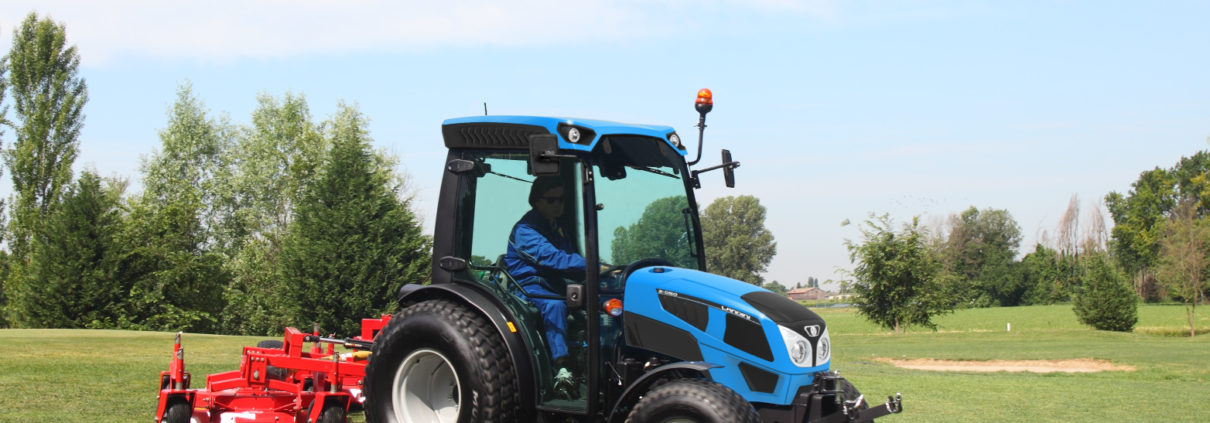
New-look Landini compacts have proven features for turf and groundscare work – A stylish new appearance for the Landini compact tractor is combined with proven specifications and features to make an attractive choice of power units for all groundscare operations.Landini Compacts Have Proven Features For Turf And Groundscare Work

The new three-model Landini 2 Series, which has replaced the well-known Mistral, sports new family-look styling for the engine hood to match the rest of the comprehensive Landini range and an all-new roof panel housing the ventilation system on the cabbed version.

The new hood retains the clamshell format of the previous design, with a high-lifting upper section giving ready access to all routine service points, while detachable lower panels completely expose the engine and its ancillary equipment.

Standard open platform versions of the 2 Series have been joined by the ‘GE’ model, which has a new front axle and modifications that shave 94mm off the height of the tractor. That can be significant for work amongst trees with low-hanging branches and other situations where the lower height is an advantage.

The GE and Standard versions have the same choice of 30kph 12×12 or 16×16 creeper gearboxes with synchro shuttle selection of forward and reverse. Likewise, the two-speed independent rear power take-off, which provides one setting for ‘power’ and one for ‘economy’.

“With implements that don’t need a lot of power, the ‘economy’ pto gearing allows the engine to be run at a lower speed to reduce both noise output and fuel consumption,” points out Ray Spinks, sales director at Landini distributor AgriArgo UK.

“A ground-drive setting relates the speed of the pto to the forward speed of the tractor, which is useful for maintaining correct application rates with sand spreaders and similar machines.”

To ensure sufficient oil flow at all times, the tractors follow the Landini philosophy of installing two pumps. In this case, a 19.7-litre/min unit is dedicated to the steering system and a 28-litre/min pump supplies the 1200kg rear implement linkage (and optional 400kg front linkage if fitted), and up to three remote services valves.

Latest-specification Yanmar engines provide the power – 2.0-litre and 2.2-litre non-turbo units delivering 44hp and 47hp in the Landini 2-045 and 2-050, and a turbo version of the 2.0-litre engine generating 54hp for the 2-060 model.

Thanks to a 40-litre fuel tank, these economical engines ensure the new Landini 2 Series tractors work long hours between refills as they tackle all groundscare tasks from grass aeration and mowing to sweeping and trailer work.

Electro-hydraulic engagement of the rear axle differential lock for maximum traction and a generous 55deg steering lock on the front axle for maximum manoeuvrability ensure the Landini 2 Series tractors have the performance needed for all groundscare applications.