Turf News is the perfect place for professionals working within the UK’s vibrant turf industry – keeping you up-to-date with topical news, latest market developments and much more across all areas of the industry.
NEWS ARTICLES

Not Just Three Numbers

Not Just Three Numbers: Understanding fertilisers: What to use where, when and why

By Chris Humphrey MBPR FQA – Technical Manager, Collier Turf Care

Not Just Three Numbers

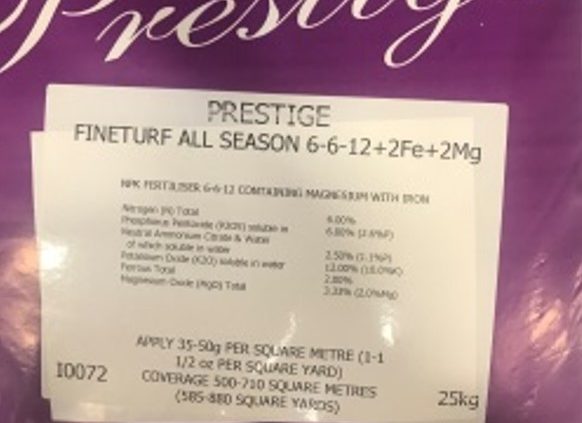
We are all familiar with turf fertilisers being referred to as three numbers (for example 6:6:12) but what does it really mean and what are we putting on our turf? To start, the three numbers are just what is required by legislation to be on the fertiliser. They relate to the percentage of major nutrients Nitrogen, Phosphorus and Potassium (NPK) in the product. But you need to know a lot more.

Read the label and discuss with your FQA (FACTS qualified advisor) your requirements. FACTS is the Fertiliser Advisor Certification and Training Scheme. Is your advisor qualified?
Ask to see their FQA card.

Why do we apply fertiliser?

Turf needs many nutrients to remain healthy and it is important to ensure that they are present in the soil in sufficient quantities and are available to be taken up by the plant.

Typical level of nutrient in grass.

Major nutrients
Nitrogen          – 2.50 – 6.0%
Phosphorus      -0.25 – 0.50%
Potassium        -1.25 – 3.50%

Secondary nutrients
Calcium           -0.40 – 0.70%
Magnesium     -0.05 -0.25%
Sulphur            -0.25 – 0.50%

Micronutrients
Iron                  -60 – 400ppm
Manganese     -50 – 400ppm
Copper             -50 – 400ppm
Zinc                 –  2 –  30ppm
Boron              –  2 –  5ppm
Molybdenum   –  2 –  5ppm

Nutrients are lost through leaching through the soil and clipping removal. But how much should we put on and in what form? Nutrients come in different forms and vary in speed of delivery, potential to scorch the turf, the effect on soil pH, availability at different temperatures, granulation size, longevity of response and physical breakdown. Nutrients also come from different sources. The major nutrient – Nitrogen – can come as Ammonium Nitrate, Sulphate of ammonia, urea, an organic source or as a synthetic nitrogen.

Ammonium Nitrate and Sulphate of Ammonia will release quickly and give a fast response at low temperatures, they will therefore not last as long as other nitrogen forms and do have a higher scorch risk. Sulphate of ammonia is also quite acidic which could be a useful or not depending on your soil pH and requirements. Urea needs bacteria to convert it to nitrate for the plant to take it up, therefore it needs some moisture and the temperature to be above 6 degrees centigrade to get it working. Organic nitrogen comes in any format where organic matter can breakdown with bacterial activity to release nitrogen. The common ones used in turf fertilisers are Bone Meal, Dried Blood, Poultry manure or Leather-meal. By the fact that organic nitrogen scores need to be broken down, they are a fairly slow release of nutria and do require some moisture and temperature to help them. The exception is Dried Blood that does break down quicker than the other organic forms. Because Organic fertilisers are slow they have a very low scorch potential. Most fertilisers that call themselves organic are actually only organic based and have a degree of inorganic nitrogen in them. Check the label or ask your FQA. The final source of nitrogen is the synthetic nitrogens such as Methylene urea, IBDU, Resin coated urea or Sulphur & Resin coated urea. These are designed to give you a slow release over a set period, often up to 9 months. They generally therefore have a lower scorch potential. It is important when using any coated product that the granulation is a suitable size for the turf area where you plan to use it and maintenance operations do not break the coatings.

How much nitrogen should you put on? This will vary on many things such as soil type, leaching potential, grass type and growth rate. You should prepare an annual fertiliser programme based on your individual requirements and the results of a soil test.

To work out how much nitrogen you are applying use the following formulas to give you the Kg/Ha you will be applying.

For Granular products

(Application rate x % Nutrient) divided by 10

Example – Apply a 4:0:8 fertiliser at 35g/m2
(35 x 4) divided by 10 = 14kg/Ha of nitrogen.

For Liquid fertilisers

(Application rate x specific gravity x % Nutrient) divided by 100
(specific gravity is the weight of a known volume of liquid fertiliser vs the same volume of water)

Example – apply a 15:0:12 liquid fertiliser at 60ltr/Ha. The liquid fertiliser has a specific gravity of 1.2 (i.e. it is 1.2 times heavier than water).
(60 x 1.2 x 15) divided by 100 +10.8kg/Ha of nitrogen.

Every site will vary and many things need to be taken into consideration when planning your fertiliser programme but as a rough outline of common nitrogen inputs are:

Golf Green/Bowls/Ornamental Lawns 80 – 120kg/Ha
Soil based Golf Tees 80 – 160kg/Ha
Sand based Golf Tees 200 – 240kg/Ha
Cricket Square 80 – 120kg/Ha
Soil based Football 80 – 120kg/Ha
Sand based Football 200 – 800kg/Ha or even more.

For the latest industry news visit turfmatters.co.uk/news

Get all of the big headlines, pictures, opinions and videos on stories that matter to you.

Follow us on Twitter for fun, fresh and engaging content.

You can also find us on Facebook for more of your must-see news, features, videos and pictures from Turf Matters.
Beware Of The Mix Up

Beware Of The Mix Up: Do you know what you are mixing up in your sprayer and what it is going to do?

By Chris Humphrey MBPR FQA – Technical Manager, Collier Turf Care

I don’t know how many times I have heard someone say “I was told I could mix these things in the spray tank”

Beware Of The Mix Up

Before you mix anything in the spray tank you must first ask yourself what am I trying to achieve? Some things just do not mix chemically, some things will mix but one may well deactivate another; sometimes what mixes well may have an inappropriate water volume.

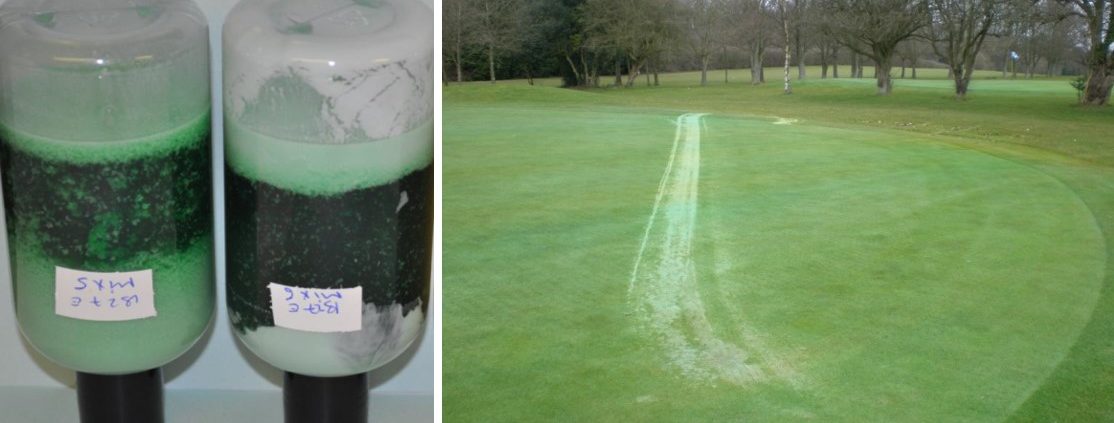
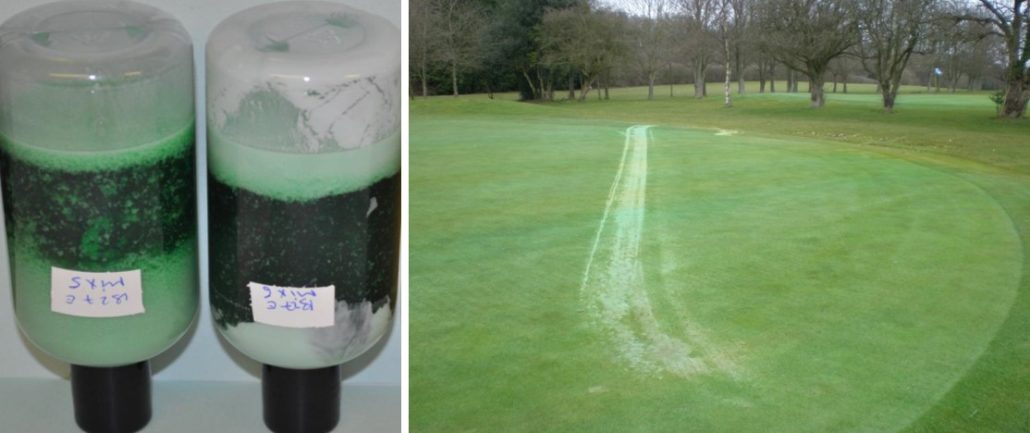
When applying a fungicide, do you put a bit of iron in the mix? It gives you colour and dries out any mycelium but most iron products will not tank mix with such active ingredients as they react badly due to the acidic ph. In addition most iron products contain sulphates which can react.

This reaction produces insoluble precipitate sediment which forms a sediment in the spray tank. This can block the sprayer, nozzles, pumps and pipework, and render the products ineffective. This can also result in uneven spray applications.

Tank mixing can be a great timesaver but only if your active ingredients are going to do what you want them to. For example, do not mix a foliar feed with a wetting agent. Although they may mix quite nicely in the spray tank, the wetting agent is designed to get into the soil and it will take the foliar feed with it. This is not ideal as you want the foliar feed on the leaf and you will get no response from it if you take it into the soil.

You may be told that by adding something to the spray tank it will improve the performance for your chemical. That is an Adjuvant. An adjuvant is officially defined as materials other than water that increase the effectiveness of an active ingredient but have no biological activity in themselves. For a product to be classed as an adjuvant it must be tested, registered and have an adjuvant number.

For all advice on tank mixing, you must ensure you consult a BASIS qualified advisor. You don’t want to end up with a tank full of jelly where chemicals react or render your expensive fungicide useless by adding an inappropriate product.

For the latest industry news visit turfmatters.co.uk/news

Get all of the big headlines, pictures, opinions and videos on stories that matter to you.

Follow us on Twitter for fun, fresh and engaging content.

You can also find us on Facebook for more of your must-see news, features, videos and pictures from Turf Matters.
Polaris Ranger Diesel Available

Polaris Ranger Diesel Available: There has never been a better time to purchase the Ranger Diesel.

Polaris announced earlier this year that all Polaris Ranger Diesel models (excluding Crew) will be supplied with a poly roof and rear panel as standard.

Polaris Ranger Diesel Available

Also, the Ranger Diesel HD EPS EU is now available for just £11,999 excluding VAT when purchased between 25 February and 30 April 2019. This offer provides customers with a saving of £400 excluding VAT.

Customers can also take advantage of the Polaris 0% finance scheme, available over two years with 2 + 22 monthly payments up to a maximum of 80% of the Recommended Retail Price. The 0% finance can include genuine Polaris UTV accessories up to the value of £1,000 excluding VAT.

Full details of the Polaris Ranger Diesel and 0% finance schemes, including terms and conditions, are available at your nearest Polaris dealer.

Also, by popular demand, Polaris is again offering a free Half Cab package to customers who purchase a new Ranger Diesel HD EPS EU or Tractor between 25 February and 31 March 2019. The package includes a fixed glass windshield for extra protection against the elements and a washer/wiper kit with battery connection cables.

This offer provides a further saving of £780 excluding VAT, offering customers a combined saving of up to £1,180 excluding VAT against the original RRP.

For the latest industry news visit turfmatters.co.uk/news

Get all of the big headlines, pictures, opinions and videos on stories that matter to you.

Follow us on Twitter for fun, fresh and engaging content.

You can also find us on Facebook for more of your must-see news, features, videos and pictures from Turf Matters.

New Hydroponic Turf System

New Hydroponic Turf System: Capillary Concrete, best known as the supplier of golf’s most scientifically advanced bunker liner product, has launched a revolution in golf turfgrass management. 

Capillary Concrete, best known as the supplier of golf’s most scientifically advanced bunker liner product, has launched a revolution in golf turfgrass management. The Hydroponic Turf System offers course managers the opportunity to make huge reductions in the amount of water needed to maintain high quality turfgrass, while at the same time promising major increases in turf health.

New Hydroponic Turf System

The system uses the capillary properties of Capillary Concrete to enable both drainage and irrigation from below and to precisely regulate the moisture content of the turf’s rootzone. 

Martin Sternberg, Capillary Concrete inventor and CEO, said: “The system divides the turf into two areas of equal size. A control basin automatically oxygenates and pumps or drains water between the two areas on a regular schedule. The system is powered by a small solar panel and the water levels in the turf profile can easily be adjusted.” 

The Hydroponic Turf System enables massive increases in gas exchange below the top four inches of the rootzone – the area which conventional aeration methods do not adequately service. Because carbon dioxide molecules are heavier than those of oxygen, the system pushes out the heavier molecules and sucks oxygen into the turf profile by raising and lowering the water table. It also delivers optimal levels of nutrients directly to the rootzone. 

Sternberg said: “We have been researching this application of our technology for five years, and the results are remarkable. Irrigating from below virtually eliminates evaporation, and our tests show up to 85 per cent savings in total water used under our Hydroponic Turf System. Irrigation costs can be lowered by up to to 30 per cent, and the level of gas exchange in the rootzone can be increased by an almost unbelievable 6,000 per cent. Using hydroponics in this way will increase the lifespan of tees and greens, it will help superintendents deliver superior turf from dryer surfaces with lower maintenance costs and a much smaller environmental footprint.” 

Capillary Concrete is currently looking for golf clubs to participate in a pilot programme to adapt the patented Hydroponics Turf System to local conditions and climates. Pilot partners will receive the new system, and also comprehensive support services enabling them to install, test and evaluate the benefits of the system for tees and greens.

For the latest industry news visit turfmatters.co.uk/news

Get all of the big headlines, pictures, opinions and videos on stories that matter to you.

Follow us on Twitter for fun, fresh and engaging content.

You can also find us on Facebook for more of your must-see news, features, videos and pictures from Turf Matters.

Rigby Taylor Agree BIGGA Deal

Rigby Taylor Agree BIGGA Deal: Rigby Taylor has announced a major sponsorship with BIGGA to tee off the company’s 100th anniversary campaign this year – a two-year sponsorship deal.

The agreement includes BIGGA’s three annual golf tournaments: 

  • The National Championship  
  • The Golf Management Trophy and  
  • The Greenkeepers Benevolent Fund Golf Day. 

Rigby Taylor Agree BIGGA Deal

Rigby Taylor will also be involved in all qualifying matches for each tournament and offering further support through the involvement of its key suppliers.

In addition, where the opportunity exists, the company will provide technical advice on tournament preparation and product support. 

Commenting on the announcement, Richard Fry, Rigby Taylor’s Marketing Director, said: “Rigby Taylor has a long history of supporting those who work in the golf industry and, as a founding member of BIGGA’s Golden Key Education initiative (as was), has always had a close relationship with the association.  

Rigby Taylor has announced a major sponsorship with the British & International Golf Greenkeepers Association (BIGGA) to tee off the company’s 100th anniversary campaign this year – a two-year sponsorship deal as BIGGA’s Golf Partner. The agreement includes BIGGA’s three annual golf tournaments: 

  • The National Championship  
  • The Golf Management Trophy and  
  • The Greenkeepers Benevolent Fund Golf Day. 

“Our sponsorship of the BIGGA golf tournaments is the company’s expression of confidence in the industry and a vehicle for gaining closer ties not only with golf course managers and greenkeepers but also their greens committees and other key decision-makers.” 

Jim Croxton, BIGGA CEO, added: “I’m thrilled that Rigby Taylor is supporting BIGGA in its golf activities for the next two years. The events are an opportunity to not only have some fun, but competitions such as the Golf Management Trophy also bring together all levels of the golf club structure, helping to build stronger relationships within teams and across barriers. And that’s incredibly important to us as an association.” 

For more information, visit: www.rigbytaylor.com

For the latest industry news visit turfmatters.co.uk/news

Get all of the big headlines, pictures, opinions and videos on stories that matter to you.

Follow us on Twitter for fun, fresh and engaging content.

You can also find us on Facebook for more of your must-see news, features, videos and pictures from Turf Matters.