Turf News is the perfect place for professionals working within the UK’s vibrant turf industry – keeping you up-to-date with topical news, latest market developments and much more across all areas of the industry.
NEWS ARTICLES

First Toro lease deal for Sheerness

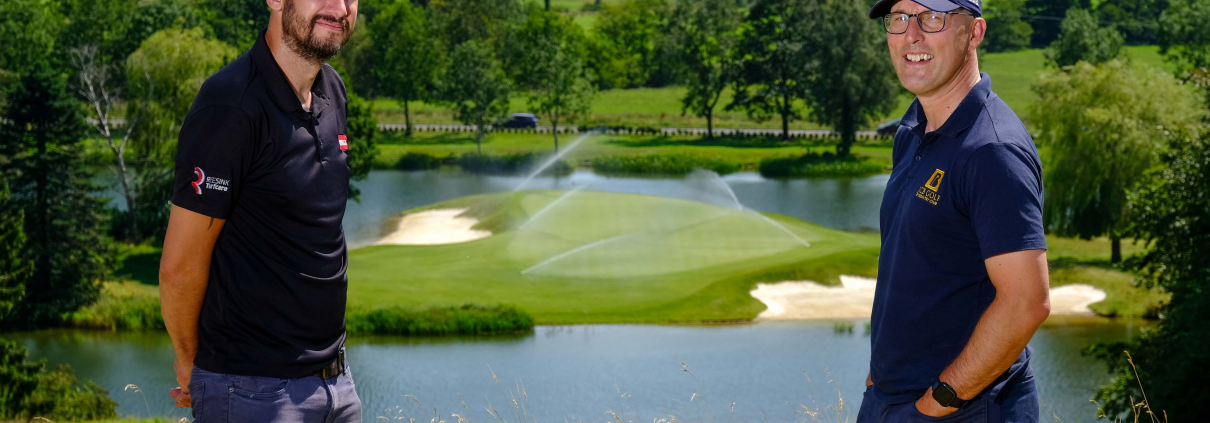
First Toro lease deal for Sheerness: Sheerness Golf Club on the historic Isle of Sheppey has signed its first lease deal with Toro and Reesink Turfcare, citing the financial benefits of a long-term agreement and much needed machine reliability as the reasons behind the decision.

Head greenkeeper Paul Boozer says: “Until now, we’ve compiled our fleet with predominantly second-hand machines and the odd one leased here and there, but that really wasn’t the best use of the money. Doing a lease deal is much better value, stretching our all-important budget further and giving us more of the machines we need for the same cost.”

First Toro lease deal for Sheerness

First Toro lease deal for Sheerness

A close second to the financial benefits of a lease deal in the decision-making process for Paul and the team, is the productivity and efficiency of Toro machines in supporting a small team.

Paul says: “We’re a team of six with a small fleet and we can’t deal with anything breaking down as we don’t have backup machines. Efficient, reliable machines are vital in keeping us productive. As the only 18-hole golf course on the Isle of Sheppey we have a responsibility to make sure we’re always pushing forward and delivering the best quality playing surfaces for our members. We can’t be let down by our machines.”

Being recognised by the county and accustomed to hosting regular inter-county matches and Kent Golf Union championship events, Sheerness Golf Course has a 500 strong, and growing, membership and it was paramount to Paul that he made the right decision in who to partner with for such a vital role.

Paul continues: “Thankfully we have a committee and management team that are supportive of new ideas, want what’s best and want to make things better. With a lease deal with Reesink and Toro we know that every five years we will have new machinery to support our plans and great backup and servicing when we need it from Reesink, and that’s a great position to be in.

“This was in no way a quick decision and has been over a year in the making. Our course is coastal and undulating, and we’ve often come up against the same issue – that so many machines couldn’t deliver the finish required across all areas. We trialled and demoed machines in all seasons and the decision was unanimous throughout that Toro was the way to go.”

In the end, Paul and the team chose the Toro Reelmaster 5610-D for the fairways, Greensmaster 3250-D for the approaches, a Groundsmaster 4300-D rotary mower, two Greensmaster 1026 pedestrian mowers for the tees and the ProCore SR72 deep-tine aerator, which Paul says is “doing brilliantly, particularly on the fairways”. Plus, two Workman HDX utility vehicles, a sprayer and ProPass 200 topdresser.

“All in all, Toro just coped with the course best,” Paul concludes.

All the factors that influenced Sheerness’s decision to opt for Toro and Reesink have been brought into focus in recent times. Investing wisely, machinery costs that are fixed, getting the right backup and support and partnering with a machinery brand which brings reliability and minimal downtime to a small team have never been so important.

To talk to someone about the finance options available and how the Toro range would suit your course, call 01480 226800.

For the latest industry news visit turfmatters.co.uk/news

Get all of the big headlines, pictures, opinions and videos on stories that matter to you.

Follow us on Twitter and Instagram for fun, fresh and engaging content.

You can also find us on Facebook for more of your must-see news, features, videos and pictures from Turf Matters.
Improve water use efficiency with Magnum Forty-Four

Improve water use efficiency with Magnum Forty-Four: Water management on managed turf grass is extremely important to ensure adequate water in the rhizosphere for nutrient uptake and overall metabolic function.

Conversely ensuring rapid movement of excess water from surfaces is vital to maintain suitable playing surfaces. This is due to the fact that the balance of moisture plays a key role in reducing abiotic stress and preventing conditions that encourage biotic stress leading to conditions detrimental to turf quality.

Improve water use efficiency with Magnum Forty-Four

Improve water use efficiency with Magnum Forty-Four

The historical build-up of certain surfactant molecules that are not biodegradable in soil profiles has been a concern therefore every effort has been made to prevent this with Magnum Forty- Four. To that end it has been specifically designed and formulated as a biodegradable penetrant wetting agent with specific surfactant technology to open hydrophobic soil profiles and rapidly reduce excessive surface water.

Penetrant wetting agents, like Magnum Forty-Four, help each water droplet penetrate the soil more easily, helping water to move through the surface layer quickly, and keep the top surface dry. On hydrophobic soils, water remains on the surface in large droplets which cannot penetrate into the soil profile. Magnum Forty-Four helps to break down this large droplets, so that the water is spread more easily and thinly, allowing it to penetrate the soil profile and work its way through the root zone.

The research and development behind surfactant technologies has now provided molecules that are able to reduce the effects of hydrophobic soils to increase wetting and provide rapid even movement of moisture through the profile to prevent puddling and dry patches, particularly important in periods of excess rainfall or drought. Magnum Forty-Four is specifically designed to work as a penetrant wetting agent to encourage even quick water movement through hydrophobic soils.

Trials were undertaken at an independent laboratory to analyse the effectiveness of Magnum Forty-Four against a competitor product. The “droplet penetration test” method was used to evaluate the products, which were compared to water. Magnum Forty-Four outperformed the competitor product, even at lower than the currently recommended rates of application.

Magnum Forty-Four also increases the efficacy of irrigation water movement and enhances spread pattern and penetration of liquid fertilisers. It is fully tank mix compatible with the vast majority of the Indigrow range, including the Asset, OneShot, Solar and Fusion products.

https://www.indigrow.com/product/magnum-forty-four-penetrant-wetter-10lts/

For the latest industry news visit turfmatters.co.uk/news

Get all of the big headlines, pictures, opinions and videos on stories that matter to you.

Follow us on Twitter and Instagram for fun, fresh and engaging content.

You can also find us on Facebook for more of your must-see news, features, videos and pictures from Turf Matters.

TriCure AD™ delivers award-winning coverage

TriCure AD™ delivers award-winning coverage: With a special nod to the consistency achieved across the course, Matt Aplin of Goring & Streatley Golf Club has scooped ‘Greenkeeper of the Year (under £75 green fees)’ from the 59club for the second year in a row!

Matt believes it is no coincidence that since they’ve been applying TriCure AD™ from Headland Amenity on the fairways, and more recently course wide, they are achieving guaranteed consistency in presentation and turf quality like never before.

TriCure AD™ delivers award-winning coverage

TriCure AD™ delivers award-winning coverage

Matt has been at the Berkshire club for over 20 years and recently oversaw the installation of a new irrigation system.  He explains, “This helps to compensate for our course being laid out over free draining chalkland, however our allowance – particularly for fairways – is extremely limited.” With its installation complete in the late summer of 2018, Matt then had to tackle the recovery of large areas badly affected by the drought.

“Our Headland Technical Manager Iain Richardson recommended the wetting agent TriCure AD™, applied at 5L/ha. Having previously applied competitor products at much higher rates to little effect, the club were absolutely astounded when, after just two applications of TriCure AD™, the fairways had returned to full coverage! Not only does the low application rate and field longevity of up to five weeks make the product super cost effective, the level of coverage retained has meant we haven’t had to overseed our fairways for two years.”

Following the exemplary results achieved on the fairways over both the 2018 & 2019 seasons, this year Matt applied TriCure AD™ course wide. “We put down the first application in the second week of May on our fairways, approaches and tees, and at half rate on the greens which is helping to deliver the firm, fast greens the members crave.” Three subsequent TriCure AD™ applications will be made monthly, tank mixed with Headland’s Elevate Fe® liquid iron complex, when not too hot, to further enhance presentation.

“Between the 2nd May and the 11th June, we received just 4mm of rain. Thankfully, our TriCure AD™ programme means the course presentation tells a different tale. Within a few days of receiving some rainfall, we were green again and received some fantastic feedback from the players.”

For the latest industry news visit turfmatters.co.uk/news

Get all of the big headlines, pictures, opinions and videos on stories that matter to you.

Follow us on Twitter and Instagram for fun, fresh and engaging content.

You can also find us on Facebook for more of your must-see news, features, videos and pictures from Turf Matters.

Bionema’s successful leatherjacket control

Bionema’s successful leatherjacket control: Bionema Ltd, a leading UK-based biopesticide technology developer, has released a step-by-step video guide on how to control leatherjackets by using a beneficial nematode solution.

Leatherjackets (larvae of crane fly) cause serious turf damage to golf courses, sport fields, racecourses, and open green spaces through their extensive feeding on roots. The video, showing a nematode trial filmed at Neath Golf Club in Wales, offers guidelines for greenkeepers and grounds managers on how to apply nematodes (roundworms) to achieve successful control.

Bionema's successful leatherjacket control

Bionema’s successful leatherjacket control

The crane fly species Tipula paludosa is univoltine and completes one generation during a year. Each female can lay 100-200 eggs in late August to mid-September. The eggs hatch within two weeks and move to the lower thatch layer where they feed throughout the winter season and continue growing, causing damage in turf which is visible in spring. By mid-August, late-stage leatherjackets begin to pupate and transform into adults, completing their life cycle.

Bionema witnessed excellent results at the Neath Golf Club field trial conducted between March 2019 and June 2020. The company used its unique Tri-Component solution, which comprises a virulent nematode species – NemaTrident®, a biocompatible wetting agent – Nemaspreader® and specialised training and advice on effective use of the product.

Once applied, using a conventional sprayer, the nematodes attacked and killed the leatherjackets, preventing further pest population, without harming beneficial insects in the targeted area. This safe and environmentally friendly method has a 70-100% kill rate and is, on average, 20-30% more effective than other nematode products on the market.

Commenting on the use of product, Neath Golf Club Head Greenkeeper Mark Tucker says: “We’ve witnessed more than 85-90% control of leatherjackets in the first year with Bionema’s NemaTrident® solution. I was very skeptical about nematodes, but the results spoken for themselves. Last year we were hitting 30 leatherjackets per 20cm2 but after one year we are hitting zero. In addition, to the leatherjacket control, the most pleasing things for me is that root growth increased by about 80% – that is a secondary benefit. The product is more sustainable for the environment and so is a much better way of dealing with this issue”

Dr Minshad Ansari, Founder and CEO of Bionema and industry expert says: “It is very important to use the Tri-Component solution for decreasing leatherjacket infestations, which causes huge economic damage in the turf industry. We are documenting many success stories of nematode applications by educating users on correct application techniques. Our goal is to see an improvement in nematode efficacy by educating greenkeepers and grounds managers in the correct application of beneficial nematodes“.

Bionema is one of the few organisations that focus on a chemical-free method of crop protection and biocontrol. It focuses on natural product development, using fungi, bacteria, and nematodes to help reduce the usage of chemical pesticides which also offer an effective treatment for regulating chafer grub infestations as well as other common pests. Bionema’s pest control products are available through distributors in the UK.

The current problem is so serious, that last year, an emergency summit was called by Dr Ansari in spring 2019 with the aim of finding industry-led solutions to counter the threat of leatherjackets in the turf industry https://bionema.com/emergency-chafers-and-leatherjackets-summit/.

To watch the video and learn more about nematode application visit: https://bionema.com/successful-leatherjacket-control/

For the latest industry news visit turfmatters.co.uk/news

Get all of the big headlines, pictures, opinions and videos on stories that matter to you.

Follow us on Twitter and Instagram for fun, fresh and engaging content.

You can also find us on Facebook for more of your must-see news, features, videos and pictures from Turf Matters.
Scott Fenwick reflects on four decades

Scott Fenwick reflects on four decades: He remembers hoisting the bag over his shoulder and playing from sunrise to sunset at Craigie Hill Golf Club.

At this point young Perth High School student Scott Fenwick harboured dreams of rising through the ranks to stardom on the professional tour.

That particular dream was not realised but his journey in the golfing world has taken its own unique and incredibly successful pathway to the top.

It was 40 years ago when Scott, a shy 16-year-old at the time, was talked into applying for the position of apprentice greenkeeper at Gleneagles.

“As a youngster I was a keen golfer and played a lot,” reminisced Scott (56).

“I harboured ambitions of being a pro golfer. When I was leaving school I was going to become a joiner, but my dad had said there was a greenkeeping job at Gleneagles.

“I came out for the interview, got the job and everything moved on from there.

“At that time the main shed was a small bothy area.

“I remember there were a lot of people and it was quite intimidating, all of these older guys and young 16-year-old me turning up for work in the morning.

“Back in those days you started off quite basic. The majority of it was raking bunkers in the morning and then out filling divots for the rest of the day.

“You got your wheelbarrow full of soil and off you went around the golf course.”

Those humble beginnings laid important foundations for progress and he would later be appointed Gleneagles’ golf courses and estates manager.

Now director of agronomy and estates, Scott has been reflecting on four memorable decades of success at one of the world’s finest golfing resorts.

“I was inspired by seeing the guys doing all the different jobs,” he says.

“It made me realise there is a lot more to looking after a golf course than I first thought.

“As time went on, the thoughts of becoming a golfer dwindled away and I got more interested in the golf course maintenance side of it all.

“But I was there almost a year before I even got a shot of a mower. Once you started getting on the machinery, everything changed.”

Producing pristine playing conditions for members and visitors across the Queen’s, King’s and PGA Centenary courses became second nature.

There has, too, been a huge buzz associated with hosting tournament golf throughout his time at Gleneagles.

“When I first started, there was still the pro-celebrity golf,” he said. “But 1987 was the first of the Scottish Opens coming, the bigger televised events.

“Tented villages were coming on site. At the time I think the Bell’s Scottish Open was the third biggest tournament on the European Tour.

“You had all the top pros coming in – Seve Ballesteros, Nick Faldo, Ben Crenshaw – so it was a huge tournament.

“It was great to be involved in that and see the actual golf course being presented on the television.

“I have always found tournament golf really enjoyable.”

When 2014 rolled around, the spotlight intensified on the fairways of Gleneagles when the Ryder Cup welcomed thousands from across the globe to the Perthshire hills.

Scott and the team had learned the PGA Centenary Course would host the biennial showpiece between Europe and the USA 13 years earlier.

“It is the biggest golfing event in the men’s game,” Scott told the Perthshire Advertiser. “We had started altering golf holes, building greens and changing areas on the course.

“We planned for the worst case scenario, but we ended up getting perfect weather.

“Everyone got stuck in and did a tremendous job.

“Our team of greenkeepers wasn’t big enough to set up the golf course, so we needed volunteers and brought a lot of former Gleneagles guys back in.”

Scott added: “We had the biggest sporting event for men, then were told we were hosting the Solheim Cup in 2019. I’m not sure if there is anywhere else that has done both.

“It’s a great achievement and terrific for everyone involved at Gleneagles.”

The Ryder Cup and Solheim Cup experiences will live long in the memory but, when the dust settled, there was no time to down tools.

Maintaining and building on high standards was paramount. That has been achieved, but the past few months have been strange times for golf.

The COVID-19 pandemic resulted in the closure of courses across the country in March and only now is there a real sense of normality returning.

While it has proved a “tough” period for those in the industry, Scott is now looking forward to building on his own and Gleneagles’ success story.

“Golf courses are there to be played and you want golfers out on them,” he said. “When this all happened, the paramount importance was safety.

“Now we’re getting back to a little bit of normality and four-balls are coming back in. Hopefully the visitors will come back as well.

“I’m enjoying what I’m doing and we’ll see where it goes next.

“The good thing about working at Gleneagles is that there is always a new challenge.”

Click here to read the original article

For the latest industry news visit turfmatters.co.uk/news

Get all of the big headlines, pictures, opinions and videos on stories that matter to you.

Follow us on Twitter and Instagram for fun, fresh and engaging content.

You can also find us on Facebook for more of your must-see news, features, videos and pictures from Turf Matters.