
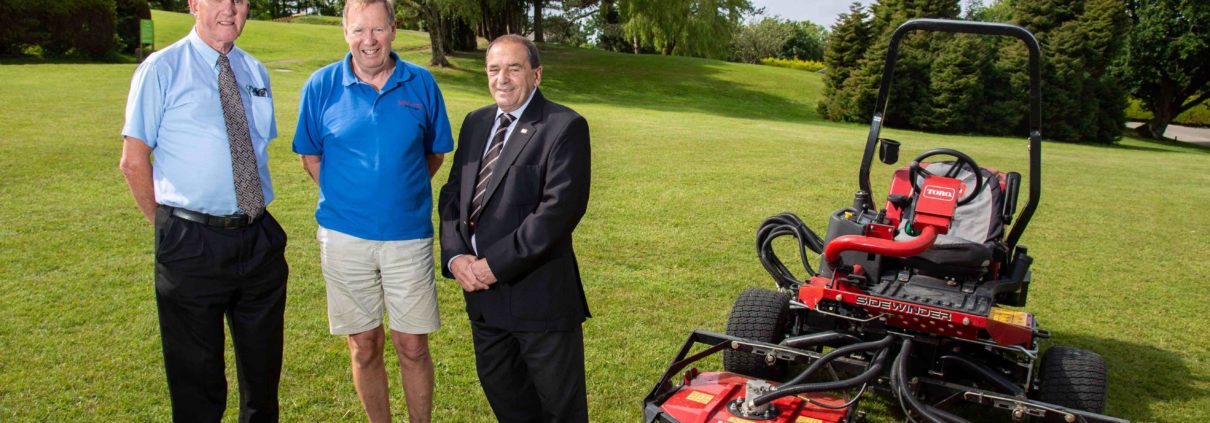
Blue Plaque To Honour Innovator

Blue Plaque To Honour Innovator: The engineer, visionary and founder of Hayter Ltd., Douglas Hayter, is being awarded a blue plaque in recognition of his contributions to the local area through his lawnmower manufacturing business, founded in Bishop’s Stortford in 1946.  

The official unveiling of the plaque will take place at Hayter’s former residence at Granary Cottage, 30 Mulberry Green, Old Harlow, on Friday 05 April, at 14.00 by Harlow MP Robert Halfon. Family and friends will be in attendance to witness the achievement bestowed by the Harlow Civic Society and its head, former Labour MP Stan Newens.

Blue Plaque To Honour Innovator

“We are immensely proud to be a part of the unveiling of the blue plaque in honour of Douglas Hayter’s achievements. He was a great visionary and business man who contributed a lot to the local community in and around Old Harlow and Bishop’s Stortford,” said Raghu Das, Managing Director EMEA, at Hayter. 

Susan Hayter had this to say around her husband’s award: “I am thrilled that even now, 19 years after Douglas’ death, the Harlow Civic Society has decided to honour Douglas’ achievements with this plaque. It is fantastic to see that his accomplishments as an inventor and pioneer are being recognised. He was a very creative man and his dyslexia fuelled his lateral thinking. I would sometimes find drawings of his latest ideas on the most random things.” 

Douglas Hayter was born in Bishop’s Stortford in 1914 where he lived before starting his working career. After working a few different jobs, he eventually moved into the building trade and set up his own business in 1937. During the war years, he was employed helping the war effort through repairing and constructing farm buildings, as well as maintaining and servicing farm machinery. He was also working on ministry projects. 

His venture into grass cutting machinery began in the 1940s when he was cutting grass around his drying timber stacks. Douglas borrowed a cutter bar mower from a friend, but found the process frustrating and slow. To make the experience easier, he combined the functionality of the historical horse-drawn rotary mower with the power of a two-stroke engine – the birth of the first Hayter Motor Scythe. The invention quickly gained admiration and Douglas started receiving requests for more machines. In 1946, the Motor Scythe went into full production and Hayter became incorporated as a limited company. 

In the years that followed, the business developed several professional and domestic mowers such as the Hayterette and the Hayter Harrier rear-roller striping mower, today synonymous with the Hayter brand. In 1960, Hayter’s company received the Royal Warrant for the supply of machinery to HM Queen Elizabeth II – an honour still retained to this day. It was around this time that Mr. Hayter and his wife took up residence in Old Harlow, whilst working hard to sell the company’s products internationally. At one stage, Mr. Hayter was selling his products in 110 countries. 

During his career, Mr. Hayter also developed several successful machines and devices outside of grounds care, one of which was a range of portable welders known as the Mighty Midgets. Many of these were supplied to the Ministry of Defence, as well as internationally. 

Douglas focused on building up the Hayter business in the local area, where he remained a significant influence until his passing in 2000. 

Hayter Ltd. Has been designing and manufacturing mowers in its factory in Bishop’s Stortford until this day. 

For the latest industry news visit turfmatters.co.uk/news

Get all of the big headlines, pictures, opinions and videos on stories that matter to you.

Follow us on Twitter and Instagram for fun, fresh and engaging content.

You can also find us on Facebook for more of your must-see news, features, videos and pictures from Turf Matters.

Keep It Sharp With Toro Blades

Keep It Sharp With Toro Blades: Switch out the old and bring in the new. With grass growth fast and furious make sure you and your machines are ready for high season with Toro’s rotary blades and guarantee a beautiful finish.

Too often, we talk about how important it is to have a good quality mower and forget that, just as important as the mower, are the parts you put in it. Now, with grass growth at its peak, is the time to be vigilant and ensure rotary blades are sharp and ready to deliver the best cut possible.

Keep It Sharp With Toro Blades

Reesink Turfcare’s parts manager Michael Hampton says: “Spring sees greenkeepers tackle large areas of grass much more frequently than other times of the year; activity that can quickly dull rotary blades. Here we look at how to prevent unnecessary downtime and out-of-action machines, with proper maintenance and parts stock planning.”

Maintenance best practice includes checking all blades to ensure they are not twisted or bent as they require more horsepower to operate, damage the turf, create vibration and noise, and shorten spindle life.

Michael comments: “To stay on top of maintenance while mowers are being used more regularly, I highly recommend Toro customers stock up on replacement rotary blades now, rather than waiting until there is an issue. In order to prevent damage to your machine and ensure operator safety, when signs of wear are identified, the blade must be replaced immediately – making on-hand spares extremely useful.”

Choosing blades produced by the manufacturer of your machine is recommended, as is “choosing blades with a toughened steel microstructure to improve wear resistance”, says Michael. “Choosing a generic blade that is not precisely manufactured for the mower may result in poor quality of cut due to incorrect blade angle and height.”

Toro’s precisely engineered blades fit the cutting unit perfectly, but each is carefully crafted to specific turf needs. For example, the ‘No Sail’ (flat) blade is a good choice in high summer working well in very dry and dusty conditions and across areas that are not mowed as regularly, plus these blades make quick work of cutting down weeds.

The ‘High Sail’ is best used early in the spring season when the grass is still thin and wispy or prone to falling over a lot, or if you’re missing grass leaves with other rotary blades.

An ‘Angled’ blade is usually what is supplied as standard with the machine, giving the best all-round cut and the ‘Atomic Sail’ is what’s best later in the season, perfect for mulching up leaves or for use with a recycling deck to mulch the grass.

Genuine Toro rotary blades are designed to work harder for longer, reducing the risk of unexpected wear and breakages other non-genuine parts can suffer. They will not need replacing as often as ‘will-fit’ parts and mowers will deliver a sharper cut for a beautiful finish for longer.

To find out more or place on order, contact Reesink’s parts department on 01480 226870.

For more information, visit: reesinkturfcare.co.uk

For the latest industry news visit turfmatters.co.uk/news

Get all of the big headlines, pictures, opinions and videos on stories that matter to you.

Follow us on Twitter and Instagram for fun, fresh and engaging content.

You can also find us on Facebook for more of your must-see news, features, videos and pictures from Turf Matters.

Commercial Landscape Irrigation Tips

Commercial Landscape Irrigation Tips: Peter Longman, Rain Bird’s Northern Europe Landscape Area Manager, takes a look at how irrigation systems are becoming an integral element of landscape design. Product selection and regular maintenance are essential.

It seems that water restrictions and hose pipe bans may be more frequent over the coming years as predictions about global warming become reality. Whilst it is true that conservation of water is everyone’s responsibility, irrigation technology is likely to play an important role in ensuring this precious commodity is used to maximum effect in the commercial landscaping, sports and residential applications.

Commercial Landscape Irrigation Tips

Landscape and Water Considerations

With efficient irrigation products and practices, it is possible to reduce water consumption by 25 per cent or more without having to give up the plants and trees that add to the look of any landscape. A fundamental requirement is to know the soil type involved – is an important factor in determining how fast and how often irrigation is needed. Different soils have differing rates of water intake as well as being able to hold moisture for varying amounts of time. These factors will influence the choice of plants as well as the type of sprinkler or other form of irrigation and will also influence the irrigation schedule. Finding out about a particular soil type does not require expensive lab tests and DIY soil testing is easy, using a jar test to measure soil texture and type.

Water pressure can vary greatly between locations. High or fluctuating pressure can have an  impact on the efficiency of an irrigation system. If there is no high pressure, it is important to install products equipped with pressure regulating devices, which can make significant water savings per minute per device. The quality of water can vary too and in some areas ‘reclaimed’ or ‘recycled’ water is available for irrigation purposes, requiring special products that stand up to the harsh chemicals that can be found in that type of water.

One way of conserving water and helping plants to stay healthy is to spread mulch in shrub beds, tree rings and flower beds. This helps drainage, encourages root development and improves the soil by making nutrients more available to the plants.

As different types of plants and shrubs within a landscape will need differing amounts of water, one approach is to divide a property into separate zones so that groundcover, shrubs and trees can be watered separately and less frequently. For some installations, drought-tolerant plants may be favourable whilst the use of grass with its higher irrigation needs, can be reserved for areas with high value or visual prominence.

Preventative Maintenance

In an existing installation, one of the most important tasks is to evaluate its performance. Check regularly for leaks as small ones can go unnoticed for long periods, potentially causing costly water wastage. Technology is available to detect and fix these leaks whilst a central irrigation controller that monitors an installed system with real-time alerts will indicate problems, allowing broken heads or damaged lines to be fixed immediately. Flow sensors will help limit the liability caused by water loss through damaged pipes or faulty valves.

Commercial Landscape Irrigation Tips

Adjusting and Scheduling Irrigation Times

With the development of new technologies, adjusting irrigation schedules in accordance with real-time and predicted weather conditions is now a reality. This allows water to be saved whilst maintaining a healthy landscape. It is estimated that daily adjustments based on weather can save an average of 30-50%  in water consumption for irrigation each year.

Starting with a weather station based irrigation system, a smart controller automatically adjusts the watering schedule to take into account both current and predicted weather conditions.This allows the controller to water plants optimally year round without the need to constantly reprogram the controller. A rain sensor can also be used to stop or delay irrigation in the event of precipitation. Modern controllers’ seasonal adjust feature will turn watering times down as seasons and conditions change. All these features will help to prevent over watering, excess run-off and unhealthy landscapes.

It is normally better to irrigate in the early morning when the sun is low, winds are calm and temperatures are cool. Midday irrigating tends to be less efficient due to evaporation and wind drift. Irrigating in the evening is not a good idea either because leaves can remain wet overnight – an open invitation for fungus to grow.

Product Selection and Performance

Wind drift interference is just one phenomenon that should influence the selection of irrigation products. It is most likely to occur during the middle of the day and even small amounts of wind can cause water used for irrigation to drift, evaporate and be wasted.

Pressure regulating sprays and rotors combined with thick streamed nozzles, such as R-VAN, can help reduce the effects of wind drift. Keeping water in a tight place and hitting the target zone will also prevent wastage.

Irrigation systems are usually set to keep plants alive in the most inefficient areas of the system, which means that the plants in other areas may get too much water. Applying more water than the ground can absorb leads to excess water running off and technology such as Cycle+Soak on Rain Bird controllers will split watering times into a few shorter periods, so water has a chance to soak in. For slopes and hills, the use of lower-flow rotary nozzles will provide a solution.

As different types of emitters apply water at different rates, it is important to make sure water is being applied evenly and not overwatering some areas. The use of sprays and rotors with matched precipitation rates are available and are designed to be used together in the same zone.

Running a system with too much pressure creates misting and excess flow, which can result in water wastage but by adding a pressure regulation to sprays and rotors allows nozzles to perform as designed, delivering the right amount of water.

Think Dripline

The popularity of drip irrigation systems continues to increase as the industry recognises its benefits. Not only does drip irrigate plants directly for the most effective watering, but also ensures that virtually no water is lost through evaporation and water run off is minimised. Converting flower beds and shrubs to drip can on average, save 50% compared with over watering with traditional sprays. For grass, subsurface dripline is installed 3-4 inches below the surface to deliver water directly to the roots. Dripline subsurface for trees and large shrubs offers the benefit of water savings and can also result in larger, healthier plants.

Until recently, however, using drip irrigation on sloped landscapes had been problematical because of the pooling and consequent soil erosion or drainage issues that could be caused at the bottom of the slope. This is a result of water continuing to flow out at the lowest point after the drip system has been turned off.  A new dripline system that is kept effectively charged along the entire slope, whilst simultaneously stopping water escaping at the bottom, is now available.

Commercial Landscape Irrigation Tips

Maintaining just the right levels for water pressure and water flow are also essential to attaining maximum efficiency from any dripline system and drip control zone kits for a range of flows are readily available. Sand, grit and debris can affect the performance on low-volume drip emitters, leading to clogs and wasted water. Filtration systems will clear these harmful elements so that clogging is never an issue.

In Summary

An understanding of the soil, the landscape, the water supply and the local weather are key to effective irrigation. Once these are taken into consideration, proper maintenance and specification of the most appropriate and practical  irrigation systems, controllers and programming software will make a major contribution to the preservation of a landscape.

For the latest industry news visit turfmatters.co.uk/news

Get all of the big headlines, pictures, opinions and videos on stories that matter to you.

Follow us on Twitter and Instagram for fun, fresh and engaging content.

You can also find us on Facebook for more of your must-see news, features, videos and pictures from Turf Matters.

ICL Appoint Barry Browne

ICL Appoint Barry Browne: ICL Turf & Landscape is pleased to announce the appointment of a new Landscape & Industrial National Sales Manager.

Barry Browne has worked in the industry for a number of years and brings with him a wealth of experience. Prior to joining ICL he spent 14 years working for Green-tech starting as a product specifier, from where he went on to hold the position of Team Manager.

ICL Appoint Barry Browne

Commenting on his new position, Barry revealed that he is relishing the new opportunity ahead. ‘I’m passionate about my work am very much looking forward to the challenge ahead, ICL are a company I have always had great respect for and I’m delighted to be joining the team”.

Please contact ICL on 01473 237100 or visit www.icl-sf.co.uk or www.icl-sf.ie if you are in Ireland.

For more news and insightful views, you can follow ICL on Twitter @ICL_Turf

For the latest industry news visit turfmatters.co.uk/news

Get all of the big headlines, pictures, opinions and videos on stories that matter to you.

Follow us on Twitter and Instagram for fun, fresh and engaging content.

You can also find us on Facebook for more of your must-see news, features, videos and pictures from Turf Matters.

STRI Group Announce New Honours

STRI Group Announce New Honours: The STRI Group has announced the addition of a new set of honours for the 2020 Golf Environment Awards (GEAs).

The Home Unions National awards, supported by the governing bodies for amateur golf in the UK, are designed to encourage clubs, just starting their ecological and environmental journey, to enter the GEAs.

STRI Group Announce New Honours

The GEAs have grown considerably in stature over the last few years and are now recognised as a prestigious and integrated award within the industry and at club level. Importantly the GEAs provide a vehicle for the industry and individual clubs to share information, grow their experience and importantly, demonstrate ecological and environmental best practice.

England Golf, Scottish Golf, Wales Golf and Golfing Union of Ireland joined the GEAs in 2018 to help create greater environmental awareness throughout golf. The Home Unions also provide a platform to help clubs grow the game by increasing membership and supporting sustainability at the heart of their communities.

Each Home Union will have its own National award for clubs in their region. Clubs must enter before the closing date of 2 August 2019. Shortlisted finalists will be confirmed in November 2019, and the winners will be announced at the GEAs in Harrogate during BTME week in January 2020.

The Home Unions National awards joins the existing GEA awards – Environmental Golf Course of the Year, Environmental Project of the Year, Conservation Greenkeeper of Year and Operation Pollinator.

Golf Environment Awards founder, Bob Taylor, said: “We wanted to make the GEAs even more accessible to golf clubs, however big or small, across all regions of the UK. Developing a new cluster of awards, with the support of the Home Unions, will hopefully encourage clubs who haven’t entered before to give the awards a try, and to use them as a springboard to aim for the other established GEA awards in the future.”

Steve Isaac, R&A Director of Sustainability, said: “The R&A is delighted that its affiliates in England, Ireland, Scotland and Wales are engaging with the Golf Environment Awards.  This new category will unearth some fantastic examples of good environmental practices which can be widely shared and adopted by others in the golf industry.”

Iain Lancaster, Club Support Manager at England Golf, said: “England Golf is delighted to be involved with the new Home Unions National Golf Environment Award. This will be a wonderful showcase for remarkable projects undertaken by our affiliated clubs. We hope it will inspire others to put good environmental management into practice.”

Sandy Veale, Golf Coordinator – Wales Golf, said: “Wales Golf is delighted to have been involved in the development of the new of the Home Unions National Award. With so many fantastic examples of good environmental management across Welsh Golf Clubs, which might otherwise have gone unrecognised, this is a fantastic opportunity to give clubs the credit they deserve and spread good practice across the Home Unions.”

Carolyn Hedley, Environment and Sustainability Manager Scottish Golf, said: “Scottish Golf is pleased to continue its support for the Golf Environment Awards in 2019 and we are delighted that the new National Award has been created to encourage more clubs to enter. The GEAs are a great way for clubs to demonstrate their superb environmental practices and projects and we would encourage more Scottish greenkeepers to get involved to get the recognition they deserve.”

Entry for the 2020 GEAs closes on Friday 2 August 2019. Visit golfenvironmentawards.com for more details and to submit your club’s application.

For the latest industry news visit turfmatters.co.uk/news

Get all of the big headlines, pictures, opinions and videos on stories that matter to you.

Follow us on Twitter and Instagram for fun, fresh and engaging content.

You can also find us on Facebook for more of your must-see news, features, videos and pictures from Turf Matters.