RainDance course features Capillary Bunkers

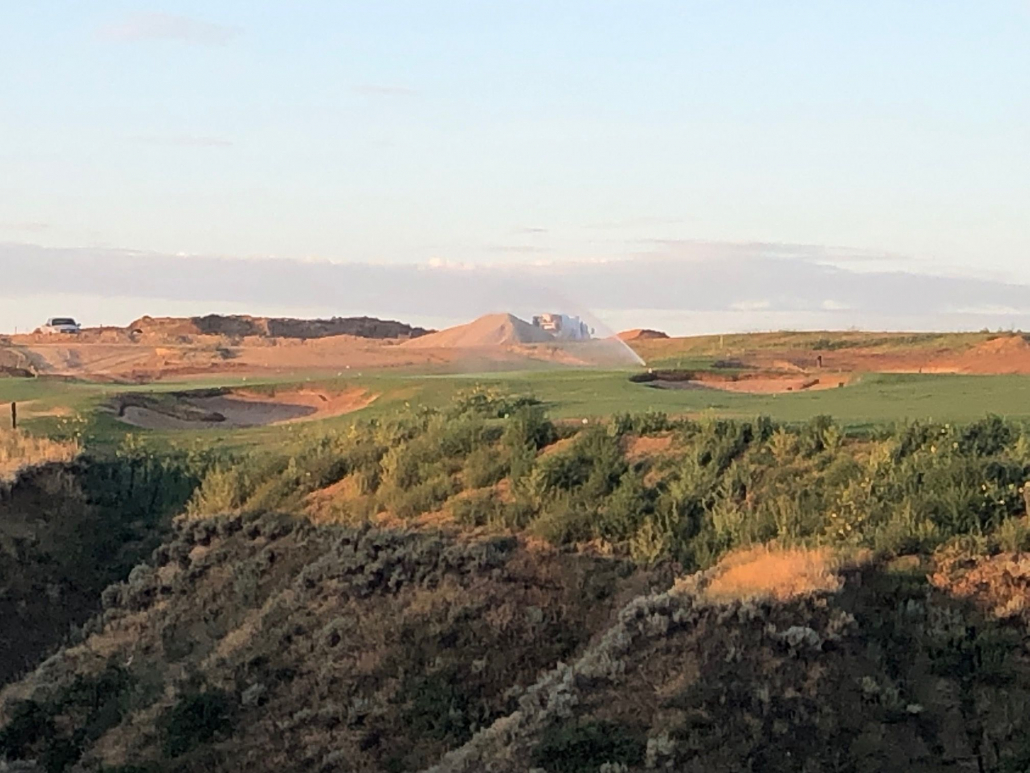
RainDance course features Capillary Bunkers: The new RainDance National golf course in Windsor, Colorado, should be finished this year and will open in July 2022. Part of a substantial housing development, the course, which is being designed by architect Harrison Minchew, along with former PGA Tour pro Fred Funk, is using Capillary Bunkers lining technology.

“I did a course with Ed Seay back in 1985, and I remember the contractor saying to me ‘You know, one day we’re going to put concrete in the bunkers to make them work better,” says Minchew. “Well, for me, that day has come.”

RainDance course features Capillary Bunkers

RainDance course features Capillary Bunkers

Originally announced back in 2014, the start of the RainDance build was delayed until last September, to allow developer Martin Lind to progress the associated residential community. Sales have been very strong, allowing the course to start last year. “I am running the job and am here 24/7,” says Minchew. “To get it all done this year is a really tight schedule, though we already haveRAINC around two thirds of the course seeded.”

Minchew first used the Capillary Bunkers product on a six hole First Tee course in Augusta. “Landscapes Unlimited were building that project, and wanted to install Capillary Bunkers,” he says. “That enabled me to see how effective the product was – I saw the water basically going straight through the bunkers – and I came to understand how it works, and to realise that it could be installed in conditions that would be impossible for competing products. So when it came to this job, I knew I wanted to use Capillary Bunkers.”

Minchew says that the golf course build, and all seeding, will be finished this year, despite an extremely wet spring. “We will have a total of about 75,000 square feet of Capillary Bunkers,” he says. “Capillary Bunkers’ Scott Grego has been working closely with us – he came in while we were installing the first few bunkers to make sure we were doing it correctly.”

For the latest industry news visit turfmatters.co.uk/news

Get all of the big headlines, pictures, opinions and videos on stories that matter to you.

Follow us on Twitter and Instagram for fun, fresh and engaging content.

You can also find us on Facebook for more of your must-see news, features, videos and pictures from Turf Matters.

Anthracnose: Interactions with the disease triangle

Anthracnose: Interactions with the disease triangle: Anthracnose of turf is caused by the pathogen Colletotrichum cereale. The disease primarily affects intensely managed turf surfaces because of the considerable stresses that these environments place on the host plants.

This article describes phases within the lifecycle of anthracnose of turf (figure 1) in the context of the three aspects of the disease triangle; pathogen, host and environment.

Biotrophic phase

Simplified lifecycle of Colletotrichum cereale, the anthracnose pathogen that affects turfgrass.

Simplified lifecycle of Colletotrichum cereale, the anthracnose pathogen that affects turfgrass.

The pathogen establishes within the host without causing symptoms of disease.

  • Pathogen

During the biotrophic phase of the anthracnose lifecycle, the pathogen establishes itself within the host plant without alerting the plant to the requirement to respond defensively. It does this by extending primary hyphae, root-like filaments, between the plant cells without actually entering the cells. The pathogen further disguises its presence from the plant using a process called deacetylation, in which chitin on the hyphae is converted to chitosan (Muench, et al., 2008).

  • Host

The plant does not respond defensively to the pathogen because the hyphae do not enter the plant cells and the presence of chitin, which primes plants to activate defensive mechanisms, is hidden. However, even at this early stage of infection, the pathogen may affect its host negatively by creating a nutrient sink at the site of infection; thus, increasing the nutrients availability for the pathogen whilst reducing the nutrients that are fulfilling plant functions.

  • Environment

Extended periods of leaf wetness allow the pathogen to penetrate the host plant and for the biotrophic phase of development to commence. Practices that reduce leaf wetness; such as use of surfactants and physical removal of dews will help to reduce pathogen establishment at this stage.
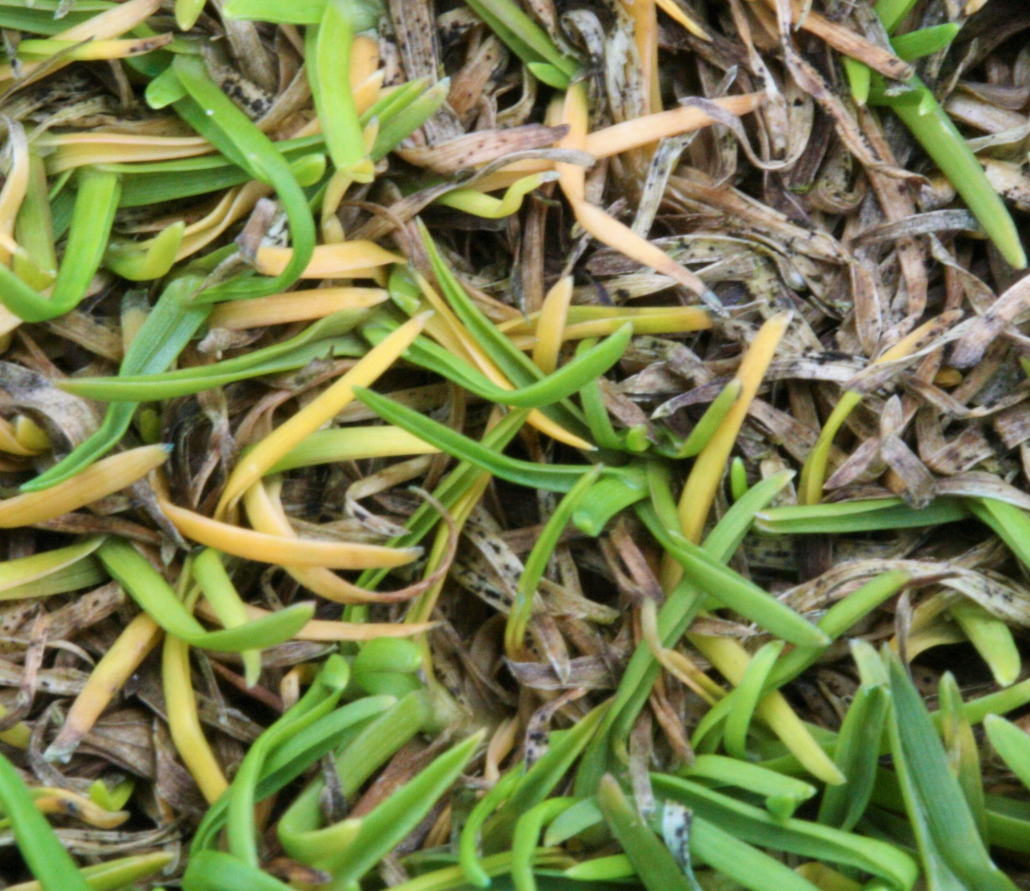
Foliar blight on a Poa annua sward showing the characteristic yellowing of leaves and diagnostic black setae.

Foliar blight on a Poa annua sward showing the characteristic yellowing of leaves and diagnostic black setae.

Necrotrophic phase

The pathogen penetrates into plant tissues and disease symptoms are observed

  • Pathogen

Necrotrophic growth is characterised by the development of secondary hyphae which penetrate into plant cells. This growth is accompanied by the production of phytotoxins which degrade plant tissue, providing the fungi with a further nutrient source. This phase of growth for anthracnose pathogens which affect other plants typically occurs within 72 hours after the initiation of the biotrophic phase  (Mims & Vaillancourt, 2002). The exact timing is not yet known for Colletotrichum cereale, the pathogen that infects turfgrass.

  • Host

There are two distinctive forms of anthracnose infection during the necrotrophic phase; basal rot and foliar blight (figure 2). It is likely that this symptomatic variance is caused by infection occurring in different parts of the plant.

Foliar blight is characterised by yellow (Poa annua) or reddish (Agrostis stolonifera) lesions on leaves and a water-soaked appearance.

Basal rot is characterised by symptoms in the lower stem or root. The infected tissue at the base of the plant appears dark brown to black with the leaf sheaths above appearing orange to yellow but without foliar lesions.

  • Environment

Development of the disease into the necrotrophic phase is favoured by conditions that put the grass plant under abiotic stress; including low fertility, close mowing, compaction, heat, drought, low light levels and poor drainage. Historic records and weather forecasts are essential to determining when to undertake actions which will minimise the impacts of potential stressors on the plant.

Relevant stresses may be current or historical. For example, the considerable metabolic requirement in spring of Poa annua to produce seedheads takes photosynthate away from roots and shoots prior to a stressful time in the growing season and could weaken the host increasing its susceptibility to infection.
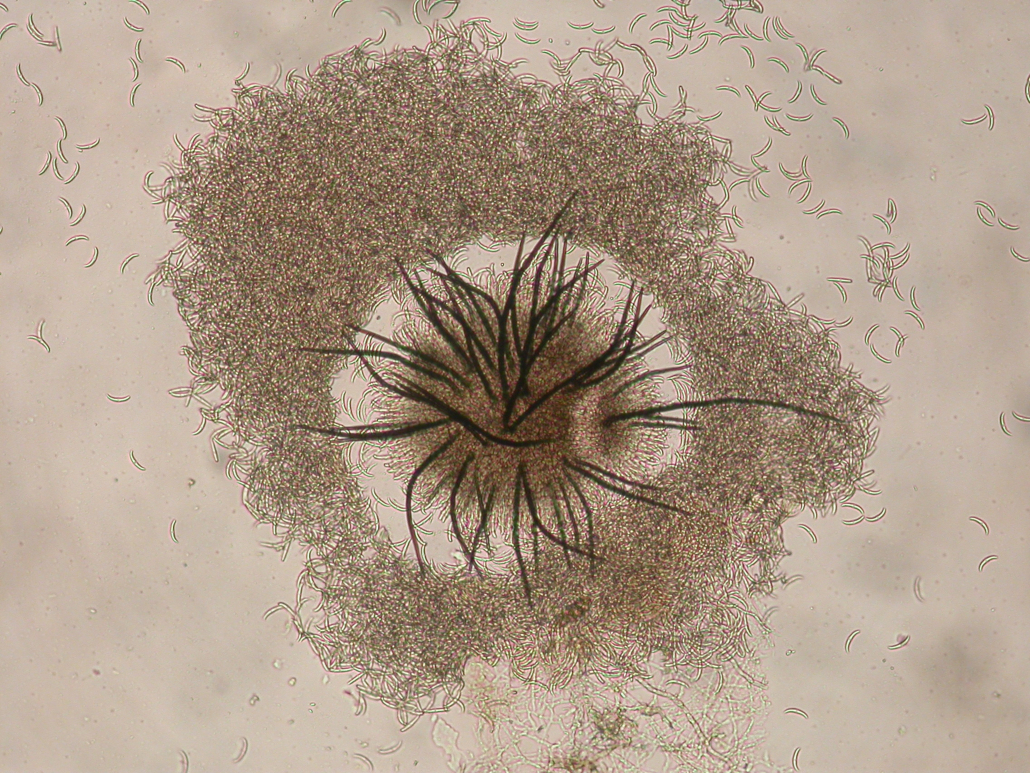
Colletotrichum spp grown in laboratory conditions on potato dextrose agar showing acervuli with diagnostic black setae producing conidia.

Colletotrichum spp grown in laboratory conditions on potato dextrose agar showing acervuli with diagnostic black setae producing conidia.

Reproductive phase

The pathogen spreads infective material to other areas

  • Pathogen

The reproductive phase begins with the development of fruiting bodies called acervuli within which the conidia, or spores, are produced (figure 3). Conidia can be transported on the wind or mechanically. Following contact with another susceptible plant, they can adhere to it by producing a suction cup called an appressorium. The pathogen then forces a highly specialised hyphae called a penetration peg into the plant resulting in the initiation of the biotrophic phase.

  • Host

During the reproductive phase black hair like structures known as setae which project from the acervuli on infected plant tissues are visible with a x10 hand lens. These structures are key diagnostic features for this pathogen when it develops as foliar blight (figure 2 & 3).

  • Environment

Warm, humid weather and increased light intensity are the primary environmental factors controlling the development of conidia. Laboratory studies indicate that Colletotrichum cereale produces conidia at temperatures between 24-32°C with increased maturity of conidia observed at 28°C compared with lower temperatures (Wang & Kerns, 2017). Once conidia have been excreted from the acervuli in a water-soluble matrix they can be spread by wind, water, or human activity but need continued leaf surface moisture to establish.

Research shows that wounding of the host plant through maintenance practices such as verticutting, top dressing and rolling does not increase the incidence of disease as the pathogen does not rely upon entry through wounds or weakened tissues due to its ability to develop a penetration peg.

This article has been written in conjunction with Dr Abigail Graceson and Tom Wood.

Dr Abigail Graceson

As a Technical Manager within the Agrovista Amenity Technical Department, Dr Abigail Graceson draws upon both her practical skills and academic research experience. In addition to her eight years’ experience as a professional gardener & horticulturalist; Dr Graceson spent nine years as a researcher specialising in horticulture, growing media and green roofs.

Tom Wood

Amenity specialist for the Yorkshire region, Tom Wood holds a first class bachelor’s degree in Sportsturf Science and Management (UCLan) which he combines with over ten years’ practical turf management experience. Over this time Tom has amassed a broad range of knowledge and skills sourced from a variety of fields including education, golf courses and technical sales.

References

Mims, C. W. & Vaillancourt, L. J., 2002. Ultrastructural characterization of infection and colonization of maize leaves by Colletotrichum graminicola, and by a C. graminicola pathogenicity mutant. Genetics and resistance, 92(7), pp. 803-812.

Muench, S. et al., 2008. The hemibiotrophic lifestyle of Colletotrichum species. Journal of plant physiology, Volume 165, pp. 41-51.

Wang, Y. & Kerns, J. P., 2017. Temperature effects on formation of appressoria and sporulation of colletotrichum cereale on two turfgrass species. International Turfgrass Society Research Journal, Volume 3, pp. 123-132.

More information on this subject can be found on the Agrovista Amenity Academy. The Agrovista Amenity Academy is an online learning resource with courses and lessons created on a range of areas of turf management and for all products sold by Agrovista Amenity.

For more information about Agrovista UK, visit www.agrovista.co.uk/amenity

For the latest industry news visit turfmatters.co.uk/news

Get all of the big headlines, pictures, opinions and videos on stories that matter to you.

Follow us on Twitter and Instagram for fun, fresh and engaging content.

You can also find us on Facebook for more of your must-see news, features, videos and pictures from Turf Matters.

Multi-Seeder ‘pivotal’ at Downfield GC

Multi-Seeder ‘pivotal’ at Downfield GC: After spending almost three months under constant snow and ice, a Multi-Seeder from Redexim has been crucial in regaining coverage on the greens at Dundee’s Downfield Golf Club.

Having previously borrowed or hired a seeder when required, the arrival of the Multi-Seeder 1600 in April 2021 couldn’t have been better timed for Golf Course Manager John Watson as the recovery from winter die-back commenced.

Multi-Seeder ‘pivotal’ at Downfield GC

Multi-Seeder ‘pivotal’ at Downfield GC

John and his team of six have been busy working on a number of projects around the 18-hole parkland course, including thatch removal and improving the drainage on some challenging clay-based greens. The investment in course condition continued with the purchase of the club’s first seeder. “I had seen a few reviews of the Multi-Seeder, and after speaking to Scott McNeil at Hendersons, they arranged to bring a demo unit in for us to carry out some overseeding on a couple of greens. I knew straight away it was going to be the machine for us!”

Under the guidance of Redexim, the Multi-Seeder dimple seeder has been re-engineered to feature an all new seed ratio and seed feed system which offers incredibly accurate distribution for all seed types – including bents. “A bag of bent seed is expensive so you want to be getting the very best germination possible with every bag. The Multi-Seeder fitted with two sarel rollers creates thousands of pots, at the perfect depth, to achieve just that and it was this feature that impressed us on the demonstration and sealed the deal.”

Following a tough winter, John has so far covered all 18 greens twice, with some additional work carried out on particular problem areas. “We lost so much coverage and it’s not an exaggeration to say that the Multi-Seeder has been pivotal in getting the greens back to where they should be. Having our own seeder now means we can carry out the operation when conditions are just right – our most recent pass, with favourable weather and growing conditions just right, gave us germination in seven days.”

John concludes, “It’s a great piece of kit, nice and simple to set up and operate. This Multi-Seeder is going to be a great asset for the club and help us greatly in our strive to constantly improve overall course condition.”

For the latest industry news visit turfmatters.co.uk/news

Get all of the big headlines, pictures, opinions and videos on stories that matter to you.

Follow us on Twitter and Instagram for fun, fresh and engaging content.

You can also find us on Facebook for more of your must-see news, features, videos and pictures from Turf Matters.

Golden future for Kilmarnock Barassie & Toro

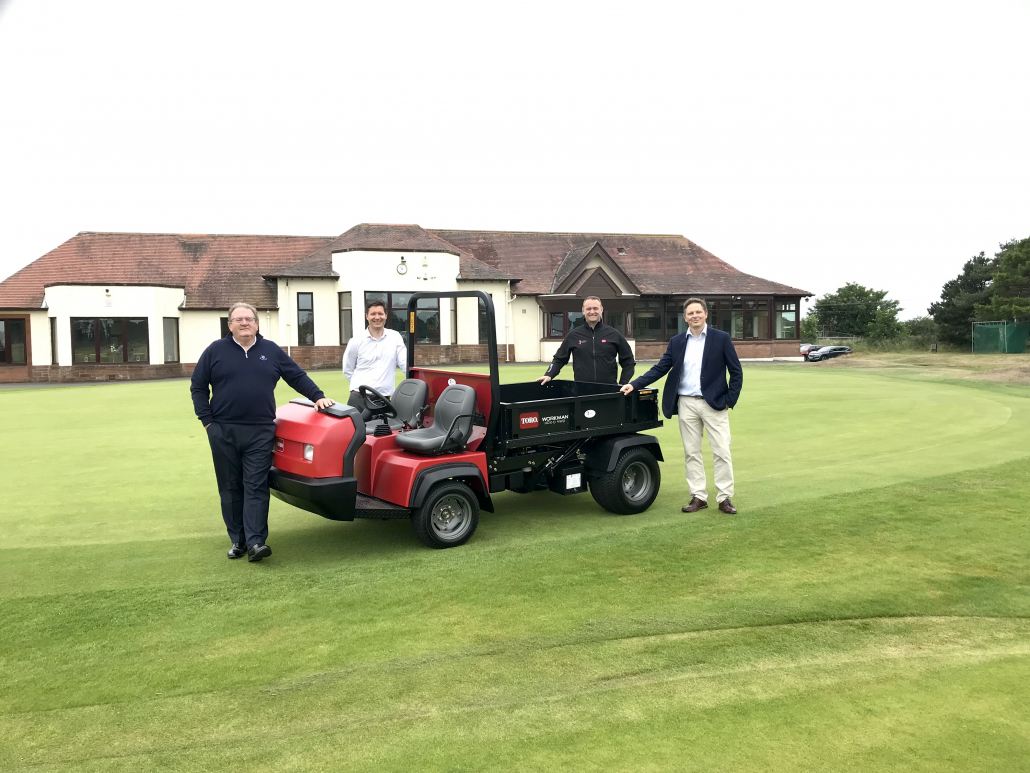
Golden future for Kilmarnock Barassie & Toro: New 10-year Toro agreement deal for Kilmarnock Barassie Golf Club in Troon on the west coast of Scotland takes relationship to 50 years.

Kilmanock (Barassie) Golf Club has been hosting Championship events since 1936 so knows a few things about what it takes to create the ideal playing surface. That’s why it’s chosen Toro for another 10 years in an exclusive partnership agreement with Reesink Turfcare.

Golden future for Kilmarnock Barassie & Toro

Golden future for Kilmarnock Barassie & Toro

The agreement with distributor Reesink Turfcare will see the whole fleet of machines replaced over two five-year cycles. Course manager Brian Finlayson who has worked at the club for 28 years and manages a team of ten greenkeepers, says Toro has suited the club since the early 1980s: “Barassie has been an all-Toro club for 40 years and the reason for that is it suits our every need. We are a very high-maintenance, championship-standard golf club and reliability and quality from our machinery are essential. Toro has never let us down.”

In the new deal, Kilmarnock Barassie Golf Club will upgrade like-for-like on previous models as it has been doing for decades as well as taking on some new technology in an effort to become more eco-friendly and reduce its carbon footprint with electric and hybrid alternatives such as the Toro Greensmaster eTriFlex 3370 and the Toro Greensmaster TriFlex Hybrid 3420.

The Greensmaster TriFlex Hybrid 3420 replaces Brian’s favourite mower, the Greensmaster 3250-D, he says: “The Greensmaster 3250-D is a world-renowned greens mower for good reason. The quality of cut is exemplary. We wanted to continue the same quality of cut but with an energy smart focus so the new order will see its hybrid counterpart, the Hybrid 3420, come on board with its electric cylinder drive.”

The club has hosted many championships since 1936 and Brian takes special pride in the Women’s Amateur Championship, held this year, and the Junior Open Championship hosted in 2006, which he considers the highlights of his career. With tournaments being such a large and important part of the club’s calendar, having back up and support Brian can rely on is vital.

This deal, which also includes TYM tractors, is the club’s first done directly with Reesink Turfcare’s Livingstone branch about which Brian says: “Reesink has looked after us fantastically well and offers us first-class support especially during tournaments. That’s a large part of the club’s life and history hosting these big events and knowing we can get first-class support and back up gives us a lot of peace of mind. I’m hoping by the end of summer Reesink will be doing all our servicing and fleet work. I can’t speak highly enough of Reesink.”

Was there any thought of switching brands or going with another distributor? Brian says: “Never, at any stage did we think about going for another manufacturer. When given the choice to go to another competitor, the staff operating the Toro equipment said hands down they wanted to continue with the brand. Plus, we don’t do full mechanics here and knowing we can count on Reesink makes things a lot easier. We’ve stuck with Toro throughout the years and will continue to do so with Reesink.”

With Barassie and Toro’s relationship reaching half a century by the end of this agreement, it’s certainly a future that looks golden!

For the latest industry news visit turfmatters.co.uk/news

Get all of the big headlines, pictures, opinions and videos on stories that matter to you.

Follow us on Twitter and Instagram for fun, fresh and engaging content.

You can also find us on Facebook for more of your must-see news, features, videos and pictures from Turf Matters.
Portlethen GC chooses Wiedenmann

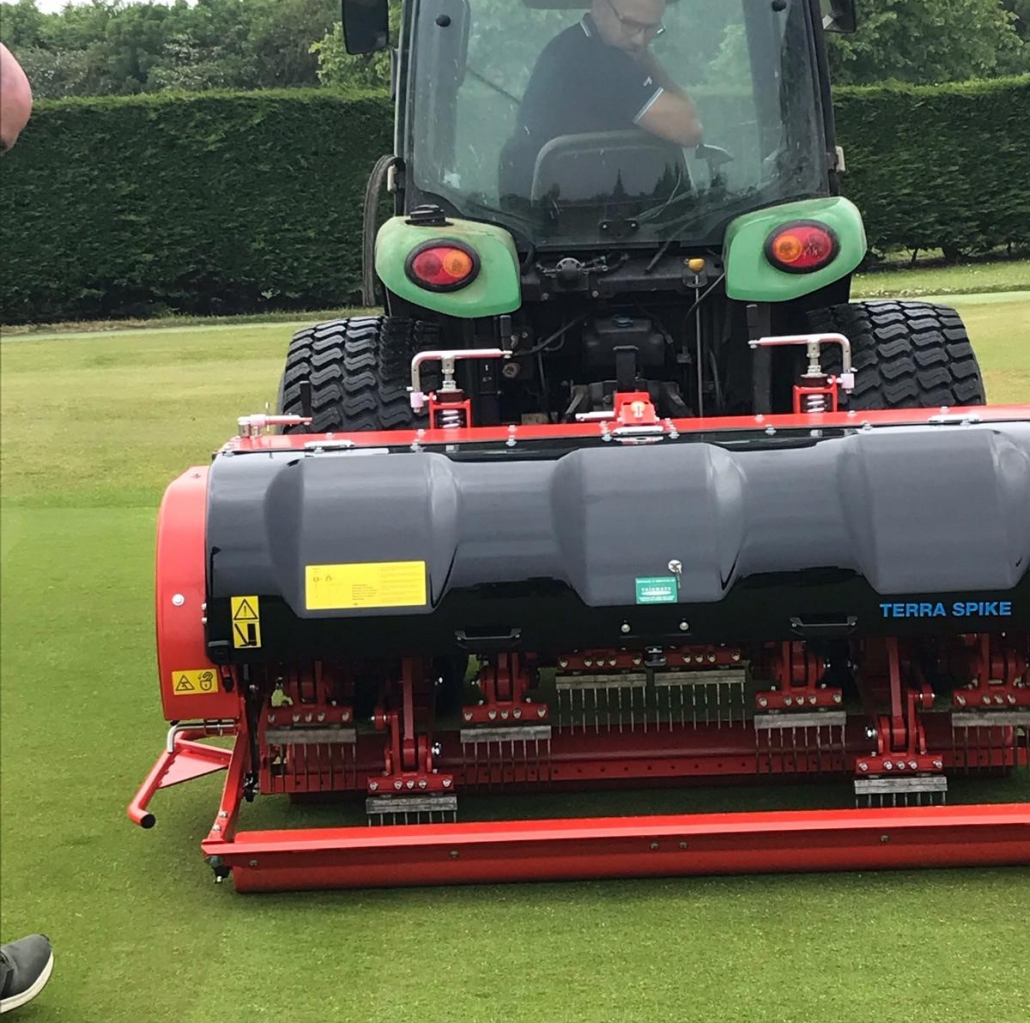
Portlethen GC chooses Wiedenmann: An Aberdeenshire golf course has added a 4.05 m winged Wiedenmann Terra Brush to its fleet at the same time as updating its Terra Spike GXi8 HD.  Portlethen GC, six miles south of Aberdeen, made the double investment during early summer. Neil Sadler, head greenkeeper since 2009, had no hesitation in opting for both machines.

“Our GXi8 HD was a ‘like for like’ purchase.  We’d got one of the very first at launch ten years ago and it’s literally given hundreds of hours of neat aeration.  We part exchanged and the new one took over from where we left off …  it is superb, so versatile, with many tine choices.   It has considerably improved the surfaces of our tees, greens and approaches. If our fairways weren’t as rocky, it would be used there, too,” said Neil Sadler.

Portlethen GC chooses Wiedenmann

Portlethen GC chooses Wiedenmann

Built just over 40 years ago, Portlethen GC, offers golfers two challenging parkland circuits of nine holes and the option of four different courses, all with an abundance of natural features. Course development has seen the planting of around 21,000 carefully selected trees, restoration of a drystone dyke, construction of stone bridges, new tees at several holes and a pond at the short fifth.

Neil leads a team of three, supplemented at times by two seasonal staff. In summer, their day begins at 05.00 am giving them three hours to work on the course ahead of first tee off at 08.00 am.

“The more we do ahead of play the better. Once the golfers catch you up, it can be a dangerous sport,” continued Neil, who unfortunately ended up in A&E twice last year, after being struck by a golf ball.

“Our club is supportive. They appreciate we need kit that helps us do the job efficiently and quickly. The Terra Brush was another easy decision.  I’d seen the Wiedenmann demonstrated and remembered it. Our previous brush had given good service but had only one row of bristles on the wings. The Wiedenmann has four rows of bristles across its entire extended width; the row pattern is a mixture of straights and diagonals.  The bristles, therefore, are more consistent and connect better with the turf, even on undulations, so really stand the grass up or work the top dressing in harder. We chose medium firm bristles.

“September through to October, the brush is out first thing every day, brushing dew from fairways and approaches. A quick pass keeps the fairways clear of debris, the removal of the moisture leaves the grass plant drier and we follow on with a clean cut.  Later on, when not cutting as much, brushing just keeps the presentation levels high. It is fantastic for sward refinement and standing the grass tall.

“We’ve only top dressed a few greens since it arrived, but I know it will work well.”

Neil already has a Wiedenmann Mega Twister blower with a 230° swivel capability and a Wiedenmann 1.7 m Terra Rake in his fleet.

“I’ve not quite got the full Wiedenmann set.  The Super 500 is on my wish list but that will have to come later,” joked Neil. “No surprises, we need a strong blower to manage our leaves. They are quite a job; the Mega Twister is sufficiently powerful and its twisting spout allows the tractor to keep moving, avoiding frequent stops to turn around and re-position.

“We take the Terra Rake through semi rough before we cut it, to clear it out and remove thatch. It gets run through the fairways a couple of times during the season. We rake the leaves as well plus lots of other uses. So far, we’ve neither had opportunity nor time to work our Wiedenmann machines in combination, but once the season quietens it’ s only a matter of time,” concluded Neil.

John Morton, Area Manager at Fairways GM, the Scottish dealer for Wiedenmann UK, and Wiedenmann UK’s Andy Kerr were on hand to install both machines.

Portlethen GC hosts the Scottish Men’s Amateur Championship jointly with Murcar Golf Links from July 25-26 followed by the Scottish Men’s Match Play on July 28-29, 2021.

For the latest industry news visit turfmatters.co.uk/news

Get all of the big headlines, pictures, opinions and videos on stories that matter to you.

Follow us on Twitter and Instagram for fun, fresh and engaging content.

You can also find us on Facebook for more of your must-see news, features, videos and pictures from Turf Matters.