
Tag Archive for: At

Bunkers ensure success at Marco Simone course

Bunkers ensure success at Marco Simone course: Although the Covid-19 pandemic means it will have to wait another year until it hosts the Ryder Cup, preparation of the Marco Simone course in Rome continue apace.

All eighteen holes of the new-look course, designed by European Golf Design, opened for member and guest play earlier this month. And Dave Sampson, of European Golf Design, says the course’s bunkers, which have been built using the Capillary Bunkers lining system, are performing particularly well.

Bunkers ensure success at Marco Simone course

Bunkers ensure success at Marco Simone course

“The first nine holes – actually the back nine of the course – started construction in August 2018, and were all grassed by the end of summer 2019,” says Sampson. “A couple of major storm events set those holes back a little, but they were all in play last summer. The second phase construction started in autumn 2019 and finished during summer 2020. Phase three, the practice greens, is currently being finished, though architect Sampson, prevented from visiting the site by the pandemic, has been approving the works via drone footage. The course is planned to make its public bow this September when it plays host to the European Tour’s Italian Open.

Sampson says: “We have been in daily contact with the guys from contractor SOL Golf who have been on site, so finishing the final greens remotely has been OK. Nothing of the original course has been retained – every hole except for the sixth plays in a new corridor.”

He adds that the choice of Capillary Bunkers as a liner was an easy one. “I have had really good success with Capillary on previous projects, including the Evian resort in France and Crans-sur-Sierre in Switzerland,” he explains. “Evian and Marco Simone have quite a lot in common, in terms of weather patterns, so it was a pretty good model. The amount of maintenance time post storms is minimal compared to what it was before.”

Designing a course for a Ryder Cup is rather different to building a normal course, Sampson says: “On a normal project, you’d be looking for the best eighteen holes, pure and simple. Here, you’re looking for the best eighteen holes that can deal with 50,000 spectators. So the routing is quite challenging, but that said, there are not long walks between greens and tees. This is a 27-hole project, so the extra nine gives us space for the range, the spectator village and the like. And you need to build the course to be extra resilient in terms of weather – there isn’t a lot of extra daylight to play with given the time of year a Ryder Cup is played, so the course needs to be playable quickly even in the event of severe weather. That’s one of the benefits of using a liner like Capillary Bunkers.”

For the latest industry news visit turfmatters.co.uk/news

Get all of the big headlines, pictures, opinions and videos on stories that matter to you.

Follow us on Twitter and Instagram for fun, fresh and engaging content.

You can also find us on Facebook for more of your must-see news, features, videos and pictures from Turf Matters.

Jacobsen celebrates 20-years at Sage Valley

Jacobsen celebrates 20-years at Sage Valley: Since the construction of Sage Valley Golf Club in 2001, Jacobsen mowers have covered every blade of grass on the 4000-acre site, and in those two decades, they have always impressed.

The private members club located just outside of Augusta, Georgia, sits within thousands of acres of preserved southern pine forest, and at its heart is the 18-hole, 7,344-yard course and three practice holes. Along with every blade of grass on the 4000 plus acre site, these courses are maintained by the Director of Agronomy, Dustin Purdue, and his team.

Jacobsen celebrates 20-years at Sage Valley

Jacobsen celebrates 20-years at Sage Valley

With roadsides, fields, common areas and the courses under his control, the importance of having mowers for specific areas can’t be underestimated. For Dustin, it is the Jacobsen machines’ versatility that has played a significant part in their success.

“We maintain 125 acres of turf, so it’s a large area,” Dustin begins. “Most golf courses are in the 80 to 90-acre range, so when we are growing, and in the growing season and full-on mowing, we need every day and every minute just to stay on top of the amount of grass we have to mow.

“We’re maintaining things from a tenth of an inch on the greens all the way to two inches in the rough and then fields per se or just native roadside grasses. So having the ability for one supplier to have all of those pieces of equipment is definitely helpful.

“On our greens, we use the Eclipse 2 walk mowers, 22-inch. We have floating head units that we use on the bent grass greens on the big course, and then we have the fixed head units that we use on our TifEagle Bermudagrass greens on the Par 3 course.

“We also use the fixed head units to mow all of our tees on the big course, and we use the GP400s to mow approaches on both courses. We use SLF530s to mow fairways, and I use the TR330s to cut the rough.

“For quality of cut, I couldn’t ask for anything more. I feel like they hold up very well; they don’t need adjustments that often, the quality of cut, the quality of the steel and the materials used is great. Once they’re set, we’re able to go out and not have to make adjustments that often.”

Over 20-years at Sage Valley, Jacobsen has become part of the team. As the expectations from golfers and the world at large have changed, so has the product offering and speed of customer service. For years Dustin’s Jacobsen team off the course has kept the greenkeeping team on it, and it is that combination that makes everything click into place at Sage Valley.

“For us Superintendents, I’d say at the end of the day, it’s just our plan, but our plan’s no good if we don’t have a team to help us implement it. So I definitely would like to deflect and give my team any praise if possible because, again, I can have the best plan and dream in the world, but if we can’t go out and get it done, then it’s no good.

“I think in this day and age, specifically in the golf industry, but I also believe abroad, customer service is a huge part of the success of larger companies.

“I believe society nowadays just moves at a faster pace, and you kind of need everything right then, and I believe we’ve just come to expect it, so having great service is huge.”

Find your nearest Jacobsen dealer on their new website: https://www.jacobsen.com/?utm_source=Turf%20Business&utm_medium=email&utm_campaign=Turf%20Business%20E-Newsletter%20April

For the latest industry news visit turfmatters.co.uk/news

Get all of the big headlines, pictures, opinions and videos on stories that matter to you.

Follow us on Twitter and Instagram for fun, fresh and engaging content.

You can also find us on Facebook for more of your must-see news, features, videos and pictures from Turf Matters.

Liner upgrade solves problems at CordeValle

Liner upgrade solves problems at CordeValle: Designed by the Robert Trent Jones II firm (and actually the firm’s home course), CordeValle GC in California’s Santa Clara Valley, has some of the largest and most imposing bunkers to be found anywhere in golf.

There may be only 63 bunkers on the golf course, but the total area of sand is a breathtaking 188,000 square feet (17,500 square metres). And, according to superintendent Brett Thornsbury, the playing consistency of the bunkers was becoming his biggest challenge..

Liner upgrade solves problems at CordeValle

Liner upgrade solves problems at CordeValle

“We have large, very elaborate bunkers with steep faces,” he said. “Over the years, as with all aging bunker sand, it had lost its original color, the consistency to move water, and the playability was negatively affected, especially during the dry summer months or excessive rain events. With this project, we wanted to restore the sand to its original color, ensure the health of the drainage system, and most importantly, install a bunker liner that was going to last for many years to come.”

CordeValle’s bunkers were originally lined with a geotextile, but its performance had deteriorated since the course’s opening in 1999. When Thornsbury became superintendent four years ago, he quickly realized the bunkers would need to be addressed in the near future to maintain a high-quality of playability and consistency.

In 2019, led by RTJII president Bruce Charlton, the course’s greens and approaches were renovated and regrassed.. The completion of this project left the bunkers as the next major issue to be improved , and last year, Thornsbury was able to start the work.

“We knew the bunkers needed to be relined, and we wanted a liner that could perform at the highest level, no matter the season. he said. “When we researched the options, it became clear to us that Capillary Concrete had a superior bunker product, and was the one we wanted to use.”

The bunker project began early in October of 2020, and was completed in the middle of March 2021. “We tried to have the lowest possible impact on play, using temporary greens where necessary, and always keeping eighteen holes open,” said Thornsbury. “Fortunately for us, we had a pretty dry winter allowing the project to work mostly uninterrupted. However just a few weeks ago we had our first major rain event of the season, producing six inches of rain in less than three days, which for us in Central California, is welcomed and unusual. Not one speck of sand moved in our newly completed bunkers. The team was relieved to see they didn’t require any repairs after such a heavy rain event and kept the sand shovels in the shop that morning. It’s a testimony to the Capillary Bunkers product.”

For the latest industry news visit turfmatters.co.uk/news

Get all of the big headlines, pictures, opinions and videos on stories that matter to you.

Follow us on Twitter and Instagram for fun, fresh and engaging content.

You can also find us on Facebook for more of your must-see news, features, videos and pictures from Turf Matters.

SISIS Flexibrush gets results at Greetham

SISIS Flexibrush gets results at Greetham: After the withdrawal of certain chemicals, Adi Porter, Course Manager at Greetham Valley Golf Club, has found the SISIS Flexibrush to be an ideal solution for dispersing worm casts.

Adi has been working at the East Midlands club for nearly thirty years and throughout that time he has seen it become one of the finest golf, hotel, leisure and conference venues in the area.

SISIS Flexibrush gets results at Greetham

SISIS Flexibrush gets results at Greetham

“We made a conscious effort to really push the standards,” said Adi. “It enabled us to significantly improve the presentation and we went from strength to strength. We soon found our membership at full capacity and had to put a waiting list in place – which was unheard of for clubs in this area.”

Under his remit, Adi is responsible for the maintenance of two 18-hole courses and a 9-hole course, a driving range, and a bowling green. Standards to Adi are everything, and he leaves no stone unturned when it comes to presenting ‘picture perfect’ facilities. It is for this reason, that he admits to being frustrated by an all-too-common issue.

“Worms are becoming more and more of a problem on every sports surface because we lost the chemical control a few years ago,” he said. “Here at Greetham, the worm population has undoubtedly increased and the worm casts can be a nuisance. If they are not kept on top of then they just get smeared into the grass with the golf that is played and foot traffic, trolleys and buggies.”

In looking for a non-chemical solution, Adi, who has been a long-term user of SISIS machinery, decided to investigate the SISIS Flexibrush.

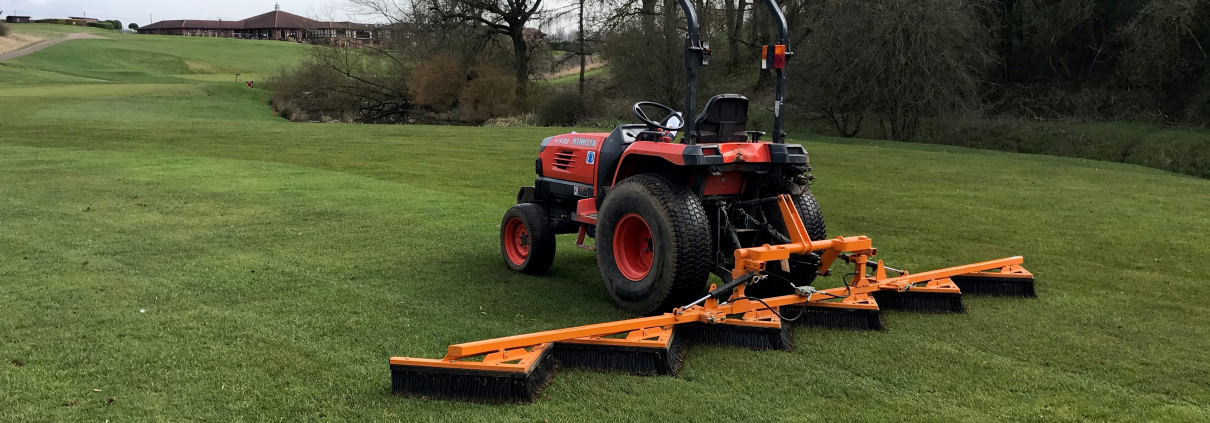
The Flexibrush is a tractor mounted brush which is equally effective to disperse top dressing and remove excess material on natural turf and on synthetic surfaces. The versatile Flexibrush can also be used for dew dispersal and striping for improved presentation. It has a 5.35 metre working width, its brush sections float to follow ground contours and the outer sections fold for transport and storage.

A demonstration was arranged at the start of 2020 and Adi has not looked back since.

“It is a fantastic, quick and cost-effective way of removing or dispersing worm casts,” said Adi. “What really sold it to me is the size of it – some of the other brushes on the market for outfields and fairways are a lot narrower and I don’t think there is one wider than the Flexibrush.

“It is very productive, and we can easily do 36 holes in a day. I also like the fact that it folds up quicky – you can easily move it about the course, through trees and from fairway to fairway.

“Another main reason for purchasing it was so that we can use it for presentation,” he continued. “We will use it for brushing before mowing to stand the grass up because it provides a better cut. Also, in the autumn and winter months when we are not actually cutting the grass, we can still present a fairway nicely by striping with the Flexibrush.

“It’s been a great purchase for us and as always we get a great service and back-up from SISIS,” Adi concluded.

For further information or a no obligation demonstration, please contact SISIS on 01332 824 777 or visit www.sisis.com

For more news, reviews and insightful views, you can follow SISIS on Twitter or Instagram @SISISMachinery and like the company’s Facebook page – www.facebook.com/SISISMachinery You can also view the latest SISIS videos by visiting www.youtube.com/SISISMachinery

For the latest industry news visit turfmatters.co.uk/news

Get all of the big headlines, pictures, opinions and videos on stories that matter to you.

Follow us on Twitter and Instagram for fun, fresh and engaging content.

You can also find us on Facebook for more of your must-see news, features, videos and pictures from Turf Matters.

EcoBunker enhances links feel at Golf Valley

EcoBunker enhances links feel at Golf Valley: Built between 2007-8 by architect David Krause, Golf Valley is a major development, around 35km south of Munich.

Created by developer Michael Weichselgartner with the aim of hosting major tournaments and the Ryder Cup, Golf Valley was built in a links-style, with over 3,000 sq m (32,000 sq ft) of bunker sand area and, according to Andy Matzner, the club’s first course manager, who now works there in a consulting capacity, has always struggled with the impact of rain on its bunker faces.

EcoBunker enhances links feel at Golf Valley

EcoBunker enhances links feel at Golf Valley

“With such a massive area of sand, it was always a huge workload every time there was serious rain,” says Matzner. “In Bavaria, in the early summer, there are regular lightning storms, and every time there was a rain event, the whole greenkeeping crew would be occupied pushing sand back up the faces. And then the next day, it would happen again! I had real difficulty motivating my staff to keep shifting sand, and obviously the impact on our maintenance costs was huge.”

Matzner, by then consulting at Golf Valley, met Richard Allen, founder of synthetic bunker edging solution provider EcoBunker, in 2017. “By that time, I had realised that the bad weather, and the consequent washouts, were just something we had to deal with,” he says. “Golf Valley has no trees, and the course is quite links-like in look and feel, and it occurred to me that revetted walls, sensitively installed, would fit in nicely, and would give the place a more authentic links character. Richard visited and assessed the bunkers, and agreed with me that revetting would improve both their appearance and their performance, so we commissioned EcoBunker to install its product on an initial 200 sq m of bunkerfaces.”

That project, in spring 2018, was handled by EcoBunker construction manager Llewelyn Matthews. Covering thirteen bunkers, Matzner and the Golf Valley team were impressed by the results. “A revetted wall in sunlight and shadow looks very impressive,” he says. “But the most important thing was the prevention of washouts. A flat sandy bunker never washes out. It may fill up but so long as the drain operates effectively, the bunker will always work.”

In late 2019, Golf Valley was hit by a huge rain event. Almost every bunker, apart from the ones that had been rebuilt by EcoBunker, was virtually destroyed. The EcoBunkers survived the storm completely intact. At this point, owner Weichselgartner decided that as many as possible of the course’s bunkers should be rebuilt using the EcoBunker solution. The EcoBunker team came back on site in October 2020 to build the next set of bunkers. That project was substantially completed in December, and Matzner says the results are impressive. “The course looks much more like a real links now, and the bunkers perform far better,” he explains. “And that is all down to EcoBunker.”

For the latest industry news visit turfmatters.co.uk/news

Get all of the big headlines, pictures, opinions and videos on stories that matter to you.

Follow us on Twitter and Instagram for fun, fresh and engaging content.

You can also find us on Facebook for more of your must-see news, features, videos and pictures from Turf Matters.