Tag Archive for: Carbon

Tubex Shelters in The Carbon Community Project

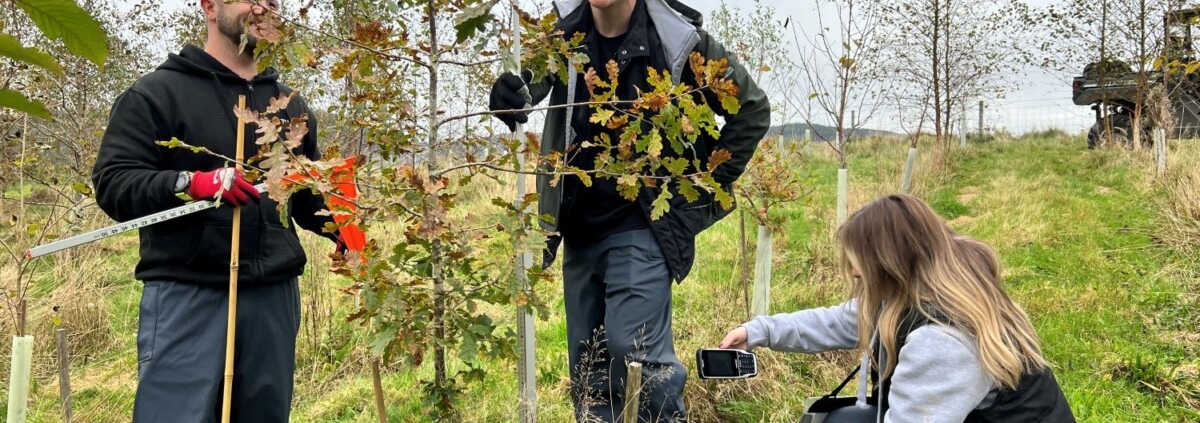
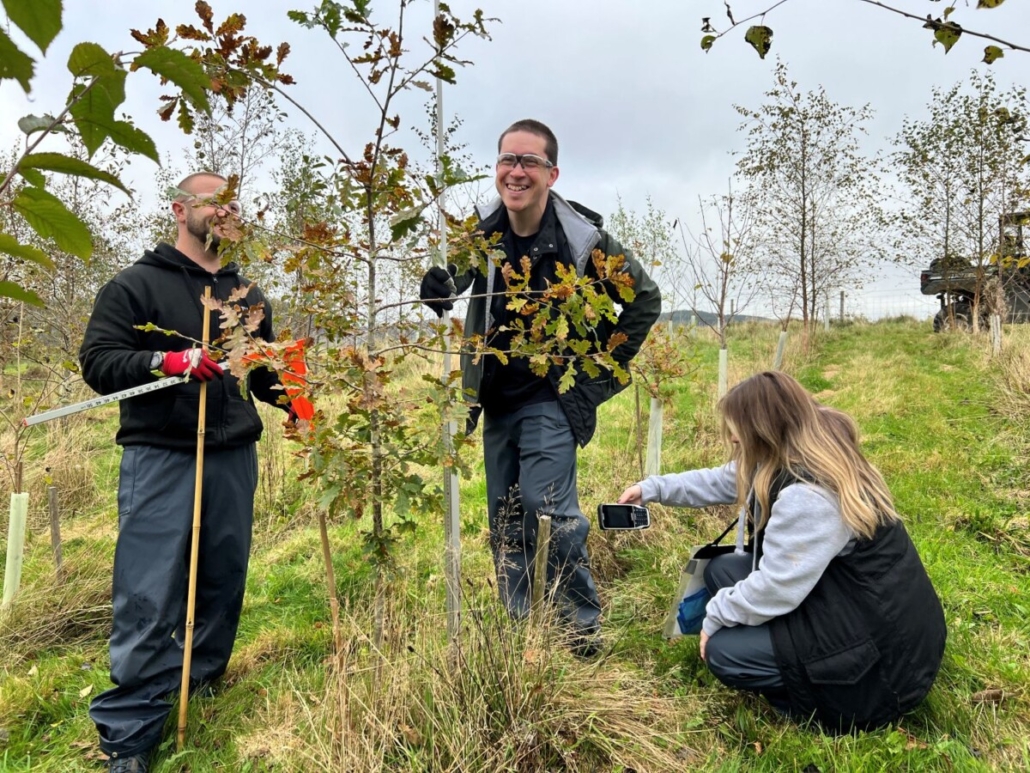
Tubex Shelters in The Carbon Community Project: One of the UK’s most significant long-term forestry research projects has used Tubex tree shelters to protect thousands of young saplings while allowing scientists easy access to measure growth.

The Carbon Community’s Glandwr Forest Carbon Study examines how trees and soil store carbon.  The project, now in its fifth year, aims to build a stronger evidence base for nature-based solutions that can increase carbon capture and improve woodland resilience.

Tubex Shelters in The Carbon Community Project

Tubex Shelters in The Carbon Community Project

Established in 2020, the 11.5-hectare study brings together scientists, forestry partners and volunteers to investigate how different tree species and soil treatments influence long-term carbon storage. More than 25,600 trees have been planted across 72 test cells, including oak, birch, cherry, alder and Sitka spruce, allowing researchers to compare growth and soil behaviours under controlled conditions.

The project focuses on approaches such as enhanced rock weathering, where crushed basalt releases nutrients and supports carbon capture, and soil microbiome inoculation, which introduces beneficial fungi from nearby healthy woodland to help young trees access nutrients more effectively. These methods together provide a growing dataset that will help clarify the role of soils and species selection in carbon sequestration.

Before the trial “we planted a few oaks grown from seed collected on site and they were eaten by rabbits within weeks,” said Heather Allen, Trustee at The Carbon Community. “When the trial was established, our forestry partner, Tilhill Forestry, strongly advised using shelters – and we agreed they were essential.”

Tubex Easywrap shelters were selected as a practical way to protect vulnerable saplings while still allowing researchers and volunteers to access each tree for measurement and monitoring. All the broadleaf trees planted use the shelters, helping maintain consistent establishment across the test cells and supporting long-term data collection.

As an environmental charity, The Carbon Community also considered the long-term implications of introducing material onto the site. The ability to collect and return the shelters for recycling once they were no longer needed was an important factor, ensuring the project could minimise waste. Each spring, volunteers remove shelters from trees that have outgrown them and collect any that have loosened during winter weather. These are returned through the Tubex recycling network, supporting a circular approach to material use. “We made a commitment to collect every single shelter when the trees were big enough,” Heather said. “We’ve been running volunteer removal days for the past couple of years – and those shelters have already made their way back for recycling.”

Community involvement has remained central throughout the project, with volunteers supporting planting, maintenance and data gathering to help researchers monitor conditions consistently across the site. “This is a long-term project,” Heather said. “We’re looking at how ecosystems can help solve the climate crisis. Good early protection has supported the research and helped us manage the site sustainably.”

Now in its fifth year, the study is beginning to analyse above-ground and below-ground data on how the treatments affect carbon capture. Strong early establishment across the site has created a stable foundation for long-term scientific assessment, with findings expected to support future woodland creation.

For Tubex, involvement in the project has centred on supplying shelters that meet the specific needs of the study. The Easywrap design has supported repeated access for measurements, helped maintain consistent establishment conditions and ensured that all used shelters could be collected and returned for recycling once no longer required. This combination of protection, practicality and material recovery has allowed the research team to manage the site effectively while maintaining the project’s sustainability commitments.

For more information about The Carbon Community and the Glandwr Forest Carbon Study, visit https://thecarboncommunity.org

For information on Tubex tree protection, visit https://tubex.com  

For the latest industry news visit turfmatters.co.uk/news

Get all of the big headlines, pictures, opinions and videos on stories that matter to you.

Follow us on Twitter and Instagram for fun, fresh and engaging content.

You can also find us on Facebook for more of your must-see news, features, videos and pictures from Turf Matters

Unlocking the carbon storage potential beneath our feet

Unlocking the carbon storage potential beneath our feet: Climate change is the defining challenge of our age, but the real battleground may be under our feet. Soil, the planet’s second-largest carbon store after the oceans, holds more than all the world’s forests combined.

Mismanaged, it leaks vast amounts of greenhouse gases. Managed well, it locks carbon away (as part of the carbon cycle) for generations, confirmation that how we treat the ground beneath us, could mean that the difference between climate success and failure – and it is about time that we started paying attention – argues Robert Wilkins, operations director at Ruskins, the soil and tree specialists.

Unlocking the carbon storage potential beneath our feet

Unlocking the carbon storage potential beneath our feet

Soil is a complex mix of minerals, organic matter, microbes, air and water. Within that mix lies one of the planet’s largest carbon stores. Globally, soils are estimated to contain about three times more carbon than the atmosphere. Every time we disturb or degrade  soils, whether through construction, farming or careless landscaping, we risk releasing some of that carbon back into the air or reducing its ability to store carbon. But when we manage soils well, we can protect existing carbon stocks and even increase them, turning the ground beneath us into a powerful ally for climate action.

Yet everyone was blinded by the increasing expensive and impossible route to Zero Carbon, that consigned anything with a whiff of offsetting to the naughty cupboard. Where as improving soil health is the easiest, cheapest and most effective way to reach net zero (perhaps excluding the low hanging fruit of closing coal powered power stations).

Net zero means balancing the carbon we emit with the carbon we remove or offset. While reducing emissions is rightly the top priority, there will always be some activities that release greenhouse gases. To compensate, societies must find ways to capture and store carbon. Forests and peatlands are often mentioned in this context, but soils cover far more ground and offer enormous untapped potential.

A hectare of healthy soil can store many tonnes of carbon, locked up in organic matter from plant roots, decayed vegetation and microbial activity. Practices that build soil organic matter not only store carbon, but improve fertility, water retention and resilience to erosion. This is why builders and developers need to understand soils, to either avoid degrading them or to enhance them in the final landscape. This will help to support new soft landscapes as nature intended, with the added advantage of better drainage and storing more carbon (and boosting biodiversity).

Soil carbon under threat

The problem is, that much of our soil is already degraded. Centuries of intensive farming, widespread sealing of land under tarmac and concrete and repeated disturbances from construction have left soils depleted.

In the UK, it is estimated that whilst UK soils hold around 9.8 billion tons of carbon, so much of it is now degraded, that it now holds only 50 per cent of what could be possible according to a report by House of Lords Science and technology Select Committee.  The UK Construction sector also destroys 10 times the amount of soil lost in the UK through erosion, every year claimed the Soils in Planning and Construction Task Force in September 2022.

Every time topsoil is stripped away or compacted by heavy machinery, stored carbon is lost. Drainage of peat soils in particular have released huge amounts of carbon, turning natural sinks into sources of the material.

As  we are only beginning to understand soils, their ability to store carbon is just one of their functions that is not widely appreciated. In addition, the focus on zero Carbon and the widespread lack of understanding about soils, has largely ignored the fact that soil, when treated properly, has the ability to reverse climate change.

This matters because degraded soils cannot perform their climate function. Instead of acting as a carbon bank, they become a liability. That is why soil protection is increasingly recognised in climate strategies and why land managers of every type – from farmers to developers – are being asked to rethink how they treat the ground.

Construction, in particular, may not be the first industry people associate with soil health, yet its impact is enormous. Large projects involve excavation, compaction and movement of soil, all of which affect carbon storage. Traditionally, soil has been treated as waste material to be shifted, dumped or simply ignored, but thankfully that attitude is changing.

Forward-thinking contractors are now incorporating soil management plans that retain the health of soils into their environmental strategies. By minimising disturbance, segregating soil types on site and ensuring that stripped topsoil is reused rather than discarded, they are reducing carbon loss.  However, the storing of soils in soil heaps, degrades the Soil Biology within them and their ability to store carbon.  More innovative approaches such as applying Soil Biology when planting final landscapes, creating green roofs, living landscapes and biodiversity-friendly planting that enhance soil function and capture carbon over the long term, are also helping to change things.

For developers and property owners, soil stewardship should be considered not as a regulatory burden, but as a climate opportunity. Every project that conserves or restores soil carbon, makes a measurable contribution to net zero. The cumulative effect across thousands of sites could be significant.  The change in ability to store carbon can be measured. Ruskins achieve on average a 75% increase in carbon storage within 6 months, when caring for soils.

Another reason soil deserves more attention is its link to biodiversity. Healthy soils teem with life such as bacteria, fungi, insects and small mammals. This underground community plays a direct role in storing carbon. Fungi, for instance, form networks that lock carbon in stable forms. When soil is alive and well, it is far more effective as a carbon sink, it supports all life above it.

This is important because climate policy is increasingly tied to biodiversity targets. In the UK, developers must deliver measurable biodiversity net gain on projects. Currently the BNG targets exclude soils, even though they hold 58% of all the species on the planet according to a recent BBC news item. Managing soils to encourage life is therefore not just good climate practice, but a way of meeting planning requirements. In effect, soil becomes the bridge between carbon targets and ecological obligations.

Measuring the invisible

However, the main challenge for developers is that soil carbon is invisible. Unlike a new solar panel or an electric bus, you cannot point to a soil profile and see the tonnes of carbon stored there. Measurement is complex, involving sampling and laboratory analysis. That makes it harder to incorporate soil into carbon accounting frameworks.

But this is changing. Advances in remote sensing, digital mapping and on-site testing are making it easier to assess soil carbon. Government bodies are funding research to establish baselines and monitoring methods. In time, soil carbon could be traded on markets much like forestry offsets, giving landowners and developers a financial incentive to manage soils responsibly. For now, the business case rests on reputation, regulatory compliance and the wider sustainability message.

However, what is particularly encouraging, is that government policy is slowly catching up. In England, the Environment Act requires biodiversity net gain, without realising this is underpinned by soil health. Flood management strategies increasingly reference soil’s role in water retention, without realising this is also underpinned by healthy soils. As healthy soils drain  upto 10 times better than unhealthy soils, into the ground water and not urban drainage systems. Net zero roadmaps further acknowledge natural carbon sinks, though soils often remain the poor relation to trees and wetlands, as it is not realised it is the health of the soil that governs its ability to store carbon.

For banks and investors, soil carbon is a risk and an opportunity. Poor soil management can lead to erosion, flooding and reduced asset value. Conversely, projects that enhance soil function may become more attractive to funders seeking sustainable investments. If soil carbon accounting matures, it could even become a tradable asset. For now, lenders are watching closely how environmental, social and governance (ESG) criteria evolve.

For us at Ruskins, soil is not a generic substance, but a living material that responds to how it is handled and its health can be improved by decompaction and applying Soil Biology. Getting it right requires expertise in soil science, hydrology and ecology. Unlocking the carbon potential of soil is less about technology than mindset. It requires planners, builders and managers to see soil not as inert ground, but as an active partner in climate goals. This cultural movement is underway, encouraged by policy and demanded by public opinion, but it needs champions in every sector to keep momentum.

All this means that if we are really to achieve net zero, the message is clear – we cannot afford to ignore the carbon beneath our feet. Soil is a giant reservoir, but like any bank account, it can be drawn down recklessly or invested wisely. The choice is ours.

For the latest industry news visit turfmatters.co.uk/news

Get all of the big headlines, pictures, opinions and videos on stories that matter to you.

Follow us on Twitter and Instagram for fun, fresh and engaging content.

You can also find us on Facebook for more of your must-see news, features, videos and pictures from Turf Matters.

Play your part in cutting carbon

Play your part in cutting carbon: Here Anthony Nadalin, director of marketing at The Toro Company, explores how Paris is leading the way in the decarbonisation of a major European city and the role outdoor power equipment can have in helping local municipalities achieve this.

France is one of the nation’s leading the effort to decarbonise and improve city air quality for residents, commuters and tourists.

Play your part in cutting carbon

Play your part in cutting carbon

Currently, 12 urban areas in France – including in and around Paris – have implemented a low-emission zone, known as an m-EPZ. These initial zones are just the beginning, as an additional 31 towns and cities are set to implement similar schemes by 2025. Along with cutting carbon, low-emission zones have been implemented to improve urban air quality for those who reside or work within them.

As France’s capital city, you would expect Paris to be at the forefront of these measures. In fact, the French capital adopted its first climate action plan in 2007 and is currently implementing the third, covering 2020 – 2030. By 2050, the city aims to have achieved a 100% reduction in local emissions and an 80% reduction in its total carbon footprint, compared to 2004 levels.

At present, the focus of all of its low-emission zones is motor vehicles powered by fossil fuels. In practice, this means that only vehicles powered by modern, efficient petrol and diesel engines are permitted to enter a zone. By 2030, Paris will only allow battery and hydrogen-powered vehicles to enter the city and the surrounding areas.

However, for Paris to successfully reach its goal of reducing local carbon emissions by 100%, it will require outdoor power equipment – used by local municipalities and businesses – to transition from petrol to more sustainable alternatives such as battery.

Challenge and opportunity

This presents both a challenge and an opportunity for organisations using such equipment. The opportunity to get ahead of the curve by adopting all-electric machinery now. For commercial businesses, it demonstrates their commitment to sustainability, while also giving them first mover advantage. However, the challenge for municipal authorities and landscaping or groundskeeping professionals is whether they can transition to all-electric machinery without sacrificing productivity and increasing their costs.

Therefore, it is no surprise that many companies are turning to battery-powered outdoor power equipment manufacturers, such as Toro to find the right solution for them.

Leading the charge

Toro is leading the charge to help the people of Paris and beyond make the switch to cordless outdoor power equipment. Toro’s approach is based on three pillars: performance, ease of use and affordability.

A fundamental principle is that the all-electric versions must meet or exceed the performance of the petrol and diesel equivalents. This is why Toro’s Revolution Series products are commercial-grade equipment designed for professional use. For example, Toro’s proprietary HyperCell® battery system was developed to deliver all-day run times, helping meet the demands of various industries without hindering power or performance.

Ease of use means that all-electric machinery must be easy to operate with stress-free maintenance. It helps that Toro’s Revolution Series is built on the proven Grandstand® and Z Master® chassis and TURBO FORCE® platforms, meaning they’re familiar to contractors and service engineers.

Furthermore, Toro Total Care offers groundskeeping professionals 24/7 support while features such as integrated charging systems and software offer a more user-friendly experience.

There remains a lively debate around the cost of cordless equipment, but we believe we are winning the argument. For a long time, equipment rental companies have focused on the total cost of ownership rather than the ticket price. Calculating the lifetime costs of a piece of equipment – capital cost, fuel, service and maintenance, and end-of-life disposal – provides a much more accurate picture than how much it costs to buy.

For some time now we have seen increasing numbers of grounds care and gardening professionals start to view equipment in the same way – and in this light, cordless machinery represents greater value for money. Easy to maintain and cost-effective to run, it can also cut the total cost of ownership and contribute to greater business profitability.

To help companies understand the financial benefits of battery power, Toro has created a TCO calculator, enabling contractors and municipal authorities to calculate their operational return on investment.

Play your part

Paris is driving urban decarbonisation in France, with many other towns and cities following suit. By 2030, municipalities and landscaping or grounds care contractors will be driving into the Paris low-emission zone in electric or hydrogen vehicles. Surely it would look deeply incongruous and send the wrong message if these vehicles were carrying diesel or petrol-powered equipment?

Furthermore, as residents get used to cleaner and quieter vehicles, they will expect the same from the outdoor power equipment used to maintain their parks and open spaces.

Joining the transition to battery-powered OPE will play a huge role in achieving decarbonisation targets for businesses looking to join cities like Paris in transitioning to a cleaner, quieter and electrified future.

To find out more about how Toro is leading the charge, or to access its TCO calculator and begin investing in battery-powered equipment, visit: https://sites.toro.com/leadthecharge/index.html.

For the latest industry news visit turfmatters.co.uk/news

Get all of the big headlines, pictures, opinions and videos on stories that matter to you.

Follow us on Twitter and Instagram for fun, fresh and engaging content.

You can also find us on Facebook for more of your must-see news, features, videos and pictures from Turf Matters.
Carbon Gold partners with Westland Horticulture

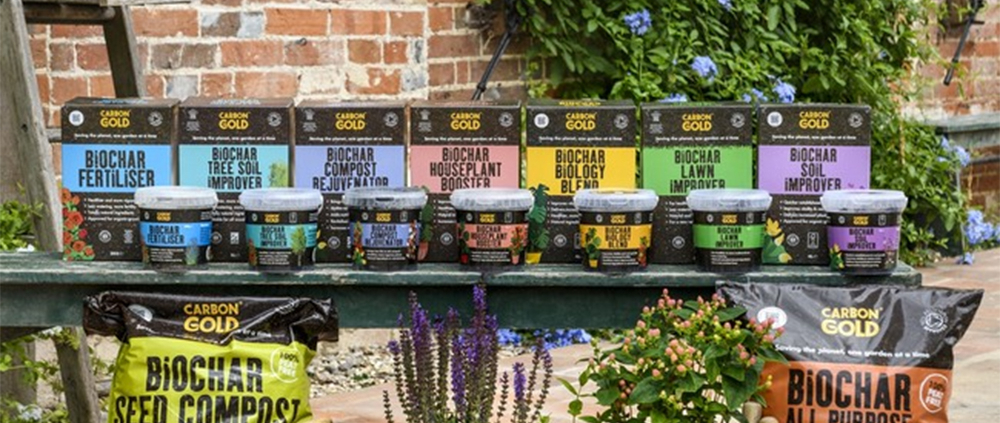
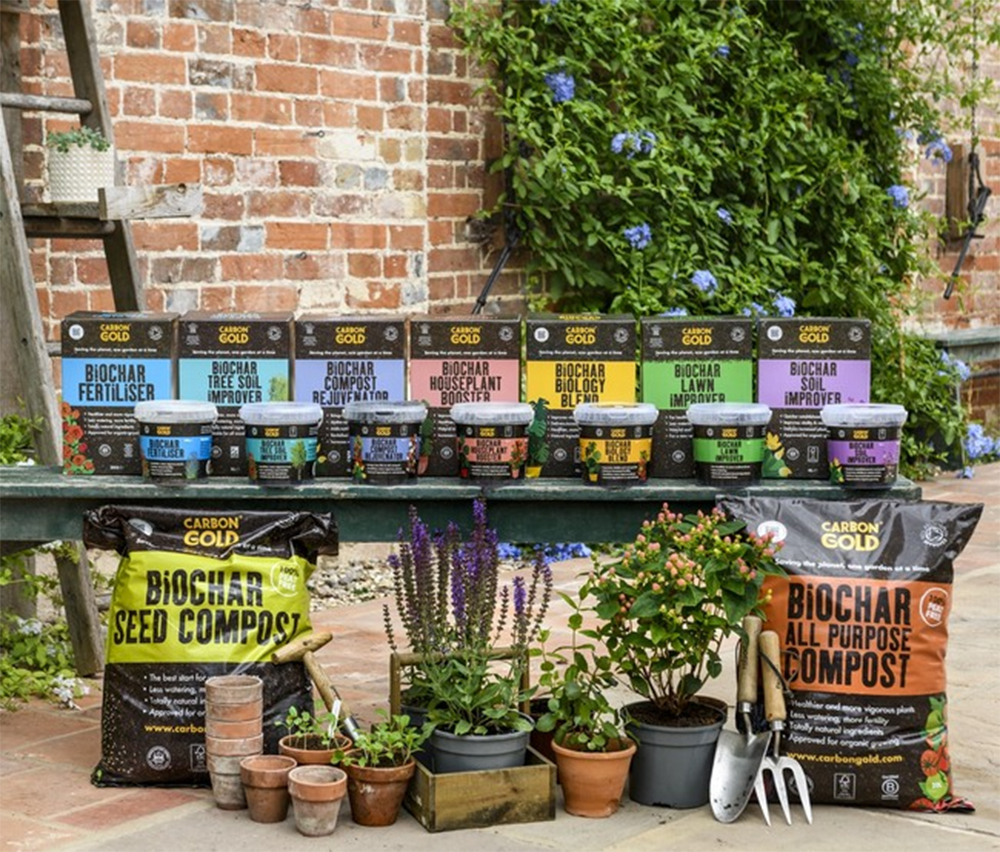
Carbon Gold partners with Westland Horticulture: Carbon Gold, the world’s leading biochar brand, is proud to announce a new partnership with Westland Horticulture.

Established in 2007, Carbon Gold has pioneered advancements in the biochar industry, achieving B-Corp certification and earning The King’s Royal Warrant. Their Soil Association-approved products, underpinned by nearly two decades of research and development, have set industry standards for sustainable soil management.

Carbon Gold partners with Westland Horticulture

Carbon Gold partners with Westland Horticulture

This partnership marks a significant milestone as it introduces a range of enriched biochar products to conventional garden retailers for the first time. Home gardeners will now have accessible solutions to naturally improve the health of their soil, sequester carbon and mitigate climate in a simple, accessible and sustainable way.

Biochar production is a scientifically verified Negative Emissions Technology CO2 removal process, recognised as a Nature Based Solution. By converting unutilised woody biomass into biochar through net negative pyrolysis technology, Carbon Gold removes CO2 from the atmosphere. Biochar serves as a carbon sink when integrated into soil or substrates, contributing to environmental sustainability.

For over a decade, Carbon Gold products have been used professionally by commercial fruit and vegetable growers, professional tree growers, sports turf such as Premier League football clubs, racing and golf courses and in urban landscaping. Home growers and gardeners will now have greater access to enriched biochar products which rejuvenate tired soils and compost, naturally hold water in summer months and allow for quicker rooting when planting out.

Westland, a world-leader in peat-free technology, sees this partnership with Carbon Gold as a strategic enhancement to its portfolio, bolstering offerings for consumers and professional growers alike while reinforcing Westland’s dedication to sustainable horticulture.

Keith Nicholson, Marketing Director at Westland Horticulture commented: “Enriched biochar has an important role to play in the future of sustainable gardening. Carbon Gold has developed a range of environmentally conscious products that we will bring to many gardeners going forward. This collaboration again places Westland at the forefront of
consumer horticulture and displays our commitment to delivering real, sustainable gardening.”

Executive Chairman, Craig Sams, added: “We’re excited for this partnership with Westland – as a leader in the horticulture industry and a business that shares our goals, we’re confident that working together will encourage gardeners to choose a more environmentally-friendly approach, with biochar at its heart. Biochar has the potential to make a significant contribution to this CO2 removal, using the soil for carbon capture and storage. That is our mission.”

For the latest industry news visit turfmatters.co.uk/news

Get all of the big headlines, pictures, opinions and videos on stories that matter to you.

Follow us on Twitter and Instagram for fun, fresh and engaging content.

You can also find us on Facebook for more of your must-see news, features, videos and pictures from Turf Matters.
BOSS ORV at the Low Carbon Agriculture Show

BOSS ORV at the Low Carbon Agriculture Show: BOSS Off-Road Vehicles, as sole UK distributor of Corvus Off-Road Vehicles, Paxster, Faunamaster and Powerland, brings eco-friendly vehicle solutions to agriculture. Models from the ranges will be on display in the Low Carbon Agriculture Show at the NAEC, Stoneleigh on the 6th and 7th of March.

The Corvus Terrain EX4 is a 100% electric 4×4 utility vehicle built in a European factory that adheres to sustainable practices. The EX4 successfully tackles rough terrain while also being legal for driving on roads, making it ideal as a silent, non-polluting everyday vehicle for agriculture and groundscare.

BOSS ORV at the Low Carbon Agriculture Show

BOSS ORV at the Low Carbon Agriculture Show

The Paxter eCompact and eStretch are all-electric, compact and agile utility vehicles. They are suited to an exceptionally wide range of applications and are engineered for hard work and practicality. Built for sustainability, they are available as new, and 2nd Drive last nut and bolt factory refurbished models. As a single-seat vehicle, the Paxter is ideal for navigating tight spaces and features an electric tipper. It has the ability to draw up to 3000 watts from onboard sockets for powering tools and machinery.

Powerland’s Tachyon electric all-terrain vehicle offers all the benefits of conventional off-road utility vehicles while ensuring no damage to the environment. The manufacturer says they have the aim of inspiring more companies to fundamentally change the way they operate for a more sustainable future. The Tachyon is the complete, fully electric (Li-ion) road-legal ATV with tractor homologation. BOSS ORV will be on stand LEV 8 at the show.

For more information you can call 01785 561046 E-mail: sales@bossorv.co.uk Web: www.bossorv.co.uk

For the latest industry news visit turfmatters.co.uk/news

Get all of the big headlines, pictures, opinions and videos on stories that matter to you.

Follow us on Twitter and Instagram for fun, fresh and engaging content.

You can also find us on Facebook for more of your must-see news, features, videos and pictures from Turf Matters.