Tag Archive for: needs

The Future of Sports Turf Higher Education Needs Your Opinion

The Future of Sports Turf Higher Education Needs Your Opinion: There is a proposed new Level 5 Sports Turf Technical Manager Apprenticeship on the horizon with the option of including a Sports Turf Foundation Degree.  What are your thoughts on this?

In October 2023, a new Level 3 Advanced Sports Turf Technician Apprenticeship was made available (for details please see Institute for Apprenticeship and Technical Education (IFATE) website).  This new progression route builds on the Level 2 Sports Turf Operatives or Level 2 Greenkeeping and/or supports those seeking to develop their supervisory skills, knowledge and behaviours in sports turf.

The Future of Sports Turf Higher Education Needs Your Opinion

The Future of Sports Turf Higher Education Needs Your Opinion

Based on the role and duties of a sports turf manager, IFATE have now recognised that a continued progression route to a higher level 5 apprenticeship qualification in sports turf may be needed.

To ascertain the taught knowledge, skills and behaviours for a level 5 sports turf manager, a new survey is now available to canvas industry opinion.   If you have a vested interest in sports turf, sports turf operatives (groundstaff/groundskeepers) and general management of sports turf (e.g. any sport that uses a predominantly natural grass surface), then please complete the survey

Survey: https://forms.office.com/e/iYyA7Y3L06

Further to this, the survey is seeking opinion for utilising an existing level 5 university sports turf qualification as an educational programme towards achieving a level 5 Sports Turf Technical Manager apprenticeship.  Specifically, utilising a ‘Foundation Degree in Sports Turf Management’.

Why a Foundation Degree?  The newly developed recommended ‘Duties’ of a level 5 Sports Turf Technical Manager indicated a role that is based on science, technology, engineering and maths (STEM).  The Foundation Degree in Sports Turf is a longstanding STEM-based higher education sports turf qualification.  The existence of the FD is potentially readymade to meet this need.  Over 200 sports turf professionals have completed the FD since 2013 and just over 50 have progressed further and graduated with a Bachelor of Science with honours (BSc. Hons).  It appears to be a successful qualification for technical sports turf professionals, however there may be barriers preventing more individuals from achieving this qualification, namely university tuition fees.

Why Apprenticeships? Completion of a formal apprenticeship is a recognised qualification that confirms that an individual has completed at least a year of training and education and has sat an independently assessed and regulated examination, known as an End-Point Assessment.  Arguably, the UK Government values Apprenticeships and generates funding to incentivise and meet the costs of this training for employers.

If the turf industry is of the opinion that the Foundation Degree in Sports Turf Management has a valuable part of Level 5 Apprenticeship for Sports Turf, then there is a good case to include this qualification.

How much will it cost?  In summary, a Level 5 apprentice’s employer could access about a 95-100% reduction in the fees.  An apprentice would have no fee.  An employer would need to facilitate an average of six hours a week for an apprentice’s off-the-job training.

Please complete the survey if you would like to contribute on the future of sports turf education and training for higher level apprenticeships

Survey: https://forms.office.com/e/iYyA7Y3L06

For the latest industry news visit turfmatters.co.uk/news

Get all of the big headlines, pictures, opinions and videos on stories that matter to you.

Follow us on Twitter and Instagram for fun, fresh and engaging content.

You can also find us on Facebook for more of your must-see news, features, videos and pictures from Turf Matters.

What your lawn needs to eat

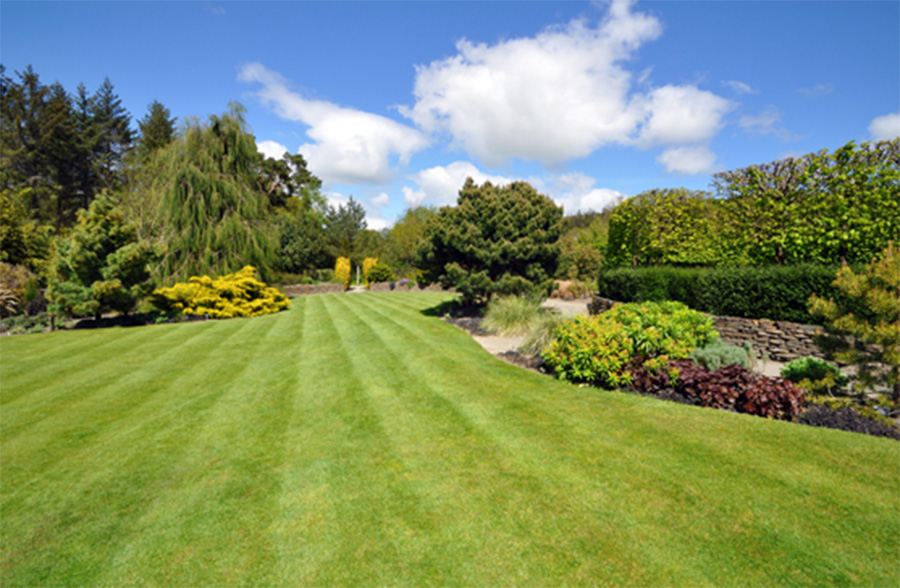
What your lawn needs to eat: The Lawn Association team know that you will be wishing for a lawn like the one pictured this summer!  But to get this result, you need to plan now!

Our latest guest blog is from a specialist who knows exactly what your lawn needs to eat to ensure it is happy, healthy and green.

What your lawn needs to eat

What your lawn needs to eat

Rhys Norville, UK Sales Manager for Terralift UK, has offered his advice below.

We all need food but which is the correct food for your lawn?

Lawn fertilisers contain three main elements to aid grass growth: Nitrogen (N), Phosphate, (P) and Potassium (K). These elements will be listed on the fertiliser container in a way that describes the percentage of each element contained in the mix. For example 6-2-8 contains 6% Nitrogen 2% Phosphorous and 8% Potassium.

There are different mixes for different times of the year, and to understand why we need to consider what each of the three elements actually does.

What are the major nutrients for grass growth?

Nitrogen: the main role is to improve the grass’s growth, but nitrogen also enhances the green colour. More Nitrogen is needed when growth rates are high, so in Spring and Summer, you need a fertiliser with a higher nitrogen content than in Autumn & Winter.

There are different forms of Nitrogen which release at different rates. For example, the readily-available Nitrate form can be absorbed instantly by the plant to boost growth as soon as it is applied. Urea, by contrast, has to break down before the plants can absorb it, taking up to twelve weeks but providing a slower and steadier feed to the plant.

Phosphate: Phosphate helps to maximise the development of new shoots after mowing. Similarly, it is important for helping new seedlings to establish good roots, and so is a useful application after any overseeding.

Potassium: This toughens up the plant’s cell-wall structure and increases its resistance to wear. It does this by keeping the grass blades ridged and upright. As with Nitrogen, Potassium can also boost the colour of the plant. Potassium applications are most common in Spring and Autumn.

What else is in your fertiliser?

It might contain Magnesium for colour hold, and to help the leaves convert nitrate into protein.

You might also find Iron as this helps the grass to develop a dark green. Iron is also used to reduce the impact of moss in grassland areas. However, iron is a trace element and the plant only requires small amounts to grow. Be careful not to over-apply iron as it can cause stress to the plant and reduce the soil’s pH which, in turn, can encourage disease and weed infestation.

Microbial activity

Microbes play a vital role in maintaining healthy soil for your grass. When the microbes within the soil are working well, they help with chelation of nutrients, natural disease suppression and regulating growth rates, so we should aim to support them as much as we possibly can. You need an organic granular fertiliser (more on this below) which contains carbon and humus.

Different types of granular fertiliser

Granular lawn fertiliser is sold as three main types:

1. Mineral-Based;
2. Organic;
3. Coated Mineral Fertiliser.

Mineral-based: This is the most common fertiliser in which different percentages of NPK are bound to an ‘inherit’ carrier such as clay or zeolite. This material helps to distribute the nutrients evenly across the lawn when spread.

Organic fertiliser: This will contain a composted organic material which may be manure or food waste, to which mineral fertiliser is mixed and bound. This creates a two-in-one application as the mineral fertiliser is being applied to support plant growth whilst the organic portion will serve as a soil conditioner to boost root development and to support healthy microbes within the soil.

Coated fertilisers: These are mineral fertilisers which are coated in a polymer to slow down the release of the fertiliser. The advantage is that you don’t have to apply fertiliser quite as often, some lasting up to six months. But of course, that makes it harder to tailor your fertiliser mix to each seasonal requirement – and the polymer may be plastic and pollute the land too.

Liquid fertiliser

There are forms of liquid fertilisers which are applied by spraying, using a knapsack or boom sprayer. The benefit of a liquid fertiliser is that it is absorbed almost immediately by the plant and so can increase growth rates within a few hours. This makes it an instant pick-me-up but of course, the benefit does not last as long as granular fertilisers which go into the soil. Every time you cut your lawn you will be removing some of the liquid fertiliser that was applied, whereas a granular will stay in the soil pool for the plant to absorb it.

Longevity of fertilisers

Typically the effects of a mineral granular fertiliser will last for around 6 weeks whereas an organic can last up to 12 weeks and as mentioned above some coated fertilisers will last up to 6 months. Liquid fertiliser will need to be reapplied after 3-4 weeks for consistent growth patterns.

However, longevity will also depend on factors such as rainfall, temperature, soil type and frequency of cutting. If you live in an area with lots of rainfall, this rain will leach the soil of nutrients, so you may need to apply fertiliser more frequently. And the warmer the soil, the quicker the fertilisers will be broken down (hence summer applications will not last as long as winter applications). Sandy soil will leach nutrients quicker than clay soil.

So these factors also need to be considered when selecting which fertiliser to use.

What does the Terralift expert use? 

Rhys tell us that he only applies Organic Granular Fertilisers, and he uses:

6.2.8+Mg in Spring Time
10.2.4 in Summer
6.2.8+Mg in the autumn usually after scarification and overseeding
3.0.6 as an over-wintering fertiliser.

Our core mission is to make accurate lawn care information freely and readily available via our website and through our Free Membership Scheme for gardening enthusiasts. Go to the @LawnAssociation Facebook page to join the Lawn Enthusiasts Group, and get free association membership via the website, www.lawnassociation.org.uk 

For the latest industry news visit turfmatters.co.uk/news

Get all of the big headlines, pictures, opinions and videos on stories that matter to you.

Follow us on Twitter and Instagram for fun, fresh and engaging content.

You can also find us on Facebook for more of your must-see news, features, videos and pictures from Turf Matters.