Tag Archive for: Saving

Time saving solutions the focus for GKB at BTME

Time saving solutions the focus for GKB at BTME: Time is a precious and ever-decreasing commodity when it comes to completing operations around the golf course. That’s why the multi-functional Sandfiller will be taking centre stage on the GKB stand, when they return to BTME in 2024.

The GKB Sandfiller is designed to tackle the problem of surface drainage and aeration on sports turf and golf courses, especially on greens. A true multi-tasker, the Sandfiller scarifies and simultaneously backfills with sand, or a combination of sand and seed, in a single pass. Delivering the perfect conditions for excellent root growth and optimal plant health, the Sandfiller can be operated by one person, where other similar methods demand more time and labour.

Time saving solutions the focus for GKB at BTME

Time saving solutions the focus for GKB at BTME

Tried and tested by contractors and courses up and down the country, the heart of the Sandfiller utilises the principles of GKB’s much-praised Combinator – carbide blades effectively slitting the surface and creating channels to be easily refilled with dried sand and leaving a clean, play-ready finish in its wake.

Alongside the Sandfiller on stand 644 will be the equally versatile Combiseeder. Four working widths of Combiseeder are available, all equipped with twin spiked rollers which create 1500 holes per square metre, and two brushes to ensure seed is accurately deposited into the pockets for optimal germination conditions. Facilitating routine overseeding quickly and efficiently, the GKB Combiseeder proves an effective tool in retaining sward density and preventing weed, annual meadow grass or moss ingress as more chemical remedies are removed from the market.

The Sandfiller and Combiseeder are just two of a broad portfolio of quality-built maintenance solutions from GKB Machines, further details of which can be found by speaking to the technical team on hand across the three days in January.

For the latest industry news visit turfmatters.co.uk/news

Get all of the big headlines, pictures, opinions and videos on stories that matter to you.

Follow us on Twitter and Instagram for fun, fresh and engaging content.

You can also find us on Facebook for more of your must-see news, features, videos and pictures from Turf Matters.

Greenkeepers praised after saving Dunhill Links

Greenkeepers praised after saving Dunhill Links: Play at the Alfred Dunhill Links Championship hung in the balance on Sunday night, until greenskeepers performed a miracle.

Read the full article from Bunkered here

Greenkeepers praised after saving Dunhill Links

Greenkeepers praised after saving Dunhill Links

For the latest industry news visit turfmatters.co.uk/news

Get all of the big headlines, pictures, opinions and videos on stories that matter to you.

Follow us on Twitter and Instagram for fun, fresh and engaging content.

You can also find us on Facebook for more of your must-see news, features, videos and pictures from Turf Matters.

Saving money from day one

Saving money from day one: Kyle Swart, superintendent of the Oakwing club in Louisiana, estimates he will save up to $85,000 a year from his new Capillary Bunkers.

“When we had a tournament, before we redid the bunkers, our biggest fear was rain in the days before the event,” says Kyle Swart, superintendent at the semi-private Oakwing course in Louisiana. “If it rained on a Friday and the tournament was on a Saturday, the bunkers would be ground under repair. If the rain came a few days before, my crew would have to spend all their time putting the bunkers back toghether when they should have been preparing the course.”

Saving money from day one

Saving money from day one

Located on Heritage Park in Alexandria, central Lousiana, the former England Airforce Basem, the home of the 23rd Fighter Wing, Oakwing was designed by Jim Lipe and opened in 2001. “There isn’t any real military installation here any more, but the England Air Authority owns the land and manages the property,” says Swart. “About 75 per cent of our play is from members.”

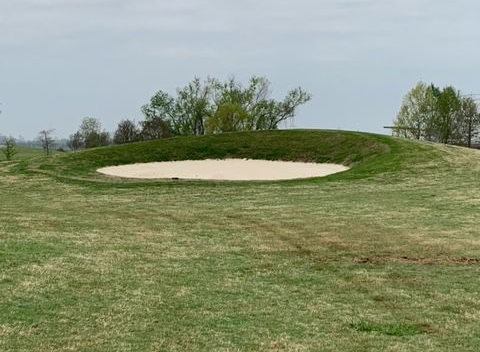
The course’s bunkers – which are large, with steep faces – had never been properly renovated since opening. “We tried to do our own bunker liner, using concrete, about ten years ago, but it failed,” says Swart. “There were fabric liners installed originally, but they were never going to last twenty years, and before we renovated, we would pull some up with the Sand Pro every now and again.”

Swart researched the options available to him and settled on the Capillary Bunkers product from Capillary Flow. “I didn’t know when there might be another renovation, so decided I had to go for the best long-term option,” he says. “What I like about the Capillary Bunker product is that the entire bunker bottom is covered. It doesn’t matter where water enters the bunker, you know it will always flow down to the drain at the bottom.”

Architect Nathan Crace handled the renovation, and Swart is ecstatic at the results. “Before we started, around fifty per cent of our bunkers simply didn’t drain,” he says. “In the first three months after we renovated, we had 22 inches of rain – we went from an incredibly dry summer to an incredibly wet winter. There is not a bunker out there that has held water or washed out, or retained any silt. They have been the best addition to this golf course.”

He says the benefits to Oakwing will be enormous. “All year long, we were trying to keep sand in the bunkers to a decent depth and now we don’t have to,” he explains. “I have a crew of ten, and it used to take three or four days to get the bunkers back into condition after heavy rain. Now one guy goes out with a rake and in a couple of hours they’re fine. My guys love them! The look on their faces when they come into work after rain has transformed. They used to come in and know they were going to spend the next three or four days in the bunkers. Now, they know they don’t have to.”

But the most dramatic change is to the bottom line. Swart says the savings from his new bunkers will be substantial. “We are going to save $50-70,000 a year just on labour from the new bunkers, and there will be another $12-15,000 from not having to replace sand,” he says. “For us, that is a big, big difference.”

For the latest industry news visit turfmatters.co.uk/news

Get all of the big headlines, pictures, opinions and videos on stories that matter to you.

Follow us on Twitter and Instagram for fun, fresh and engaging content.

You can also find us on Facebook for more of your must-see news, features, videos and pictures from Turf Matters.
65% Water Saving From Hydroponic Tee Box

65% Water Saving From Hydroponic Tee Box: Capillary Concrete’s revolutionary new Capillary Hydroponics system is delivering outstanding results a year into its first major customer installation, at the Hawk’s Landing Golf Club in Orlando, Florida.

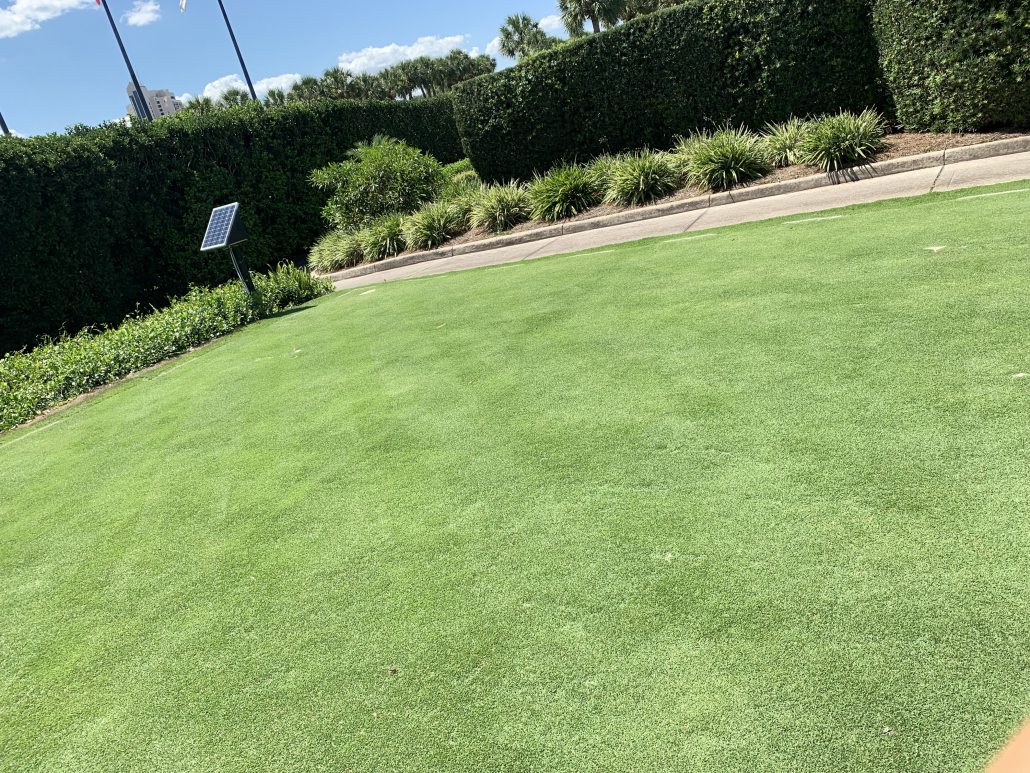
Last September/October, Capillary Concrete built a new tee box at Hawk’s Landing, incorporating the Capillary Hydroponics system, along with superintendent Josh Kelley’s team and contractor Double Eagle Golf Works. The system divides the tee box into two areas, with a layer of Capillary Concrete under the rootzone. Two air lift pumps, powered by a 55 watt solar panel, move water inside the closed system. All irrigation is applied subsurface; because of this, water is mainly lost through transpiration, with evaporation minimal. The system creates a moving water table, using capillary action to move water out of one zone and into another. The water pushes the heavier carbon dioxide molecules out of the rootzone and sucks in oxygen to replace them. It is a far more successful method of gas exchange in the rootzone than conventional methods of aeration.

65% Water Saving From Hydroponic Tee Box

Kelley says: “We have been working with Capillary Concrete on our bunkers since 2016, and they first mentioned the Hydroponic System to us in summer 2018. We said we were keen to try it, and so we began building the test tee in late September. It was completed and grassed in early October. Now, a typical tee box is obviously just a pile of dirt that you shape up. As you get to the higher end, you might put drainage under it, or even use a special rootzone. The process here was that we laid out the rectangular box, cored down twelve inches, and then installed two inches of Capillary Concrete before filling up with sand, levelling and sodding. It was not a difficult project.”

“It is a trial site; we aren’t doing anything special to it,” Kelley continues. “We have run no overhead irrigation at all, except to water in two applications of herbicide. The tee itself has performed superbly; zero hotspots, no disease issues, no wet areas.”

Capillary Concrete inventor and CEO Martin Sternberg CGCS, says: “We are grateful to Josh and Hawk’s Landing for the ability to test Capillary Hydroponics close to our Orlando base. When we installed the tee, we put a flow meter on the irrigation so we could measure exactly how much water was being used. After almost a year, we can say that it has used 65 per cent less water than a similar sized, conventionally irrigated tee box, and we think that we can tweak the system to get that figure to 85 per cent.”

Sternberg adds: “I started experimenting with tees five years ago in Sweden, primarily as a subsurface irrigation project. But the addition of a hydroponic moving water table – which we can do because of the strength and capillary properties of our product – is what makes this a game changer. We know we are getting up to 6,000 per cent more gas exchange in the rootzone in comparison to convention methods of aeration, and it is obvious that will have a massive impact on turf health. This is akin to what happens naturally in a seaside links environment, where you typically have a very low water table – but critically, it moves with the tide. That promotes a gas exchange. The best way to promote gas exchange is to push it with a water front – which is what we can do using Capillary Concrete. The hydroponic industry is 25-30 years ahead of us in the turfgrass industry in terms of understanding how to optimize plant root oxygen exchange, but it hasn’t been physically possible to build large outdoor structures for hydroponics without a product that performs as Capillary Concrete does. If you compare the cost of building, to use Capillary Hydronponics is slightly more expensive than building a push-up or California tee, but comparable to USGA specification construction.”

Josh Kelley says: “I really think in markets where water is scarce or expensive, this will change the way we do things in the golf business, and I’m delighted that we at Hawk’s Landing were one of the first to get to try it out.”

For the latest industry news visit turfmatters.co.uk/news

Get all of the big headlines, pictures, opinions and videos on stories that matter to you.

Follow us on Twitter and Instagram for fun, fresh and engaging content.

You can also find us on Facebook for more of your must-see news, features, videos and pictures from Turf Matters.