Doosan confirms dealer changes

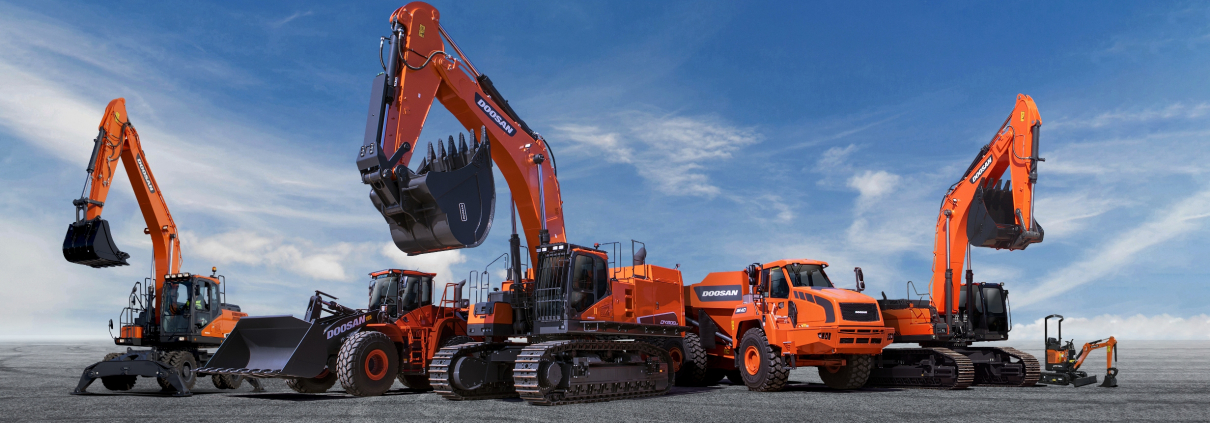
Doosan confirms dealer changes: Doosan Infracore Europe has confirmed new changes effective immediately in the company’s Authorised Dealer network in the Republic of Ireland.

EMS (Embankment Machinery Sales), based in Naas in County Kildare, is now responsible for sales and service for the full range of Doosan crawler and wheeled excavators in Leinster, Munster and Connacht. EMS (www.emsmachinery.com) is also the dealer in the same areas for the full range of Doosan mini- and midi-excavators from 1 to 8.5 tonne.

Doosan confirms dealer changes

Philip P. McCormack Plant, based in Clane in County Kildare (www.pmcplant.ie), is responsible for sales and servicing of the Doosan wheel loader range in Leinster, Munster and Connacht. This is in addition to the Doosan range of articulated dump trucks (ADTs) for which Philip P. McCormack Plant has been the dealer in the same areas for several years.

Commenting on the changes to the Doosan dealer network in Ireland, Anthony Pearce, UK & Nordics Regional Sales Leader for Doosan Infracore Europe, said: “Working closely with both EMS and Philip P. McCormack Plant, we are aiming to continue to grow our business in Ireland in a positive and sustainable manner. I see these latest moves as a fantastic opportunity whilst continuing to provide the Irish market with an unrivalled level of service and customer support.”

For more on Doosan construction equipment, visit the website: www.doosanequipment.eu

For the latest industry news visit turfmatters.co.uk/news

Get all of the big headlines, pictures, opinions and videos on stories that matter to you.

Follow us on Twitter and Instagram for fun, fresh and engaging content.

You can also find us on Facebook for more of your must-see news, features, videos and pictures from Turf Matters.

University enjoys H&S benefits

University enjoys H&S benefits: Agria UK’s remotely controlled agria 9600 hybrid bank mower makes lots of friends in high places. Recent converts include the 16 members of the University of Aberdeen’s grounds’ team, all now fully trained and regular users.

Bruce Reid, Grounds Officer in the University’s Estates and Facilities Department, said he knew instantly it was a machine that suited their purpose:
University enjoys H&S benefits

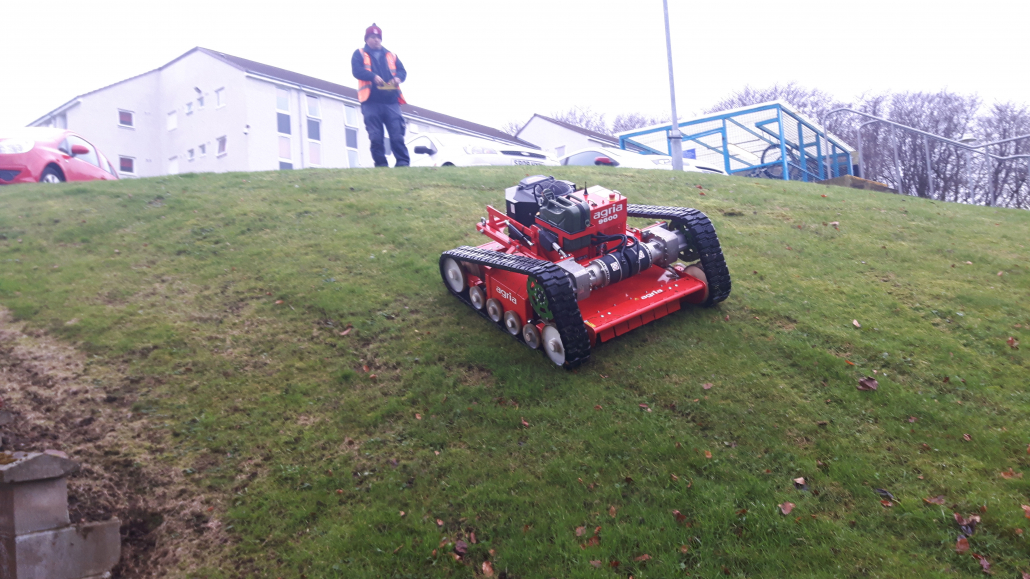
“It works well for us because it’s not complicated; it is so H&S focused and does a thoroughly good job. Tending steep banking both safely and quickly is imperative and that’s why the agria 9600 stood out. On first view at its demo, it looked like a high climbing miniature tank patrolling the grounds. We were an early adopter and purchased one of the first in July.”

“We have our fair share of extreme slopes and banked areas. There are three distinct campuses.  King’s College campus, is over 500 years old, and dominates the section of the city known as Old Aberdeen.  It lies approximately two miles north of the city centre.  To the west, there is the more recent Foresterhill campus, next door to Aberdeen Royal Infirmary and home to the School of Medicine and Dentistry, as well as the School of Medical Sciences and then to the east is Hillhead campus which is predominantly student halls. Together with research and lecture buildings, all sites have bespoke grounds, sports facilities and green areas. Hillhead in particular, has purpose built student residences set among landscaped areas which house several thousand students.  Typically, it’s here where we have many steep slopes, gradients easily in the 30° to 50° range, all at varying heights. We try to cut and mulch these fortnightly during the growing season,” continued Bruce Reid.

With its low centre of gravity and rubber caterpillar tracks, the agria 9600 powers safely through heavy duty work on high slopes to 50°.  The operator uses a joy stick on a light, hand held LED display control panel to manage six key mower functions. The display shows travel speed, cutting height, hours of operation, the battery charge status, the radio signal strength and an on / off switch.

Range is an impressive 300 m at a generous forward speed of 10 km/ hr allowing some of the most difficult and awkward-to-reach terrain to be tackled from a healthy distance. Should frequency be disturbed, the remote control changes to a different band frequency automatically.

A Hybrid drive concept means the agria 9600 combines a petrol engine with being electrically driven. This set up is therefore more environmentally friendly than hydraulic systems. The petrol engine powers the mower and generator while the generator produces electricity in Safety Extra Low voltage (48V) for driving.

In two widths, 112 cm and 80 cm, it cuts and mulches in two directions and is effortless on a variety of applications, including fine turf.

“The main thing for us is health & safety,” continued Bruce Reid.  “We don’t want operators walking behind mowers on any of our banked areas. It is infinitely safer to have a remote machine perform these tasks. Like everyone else, we have risk assessments for all grounds care activities and right away, a remotely controlled mower minimises risk.

“Ours is the 80 cm wide version. It’s a very straight forward machine yet versatile. The whole team took part in a familiarisation and training session given by Agria UK so everyone is now extremely confident. They feel safe because they don’t need to remain close to the machine nor do they need to set foot on the bank. It’s surprising light machine to transport, it can be popped on a trailer and moved with an ATV which helps save time and transport costs.”

Edzard Michalsky, Product manager for Agria said: “The beauty of this machine –and indeed all remote controlled agria mowing systems – is that there are no hand-arm vibrations to factor. Everyone deserves a healthy working environment and this machine means you can spend a whole shift engaged in cutting and mulching.”

Wilson Morrison, Sales Manager from dealer Fairways GM, who distribute Agria UK products in Scotland, said: “Bruce and his team put H&S at the top of their list. The agria 9600 gives them a head start. For example, if for any reason the transmission signal between machine and operator is lost the machine automatically shuts down.  Both the machine and the remote control offer emergency shut off switches and safety flaps giving protection against thrown objects, this has been tested independently by industry experts. At 420 kgs theirs is a light easily transportable machine. Running time is approx. 15 hours on each charge.  Each unit comes with a replacement battery and charger which almost doubles the working time.  Fuel consumption is around 20 litres per six hours run time. Developments like these help future proof the industry.”

See the agria 9600 at BTME on Stand RED 202 alongside sister company, Wiedenmann UK on 218.

For the latest industry news visit turfmatters.co.uk/news

Get all of the big headlines, pictures, opinions and videos on stories that matter to you.

Follow us on Twitter and Instagram for fun, fresh and engaging content.

You can also find us on Facebook for more of your must-see news, features, videos and pictures from Turf Matters.

Alan Prickett joins ISEKI UK

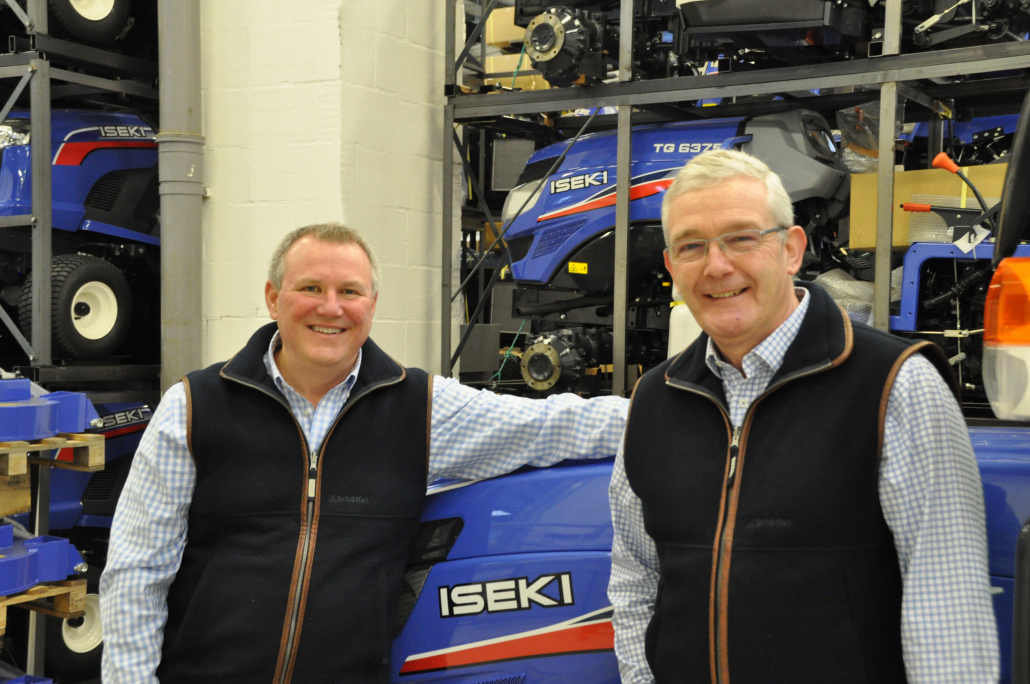
Alan Prickett joins ISEKI UK: ISEKI UK & Ireland are pleased to announce that Alan Prickett has joined the growing team in the role of Business Development Manager, responsible for dealers in the central band of the UK, along with key and national account sales.

Alan is a very well-known figure in the industry having previously worked for many years at Ransomes Jacobsen Ltd. Prior to his leaving there in July of 2019 he held a number of positions ranging from Regional Sales Manager to Managing Director.

Alan Prickett joins ISEKI UK

In Alan’s early career he studied agricultural engineering in Oxfordshire, before commencing a career in the professional turf industry from 1981, initially working for professional machinery dealerships in the midlands, rising to the level of sales management and key accounts.

Commenting on the appointment David Withers adds; “Alan will be a great asset to the team at ISEKI, he will be looking to further drive market share gains in the compact tractor and collecting mower categories where ISEKI excel.”

For more information, visit: www.iseki.co.uk.

For the latest industry news visit turfmatters.co.uk/news

Get all of the big headlines, pictures, opinions and videos on stories that matter to you.

Follow us on Twitter and Instagram for fun, fresh and engaging content.

You can also find us on Facebook for more of your must-see news, features, videos and pictures from Turf Matters.
Engcon’s part in the first Cat® 330

Engcon’s part in the first Cat® 330: The tiltrotator manufacturer Engcon is an important part of the world’s first Cat® 330 Next Gen equipped with both a front blade and a tiltrotator – which has proven to be a successful combination.

A one of a kind excavator
Behind the controls of this unique excavator is Kristoffer Westman from Sundbergs Åkeri, a Swedish plant and transportation company. He puts the excavator to work on constructing a forest road, taking advantage of the greater flexibility and efficiency the combination of the front blade and tiltrotator bring.

Engcon's part in the first Cat® 330

At the end of 2018, Caterpillar launched the next generation excavators in the 30-ton class – 330 and 330 GC. When Sundbergs Åkeri chose equipment for its newly acquired Cat® 330 Next Gen in early 2019, among other things, a tiltrotator and grading bucket from Engcon were selected.

Together with a custom-built excavator blade from Nyströms Verkstadsservice in Edsbro, Sundbergs Åkeri now has a one of a kind excavator that delivers significant improvements in efficiency with the company’s road construction work.

“From just scooping up material which I then have levelling with the bucket, I can now plan where to place the material with the front blade. This means that I now roll the material in front of the blade, which results in larger stones falling to the bottom and finer material settling on the surface. It also makes the road easier to adjust before gravelling” says Kristoffer Westman.

A successful combination
Up until now when building forest roads it has been uncommon to use an excavator with a tiltrotator, but for Kristoffer it has so far brought only benefits, especially in combination with the front blade.

“I haven’t driven more than a couple of hundred hours, but this is how an excavator should be. The tiltrotator complements the front blade very well as I can use it to rotate the grading bucket to a position where it acts as a wing along the front blade. That way I can either steer in or out of the ground from the embankment” says Kristoffer Westman.

Kristoffer Westman goes on to say that his new Cat® 330 is also equipped with Engcon’s automatic quick mounting system with EC-Oil.

“Thanks to EC-Oil, it only takes 10 seconds for me to hang the tiltrotator and switch on the tooth bucket in case I need extra breaking power. This without me even having to leave the cab to connect some hoses” Kristoffer concludes.

The new excavator is currently being used in the construction of a new forest road west of Örnsköldsvik in the northern part of Sweden. The front blade is controlled via Engcon’s proportional joysticks MIG2, which means that Kristoffer does not need to change the grip to dig or excavate. The control of the tracks is also connected to Engcon’s control system DC2.

For the latest industry news visit turfmatters.co.uk/news

Get all of the big headlines, pictures, opinions and videos on stories that matter to you.

Follow us on Twitter and Instagram for fun, fresh and engaging content.

You can also find us on Facebook for more of your must-see news, features, videos and pictures from Turf Matters.
Ecobunker enables Sandbelt style bunkers

Ecobunker enables Sandbelt style bunkers: The famous courses of the Melbourne Sandbelt, notably Royal Melbourne and Kingston Heath, are distinctive for many reasons, but one of the most important is the characteristic bunker style created by Dr Alister MacKenzie and his collaborators Alex Russell and Mick Morcom. 

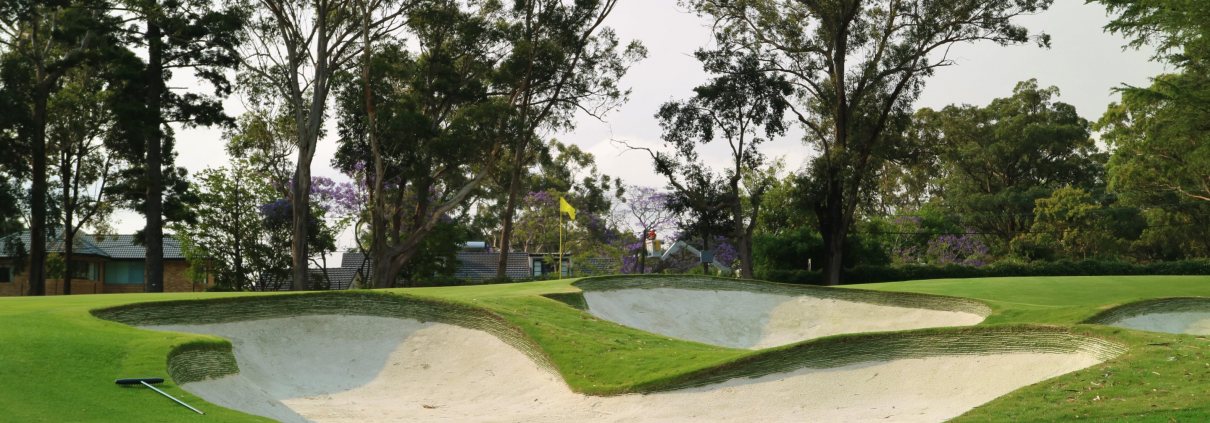
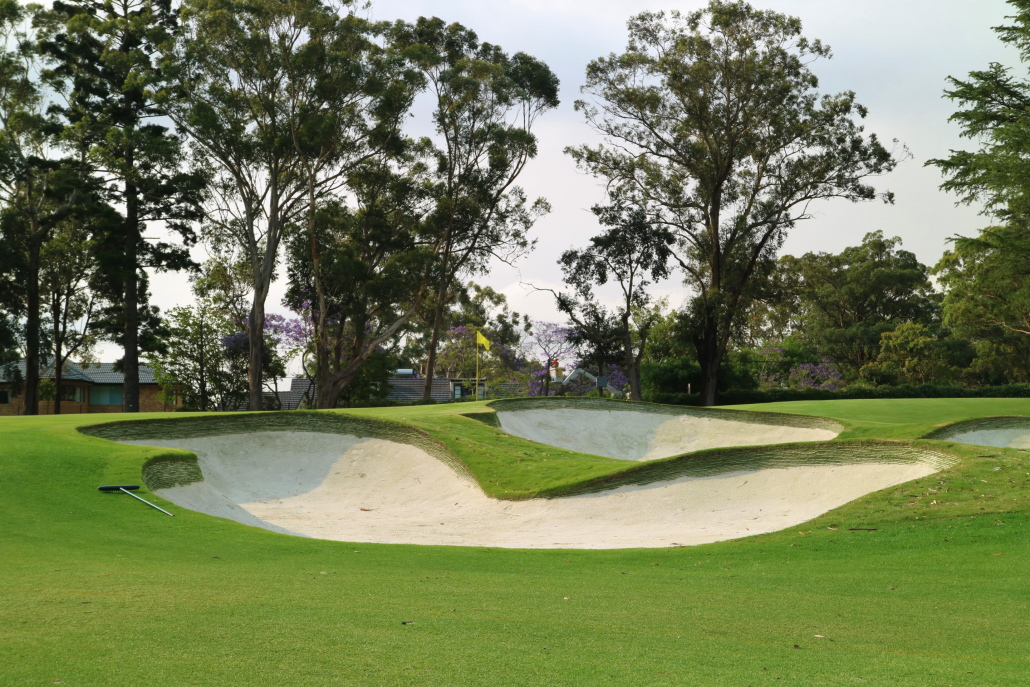
Sandbelt bunkers are characterised by their size, by their swooping shape, with capes and bays dividing them up into different compartments, by their flashed sand faces, and by the fact that they cut so deeply into fairways and greens – and are typically presented with short grass – fairway or even green cut – right up to the edge of the bunker, with no collar of longer grass that can interfere with the architect’s desired short game playability, and create visual interference in an otherwise extremely ‘clean’ look.

Ecobunker enables Sandbelt style bunkers

That look has been enormously influential around the world of golf. Gil Hanse’s Olympic course in Rio de Janerio and Tiger Woods’ first American design, Bluejack National in Texas, are only two in a long list of courses said by their designers to be influenced by the Sandbelt look. But replicating those trademark Melburnian bunkers is hard. The soil on the Melbourne courses, though sandy, contains a lot of fine particles and grey organic matter that mean it binds together to create a hard surface. Coarser sand – and even more so, clay soil – does not bind the same way, and creating that hard, vertical lip so characteristic of Melbourne is basically impossible; the soil gets wet and crumbles away.

The recent President’s Cup at Royal Melbourne showed very well how the Sandbelt bunkers work. As well as the clean edge, the sand packs down so hard that Melbourne clubs do not rake their bunker faces, rather using a ‘flat rake’ to create extremely firm conditions on the bunker faces, ensuring that all balls that enter the bunker run down to the prepared base, removing the problem of plugged lies.

So Sandbelt bunkers are desirable, but they depend completely on the particular conditions on the Sandbelt to make them possible. Sydney-based golf architect Harley Kruse has found a way round this problem. At Killara Golf Club, in the northern suburbs of Sydney, a successful 1800 member club whose golf course was basically untouched since the 1960s, Kruse was hired to do a significant course renovation. After careful planning, the works were agreed: reconstruction of all eighteen green complexes, reversing two holes, rebuilding some fairway bunkers and eliminating one par three while bringing a spare hole into the normal rotation.

“Greens were suffering; the rootzone wasn’t good and they were all poa,” Kruse says. “They were small, averaging 370 sq, and basically flat, with very limited strategic value. We have increased them to an average size of 500-550 sq m, with lots more interest; we’ve also taken out 300 big trees and opened up the vistas.”

Kruse and the club wanted sandbelt-inspired bunkers, but the clay soil at Killara meant that was going to be difficult. However, they found a solution via a good friend, Rod Hinwood, course manager at the exclusive Ellerston GC in rural New South Wales. Hinwood demonstrated the successful results that EcoBunker was delivering on his pronounced bunker edges, which had previously been vulnerable to erosion. “It occurred to me that we might be able to do something similar at Killara, and thus be able to get the edging treatment that we wanted,” said Kruse.

The new bunkers are lined with Capillary Concrete, and feature a 40cm high lip constructed using EcoBunker Advanced patented synthetic bunker edging system. The sand is then flashed up the EcoBunker wall – and is held in place by the Capillary Concrete – and the bunker surrounds can be mowed short right to the edge, because of the strength the EcoBunker and Capillary Concrete underpinnings provide.

“EcoBunker was designed from the outset to give architects the maximum freedom to create the bunker shapes they wanted,” says EcoBunker inventor and CEO Richard Allen. “The work that Harley has done at Killara is a classic example of that. When I first went to Melbourne last year, the principal reason was to see the Sandbelt bunkers up close; the fact that our product has allowed a great architect to create similar bunkers on unsuitable soil is fantastic. This style of bunker has long been something of a ‘holy grail’ for a lot of golf courses that simply haven’t been able to implement it because of their soil conditions. Now, they can see a proven solution that will allow them to do so.”

“If we had tried to do that edge using the site soils, it would crumble away,” says Kruse. “Getting that stable lip in clay soils is very difficult to achieve. But EcoBunker allows us to do it.”

For the latest industry news visit turfmatters.co.uk/news

Get all of the big headlines, pictures, opinions and videos on stories that matter to you.

Follow us on Twitter and Instagram for fun, fresh and engaging content.

You can also find us on Facebook for more of your must-see news, features, videos and pictures from Turf Matters.