

Foxes keep groundsman busy

Foxes keep groundsman busy: A brush with the local fox population is keeping Leeds Rhinos’ groundsman Ryan Golding busy during the coronavirus crisis.

Most of Rhinos’ 150 employees have been placed on furlough, a form of paid leave, but Golding is among a handful still working – and vulpine pitch invaders are giving him plenty to do.

“They are a nightmare,” Golding said of the four-legged hooligans.

“They live near the railway track, in all the bushes there.

“On a night, when they are scavenging for food, they come into the stadium and they always dig in the same place on the pitch.

“They are digging bones into the pitch – I am finding bones all the time.”

The urban foxes are sometimes spotted on the terraces after games, which is one reason why cleaning crews are brought in so quickly following the final whistle.

Golding hopes fencing will deter the pests and noted: “It’s a unique problem, with it being an inner-city stadium.

“You

wouldn’t have a problem like that on an industrial site, it’s just another thing we have to deal with.”

On the other hand, the foxes do keep Emerald Headingley’s pigeons – another traditional groundsman’s enemy – at bay.

“They are stalking around the pitch on a night, waiting for the pigeons to land,” Golding reported.

“There are feathers everywhere! On a morning I have to go around picking pigeon carcasses up.

“It is like a war zone, but they don’t go near our feed, fertilizers or chemicals, which is good.”

Even without the foxes, Golding has his hands full restoring the pitch to its usual glory following unprecedented rainfall last winter.

“My assistants have been furloughed, so it’s just me,” he said.

“I am having to look after all the stadium and all of Kirkstall [Rhinos’ training base] on my own.

“It is challenging, but it’s quite enjoyable – it is taking me back to when I was younger, getting my hands dirty.

“It is very negative circumstances, but it is what it is – there’s people dying, so you can’t really moan.”

The last few months have been tough for Rhinos’ ground crew who, as well as looking after Headingley, had to cope with flooding at Kirkstall.

Golding recalled: “We had a record three months of rainfall – around 300-350 millimetres.

“That is a hell of a lot – and it wasn’t necessarily the weather, it was the timing.

“We always seemed to get downpours the night before games and the morning of.

“We weren’t really getting any luck and the game where it turned was the double-header [when Headingley staged Rhinos’ Betfred Super League opener against Hull immediately after Castleford Tigers had faced Toronto Wolfpack].

“We had a lot more rain than expected after the first game.

“I had two choices, to leave it as it is and have a slow surface, or take it on the chin and make it a fast one.”

Rhinos scored 154 points in their three home games after the loss to Hull and Golding added: “People say it looks like a beach, but it plays really well.

“That’s something I had to discuss with the management team, Rich [Agar, Rhinos’ coach] and Kev [Sinfield, director of rugby].

“I am not bothered what people say if it allows us to play fast rugby and get two points.

“That’s what we did, we applied sand quite regularly to make a fast, stable surface to enable the players to gain purchase – rather than it turning into a mudbath.”

The break has allowed Golding time to work on the pitch, but – with no clear indication when rugby will resume – he explained: “I don’t want to throw everything into recovery yet.

“It’s a bit like a finely-tuned athlete, you don’t want to hand it all the supplements and everything it requires now because it’s going to keep needing that.

“It is a sand-based surface so it drains very quickly and leaches nutrients very quickly, so I have to be careful with what I am applying.”

Life won’t get any less hectic for Golding – and his team – when the season eventually resumes.

Midweek matches are likely as Super League clubs race to make up for lost time, but Golding has no concerns over having to prepare the ground for multiple games in a short space of time.

He stressed: “I don’t see it as a bad thing.

“You get some groundsmen who are very much ‘keep off the pitch’, but I wouldn’t have a job if it wasn’t for the sport so let’s get as many games on as we can and get back to enjoying sport.”

Click here to read the original article

For the latest industry news visit turfmatters.co.uk/news

Get all of the big headlines, pictures, opinions and videos on stories that matter to you.

Follow us on Twitter and Instagram for fun, fresh and engaging content.

You can also find us on Facebook for more of your must-see news, features, videos and pictures from Turf Matters.

Sheep taking over golf courses

Sheep taking over golf courses: At least two closed and empty English golf clubs have been taken over by sheep during the coronavirus lockdown – where the ruminants have been taking on the grass cutting duties normally reserved for the currently furloughed greenkeepers.

Several UK golf courses are located near to farmland but animals are typically deterred from venturing towards the courses due to the presence of golfers and greenkeepers. Plus, their source of food, which is now growing more quickly than it has been in recent months, is usually mown away just as rapidly.

But with no golfers bar one or two breaking the rules, and with most golf clubs furloughing all but one greenkeeper, golf courses are proving to be rich pickings for hungry sheep.

Avington Park Golf Course and Bramshaw Golf Club, both in southern England, have showcased the hard-working animals on social media.

According to entertainment website TMZ, there have been about 100 sheep roaming and grazing on Avington Park’s 32-acre golf course.

Bramshaw Golf Club also saw the funny side of the invasion – and also outlined the benefits to the course.

The club wrote on Twitter: ‘Been out there for a couple of days. Not doing any harm at the moment.. free labour!’

While sheep on golf courses due to a lack of golfers because of a pandemic may be something new, many golf courses around the world do use herbivores to help out with the maintenance of their facilities.

Machrihanish Dunes in Scotland has used sheep to control the rough in the past.

A spokesman told The Golf Business in 2014: “Here at Machrihanish Dunes we are very proud of our eco friendly status.

“By using the natural lawnmowers to thin out the rough on the course we are able to help preserve several rare and protected species of orchids that grow here on this site and in few other places. The added benefit is visitors can enjoy the company of these unique companions as they play a round. These woolly wonders will have people flocking to see them in action.”

Click here to read the original article

For the latest industry news visit turfmatters.co.uk/news

Get all of the big headlines, pictures, opinions and videos on stories that matter to you.

Follow us on Twitter and Instagram for fun, fresh and engaging content.

You can also find us on Facebook for more of your must-see news, features, videos and pictures from Turf Matters.
Todmorden CC pay NHS tribute

Todmorden CC pay NHS tribute: Todmorden Cricket Club have paid tribute to the NHS by cutting its logo onto their pitch.

Former club president and groundsman Nevil Sutcliffe said: “It’s just a bit of a tribute from us.

“It took me a couple of hours Monday morning, half-an-hour on Sunday working out what to do.

“The response has been incredible, crackers. It’s gone viral as they say.

“It’s doing the rounds on Twitter and locally on Facebook.”

Click here to read the original article

For the latest industry news visit turfmatters.co.uk/news

Get all of the big headlines, pictures, opinions and videos on stories that matter to you.

Follow us on Twitter and Instagram for fun, fresh and engaging content.

You can also find us on Facebook for more of your must-see news, features, videos and pictures from Turf Matters.

BIGGA and R&A’s updated advice

BIGGA and R&A’s updated advice: The British and International Golf Greenkeepers Association and R&A have updated their guidance after the lockdown for coronavirus was extended

Greenkeepers have been given updated advice on what counts as essential maintenance during the coronavirus pandemic.

BIGGA and R&A's updated advice

BIGGA and R&A’s updated advice

The British and International Golf Greenkeepers Association (BIGGA) and R&A have issued new guidance after the Government extended the lockdown period, aimed at stemming the spread of the virus, for at least another three weeks.

Their new position was put together in order to take into account the “changing seasonal climactic condition and the need to utilise the time of reduced greenkeeping teams most effectively”.

The association were clear that the directions were not a justification to increase staffing numbers at clubs.

Here is their new statement in full…

Essential Maintenance update – 17 April

The following update (Version 2) to the Essential Maintenance Statement for Golf Courses is published in view of the extension of the UK Government regulations, the changing seasonal climatic conditions and the need to utilise the time of reduced greenkeeping teams most effectively.

These updates are not a justification to increase staff numbers beyond those currently utilised. Any substantive updates from Version 1 are highlighted by an asterisk * in the text below.

Essential Maintenance Statement for Golf Courses during COVID-19 Outbreak

The following industry statement, produced in association with BIGGA, sets out a reduced, essential maintenance regime for greenkeeping that limits activity on the golf course while protecting workers, jobs and securing the playing surfaces at golfing facilities. When a resumption in play is allowed, this will be vital to get the millions of golfers back onto our courses, benefiting their physical and mental wellbeing.

The UK’s £2bn GVA golf industry is only sustainable if greenkeepers continue to work, but it is paramount that this is done in a safe and secure environment.

Our industry statement outlines those treatments considered essential for the safe maintenance of a golf course during the current government restrictions. It is accepted that golf courses exist in many different forms, on many different soil types and in differing landscapes and that this guidance may require adaptation.

Working Practices

The primary consideration must be the health and wellbeing of greenkeeping staff. All golf facilities should implement stringent measures to ensure staff members are not at risk. The number of greenkeeping staff and the amount of time they are at work should be kept to a minimum and be tailored to fit with the agreed essential maintenance programme.

Measures should include but are not limited to:

  • Focus on hygiene and social distancing
  • Ensure staff members work separately
  • Allocate individual machinery to one worker only
  • If multiple staff are on site, then stagger working hours and break times
  • Limit or prohibit use of communal areas
  • Regularly disinfect any surface that is contacted e.g. door handles, fuel pumps, communal machinery
  • Ensure there is a robust lone working policy

Mowing

Greens should be mown according to the rate of growth to a maximum of three times per week. Dew removal should be considered on non-mowing days as required to prevent disease spread.

Tees and green surrounds should be mown according to the rate of growth to a maximum of twice per week.*

Fairways should be mown according to the rate of growth to a maximum of once per week.

Managed roughs and grass paths should be mown according to need to a maximum of once per week.*

Only roughs considered to be in direct play should be mown allowing for naturalisation to areas largely out of play.

The height of cut adopted for all these areas is site specific but the elevation of the cutting height on fine turf areas is advised to minimise unnecessary stress on the turf. The application of plant growth regulators during periods of excessive growth is acceptable.* The aim of the above operations is to maintain uniformity, density, texture and health to allow surfaces to be quickly brought back to an appropriate playing standard once play resumes.

Irrigation and Nutrition

Irrigation and nutrition should be carried out as necessary but with the objectives of keeping the turf alive, maintaining a full sward and preventing turf thinning. Avoid excesses of either input, which will only serve to promote unnecessary growth and necessitate more maintenance.  Utilise best practice methods where available, such as wetting agent application, use of moisture probes and surface aeration, to optimise efficiency of water use on key playing surfaces.*

Construction and Renovation

Starting construction or renovation projects is not considered essential at this time. The completion of unfinished winter projects that are already underway is permissible but only if this can be done safely by greenkeeping staff, and without increasing staffing numbers.*

Machinery and Equipment Maintenance

This should be carried out as required to ensure that essential equipment is kept safe and operational.

Other Maintenance

Operations such as maintaining bunkers, penalty areas and wider practice facilities and aerating, top dressing and spraying on a routine basis are not considered essential at this time. However, it is conceivable that occasional spraying or the application of a cultural practice, such as aerating, top dressing and overseeding, may be considered essential at certain times and in some circumstances (for example, to control or manage acute pest, weed or disease issues or other localised disorders).*

Updates

Given the fluidity of the current situation there may be a requirement to update and re-issue this guidance in respect of future government advice.

Click here to read the original article

For the latest industry news visit turfmatters.co.uk/news

Get all of the big headlines, pictures, opinions and videos on stories that matter to you.

Follow us on Twitter and Instagram for fun, fresh and engaging content.

You can also find us on Facebook for more of your must-see news, features, videos and pictures from Turf Matters.

Irish surfaces kept pitch perfect

Irish surfaces kept pitch perfect: There may be no games taking place in the Danske Bank Premiership right now, but a small band of individuals up and down the country are still having to prepare as if there are.

The day that football does return is still a long way down the line as the coronavirus continues to make its presence felt across the world, but pitches still need to be maintained in the meantime and it’s down to groundsmen across the league to ensure that they’re ready to go when sport gets the green light again.

Tommy Doherty, the groundsman at the Coleraine Showgrounds, said: “It’s just about keeping it ready while we’re waiting for a call from the Irish League to get back to playing again.”

The general duties tend to be the same around most grounds right now, bar those clubs who have 4G pitches, in that the grass needs mowed and the white lines need repeatedly marked.

It’s vital work done behind the scenes to little fanfare, and if it isn’t done now then the Irish League wouldn’t be able to return as soon as it will. Instead, every ground should be up to scratch when needed.

Glentoran groundsman William Kirkwood explained: “If Mick McDermott rang me right now and told me there’s a match tomorrow then the pitch would be ready to go. It’s not panic time. We do keep on top of things.”

It’s a thankless task, especially because no fans are even able to see the fruits of the groundsmen’s labour at the moment, and it’s frustrating as well. After all, the season could, theoretically, be cancelled at any point.

Dungannon Swifts groundsman Davy Magee said: “It’s tough when you’re cutting the grass and marking the pitch and there’s no football at the weekend. It’s all for nothing, you know?”

Doherty agreed, and added: “It keeps you busy, although you miss the football. There may not be any football for the rest of the year and all my work is for nothing, but you can’t take that chance. They could step onto the pitch at any time.”

In the meantime, Kirkwood and Magee are trying to get ahead of the curve by completing some of the work that they were hoping to do over the off-season.

Kirkwood’s intentions are to spread 100 tonnes of sand on The Oval pitch and then re-seed the surface so that it’s in pristine condition for the start of next season, plans which have been halted both by the lack of rain and the lockdown.

“I want to try and do it now, but most of my suppliers are closed. Most of the sand comes from Emerson’s in Lurgan but they’re closed up. Because it’s heavy work, I usually bring in a contractor but he’s closed up too,” he explained. “I’m preparing to do it myself, but hopefully at the start of May those guys might be able to work again.”

Magee has already seeded his pitch but has run into similar problems.

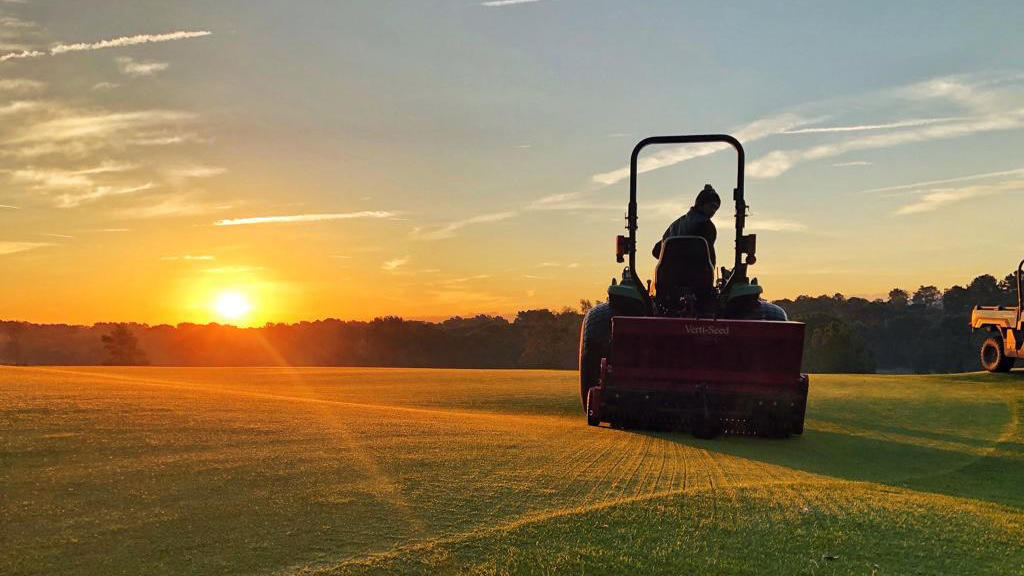
“We seeded it three weeks ago and now it’s just about waiting for the new stuff to come up,” said the Swifts man. “We can’t get sand or anything like that because everywhere is closed, and we need sand to fill holes. We can’t get the machinery either.”

But at the end of the day, for all the work they can do, what all three groundsmen are united on is that football can’t return soon enough and they’ll see their pristinely prepared pitches back in use once more.

Click here to read the original article

For the latest industry news visit turfmatters.co.uk/news

Get all of the big headlines, pictures, opinions and videos on stories that matter to you.

Follow us on Twitter and Instagram for fun, fresh and engaging content.

You can also find us on Facebook for more of your must-see news, features, videos and pictures from Turf Matters.