Double Irrigation At Breadsall Priory

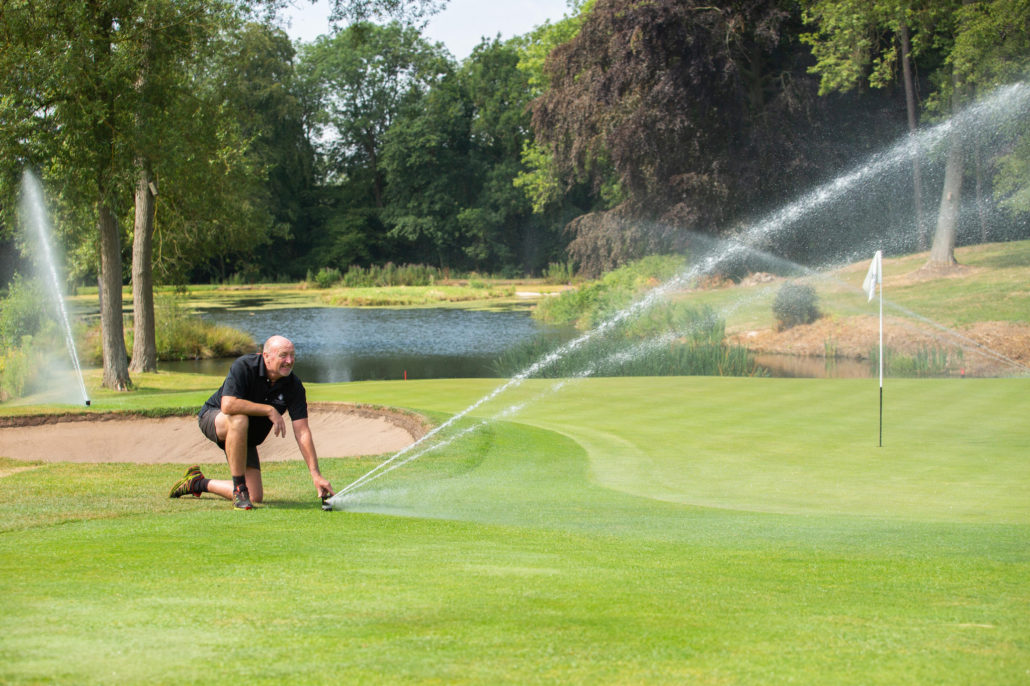
Double Irrigation At Breadsall Priory: Breadsall Priory Marriott Hotel and Country Club in Derbyshire has renovated two ageing irrigation systems to one Lynx control system from Toro to keep its 18-hole Championship Priory Course and Moorland Course in top condition.

Course manager John Smith explains: “When our previous control systems began experiencing communication errors and electrical breakdowns, we didn’t know if the grass was getting the water it needed. The systems urgently needed to change, but we didn’t want to unnecessarily overhaul all the wiring and pipework.

Double Irrigation At Breadsall Priory

“Completely replacing everything would have resulted in huge costs, but with the help of Reesink Turfcare’s Toro irrigation team, including Peter Newton and Cevan Edwards, we discovered we only needed to upgrade the two control systems and have saved a lot of money thanks to the renovating rather than replacing.”

“The install went without a hitch,” John recalls: “Before upgrading the systems, Toro technicians came to check the 28-year-old wiring would be compatible with Lynx and, finding that it was, returned in the winter of last year to undertake the renovation. Four guys made fast work of completing the install in just one and half weeks, with no disruption to golfers or our maintenance programme.”

Delighted with Lynx, John enthuses: “We’ve been using Lynx since April of this year and, as the oldest Marriott Hotel in the world with a reputation to uphold, having a comprehensive system we can rely on to irrigate both courses has given us great peace of mind. Now we have total control over when water goes on, the flow rate, and the trajectory. Lynx has really improved the efficiency, versatility and reliability of our irrigation routine.”

Having been witness to how well Lynx performs, John decided to add to the renovation project by upgrading the sprinklers, too, hoping to see even more benefit to the club’s irrigation. The perfect partner to Lynx, Toro Infinity sprinklers have replaced the sprinklers across multiple greens on the Championship Priory Course that were “in need of updating.”

John says: “We chose to start changing our sprinklers over to Infinity for improved performance and ease of maintenance. What I like about the new sprinklers is that to perform any kind of maintenance you can access everything you need from the surface. Being able to make changes without digging up or replacing bodies is a real time and money saver. Plus, the sprinkler heads have diversified nozzles offering a range of trajectories to suit the changing needs of the turf. As a result we’ve decided to phase an Infinity upgrade on all of the greens over the next few years.”

With the successful renovation behind it, Breadsall is looking to further innovate the way it irrigates the courses: “Using Lynx and Infinity from April has already made the quality of our turf far better, which is so important for our ancient site. Next up, we want to extract water from our lake to irrigate the courses and, given the great experience we’ve just had with Reesink, we will be working with them again to improve our lake’s water quality with an Otterbine aerator,” John concludes.

For more information, visit: reesinkturfcare.co.uk

For the latest industry news visit turfmatters.co.uk/news

Get all of the big headlines, pictures, opinions and videos on stories that matter to you.

Follow us on Twitter for fun, fresh and engaging content.

You can also find us on Facebook for more of your must-see news, features, videos and pictures from Turf Matters.

STRI Awarded Stowe Golf Project

STRI Awarded Stowe Golf Project: Top independent school Stowe has appointed STRI Group to design and build its new flagship nine-hole golf course in Buckinghamshire.

STRI has worked closely with Stowe School, over recent years, to create and develop the golf course layout and undertake ecological and environmental surveys for the planning process.

STRI Awarded Stowe Golf Project

Golf has been played at Stowe School since 1923, and their current course sits within an historic deer park. Working closely with the National Trust the opportunity arose for the school to close the existing golf course and reinstate the land to its former condition.

This also presented the opportunity to create a new golf course in a larger, more open landscape, which would provide a more challenging course with a less compact feel.

The location of the new golf course is on a very special site.  The rolling landscape provides superb natural features for golf and the land lies adjacent to the earthwork remains of Lamport Village. It also sits among other historic features including Lord Cobham and Gibbs’s Bourbon Tower (c1740) and Bridgeman’s 1720’s Bycell Riding which lies to the south of the site, adjacent to Gibbs’s Stowe Castle (c1740).

The design process was extensive and intricate, with STRI’s golf course architect, Jonathan Tucker, creating a course that avoided areas of historic value, and the many ecological and environmental sensitivities on the site.

The course development gives the opportunity to recreate historic features on the site, including a c.650m deer fence, positioned in a manner which matches historic records, and several bespoke tree plantations.

Andrew Hancox, Head of Golf and PGA Professional at Stowe School, said: “Stowe really is synonymous with the game of golf and with such a fine and distinguished golfing history, it is only right that we embark upon a new and exciting journey by opening our new golf course and launching the Stowe Golf Academy.

“With significantly longer and more challenging holes, along with greens constructed in accordance with USGA guidelines, I genuinely believe that our new golf course will present itself as one of the finest school golf facilities in the country.”

Project Director for STRI, Richard Stuttard, said: “This is an exciting opportunity to create an exceptional golf course within beautiful surroundings. STRI’s teams have relished the challenge of creating and implementing a design that is sympathetic to this unique environment and I’m confident that the end result will be something very special.”

For the latest industry news visit turfmatters.co.uk/news

Get all of the big headlines, pictures, opinions and videos on stories that matter to you.

Follow us on Twitter for fun, fresh and engaging content.

You can also find us on Facebook for more of your must-see news, features, videos and pictures from Turf Matters.

The Value Of Irrigation Technology

The Value Of Irrigation Technology: When the Madejski Stadium, home to Reading Football Club and London Irish Rugby Club, underwent its first major pitch reconstruction for ten years, contractors, MJ Abbott and Premier Pitches, worked closely together during the time-critical close season over a six-week period. The venue became the first to have a dual-use pitch with the added durability of the SISGrass hybrid system turf technology.

After removing around 15 miles of existing pipework, MJ Abbott completely reconstructed the pitch, taking the old one out and starting from the bottom up, reshaped all the sub-base levels, reinstalled the drainage, undersoil heating and rootzone layers. Premier Pitches took responsibility for pitch cultivation and seeding. The company also maintains their involvement by way of annual pitch renovation.
The Value Of Irrigation Technology

During the later stages of construction employing effective irrigation to the grass root zone was critical to enable the final pitch levels to be accurately graded and to allow for successful cultivation and seeding of the new surface. Nathan George, Contracts Manager at MJ Abbott was confident that selecting Rain Bird products for the new pitch’s irrigation requirements was the way forward: “The irrigation cycle is determined by both the weather in general as well as the effects of sun and shade caused by the inherent design of the stadium. We had a high level of confidence in Rain Bird irrigation technology for the project because of the overall quality, performance and versatility of the company’s products,” he says.

Rain Bird’s highly durable 8005 rotors were specified for the central area of the pitch and with their easily adjustable arc from 50° to 330°and 12 to 24.7 metre radius were well suited to the application. Featuring Rain Curtain™ nozzles, the 8005 rotors ensure optimum distribution and close-in watering resulting in superior irrigation uniformity.

Rain Bird’s 950E rotors were selected for the pitch perimeter as they are specifically designed to withstand the rigours of sports field irrigation applications, including hybrid grass. They offer full or part circle and irrigation up to 345° and feature a top adjustable pressure regulator, factory preset at 5.5 bar.

Rain Bird’s Site Control System, used by Adam Grantham Reading Football Club’s Grounds Manager and his team, can be controlled both through a PC and remotely through an iPad. It gives complete control over the irrigation and the flexibility to set up and match the irrigation cycles precisely to the prevailing and predicted weather.  The software provides a quick and easy way to build irrigation schedules and programmes based on set parameters. The system’s many advanced features include an interactive map interface that displays the position and operation of individual rotors, displaying real-time irrigation activity and for close monitoring of the system.

The Value Of Irrigation Technology

Adam Grantham commented: “The Rain Bird system is great and very user friendly, and can be as complex as you would like it to be. I have found it very easy to monitor moisture levels with the sprinkler system coverage being very consistent. The pitch is holding together well and receiving good feedback from the coaching staff and players”. From MJ Abbott’s viewpoint the success of the Madejski project was reflected by the fact that the company has gone on to secure further contracts from Reading FC for new training ground pitches.

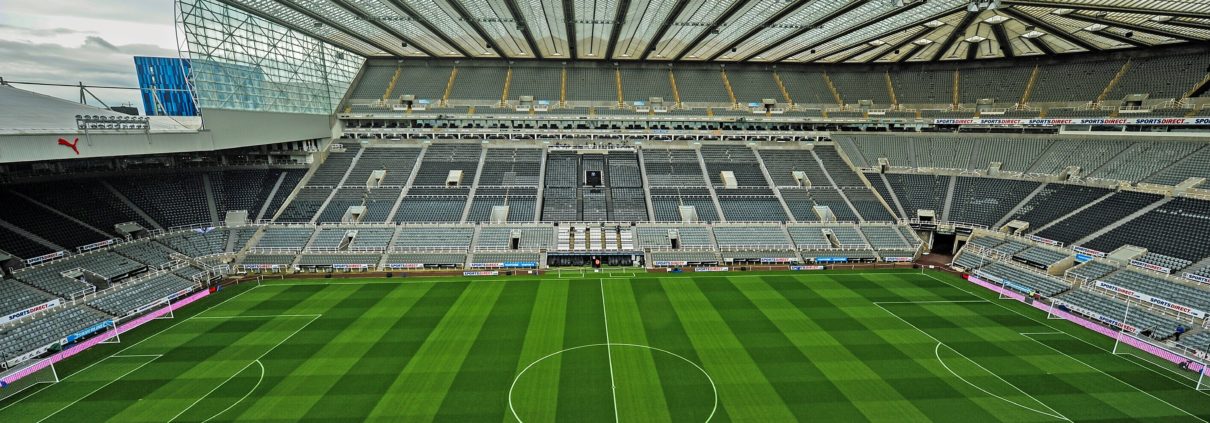
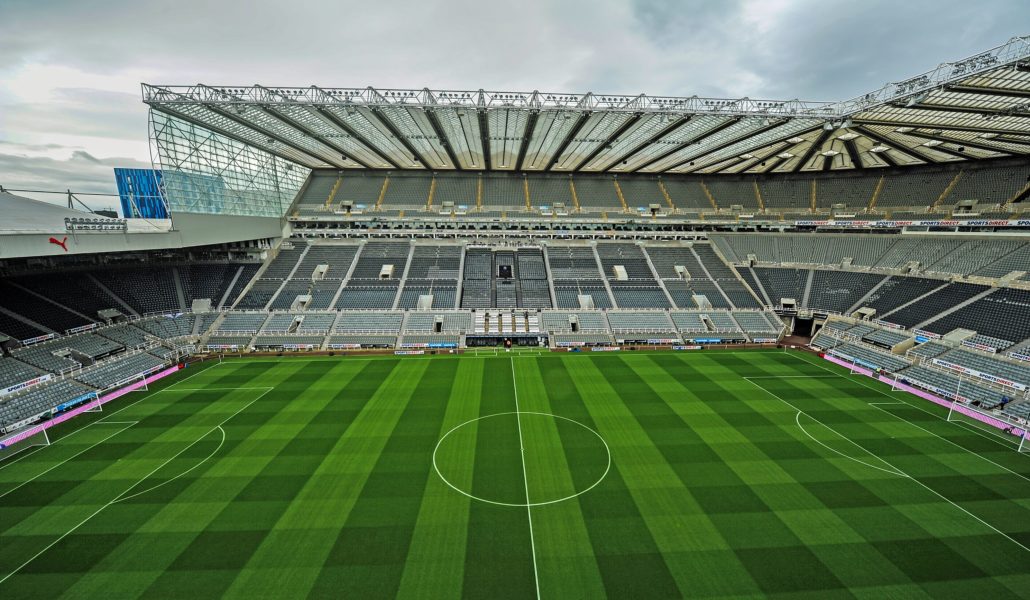
Meanwhile when the decision was made to install a new playing surface and irrigation system before the start of the 2017-8 Premier League season at Newcastle United, a fast response and close cooperation between pitch contractors MJ Abbott and Premier Pitches was essential. As part of the project the club had to select a new fully automatic pitch irrigation system.

After removing the existing vegetation and old fibre root zone, MJ Abbott removed the existing lower sand layer to a suitable depth to expose the existing slits within the drainage system that was to be retained. An imported rootzone was laid to re-establish the original pitch levels, followed by cultivation and seeding carried out by Premier Pitches. The new pitch was then stitched with the SISGrass hybrid pitch system. The St James’ Park project was successfully delivered a week ahead of schedule.

For the new irrigation system, MJ Abbott had to take into account the particular conditions created by the configuration of the pitch within the stadium. Nathan George, Contracts Manager, explains:  “ The stadium design means that at certain times of the day, the southern end of the pitch is in full shade with the remainder in full sun. Complete control over individual sprinkler application rates was therefore essential. We knew from experience that Rain Bird offers high quality products for stadia applications in terms of rotors, sprinklers and automatic irrigation control systems so would be an excellent partner for this project.“ Rain Bird 950E valve-in-head sprinklers were selected for the perimeter and the corners of the pitch whilst 8005 pop up rotors were chosen for the central areas.

The Value Of Irrigation Technology

Integral to the new pitch is the SISGrass Hydrobox system which was developed specifically for use with pop-up irrigation systems, including Rain Bird. Nathan explains ” Hydrboxes are installed to all central pitch sprinklers. The box is filled with rootzone and stitched in the same configuration as the main pitch. To access the sprinkler for maintenance purposes, the Hydrobox is simply lifted out, leaving the sprinkler clear of any pitch construction. To reinstate the pitch surface around the head the Hydrobox is lifted back over the sprinkler and replaced into the hole.” The system not only makes maintenance much easier but also allows grass to grow right around the sprinkler head for an optimum playing surface.

Rain Bird’s IQ Cloud Platform, used in conjunction with an ESP-LXD controller fitted with a network communication cartridge, was selected to give the groundstaff a real time fully automatic remote irrigation control system. The installation can be managed remotely by a web enabled computer, tablet or smartphone connected to the internet.

The ESP-LXD controller enables employment of IQ-Cloud’s full suite of remote water management tools. Groundstaff know in real time which zones and irrigation systems are operating and can access information on flow rates and performance. Reports can be automatically created and shared, saving time and providing information on irrigation times, total water usage and other significant data. Automated e-mail alerts and alarms can be set up to help manage potential problems.

The overall result has delighted Eddie Rutherford, Stadium Manager, who says it is probably the best the pitch that the club has had since he has been there. The quick planning required and success of the project was helped by Premier Pitches’ long term experience at St James Park and Director Russell Latham also recognised the experience and expertise of MJ Abbott.  “ We have worked with MJ Abbott on pitch construction projects for over five years now. Their efficient and meticulous way of approaching a project from design and planning to delivery is everything that our key clients want to see.”

For more information, visit: www.rainbird.com

For the latest industry news visit turfmatters.co.uk/news

Get all of the big headlines, pictures, opinions and videos on stories that matter to you.

Follow us on Twitter for fun, fresh and engaging content.

You can also find us on Facebook for more of your must-see news, features, videos and pictures from Turf Matters.

Wolves Put Trust In ICL Granulars

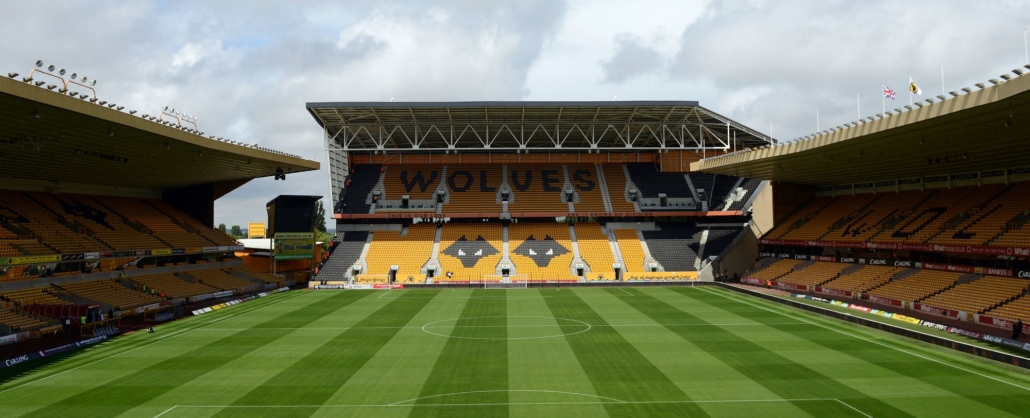
Wolves Put Trust In ICL Granulars: Wayne Lumbard, Head Groundsman at Wolverhampton Wanderers FC has reason to celebrate. Not only has the team been promoted to the Premier League, but in his opinion the pitch is at the best it has ever been throughout his thirteen-year tenure at the club – with a little help from ICL.

It is safe to say that Wayne has experienced some highs and lows at the club. However, after being relegated twice, optimism at the club is now at an all-time high.

Wolves Put Trust In ICL Granulars

“Collectively, what everyone at the club has done has been the main ingredient behind our success,” he says. “The football has been the best I’ve ever seen here the pitch has been consistently great all season – everything on and off the pitch has just clicked.”

Wayne acknowledges that the relatively new owners have been instrumental in Wolves’ rise back to the highest heights of English football, and they have certainly signalled some substantial improvements.

Last year, a state-of-the-art Desso Grassmaster hybrid pitch was installed at the Molineux Stadium and after being hugely impressed, the owners sanctioned three more to be built at the Sir Jack Hayward Training Centre in Compton Park.

With a completely new stadium pitch to work with, Wayne chose to adhere to a granular fertilizer programme from ICL.

“It was our first season on the new pitch at the stadium so it was a case of testing the products but the programme worked so well. I am confident that we now have everything down to a tee,” he said.

“Straight from renovation and two weeks after seeding, I applied SierrablenPlus Renovator 20-20-8 as a base feed at a rate of 30 g/m² and continued to apply this all the way through the season until the final game of the season.

“After the initial base feed, it was a case of applying the spring and summer fertilizers at the correct time. We had huge success with Greenmaster Pro-Lite NK 12-0-12 which we applied at 30g/m2 before we moved into Autumn with Greenmaster Pro-Lite Double K at 30g/m2 because we needed more potassium than nitrogen at that time of year. Into winter, we decided to go with a Greenmaster Pro-Lite Invigorator 4-0-8 at 30g/m2 while still continuing with regular feeds of ProTurf 20-0-7 at 25g/m2 – which we had been applying since June.

“It is all about applying the right products at the right time and in the right place. Personally, I think what is more important than anything, is the overlap of the products so that you have that even line of consistency throughout the season.

“I’ve been using ICL products since 1983 and they give you everything you want, not just technically, but aesthetically as well. What I like is that there is something for whatever the problem, whatever the issue. Whatever you want, there is a product.

“With the pressures that groundsmen are under today with having to produce a pitch for match day, I want guarantees and that is what I get with ICL. Quite simply, they are products that I can trust and along with the back-up assistance I receive from Emma Kilby (ICL Technical Area Sales Manager) is as good as the products themselves.

“I sit down with Emma at the end of each season, we look at the iTurf programme we had in place and how the pitches at the stadium and training ground performed. At this stage, if we need to make any tweaks to our programme, then we will. Based on the last twelve months, I can’t see us making too many changes – the pitches have performed fantastically well and along with the grounds team, ICL products have played their part in our success.”

Please contact ICL on 01473 237100 or visit http://www.icl-sf.co.uk or http://www.icl-sf.ie if you are in Ireland.

For the latest industry news visit turfmatters.co.uk/news

Get all of the big headlines, pictures, opinions and videos on stories that matter to you.

Follow us on Twitter for fun, fresh and engaging content.

You can also find us on Facebook for more of your must-see news, features, videos and pictures from Turf Matters.


Football’s “Made in England” Pitches

Football’s “Made in England” Pitches: Sunday’s World Football Cup Final, the first-ever to be staged on a revolutionary hi-tech playing surface, is set to deliver a multi-million pound boost to SIS Pitches, the English firm behind the groundbreaking technology.

Cumbria-based SIS Pitches installed its hybrid surfaces using patented fibre injection technology with undersoil aeration system in six of the 12 tournament venues, including Moscow’s 81,000-capacity Luzhniki Stadium, which will host Sunday’s decider between France and Croatia.

Football’s “Made in England” Pitches

Luzhniki’s pitch uses SISGrass, – 95% natural grass reinforced with 5% synthetic fibres – and SISAir, a unique aeration system capable of removing a deluge of rain from the surface in just five seconds, whilst optimising root moisture via a network of undersoil pipes.

George Mullan, CEO of SIS Pitches, said: “With around one billion people expected to watch the final, there’s clearly pressure to get the pitch in top condition, despite it being used for over 60 hours – the equivalent of a full Premier League season – in the past five weeks. That would have been impossible on a traditional all-grass pitch.

“Everyone has been raving about the quality of football at this tournament and our pitches have certainly given Modric, Lukaku, Mbappe and Kane a brilliant platform to perform on. The feedback we’ve had from everyone involved has been hugely positive. It’s the first worldwide showcase for these technologies to be combined at a World Football Cup final and it’s performed perfectly.”

The six World Football Cup stadia using SISGrass are Luzhniki, Spartak, Samara, Kaliningrad, Saransk and Rostov.

Football’s “Made in England” Pitches

Having installed over 80 hybrid surfaces worldwide, including English Premier League sides Chelsea, Newcastle United, Fulham and Bournemouth, as well as Scottish champions Celtic and the English FA’s St George’s Park complex, with Barcelona to follow, SIS Pitches predicts annual revenues will grow from £55m to £65m in 2019.

Mullan said: “We’re seeing huge interest from professional sports teams in the US and Japan, as well as the enormous American university sector and we’re installing eight SISGrass pitches in France this summer alone.”

Founded in 2001, SIS Pitches employs over 340 staff worldwide, with manufacturing headquarters in Maryport, Cumbria.

For the latest industry news visit turfmatters.co.uk/news

Get all of the big headlines, pictures, opinions and videos on stories that matter to you.

Follow us on Twitter for fun, fresh and engaging content.

You can also find us on Facebook for more of your must-see news, features, videos and pictures from Turf Matters.