
A seasonal guide to golf course maintenance

A seasonal guide to golf course maintenance: As we head into the winter months, with the chilliest and the wettest of the weather yet to come, you may be asking what maintenance is necessary as the seasons change.

In this blog, we’ll be running down the typical kinds of maintenance that you need to undertake to ensure that your golf course remains at its best season-after-season.

A seasonal guide to golf course maintenance

A seasonal guide to golf course maintenance

This schedule will apply to most golf courses, but each maintenance schedule will need to be tailored to soil type, weather patterns and other, similar, site-specific factors.

Spring

March

In any typical year, March will see in the backend of winter and welcome milder temperatures, which increase both air and soil temperatures, encouraging growth. If you enjoy a few days’ worth of mild weather, apply a light application of lawn tonic to encourage some further early grass growth. This will help to create smoother surfaces earlier in the year and help to avoid some of the issues we see at some of the earlier golf tournaments in the year.

Dry Patch will also be an issue on many courses, so it’s certainly worth doing all you can to be prepared for this eventuality. An early application of wetting agent will be ideal around now because the ground will still be moist; thus, ground penetration will be felt throughout the season and will combat dry patch as your wetting programme continues.

April

April is one of the busiest times for maintenance around the course; the onset of growth is imminent, so now is the time to tidy up, mow and prepare for the most active golfing period of the year.

May is usually the best time of year to spray broadleaved weeds around the course. But by preparing everything you need for this in April, you can reduce the pressures on your time as the course gets busier and negate any health and safety concerns that come with using chemicals.

If you’re planning to use a contractor for this, now is perhaps your last good opportunity to book them. In the meantime, reduce your usual nitrogen feeding routine as this encourages excess leaf growth, without encouraging root development. Instead, increase potassium applications to improve the roots of the grass and its ability to pull water from the soil.

Other key pointers this month, include:

  • Avoid the application of any chemicals that might impact the growth of the grass roots; for example, herbicides could be detrimental if you experience a period of dry weather.
  • Continue to aerate the soil around the course to promote the growth of roots and the movement of air and water within the soil.
  • Ensure mower blades are sharp and cutting cleanly – a blunt blade can damage swards.
  • Raise the blade of the mower and trim only when necessary to avoid excess stress on the grass.
  • Confine irrigation to only crucial areas, such as the green – brown fairways are not the end of the world at this time of the year.
  • Any fairways with shallow soils should be given a layer of topdressing to improve soil depth and aeration to increase rooting depth.

May

It’s at this time of year when warmer weather will create the ideal conditions for a good spell of growth. The past few years have seen prolonged dry spells during the summer, so now is a good time to think about collecting rainwater and minimising water use where you can in preparation for high temperatures.

Summer

June

During June, you should begin:

  • Reducing your applications of nitrogen.
  • Reduce irrigation so that the surface firms and the roots must work that bit harder for their water.
  • Watering by hand to prevent water build up in areas of low land.
  • Frequently verti-cutting without overstressing the surface.
  • Frequently dressing surfaces to maintain a smooth, freely draining surface.
  • Regularly aerating to ensure the free draining of any surface water.
  • Removing excess organic matter or debris, such as sticks, weeds and fallen leaves.
  • Brushing the grass to ensure that the surface is aerated, free of debris and produces a cleaner cut during mowing.
  • Rolling to keep the surface smooth and to remove any developing bumps or problem areas.
A seasonal guide to golf course maintenance

A seasonal guide to golf course maintenance

July

As the weather continues to get warmer, more golfers will visit the course, which unfortunately brings about disease that may affect your grass. This is a difficult time for any groundsman; while you obviously want golfers to enjoy the fruits of your hard work, at the same time, you need to be on your toes to ensure that your grass remains healthy.

Sustaining healthy turf is crucial to sidestepping disease, excessive strain and maintaining a nutritional balance. If you’re faced with symptoms that you’ve never seen before, while it might not be anything to worry about, it’s best to get them checked by a specialist. This is especially important when you consider that back in 2012, two new turf diseases were found on courses in England and Ireland.

Once you’re fully aware of what you’re dealing with, the correct action can be taken to protect the grass.

By simply ensuring that your grass remains stress-free, you can actually prevent a great deal of diseases. Feeding, irrigation, maintenance and mowing are all key factors in ensuring that your grass is relaxed and content.

August

August can be a great time to begin corrective works such as hollow coring and the overseeding of greens. This is because the temperatures in both the ground and in the air are usually high enough to ensure that grass recovery from your works will be very quick.

Consider that recuperation from these works may take as little as two weeks in August, but if you’re leaving it until September, you may find it can take up to four to six weeks.

That said, while many golf courses may see much less foot traffic during August, not all courses are quiet. In this case, any repair and renovation work will need to be planned carefully around how busy the course is.

Autumn

September

Typically, at this time of year, temperatures will begin to fall, and morning dews may appear across the course. They’ll be less pressure on water resources, and if your previous repair and maintenance works have taken well, you’ll have some time for other essential jobs before the leaves begin to fall.

One area of the course that you should be reviewed every couple of years is the teeing grounds. Tees are frequently forgotten in favour of greens, however as play increases the tee size and condition may not be adequate to support play.

Your tees must have access to plenty of light, so be sure to prune, trim and remove branches of neighbouring trees where necessary to keep the turf in good condition. Taking advantage of the drop off in play at this time of year to begin a tee maintenance project ensures that it has time to settle before the start of the next season.

A seasonal guide to golf course maintenance

A seasonal guide to golf course maintenance

October

Now Autumn is beginning to come to a close; it’s time to think very carefully about your course’s winter golf policy. There’s no question that playing on frosted greens will cause damage to the plant; however, such damage is really down to the discretion of the individual course to decide whether it is acceptable.

On the one hand, two or three golfers on frosty greens might not be a problem, but when you have a hundred doing so in a given day, then it may well be. This could spell the difference between a few footprints, which will rectify itself in spring, or a setback of two to three weeks in the grass coming into its summer condition.

Winter

November

The larvae of crane flies, leatherjackets, aren’t always a problem on every course, and some that are impacted will experience such a small invasion that it won’t warrant the cost of spraying. However, these pests can grow up to 4cm and have a particularly ravenous appetite when it comes to grassroots and stems of fine turf. By treating this issue anytime from now until next April, you’ll spare yourself another headache.

Although tree-lined courses are a significant draw for golfers, they can also give groundskeepers a great deal of work to do at this time of year. Although leaf blowers and sweepers can make life just that bit easier, there’s still a good few weeks of leaf collection ahead of you. Once the leaves are all down, take some time to ensure you’re removing any damaged or diseased wood from the trees and remove those which are casting shade or restricting airflow to the turf.

With less light during the day, you may find surface moisture and shade will create moss and algae. If you can’t remove this, try using a soil amender as a top-dressing to keep the surface dry.

A seasonal guide to golf course maintenance

A seasonal guide to golf course maintenance

December, January & February

As you come to the end of one year and into the beginning of the next, it’s time to begin planning for the new season.

The height of winter is a great time to look for any areas of the course that aren’t draining as you’d like and where drainage work is necessary. Movement across the course will become more difficult at this time of year, and if your winter policy allows play, then it’s important to monitor what effect this may be having and whether further paths and thoroughfares are necessary.

Stephen Beal is a grass seed expert and the Sales & Marketing Manager at www.barenbrug.co.uk

For the latest industry news visit turfmatters.co.uk/news

Get all of the big headlines, pictures, opinions and videos on stories that matter to you.

Follow us on Twitter and Instagram for fun, fresh and engaging content.

You can also find us on Facebook for more of your must-see news, features, videos and pictures from Turf Matters. 

Walton Heath invests in Toro fleet deal

Walton Heath invests in Toro fleet deal: Walton Heath Golf Club has had Toro machinery in its fleet of greenkeeping machinery for decades, but after seeing the benefits a Toro package deal would bring to the course and its members, the club signed its first five-year agreement with the brand.

With its Old Course having ranked in world top 100 lists every year since the inception of the rankings in 1938, Walton Heath Golf Club knows a little something about consistently providing excellence. This is part of the reason they opted for a Toro fleet deal, as club chairman Dr Alastair Wells explains:

Walton Heath invests in Toro fleet deal

Walton Heath invests in Toro fleet deal

“Having a fully modern fleet means we can maintain the courses to a very high standard,” he says. “For example, the uniformity of cut and reliability are always going to be better with new Toro machines, plus there are financial benefits. With a package deal we can retain cash as the cost is spread out over five years, which was one reason why we made the switch from buying machines on an annual basis.”

“With such a large investment to consider, the decision to go with Toro wasn’t made lightly as we wanted to provide our highly valued course manager Michael Mann and his team the best possible equipment. We had machinery demonstrations from a number of leading brands, however it became clear that Toro was the way to go. Toro and Reesink Turfcare are such reputable companies for one but added to that is the fact that Toro equipment is first class.”

The comprehensive fleet deal includes four Toro Greensmaster TriFlex Hybrid 3420s, two Groundsmaster 4700-Ds, four Reelmaster 6700-Ds and a further two Multi Pro 5800-Ds, three Workman HDXs and one Workman MDX.

“Toro really suits the terrain here,” continues Dr Wells. “We’ve been happy with the service from Reesink and Toro before, so it made sense to invest in a brand we know and trust.”

With the new deal spearheaded by course manager Michael Mann, this significant investment in Toro is only one part of the club’s efforts to improve and develop the course.

“The two courses here at Walton Heath are highly regarded across the country, in part due to the great tournament history they have, but also because of our continuous efforts to make improvements,” continues Dr Wells. “Since 2000, nine hectares of pure heath land have been restored and more recently we’ve brought in architects Mackenzie and Ebert to review both the Old and New course. This new agreement with Toro and Reesink is just the start of further development in the club, which we believe will see improved results.”

Reesink’s Jon Cole, branch manager – South East, adds: “We are delighted to have cemented our long-term relationship with Walton Heath Golf Club following the club’s due diligence process. Our local representative, Mike Taylor, supported by the Reesink South East team engaged in a busy evaluation process with Michael Mann and his team at Walton Heath. So after the hard work put into the selection process, we are immensely pleased to have the club reconfirm their confidence in us and the Toro brand.”

For the latest industry news visit turfmatters.co.uk/news

Get all of the big headlines, pictures, opinions and videos on stories that matter to you.

Follow us on Twitter and Instagram for fun, fresh and engaging content.

You can also find us on Facebook for more of your must-see news, features, videos and pictures from Turf Matters. 

Safety first for employees, dealers and customers

Safety first for employees, dealers and customers: John Deere will not attend international trade shows in 2021.

In order to ensure the safety of customers and employees, John Deere has announced that it will not attend any international agricultural and turf trade shows in Europe and the CIS during the company’s 2021 fiscal year (1 November 2020 to 31 October 2021), as this would require extensive international travel. Instead, the company will use a new marketing mix of traditional and digital tools to deliver information to customers.

Safety first for employees, dealers and customers

Safety first for employees, dealers and customers

Events of the last few months have profoundly changed everyone’s working and social lives. The protection of people’s health and safety is now more critical than ever, while maintaining close contact with customers is still important to provide reliable services in these uncertain times.

“Farmers have done an excellent job in the emergency phase of COVID-19 to ensure food supplies. For that we wish to express our appreciation to all our customers,” said Denny Docherty, John Deere Vice President Sales & Marketing, Region 2. “The pandemic has changed the world and our industry is undergoing a period of great change too. This also applies to our marketing activities.”

The need for a new approach to communications with customers has therefore prompted John Deere to reduce its participation in trade fairs for the time being, and the company has decided not to exhibit at any international agricultural or turf show during the company’s next fiscal year, which ends on 31 October 2021.

John Deere’s key focus in 2021 will be the change in its operating model, to become a ‘smart industrial company’. As previously announced, Deere is moving towards being a production system-based organisation, in order to build a more customer driven and streamlined business. This is one of the biggest organisational restructurings in the company’s 183-year history, which requires a change of marketing approach and an extended focus on Precision Ag technologies.

“We are also expecting a major change in the exhibition landscape, driven by COVID-19 and digitalisation,” said Andreas Jess, John Deere Director Marketing, Region 2. “In the medium term, our company would welcome a new timetable to be implemented by the international trade fair organisations, to free up the show cycle across Europe. However, we will continue to support our John Deere dealers if they decide to participate in their local agricultural and turf shows, always based on the fact that the health and safety of both customers and dealers can be ensured.”

For the latest industry news visit turfmatters.co.uk/news

Get all of the big headlines, pictures, opinions and videos on stories that matter to you.

Follow us on Twitter and Instagram for fun, fresh and engaging content.

You can also find us on Facebook for more of your must-see news, features, videos and pictures from Turf Matters. 

Kubota appoints HRN Tractors

Kubota appoints HRN Tractors: Kubota (UK) Ltd is pleased to announce that HRN Tractors Ltd is to become a Kubota full-line dealer in Scotland across its six depots, with effect from today (17 September 2020).

While HRN Tractors will represent Kubota construction equipment for all of Scotland, its agricultural products will be available for depots north of Perth, with groundcare and professional turf products for the region north of Dundee.

Kubota appoints HRN Tractors

Kubota appoints HRN Tractors

“This appointment reinforces Kubota’s commitment to its customers and the market,” explains David Hart, managing director of Kubota (UK). “As a full-line dealer, HRN Tractors will be in a strong position to make the future investments required in facilities, technology and staff, to actively support our customers across agricultural, groundcare and construction sectors.”

HRN Tractors was established by the Barclay family in 1980, and is a well-known and respected name throughout the farming community. In addition to its extensive dealership activities, the family also farms across 2,000 acres of combinable crops and is home to the pedigree Harestone herd. With its head office at Insch, HRN Tractors has depots at Turriff, Kinloss, Muir of Ord, Caithness and Balbeggie.

“HRN is delighted to have received the Kubota franchise,” says Hamish Bruce, dealer principal of HRN Tractors. “It supplies us with a wide range of agricultural, construction and groundcare products to sell to our growing customer base. We believe that Kubota has massive potential for market growth in Scotland, and that HRN and Kubota have a very bright future together.”

For the latest industry news visit turfmatters.co.uk/news

Get all of the big headlines, pictures, opinions and videos on stories that matter to you.

Follow us on Twitter and Instagram for fun, fresh and engaging content.

You can also find us on Facebook for more of your must-see news, features, videos and pictures from Turf Matters. 

First impressions count with the Quadraplay

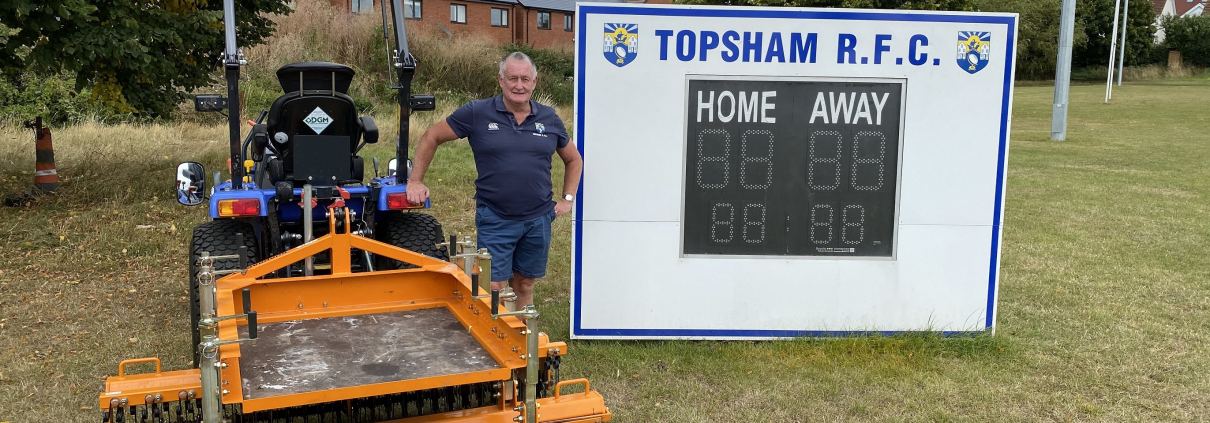
First impressions count with the Quadraplay: Nigel Mortimore, Head Groundsman at Topsham Rugby Football Club, is a strong believer in first impressions – and his SISIS Quadraplay is helping him to create a pitch that opposition teams will long remember.   

A retired Physical Education teacher, Nigel has been maintaining the pitches at Topsham Rugby Football Club for the past seven years. The site, which includes two full size rugby pitches and two smaller pitches for the junior teams, can often see more than 600 people in attendance on a matchday.

First impressions count with the Quadraplay

First impressions count with the Quadraplay

When Nigel first started the role, he had little experience in groundsmanship, so he was therefore keen to get up to speed as soon as possible.

“I live local to here, I enjoyed playing rugby and I’ve always had an interest in fields and sports pitches but going from playing on one to looking after one was a steep learning curve,” he said.

“I joined the RFU’s Rugby Groundsmen Connected scheme, which along with Devon RFU, has been invaluable in gaining advice and support. I also got in contact with the groundsman at Exeter University and I worked alongside him and his team to see how they maintain their pitches. The previous groundsman at Topsham, John Evans, was also a great help.”

After learning the fundamental skills of groundsmanship, Nigel’s attention soon turned towards new maintenance machinery. The SISIS Quadraplay had previously caught his eye and an evening with Keith Kent helped him make the final decision.

“Keith Kent came here to Topsham to host a Groundsmen Connected seminar. He brought a range of SISIS equipment with him and that was when I first saw the Quadraplay in action – I immediately knew that this machine was what we needed.

“The club’s committee attended that evening and the final decision was made there and then. Those committee members bought into what benefits the Quadraplay could offer after seeing how it could be used and how much it could help us.”

The SISIS Quadraplay multiple-purpose, single-pass maintenance incorporates a mounted frame for up to four implements such as grooming rakes, spikers, slitters, rollers and brushes. The implements can be fitted to the mainframe in any order and can be independently adjusted to achieve the desired effect. Compact, robust, versatile and with the ability to carry out up to four operations simultaneously – the Quadraplay makes life a lot easier for many groundsmen.

“We purchased the Quadraplay to improve the conditions of the fields and it has done exactly that,” said Nigel.

“It is used pretty much every day depending on conditions. If the surface is nice and damp, we will go out and slit it and we will do that in different directions on various days. Slitting the pitches has really helped with the drainage here. Prior to having the Quadraplay we were forced to cancel games when we had torrential rain but now, we don’t have that problem.

First impressions count with the Quadraplay

First impressions count with the Quadraplay

“The brush puts a lovely stripe on the pitch which is important for matchday presentation. The tines are also brilliant, and we tend to tine it and brush it particularly at the end of the season. This helps to take off the peaks and put them into the troughs for a consistent playing surface.

“Having the ability to carry out four tasks with the Quadraplay is extremely beneficial,” continued Nigel. “The adjustment is very easy, and it is incredibly simple to connect it to the back of our tractor. I also like the fact that there is no PTO on it so there are no risks of oil spillages. It is easy to maintain, well-built and it is just a fantastic piece of kit.”

Nigel believes that the machine has signalled major improvements to the pitches. He also claims that it is not just the home team that these improvements have had an impact on.

“The quality of surface has improved no end. The players are getting a good footing on it and that in turn improves the game of rugby – the better the surface the better the play. A lot of the Topsham players have commented on how much they feel it has improved.

“I’ve got a real thing about first impressions especially when you go to play a game at an away ground. If you were to get off a coach on a matchday and you see a fantastic looking pitch which has been dressed, striped and ready for play then you know you will be facing a good team. I think our pitch, thanks to the SISIS Quadraplay, now puts opposition teams on the backfoot straight away.”

For further information or a no obligation demonstration, please contact SISIS on 01332 824 777 or visit www.sisis.com

For more news, reviews and insightful views, you can follow SISIS on Twitter and Instagram @SISISMachinery and like the company’s Facebook page – www.facebook.com/SISISMachinery. You can also view the latest SISIS videos by visiting www.youtube.com/SISISMachinery

For the latest industry news visit turfmatters.co.uk/news

Get all of the big headlines, pictures, opinions and videos on stories that matter to you.

Follow us on Twitter and Instagram for fun, fresh and engaging content.

You can also find us on Facebook for more of your must-see news, features, videos and pictures from Turf Matters.