Rigby Taylor and Maidstone Rugby pitch in

Rigby Taylor and Maidstone Rugby pitch in: A week is a long time in politics, according to the idiom. But for Bob Hayton, grounds chairman at Maidstone Rugby, deciding whether to aerate or apply fertiliser, for example – or to delay either for a few days – can, he says, make all the difference to successful pitch care.

“The weather can change so quickly,” he says, “so it is crucial to time any application of granular feed for when rain is forecast within a day or two. Likewise, there’s wisdom in holding back on aerating when it is very wet, whatever the size of the tractor.”

Rigby Taylor and Maidstone Rugby pitch in

Rigby Taylor and Maidstone Rugby pitch in

Groundscare ‘rules’ such as these were imparted to Bob two years ago when, with no sports field groundscare experience but lots of enthusiasm for improved pitches spurred by his spell as a player for the rugby union club’s veterans squad, he took the reins as volunteer grounds chairman of the Kent-based club whose 1st XV competes in the London 2 South League.

“I ‘shadowed’ my predecessor for a couple of years before I took on the role so I knew something about pitch care, including the importance of correctly timing certain maintenance routines,” says Bob, who adds:

“The former grounds chairman – who I actually work for and is a successful local farmer and a great sponsor of the club – achieved great improvements to the pitches, and he impressed on me that knowing when to do things and when not is key to keeping the pitches playable and presentable. I follow his mantra of ‘the difference between a good farmer and bad one can be just a week; the trick is doing the right things at the right time’.”

The three pitches are natural grass on soil, on clay, “and while there is some drainage, to be honest we are not sure where they are and what state they are in! The pitches are effectively ‘tiered’ on a sloping site next to a large car park which means we get a lot of water run off when it rains”.

In the past, this water has caused major problems in terms of large patches of ‘greasy’ or ‘soft’ ground. But now, with Bob and his team of around eight volunteers steadfastly applying lots of sand in recent seasons complemented by regular aeration, “thankfully the surface water is nowhere near as bad and it doesn’t stay on the surface too long, either”.

He continues: “The pitches are renovated each year (by Rigby Taylor) with a concerted programme of deep spiking, including Earthquaking, and they have a lot of sand applied – probably 30 tonnes over each pitch each year.” Despite this, when there is a lot of rainfall certain areas of certain pitches do still have (smaller) puddles so, says Bob, “we’re constantly aerating to a depth of four inches and hand-forking some areas then ‘topping’ up the sand on patches. Problems like these cannot be solved overnight, but we are getting there”.

Bob’s enthusiasm for aerating and the use of sand was spurred by a visit by former Twickenham grass guru Keith Kent, as part of the RFU’s initiative to help grassroots clubs. “Keith’s very informative presentation focused on aeration and the use of the correct type of sand (round sand),” reflects Bob. “Also, the accompanying machine demonstrations really opened our eyes to the lack of equipment we had.

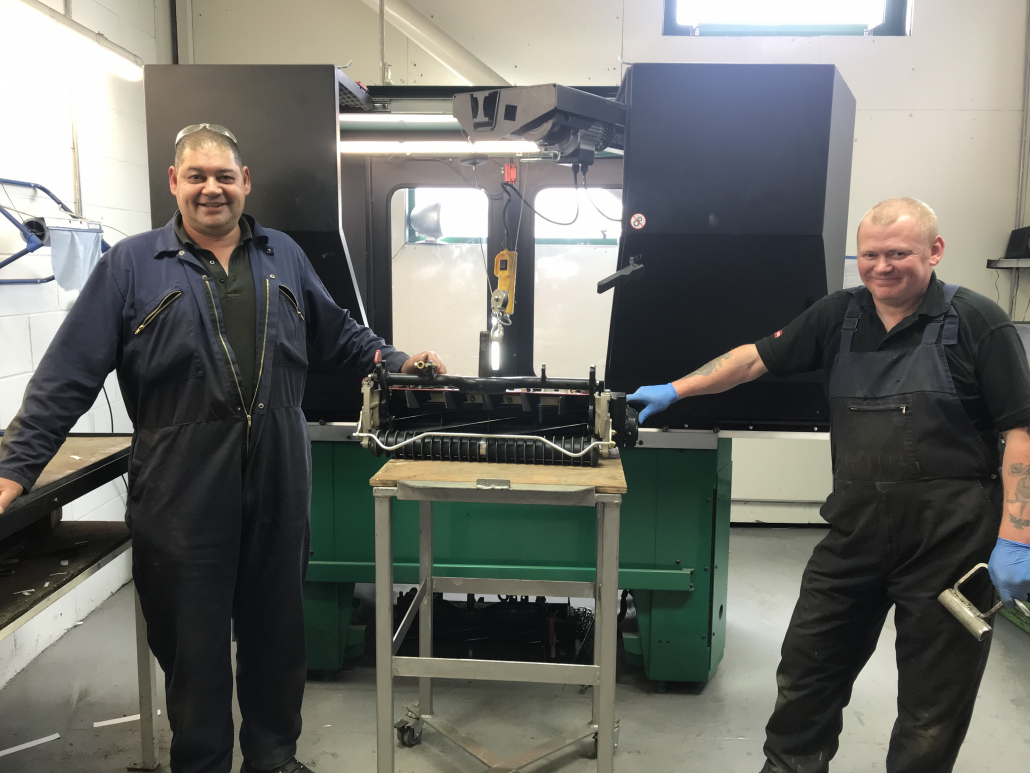
“The input of a fellow veteran player, Martin Maytum, has also been important to the improvements we’ve made here. Martin has imparted his sports field groundscare experience – he has been in the industry for more than 30 years, beginning as a 16-year-old apprentice at Crystal Palace FC and subsequent spells at Maidstone United, Kent Police sports ground, Queens Park Rangers’ training ground and Kings Hill Sports Park. He is also a volunteer pitch advisor for the Rugby Football Union, before recently joining Rigby Taylor as the technical sales manager for this area. So, in addition to our Saturday afternoon chats about the pitches, I’m sure we’ll be sitting down for longer conversations.”

Rigby Taylor and Maidstone Rugby pitch in

Rigby Taylor and Maidstone Rugby pitch in

Addressing the club’s equipment situation – with, for instance, a refurbished drum-type Multitiner aerator and a Quadraply, which incorporates a frame to accommodate various implements including grooming rake, spiker and slitter – Bob and his team have gone on to instigate a concerted maintenance programme that not only involves Rigby Taylor’s annual renovations but also includes amenity supplies from the company such as the use of the Sports Field Renovation seed for overseeding (on the  rye grass base sward), Delta Sport super-maxi granular fertilisers and iGO line marking machine applying Impact paint.

Designed for rapid establishment, as well as showing excellent tolerance to wear, cold, shade, disease and drought, for example, Sports Field Renovation seed is a mixture of tetraploid perennial rye (the Tetragreen cultivars) and perennial ryes Columbine and Greensky, and is treated with Germin-8T which contains a speciality surfactant that is activated when the seed comes into contact with rootzone moisture. This provides effective penetration of water through the seeds’ outer layer (pericorp) into the endosperm, by lowering the surface tension of the surrounding water molecules. Roots can also take advantage of the micronised mycorryhizal fungi that will deliver long-term plant benefits.

The result is that at the active germination stage, each emerging seedling has immediate access to a highly beneficial package of targeted nutrients, biostimulants and micronised mycorrhizal fungi that together aid early establishment, improved root mass development and accelerated leaf extension.

Derived from composted chicken litter with nitrogen, phosphorus and potassium from mineral sources, Delta slow release (over six-eight weeks) fertilisers promote improved microbial activity, with the inherent carbon stimulating the soil microbes. Bob and team use a hand spreader to apply the 12-4-8 formulation in winter and 8-6-6 in summer.

“I do compare these products with others but have always found Rigby Taylor products to be effective and competitively priced,” Bob comments.

Coupled with a sward height of 30 mm and a dedicated approach by the team of volunteers, the pitches hold up well to their constant use by the 500 or so club members comprising four senior men’s teams as well as youth and mini sections covering age groups from U7s to U18s: two of the three pitches are in action every Saturday and Sunday.

“One of the main bugbears is to ensure spectators actually stand behind the touchlines,” adds Bob. “People standing in a concentrated area can often do more damage than the players!”

For the latest industry news visit turfmatters.co.uk/news

Get all of the big headlines, pictures, opinions and videos on stories that matter to you.

Follow us on Twitter and Instagram for fun, fresh and engaging content.

You can also find us on Facebook for more of your must-see news, features, videos and pictures from Turf Matters.
Spaldings expands its Groundcare range

Spaldings expands its Groundcare range: Honda brushcutters, walk-behind mowers and lawn tractors, and a new range of cordless electric hand tools have been added to the extensive range of products available to landscape and groundcare professionals from Spaldings, the direct sales specialist.

The new equipment results from Honda’s appointment of Spaldings as a national dealer covering the UK and Ireland, and as a local dealership in the Lincoln area for selected products.

Spaldings expands its Groundcare range

Spaldings expands its Groundcare range

All the Honda products are now available through Spaldings’ multiple sales channels – online, by telephone, through the regional sales team, and at the retail counter in the company’s premises on Sadlers Road, Lincoln

As with similar products, return-to-base service and repairs support is available.

Spaldings has supplied Honda portable generators and water pumps for the past three years; the addition of products from the Honda Lawn & Garden range for professional and domestic use means groundcare specialists are catered for by an even larger range.

Steve Constable, Spaldings managing director, said: “As an approved Honda service agent we are able to offer genuine Honda Lawn & Garden products to our customers giving them greater choice in their decision making.

“The expertise gained from over a decade of being a main servicing dealer for other well-known brands ensures that Spaldings can offer full service and warranty back-up as standard, maintaining our reputation for first class service, quality and value built up over the past 65 years.”

Steve Morris, Head of Power Products at Honda (UK) said: “Spaldings has established itself as a trusted name in the ground care sector, so Honda is delighted to be working alongside the business.

“The company’s decision to stock a wide variety of Honda Lawn & Garden products, aimed at both professional and domestic users, is only the start of good news to come from this partnership in the future.”

In addition to 25cc and 35cc four-stroke petrol brushcutters and the multi-function Honda Versatool – a push-and-click powerhead available with several different attachments – the Honda products now stocked by Spaldings include newly-introduced battery-powered hand tools and walk-behind mowers.

The professional grade cordless hand tools include the Honda HHT 36 AXB brushcutter supplied with a three-tooth blade and nylon strimming line, ‘handlebar’ grips and a double shoulder harness.

It weighs just 6.5kg before fitting the 36 volt, 6.0Ah lithium-ion universal battery that is also used for Honda’s new 60cm hedge trimmer.

When powering the HHB 36 AXB leaf blower, the battery pack is worn on the user’s belt to minimise the weight of the blower, which comes with two interchangeable nozzles and variable fan speed to deliver the best airflow to shift dry, wet and heavy debris.

With the cordless rotary mowers, buyers get proven features from Honda’s petrol-fuelled izy machines, including a pressed steel deck, but with a new-design quiet and efficient brushless electric motor powered by a 4Ah, 6Ah or 9Ah lithium-ion battery.

There are two izy-ON models – a 41cm (16in) push mower and a 46cm (18in) self-propelled with single-lever change over between mulching and bag collection.

They complement a comprehensive line-up of domestic and professional petrol mowers starting at 46cm (18in) and culminating in several 53cm (21in) models with mulching and rear roller variants.

For maintaining larger areas with minimum effort, Spaldings offers within 60 miles of its Lincoln retail outlet Honda’s Miimo ‘set and forget’ robotic lawn mowers and the HF 2417 from Honda’s premium range of lawn tractors.

These have been upgraded for this year with a four-speed ‘cruise control’ transmission and new high-back seat with armrests to complement a new digital instrument panel and the mobile device holder and battery-charging USB port.

For the latest industry news visit turfmatters.co.uk/news

Get all of the big headlines, pictures, opinions and videos on stories that matter to you.

Follow us on Twitter and Instagram for fun, fresh and engaging content.

You can also find us on Facebook for more of your must-see news, features, videos and pictures from Turf Matters.
Two finance deals on TYM Tractors

Two finance deals on TYM Tractors: Reesink Turfcare, UK distributor of TYM tractors, appreciates finances are likely tighter than expected in these difficult times and is supporting customers in getting the tractor they need by launching two finance deals – customers can choose interest-free or a low rate five year finance deal.   

Having reliable and economic tractors in the shed is vital, now more than ever, considering the unprecedented circumstances the turfcare community finds itself in. Reesink tractor sales manager Steven Haynes says: “We understand that for most this year’s forecasts, plans and budgets have been hugely affected by the effect of Coronavirus and it’s vital that as a distributor we support our customers in delivering against their objectives without significant initial cash outlay.”

Two finance deals on TYM Tractors

Two finance deals on TYM Tractors

That’s why Reesink Turfcare has been working with its long-term finance partner Hitachi Capital Business Finance to create two interest rate finance deals for its entire range of popular TYM tractors. Plus, there’s three years ‘Bumper2Bumper’ warranty across the entire range for complete peace of mind.

One deal offers zero percent interest for two years. With a payment break until September 2020, then 24 monthly repayments thereafter. The scheme is based on financing up to 50 percent of the tractor’s retail price.

The second option is a longer-term finance package with a low interest rate of 1.5 percent over 60 months. Based on a 1+59 payment profile and again, financing up to 50 percent of the tractor’s RRP price.

Steven says: “These finance options are designed to help customers buy the tractors they need without compromising cash flow, allowing them to replenish or add to their fleet in a way that suits their financial situation.”

Both deals are available from now until 31 August 2020. Finance is subject to acceptance and business users and only available in the UK. To find out more contact Reesink on 01480 226800 or email info@reesinkturfcare.co.uk.

For the latest industry news visit turfmatters.co.uk/news

Get all of the big headlines, pictures, opinions and videos on stories that matter to you.

Follow us on Twitter and Instagram for fun, fresh and engaging content.

You can also find us on Facebook for more of your must-see news, features, videos and pictures from Turf Matters.

Public parks and green spaces at risk

Public parks and green spaces at risk: Despite their newfound importance – as a place to get outside, exercise and meet loved ones safely during the COVID-19 lockdown – Fields in Trust’s annual ‘Green Space Index’ suggests Britain’s parks and green spaces are at significant risk of loss to development

And the situation could get worse, Fields in Trust in partnership with the Co-op, estimate that hundreds of thousands more people could lose their local green space in years to come.

Public parks and green spaces at risk

Public parks and green spaces at risk

2.7 million people already live more than a ten-minute walk from a public park and a further 170,000 people could be in the same position in the next five years. The new study suggests that the equivalent of almost 20,000[1] football pitches worth of green space could be lost over the next 20 years as population increases.

Earlier research from Fields in Trust valued the physical health and mental wellbeing benefits for communities at more than £34 billion each year, They found regular users of parks have fewer visits to their GP resulting in a saving to the NHS alone of £111 million pa; the equivalent of 3,500 nurses salaries.[2]

Furthermore, the Co-op’s own Community Wellbeing Index found a direct correlation between proximity to green space and a community’s wider wellbeing score, which factors in a sense of equality, relationships with neighbours and local economy.[3]

In response to the findings and as part of the Government’s strategy for the long-term recovery of the nation’s wellbeing, Fields in Trust and the Co-op are each calling on the Government to ensure the protection and provision of parks and green spaces for community wellbeing.

Helen Griffiths, Chief Executive of Fields in Trust, said:

“Parks and green spaces play a vital role in people’s health and wellbeing, and these benefits have been shown even more starkly during the really difficult times our country has faced in recent months. Our local parks and green spaces have been crucial during the crisis and they will have a significant part to play in our recovery

“Yet our research shows that over 2.7 million people don’t have a park within a short walk of home and this number is forecast to grow over the coming years. This doesn’t have to be the case and that’s why we’re calling for a national strategy to recognise their value by ensuring access to parks and green spaces is guaranteed both now and in the future in areas where they are most needed.”

The Green Space Index – Fields in Trust’s barometer of publicly accessible park and green space provision and distribution – found that, as a region, London has the lowest amount of green space per person, with just 18.96 square metres for each person. Figures recently released by the Office of National Statistics found that Londoners are also the least likely to have access to a garden.

In addition, the Green Space Index also ranks Britain’s regions and nations against a minimum standard of park and green space provision (data sheet attached). London, Yorkshire, and the North East fall well below the minimum score. Scotland continues to provide more provision per person than both England and Wales. It is also likely that any future loss of parks and green spaces will disproportionately impact disadvantaged and underrepresented communities who ascribe a greater value to local parks and green spaces than average in the Fields in Trust research study.

Steve Murrells, Chief Executive at the Co-op said:

COVID-19 has proved that green spaces promise long term benefits to a community’s wellbeing. However, despite this, our precious parks and outdoor spaces are at risk – we need to act now.

At the Co-op, we believe that empowering community groups to save, protect and enhance the places and spaces that really matter to them is the most effective way to safeguard those spaces and we need to remove the barriers that make that difficult for communities.”

The Green Space Index is an annual report from the charity Fields in Trust which analyses provision of park and green spaces. The report was first produced in 2019, and this year is the Index’s second edition. To complement the Green Space Index, Fields in Trust has partnered with Co-op to produce an analysis of how future population changes may impact park and green space provision. People can find out more about the green space provision close to home by using the interactive web apps on the Fields in Trust website

For the latest industry news visit turfmatters.co.uk/news

Get all of the big headlines, pictures, opinions and videos on stories that matter to you.

Follow us on Twitter and Instagram for fun, fresh and engaging content.

You can also find us on Facebook for more of your must-see news, features, videos and pictures from Turf Matters.

Behind the scenes of pioneering research on wetting agents

Behind the scenes of pioneering research on wetting agents: ICL and Lancaster University joined forces in 2017 to conduct a first-time research into the effects of wetting agents on plant physiology.

PhD researcher Vasileios Giannakopoulos committed himself to the three-year project to find out how wetting agents modify soil and plant relations. The outcomes of Vasileios’ research will be used by ICL as scientific support in the development of wetting agents. We spoke to him about his work as a PhD researcher. What does a day at work look like? What are his challenges? What are the results so far? How does he see the future of wetting agents? Vasileios: “There has been very little similar research, so we have no comparison. It is very exciting.”

Behind the scenes of pioneering research on wetting agents

Behind the scenes of pioneering research on wetting agents

Vasileios (also named ‘Billy’, which is the translation of his name in English), started his academic career at the Alexander Technological Educational Institute of Thessaloniki, Greece. He received his Bachelor in Agricultural Development and Agribusiness Management in 2017. Part of his study was a 6-month internship at the Nafferton Ecological Farming Group at Newcastle University in the UK. In 2017 he started as a PhD researcher in Plant Physiology at Lancaster University (Lancaster Environment Centre). Vasileios: “When I returned to Greece and finished my studies, I looked for PhD positions in plant physiology and particularly in plant-water relations. I was interested in Lancaster Environment Center as it is one of the biggest environment centers in Europe. I applied for this PhD, because the topic of wetting agents on water-use efficiency is relatively new and very interesting.”

What the research is all about

Wetting agents, or surfactants, are chemical substances that increase the spreading and penetrating properties of water by lowering its surface tension. Previous studies on wetting agents mainly focused on how the products mitigate soil water repellency and improve water distribution. But in collaboration with ICL, Vasileios now investigates how wetting agents modify the soil and plant-water relations.


It is the first time that such an in-depth research on plant physiology is being conducted. And with growing demand, droughts, and environmental awareness, this research is more relevant than ever. Vasileios: “We are working with ICL’s wetting agents (H2Pro TriSmart, H2Pro AquaSmart, and H2Pro FlowSmart) to look at the effects on water use efficiency and nutrient use efficiency. Wetting agents are now mainly used in the turf industry and are very efficient in fighting soil water repellency and localized dry spots, but with this research we can prove its benefits on a plant physiology level and open doors to other industries as well.”


In this research, Vasileios works with different species of grasses, mainly barley (Hordeum vulgare) and perennial ryegrass (Lolium perenne ). In the past 3 years many tests were done with wetting agents in the glass house and lab of Lancaster University: 1) Vasileios tested whether wetting agents alter soil water availability (meaning the way water is attached to the soil and the ease with which soil water is extracted), 2) he measured transpiration under elevated evaporative demands conditions (high and low air humidity), 3) he measured root traits (length, surface area and volume) and 4) stomatal conductance (the rate of CO2 entering or water vapor exiting the stomata of the leaf.

A day at work

Vasileios switches a lot between the office, the glass house and the lab. When he has an experiment going on, he might spend the entire day in the glass house or lab conducting measurements. Experimenting with plants requires patience as plants need time to grow. Vasileios: “During these periods I mostly work in the office. In the office I will analyze data from previous experiments, write up chapters of my thesis, read papers, search literature. Most of these tasks are interconnected. If you want to write something, you start with researching papers and literature.”

The results so far

With only 6 months to go, the research shows promising results. Vasileios found that wetting agents increase root access to water. This could mean that wetting agents optimize drought resilience in plants. If this is scientifically proven, that would be a huge benefit of using wetting agents. Vasileios also found that the stomata of leaves were slightly more open when a wetting agent was applied. Vasileios: “I noticed that across 4 different humidities (from high to low) wetting agents increase the transpiration from the leaves of well-watered plants.”

Whether wetting agents improve nutrient uptake is not yet scientifically supported, because Vasileios is in the middle of the testing phase. Vasileios: “Apart from the current results, I hope to come with a positive answer on the nutrient uptake soon. When I started this PhD, I didn’t know what to expect as there are no previous studies on this subject, but I am certainly not disappointed with the results until now.”

Behind the scenes of pioneering research on wetting agents

Behind the scenes of pioneering research on wetting agents

What it takes to be a PhD researcher

Who thinks that a PhD is all about experimenting in a laboratory is wrong. It is mainly about communication. Reports, scientific papers, research, experiments, analyses of data: you may find yourself writing about 60% of the time. Vasileios: “It was quite a challenge in the beginning, especially because English is not my first language. I was used to scientific writing in Greek.”

Besides writing, Vasileios mentions three others skills that a PhD researcher must learn: public speaking, collaboration, and problem solving. Vasileios: “I work on an individual project with people in the same lab or office. This means I have to be able to work in a team as well as independently. You can seek advice, but some difficulties you have to encounter on your own. Learning to be inventive in solving problems really made my life a lot easier.”

During his PhD, Vasileios has had to present his work to different audiences. Public speaking was quite new to him and to present data in an understandable way was a challenge. He is still learning. Vasileios laughs: “When no one has any questions after a presentation, you can wonder whether the presentation was very clear or very confusing.”

Industry involvement

In this three-year research ICL’s H2Pro range wetting agents are used: TriSmart, AquaSmart, and FlowSmart. As a global leader in specialty fertilizers, ICL finds it important to invest in research and development and is always eager to gain new knowledge. The outcomes of Vasileios’ research will become important scientific support for the development and responsible use of wetting agents. Vasileios: “ICL is an expert in wetting agents and has a great R&D department. They really know their products and have been very active throughout my research. We have meetings frequently and their advice is an important contribution to my research.”

The involvement of ICL bridged a gap between the industry and academic world. Vasileios: “Though I love the lab, this is not the real world. We really benefit from getting input directly from the industry. And it is also good to be reminded of who will benefit from the outcomes of my research: the turf managers, the growers, and the farmers.”

Future plans

At the moment Vasileios is working from home. The university is closed due to the coronavirus and the work that he still needs to do in the lab is postponed. He is awaiting news from the university and hopes to complete his experimental work and finalize his research by September 2020. He hopes that he can continue in academic research as there are always new questions to be answered. Vasileios: “I will never exclude a job in the industry, but I do feel at home in the academic world. With this PhD, I feel we have opened a door to something new. The demanding future will want us to become more efficient with water, fight droughts and improve plant resilience, so this is rather the beginning than the end of our research.”

Please contact ICL on 01473 237100 or visit www.icl-sf.co.uk or www.icl-sf.ie if you are in Ireland.

For more news and insightful views, you can follow ICL on Twitter @ICL_Turf

For the latest industry news visit turfmatters.co.uk/news

Get all of the big headlines, pictures, opinions and videos on stories that matter to you.

Follow us on Twitter and Instagram for fun, fresh and engaging content.

You can also find us on Facebook for more of your must-see news, features, videos and pictures from Turf Matters.