
The growing role of PGR’s

The growing role of PGR’s: Plant Growth Regulators (PGR’s) are a longstanding programme component for those maintaining all types of amenity grassland and managed amenity turf.

Clipless NT® from Headland Amenity’s is a Trinexapac-ethyl PGR, which is typically applied from mid-April on outfield or course turf and mid-late May on fine turf. Alex Hawkes, Headland’s Sports Turf Manager explores how PGR’s work and how many are now finding additional benefits of their use.
The growing role of PGR’s

The growing role of PGR’s

PGR’s effectively block the production of gibberellic acid – the plant hormone responsible for cell elongation. By lowering levels of the hormone within the plant leaf, PGR’s reduce cell elongation and vertical growth and, instead, redirect the energy within the plant to generate enhanced root development and lateral growth. In its simplest capacity, it can contribute towards a sward that requires less frequent mowing, saving manpower and associated machinery costs. They can be particularly useful for reducing mowing in difficult or dangerous areas such as steep banks.

Because growth is redirected from vertical to horizontal, PGR’s are often employed by greenkeepers and groundsmen alike to increase the density of a given area. Moreover, they have also been shown to optimise the conditions for seeding operations – particularly those in or near competitive swards. With the regulated growth and lower energy consumption of the existing plant, nutrition from the soil profile is optimised for germination and establishment of the new seedling.

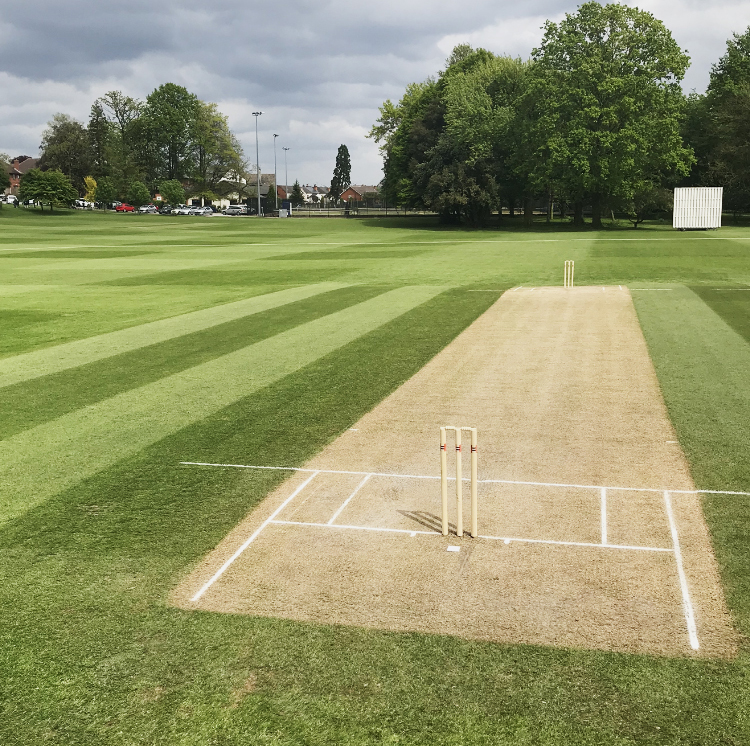
At Trent College in Nottingham, Head of Gardens and Grounds Peter Flewitt trialled Clipless NT® in this capacity, on the schools four cricket squares. “In our environment, we are able to renovate the squares much earlier in the growing season than perhaps other local clubs or the county grounds would. We applied Clipless NT® at the end of July, a week before we started our renovations and we nicknamed this area our ‘old grass’. We were interested to see if by regulating the growth here, the new seed sown in the vicinity would germinate better due to lower competition – and it worked well.”

Peter continues, “We left the ‘new grass’ to grow through and the difference in their comparative growth speeds was evident – particularly when we mowed for the first time that it was just this new grass being cut. With the Clipless NT®, used in conjunction with H-Cote™ (slow-release fertiliser) we were able to then manage and sustain the healthy, dense sward we achieved in our renovations through the autumn and winter period when our workload shifts focus onto our winter sports areas. With the wet winter we had, the Clipless NT® application kept growth in check meaning we didn’t have to take any mowing equipment out onto the soft ground at any stage.”

For the latest industry news visit turfmatters.co.uk/news

Get all of the big headlines, pictures, opinions and videos on stories that matter to you.

Follow us on Twitter and Instagram for fun, fresh and engaging content.

You can also find us on Facebook for more of your must-see news, features, videos and pictures from Turf Matters.
How to help rainfall rescue project

How to help rainfall rescue project: If you’ve some time on your hands, here’s a UK rainfall project that’s caught our eye at Rain Bird Golf.

The weather is always a topic of conversation for Brits.  Can you, your staff or family members take part in the Rainfall Rescue project and add to our UK rainfall know-how?

How to help rainfall rescue project

How to help rainfall rescue project

The UK has rainfall records dating back 200 years or so, but the vast majority of these are in handwritten form and can’t easily be used to analyse past periods of flooding and drought. Professor Ed Hawkins is a Reading University scientist who has run a number of “weather rescue” projects but this is the biggest yet.

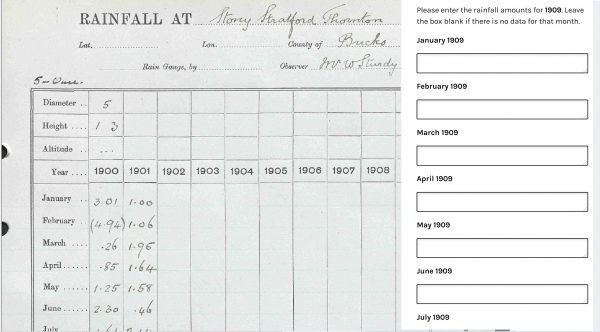
The Rainfall Rescue Project is seeking volunteers to transfer hand-written data to online spreadsheets.

The project is looking to fill the yawning gap in UK digital rain gauge records between the 1820s and 1950s.

Each of the 65,000 scanned sheets contains monthly rainfall totals for a particular decade at a particular station, approximately three to five million data points in all. If Prof Hawkins’ team can convert this information to a digital format, it could lead to a much better understanding of the frequency and scale of big droughts and floods. And, that will assist with planning for future flood and water-resource infrastructure.

For example, many across the country had a sodden start to the year because of heavy rainfall. Meteorologists suspect October 1903 was just as bad, if not worse, but unfortunately, because all the rainfall data from that time was hand-written, it’s not possible to analyse this data. Likewise, there were some very dry springs and winters in the 1880s and 1890s. Britain had six or seven very dry winters and springs on the trot. If that happened today, it would probably cause serious problems for water companies because they rely on wet winters and wet springs to recharge reservoirs.

Prof Ed Hawkins explains, “Water companies have to plan for a one-in-100 or one-in-500-year drought but we’ve only got 60 years of very dense digital data, and so it’s very hard for them to come up with reliable estimates. We know there are periods in the past that, if they happened again, would probably break the system. The same is true for very heavy rainfall and floods.

You’re not required to rummage through old bound volumes; the Met Office has already scanned the necessary documents – all 65,000 sheets. You simply have to visit a website, read the scribbled rainfall amounts and enter the numbers into a series of boxes. If you do just a couple of minutes every now and then – that’s great,” said Prof Ed Hawkins. “If you want to spend an hour doing 30 or 40 columns – then that’ll be amazing. But any amount of time, it will all add up and be a tremendous help.”

This can literally take 5 minutes – why not use your tea-break?
Take part in the Rainfall Rescue project here.

If you choose a particular year to work on, why that year? Is it the year your golf course opened or the year you held your most memorable tournament? Share your story on Twitter with #rainfallrescueUK. Tag@rainbirdgolfuk and we’ll share your story too!

Jimmy Sandison – Regional Golf Sales Manager – UK, Ireland, Iceland and Scandinavia

For the latest industry news visit turfmatters.co.uk/news

Get all of the big headlines, pictures, opinions and videos on stories that matter to you.

Follow us on Twitter and Instagram for fun, fresh and engaging content.

You can also find us on Facebook for more of your must-see news, features, videos and pictures from Turf Matters.

Greenkeepers work fury

Greenkeepers work fury: Greenkeepers at Caird Park Golf Club in Dundee are said to be fuming they are being forced to continue going in to work despite two of their colleagues testing positive for coronavirus, according to the region’s Evening Telegraph.

A report from BIGGA last week claimed that it was in their understanding that greenkeepers are able to keep “essential maintenance” of golf courses should they wish to, despite the UK lockdown for COVID-19 so that golfers would still have courses to play when the health crisis is over.

Union bosses are said to be backing the call for greenkeepers at the club to be off work due to two members of staff testing positive for COVID-19, with one other self-isolating due to having symptoms.

A decision to remove staff workers from the course is now being strongly backed by union bosses representing the club.

“Following the confirmation of the cases the remaining staff feel they shouldn’t be asked to go into work,” said Dundee branch secretary of the GMB, Jim Cunningham.

“The union is backing this call and we are demanding that our members should not have to go to work in the meantime. We have asked that the remaining workforce is currently removed from such  hazardous duties.”

He added: “We have been told that golf courses must be maintained so that when the current crisis is over they can immediately come back into use.

“However, we don’t believe that the greenkeepers and groundsman are essential staff currently. City council gardeners are not working at the moment and we don’t think our members should have to either.”

It is also claimed in the report that members of staff were not being supplied with the correct level of protective equipment with which to go about doing thejr jobs on the course.

Click here to read the original article

For the latest industry news visit turfmatters.co.uk/news

Get all of the big headlines, pictures, opinions and videos on stories that matter to you.

Follow us on Twitter and Instagram for fun, fresh and engaging content.

You can also find us on Facebook for more of your must-see news, features, videos and pictures from Turf Matters.

ICL’s LockStar available in Ireland

ICL’s LockStar available in Ireland: ICL has announced that LockStar – a new residual, pre-emergent total herbicide for vegetation management, is now available in Ireland.

LockStar arrives at a time when public green spaces, amenity areas and transportation infrastructure are all coming under increasing pressure from reduced budgets, weed infestations and a reduction in chemical solutions available on the market. This new herbicide will keep areas such as these weed-free, functional and visually pleasing.

ICL’s LockStar available in Ireland

ICL’s LockStar available in Ireland

Developed for use on natural surfaces not intended to bear vegetation, permeable surfaces overlying soil and railway ballast, LockStar controls a broad spectrum of weeds and has an innovative, long-lasting formula which allows for professional and safe weed control. The formula contains diflufenican and iodosulfuron-methyl-sodium – the first herbicide to receive full approval in amenity and landscape situations for many years.

When applied before germination LockStar creates a dual barrier at the soil surface ensuring that soil is kept weed-free for up to four months. To control weeds that are already present, LockStar should be tank-mixed with glyphosate or a fatty acid.

Plants can become resistant to active ingredients within products with the same mode of action, which is why LockStar features these two different active ingredients. Affecting plants in multiple ways, they give increased longevity compared to products with a single mode of action – useful for users undertaking a resistance management programme.

LockStar, available in a 500g pack, uses the latest generation of water dispersible granules, which means the product quickly dissolves in water and remains stable in the spray tank for a minimum of 24 hours.

Compared to conventional weed management programmes, LockStar keeps surfaces clean and weed-free for longer, as well as reducing the number of applications and amounts of herbicide required.

In Ireland LockStar should be applied at a rate of 500g/ha between March and June, with just a single application per season.

Please contact ICL Country Manager Colman Warde on +353 8777 99527 or visit www.icl-sf.ie for more information.

For more news and insightful views, you can follow ICL on Twitter @ICL_Turf

For the latest industry news visit turfmatters.co.uk/news

Get all of the big headlines, pictures, opinions and videos on stories that matter to you.

Follow us on Twitter and Instagram for fun, fresh and engaging content.

You can also find us on Facebook for more of your must-see news, features, videos and pictures from Turf Matters.

Ffos Las stay on course

Ffos Las stay on course: The dual-purpose track at Ffos Las Racecourse in Carmarthenshire stages Flat meetings throughout the summer months and National Hunt meetings for the rest of the year.

The challenge of keeping the track fit for the year-round schedule falls to Estate Manager and Clerk of the Course, Dai Jones. For Dai, the combination of Masterline PM79 and Johnson’s J Nitro 4Turf is the odds-on favourite for delivering hard-wearing, quick-recovery surfaces even under the most challenging of conditions.

Ffos Las stay on course

Ffos Las stay on course

Formally the site of an open cast coal mine, the location of the Ffos Las course leaves them exposed to strong south-westerly sea winds which, when combined with multiple years of heavy rainfall on the trot, causes challenging ground and growing conditions. “DLF worked in close counsel with the contractors throughout the construction process” explains Dai, who has been at the venue for two years. “They recommended the ProMaster 79 mixture from Masterline which was used to get the course ready for opening in 2009 and has continued to work well for us ever since.”

“With over 65 inches of rain falling here last year, I sat down with our local DLF Regional Technical Manager Ian Barnett to look at some alternative mixtures that would help to give some additional strength to some of the hardest hit areas.” They opted for ProNitro coated J Nitro 4Turf from Johnsons Sports Seed. 4Turf tetraploid rye ensures exceptional disease resistance and very rapid germination even at soil temperatures as low as 3oC. Its deep-rooted quality makes it ideal for the high wear requirements associated with equestrian use.

The J Nitro 4Turf gives Dai and the team a mixture for divot repair and overseeding that delivers reliable results for racing throughout the challenging winter months. “We used this on the take-off and landing sides of the fences, the hurdles and the bends through the winter months and found it to establish well even in the cold and wet. The root growth is tremendous giving us great hardiness and wear tolerance.”

He concludes, “We’ve now got a combination that is really well suited to our conditions. Through the summer we get strong recovery, great colour and healthy surfaces for racing with the PM79 mix. We can now sustain this when the ground softens, with J Nitro 4Turf giving us that extra boost.”

For the latest industry news visit turfmatters.co.uk/news

Get all of the big headlines, pictures, opinions and videos on stories that matter to you.

Follow us on Twitter and Instagram for fun, fresh and engaging content.

You can also find us on Facebook for more of your must-see news, features, videos and pictures from Turf Matters.