Tag Archive for: Aids

Green-tech aids increase in biodiversity

Green-tech aids increase in biodiversity: As Scotland’s eighth newest city (2022), Dunfermline was the birthplace of King Charles 1 and once served as the ancient capital of Scotland. Over recent years the city has become more popular with house prices increasing and investment in new residential developments.

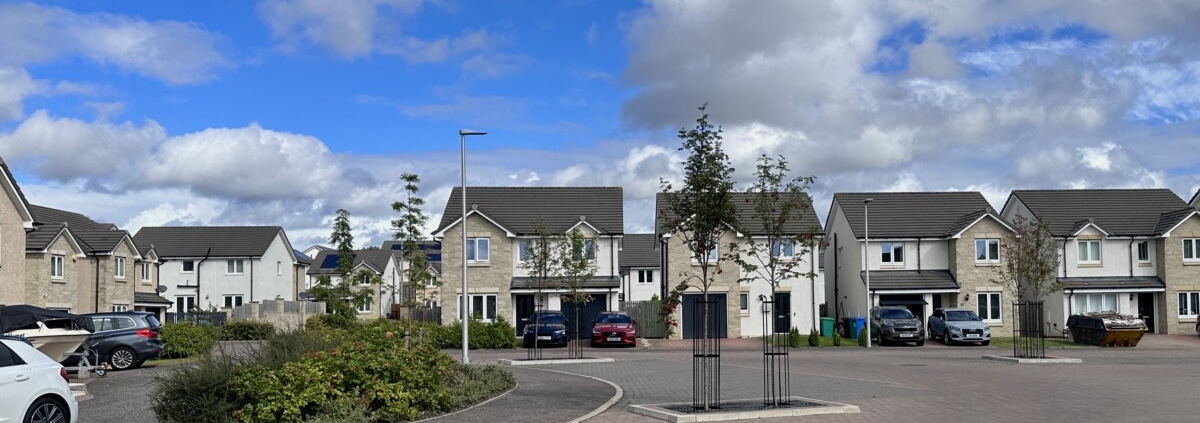
As part of the Dunfermline Eastern Expansion, Taylor Wimpey have built around a hundred homes, a mix of 3, 4, and 5-bedroom houses, as well as affordable housing units, situated around Macpherson and MacCallum Avenues.

Green-tech aids increase in biodiversity

Green-tech aids increase in biodiversity

Although Biodiversity Net Gain (BNG) is not mandatory in Scotland just yet, the National Planning Framework 4 (NPF4), focuses on ‘significant biodiversity enhancements’ for major developments. And any urban greening, particularly street trees, plays a vital role.

Although new developments have modern storm drains and sewers, unlike the old, woefully inadequate Victorian-era systems in the city centres, it is still important to attenuate rainwater, and subsequent runoff, diverting it from gushing straight down the drains. Trees are highly efficient at doing this, both through their root network, and leaf canopy. Add to this their ability to store carbon, capture airborne particulates, and provide habitat for birds and insects, and the value of trees to our neighbourhoods cannot be denied.

Green-tech Involvement

Advance Construction (Scotland) have been offering groundworks and civil engineering expertise throughout Scotland for over twenty-five years. They have worked with Green-tech for over ten of those years across various projects.

ACS approached Green-tech to price up twenty-one tree pits throughout the new Taylor-Wimpey development, using the TreeParker® tree pit support system.

Having been used in mainland Europe for the past twelve years or more, on high-profile projects such as the pavements around the Eiffel Tower, and Rotterdam’s main boulevard, Coolsingle, TreeParker® works by supporting the paving above a tree pit, whether used for pedestrian or vehicular traffic. In doing this, it protects the soil within the tree pit from becoming compacted. This enables the landscaper to use a soft, friable, organic topsoil for the tree to grow in, rather than having to make do with a less organic, structural tree sand.

Unlike similar systems, it has several distinct advantages. The heavy-duty, reinforced legs are available in six height options from the factory: 400, 600, 800, 1000, 1200, and 1500mm. This gives a previously unheard-of adaptability with depth options. From a contractor’s point of view, it means there is never any need to stack two units to achieve a depth over 600mm, saving installation time and money.

The other major advantage is that there are no side walls to get in the way of utilities, new or existing. By having smooth, rounded legs rather than side walls, the units can easily straddle or work around service pipes and lines.

There was a mix of tree pits across the site, mostly single trees, but also three double tree pits in the central section of MacCallum Avenue. To finish off the installations, Green-tech supplied cast-iron Newdale tree grilles, along with Wharfdale tree guards, to protect the trees from any vehicular contact. Grilles are an ideal way to give a smart, long-lasting finish to a tree pit, whilst allowing air and water access into the rooting area.

In total, twenty-one TreeParker® tree pits were installed, each having Mona Relief irrigation rings and cast aluminium filler caps, as well as underground anchor systems. With it being vital to the health of any tree or planting scheme, Green-tech delivered a total of 260 tonnes of Green-tree British Standard subsoil and Geocell topsoil to site over a staggered period as required.

Client Feedback

Stuart Mcneill, Managing Quantity Surveyor for Advance Construction (Scotland) comments, “We have always found Green-tech to provide excellent service. They deliver what they say, when they say they will. We found the TreeParker® system to be surprisingly quick and simple to install, and we look forward to working with it again.”

Further Information

For further product information or to request a CPD in person or remotely on any of our urban or rural modules, please email info@gtspecifier.co.uk or call on 01423 369728.

For the latest industry news visit turfmatters.co.uk/news

Get all of the big headlines, pictures, opinions and videos on stories that matter to you.

Follow us on Twitter and Instagram for fun, fresh and engaging content.

You can also find us on Facebook for more of your must-see news, features, videos and pictures from Turf Matters.

EcoBunker aids transformation at Skylark

EcoBunker aids transformation at Skylark: Seven years ago, Skylark Golf & County Club in Hampshire in the south of England, was in a sorry state.

“The course was opened in the late 1990s, and it was known at Quinn Dell,” says course manager Simon Bell-Tye. “And when I got here in 2014, it had been neglected and run down for most of that time. It was a field with holes in it.”

EcoBunker aids transformation at Skylark

EcoBunker aids transformation at Skylark

But the arrival of its new course manager was a sign that the place was on the up. Acquired by local company JDI (Just Develop It) in late 2013, the renamed Skylark hasn’t looked back.

“My boss at the time, Dan Richards, an ex-golf pro, had a real vision for the place, starting with making the course more presentable and playable,” says Bell-Tye. “But it was a big job. There was a weed called toad rush in the greens. I didn’t know what it was – I’d never come across it before – and the bunkers were just scoops in the ground.”

Now, though, Skylark’s bunkers are among its best-regarded features, thanks to the installation of synthetic edging system EcoBunker over several years. “I’m a member at Royal Winchester and I saw them doing the EcoBunkers there,” says Simon. “I mentioned this to Dan and he said ‘Good idea, get them in’. Rich Allen came and explained their process, and we took him and their construction manager Llewelyn Matthews to the eleventh hole, which had our very worst bunkers. Then Llew spent a week showing us how to build the EcoBunkers, and we haven’t looked back since.”

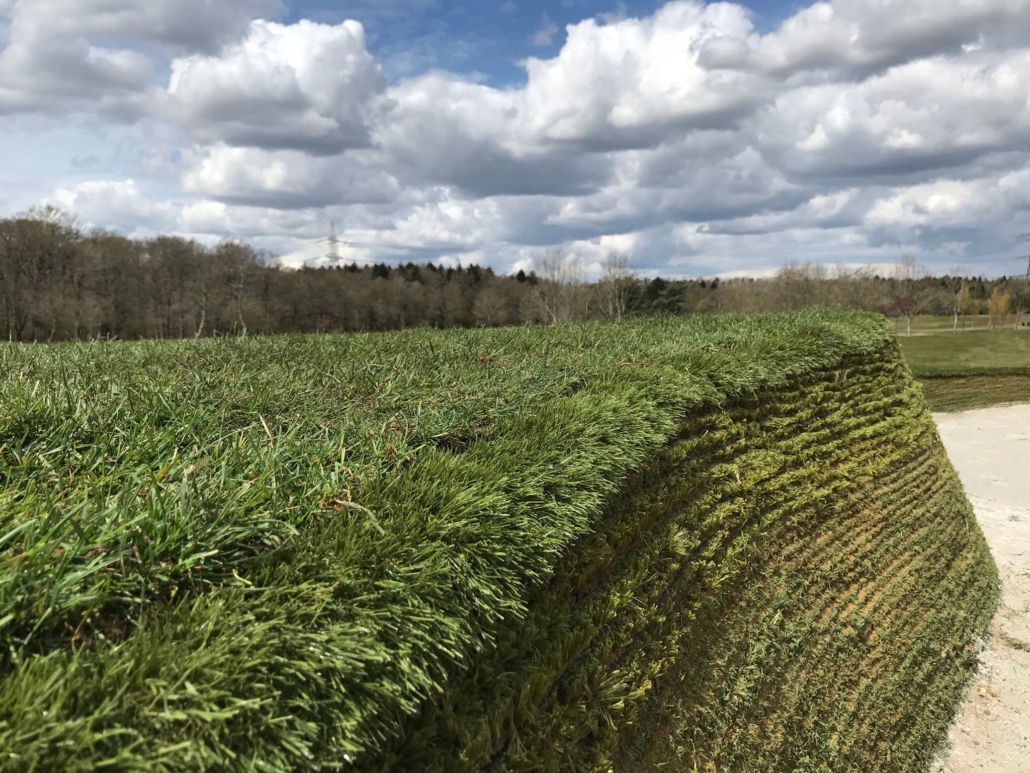
But the ‘normal’ EcoBunker method wasn’t enough for Skylark. To reduce the bunker maintenance still further, EcoBunker CEO Richard Allen devised a new add-on, named EcoEdge – which sees top quality artificial grass, backed with rubber, used as a rim for the bunkers. Compared to the usual EcoBunker Advanced methodology, where natural grass is planted on top of the synthetic edge, this obviously reduces the maintenance requirement for bunker edging still further. “Skylark was the first club in the world to use the EcoEdge system, although since, a number of other clubs have invested in it,” says Allen.

The reaction to the EcoBunkers was immediate. “Members loved them, so I got a budget to do a number of bunkers each year,” says Bell-Tye. “Ultimately, we have added fourteen extra bunkers to the golf course. We build them all in house – last winter I used forty pallets of material in four bunkers – and they look wonderful. They are huge, and they just pop out at you.”

Skylark’s success has come both on and off the course. From hosting one or two weddings a year, the club now does 140-150. And the golf? “When I joined we had 200-250 golf members. Now we’re up to 750, and we are full, with a joining fee,” says Bell-Tye.

For the latest industry news visit turfmatters.co.uk/news

Get all of the big headlines, pictures, opinions and videos on stories that matter to you.

Follow us on Twitter and Instagram for fun, fresh and engaging content.

You can also find us on Facebook for more of your must-see news, features, videos and pictures from Turf Matters.
GDD Calculator aids more accurate decisions

GDD Calculator aids more accurate decisions: A new Syngenta GreenCast Growing Degree Day calculator is set to provide turf managers with a more accurate tool to help make better decisions on timing for Primo Maxx II applications and other actions.  

The GreenCast GDD Calculator will automatically generate a predictive email notification when a user defined Growing Degree Day (GDD) target is approaching – in time for greenkeepers to assess local conditions and to decide what actions to take.   

GDD Calculator aids more accurate decisions

GDD Calculator aids more accurate decisions

Commenting on the live launch of the GDD Calculator on GreenCast this week (11 May 2020), Syngenta Technical Manager, Glenn Kirby, said: “We know that GDD can be a useful guide to many turf management actions.  

“However, from my own and other greenkeepers’ experience, the challenge in a busy working schedule is finding the time to regularly record the temperature information and the reliability of that weather data source. 

“The GDD Calculator does that all autonomously, and provides easy to interpret information in time to use for every day decision making.” 

Advancing GDD to a new level, the GreenCast calculator utilises immense data processing capability to compute figures from hourly temperatures throughout the 24-hour period, compared to a simplistic daily high and low temperature conventionally used in GDD calculation.  

“That better reflects the duration of growing conditions through the day, for a more accurate assessment of how turf will actually perform,” advised Glenn. 

Evaluation compared to conventional GDD calculation has highlighted it is more responsive to assess onset of true growing conditions, particularly through early spring, and as growth declines in the autumn.       

Users can set their own target GDD figure, or multiple targets if GDD is being used to aid decisions on different aspects of turf management, such as Primo Maxx II intervals, fertiliser programmes or pest risks, for example. 

Glenn highlights Growing Degree Days have been shown to be an extremely useful guide for timing of turf management decisions. But he cautions that much of the research and many of the models have been based on US trials, under different conditions and with different grass species seen in the UK. 

“The Syngenta GDD Calculator gives far greater flexibility to be able to utilise and interpret a wide range of information resources. But they do all need to be validated against an individual course’s specific conditions to see how they can be applied.  

Uniquely, the Syngenta calculator allows users to adjust the base temperature used in calculations. Whilst a normal base for the UK is 6°C, which reflects the onset of consistent turf growth, Glenn suggests, many US models work from a base of 10°C – which generates hugely different cumulative GDD figures.  

“It is crucial to understand how recommendations have been calculated and the information on which they are based, and then use the GDD Calculator to interpret how that will work on your course,” he advocated. 

Whilst a GDD of 150 may be appropriate for Primo Maxx II intervals on one specific course, for example, he points out another course with a different management style, turf species or soil types, may find they get better results by repeating applications at a GDD of 140.     

The GDD calculator is now being used at STRI in Yorkshire, as part of a new initiative assessing Primo Maxx II applications and intervals to aid turf management under lower intensity lockdown management. 

“For the first time, there will be scientifically assessed GDD data for cool season grasses under UK growing conditions, to enable turf managers to better interpret existing turf growth models for their own individual situations,” added Glenn.  

”It is free and easy to use, so would urge anyone to start gathering the data and assess how it correlates to their own decision making process now, to be able to further integrate GDD in the future,”  

The Syngenta GDD Calculator is available for all UK turf managers, agronomists and researchers registered on the GreenCast website.

For the latest industry news visit turfmatters.co.uk/news

Get all of the big headlines, pictures, opinions and videos on stories that matter to you.

Follow us on Twitter and Instagram for fun, fresh and engaging content.

You can also find us on Facebook for more of your must-see news, features, videos and pictures from Turf Matters.
Greenmaster Aids Recovery

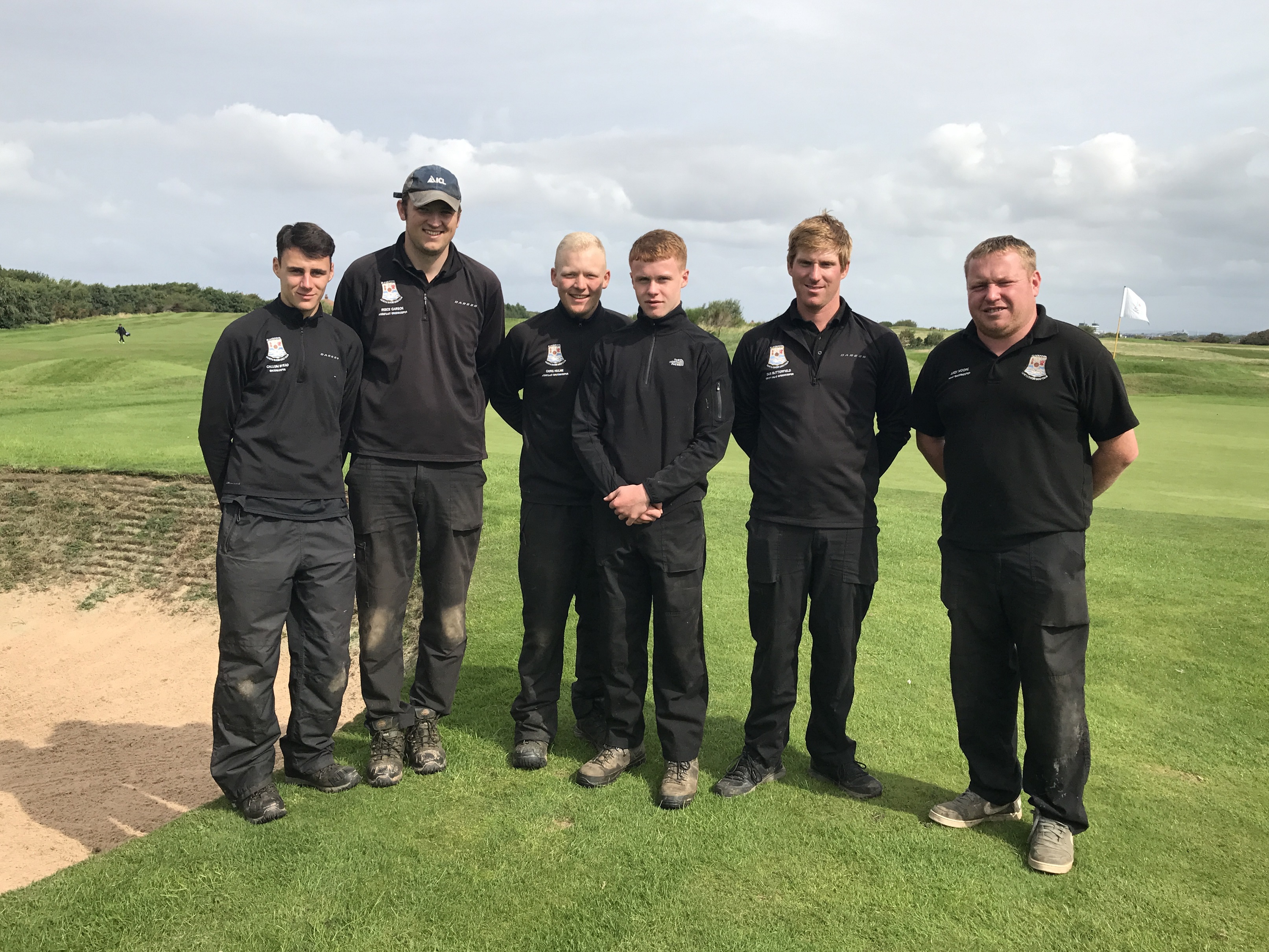
Greenmaster Aids Recovery: Following a severe Microdochium Nivale outbreak which left scars on the greens at Blackpool North Shore Golf Club, Head Greenkeeper Andy Moore, turned to two products from the ICL Greenmaster Pro-Lite range in order to assist the recovery.

Designed by legendary golf course architect Harry Colt, Blackpool North Shore was established in 1904, and has been an Open Championship qualifying venue. The course can even boast the fact that it hosted the first ever fund raising event of The Duke of Edinburgh Awards Scheme in 1963 and attracted a number of golfing greats such as Jack Nicklaus, Arnold Palmer and Gary Player. The course has continued to flourish and has been home to the PGA Lancashire Open for over 17 consecutive years.

Greenmaster Aids Recovery

Andy, who was promoted from Deputy to Head Greenkeeper in March 2017 immediately had his work cut out, as he explains:

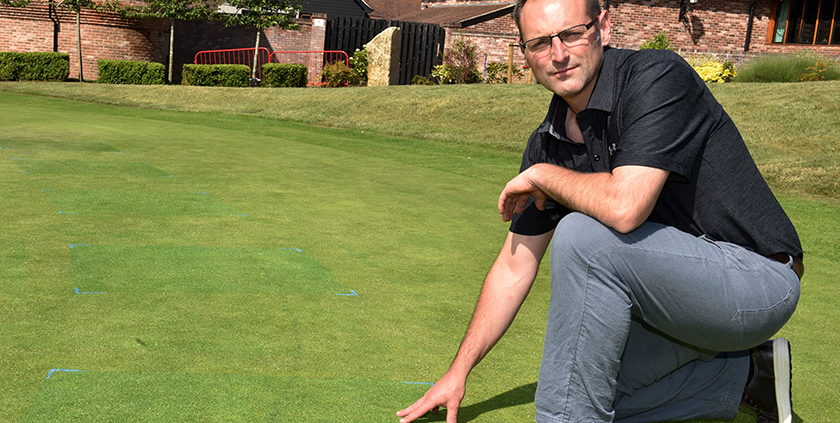
“We got hit quite hard in autumn 2016 and almost every green was infected with Microdochium. After that we were left with a lot of scars and my first six months were all about trying to get the greens back and to try and achieve a truer surface,” he said.

As a result from the outbreak, members were forced to play on temporary surfaces for a period of six months, and Andy knew he had to turn things around incredibly quickly.

“The members knew the full extent of it and although they were understanding they still needed to see improvements. If we were going into April, May or June and we still hadn’t done anything about the scarring then the members could have remained on temporary greens for nine months. They pay good money to be part of this club and I wanted to give them something they could be proud of. I spoke to Phil Collinson (ICL Technical Area Sales Manager) and am pleased I did because the two Greenmaster Pro-Lite products have worked wonders for us.”

Greenmaster Aids Recovery

Andy and Phil decided that ICL’s Greenmaster Pro-Lite Cold Start 11-5-5 and Greenmaster Pro-Lite Invigorator 4-0-8, would be the best course of action, and it wasn’t long before Andy started seeing the results.

“Initially, I felt that we had to alleviate the disease scars and encourage the poa so that we could produce a truer and smoother surface the members could start to enjoy playing on again.As well as providing nutrition we also carried out some solid tining maintenance  along with overseeding. We started with one application of Cold Start at 25g/m2 and then we applied Invigorator at 30g/m2every four weeks. We went with both products, to get the recovery as quickly as possible. The trial work carried out by ICL backed up Phil’s recommendations and this gave me even more confidence in the approach.

“We started by applying Cold Start in February 2017 and it  gave us fantastic recovery at a time of year when conditions were challenging for growth. We followed this up with an application of Invigorator 4 weeks later to keep driving the recovery we needed. Once we got the greens to a good standard, and the recovery was gained, we appliedGreenmaster Cold Start at a low rate again in mid-April . They no longer required any further applications of Invigorator because its main use was to get the greens back to a puttable standard, and it did just that .It was at this point we switched to the ICL liquid products that have given us the consistency we wanted over the summer.”

With the greens back to the excellent standard expected by both Andy and the club members, he has since embarked on a full ICL iTurf programme, which he devised with Phil Collinson.

Greenmaster Aids Recovery

“I’m fairly new into the management side of things but I was always aware of what products worked for us and what didn’t. With that in mind I wanted to embark on an ICL iTurf programme and I always had a good relationship with Phil so it just felt right. A programme has now been put in place and we’ve had great success with it. I think the combination of the ICL products and the site conditions here have worked really well. The course is close to the best it has ever been and that is according to the members. In my opinion, that is the best feedback I can get.”

“We are now working with Phil to put in place an integrated management programme that will help avoid a repeat of the disease problems that the club experienced last year.”

Please contact ICL on 01473 237100 or visit www.icl-sf.co.uk or www.icl-sf.ie if you are in Ireland.

For the latest industry news visit turfnews.co.uk

Get all of the big headlines, pictures, opinions and videos on stories that matter to you.

Follow us on Twitter for fun, fresh and engaging content.

You can also find us on Facebook for more of your must-see news, features, videos and pictures from Turf Matters.