

Tag Archive for: Bunker

Capillary Concrete solving bunker problems

Capillary Concrete solving bunker problems: The exclusive Loch Lomond Golf Club in Scotland is coming to the end of a huge four year renovation project – at a total cost of £7.5 million, probably the most costly in the history of British golf – in which 85 per cent of the golf course has been sand-capped (apart from the USGA greens), its drainage infrastructure rebuilt, its irrigation system completely renewed and its bunkers reconstructed using the Capillary Bunkers lining system.

Surrounded by mountains and next to Britain’s largest freshwater lake, Loch Lomond has always faced huge problems caused by its environment. “We have a lot of bunkers – and a lot of rain,” says David Cole MG, the club’s director of golf course and estates. “We average around 2000mm (79 inches of rain a year), and our bunker design has some steep faces in places. As a result, we have always suffered badly from washouts and contamination. Bunker maintenance is our second largest consumer of greenkeeping resources, second to greens – due to the design, the size (8500m2), the amount, the player expectations and the environment, it takes a lot of resources to prepare the bunkers internally and externally for play on a daily basis, and it was frustrating not being able to produce a consistently good product from this valuable resource due to the ageing infrastructure and the uncontrollable element of frequent rainfall.

Capillary Concrete solving bunker problems

Capillary Concrete solving bunker problems

Cole and his team, along with contractor Esie O’Mahony of GolfLink Evolve, have rebuilt the course from the bottom up. The new drainage pipes are laid in trenches lined with geotextile to reduce the ingress of fine particles, and the pipes themselves have been resized to deal with the volume of water. The project was planned to be completed over the winter of 2019/20, but the Covid-19 pandemic meant that two holes were left unfinished. Those have been dealt with over this winter.

In among this huge quantity of construction, Cole was determined to improve the consistency of the bunker presentation and reduce the internal bunker maintenance challenge. “We wanted to try to eliminate sand contamination and washouts and ensure we give our members a quality product no matter the weather, he says. “After reviewing and trialling the options available, we selected Capillary Concrete throughout the project to line the bunkers. The product gives a lot of confidence. It’s concrete, so you know it is going to last, and the fact that you can install in wet weather situations is a huge plus for us as the renovation and installations took place throughout the wettest period of the year. The cost is obviously important – we are spending a lot of money on this project, but we are conscious that it is our members’ money, and we want to get good value for them – and Capillary Bunkers was very competitive.”

Cole says he is already seeing the benefits. “The simple fact is that we aren’t spending hours pushing sand back up bunker faces after rain. Ultimately since the liner has been installed the sand does not slip off the face after heavy rain events and daily preparations to present a good product for our members and guests is less labour intensive than previous. This allows us to focus more time on the detail work of internal bunker maintenance, and/or redirect resources to other priority areas that been neglected prior to this undertaking. Most days, three guys can deal with the internal bunker preparation, when previously it was five or six. Quantifying that isn’t easy and COVID-19 has not helped, but I think we may see a forty-fifty per cent reduction in resources we use preparing the internals of bunkers yet still producing a superior product.”

For the latest industry news visit turfmatters.co.uk/news

Get all of the big headlines, pictures, opinions and videos on stories that matter to you.

Follow us on Twitter and Instagram for fun, fresh and engaging content.

You can also find us on Facebook for more of your must-see news, features, videos and pictures from Turf Matters.
Irish links extends bunker longevity

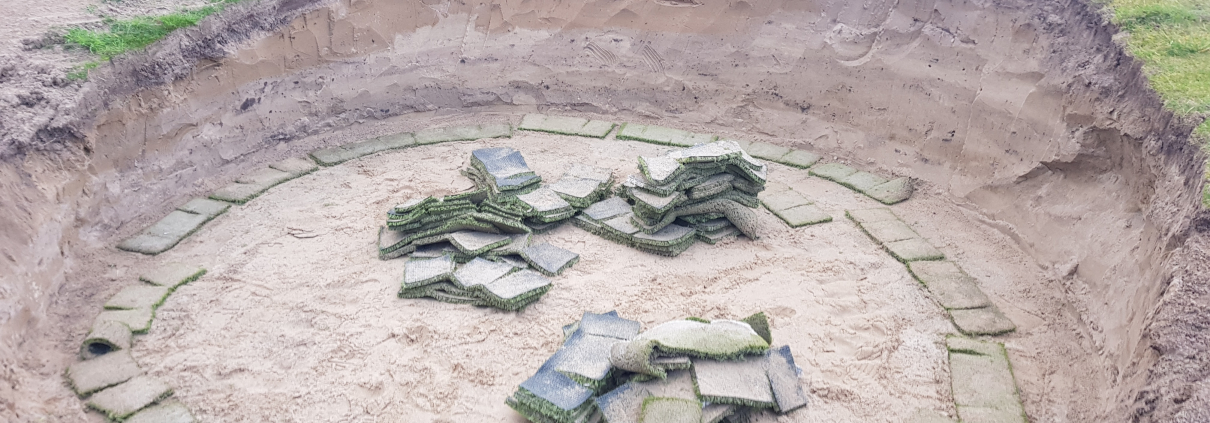
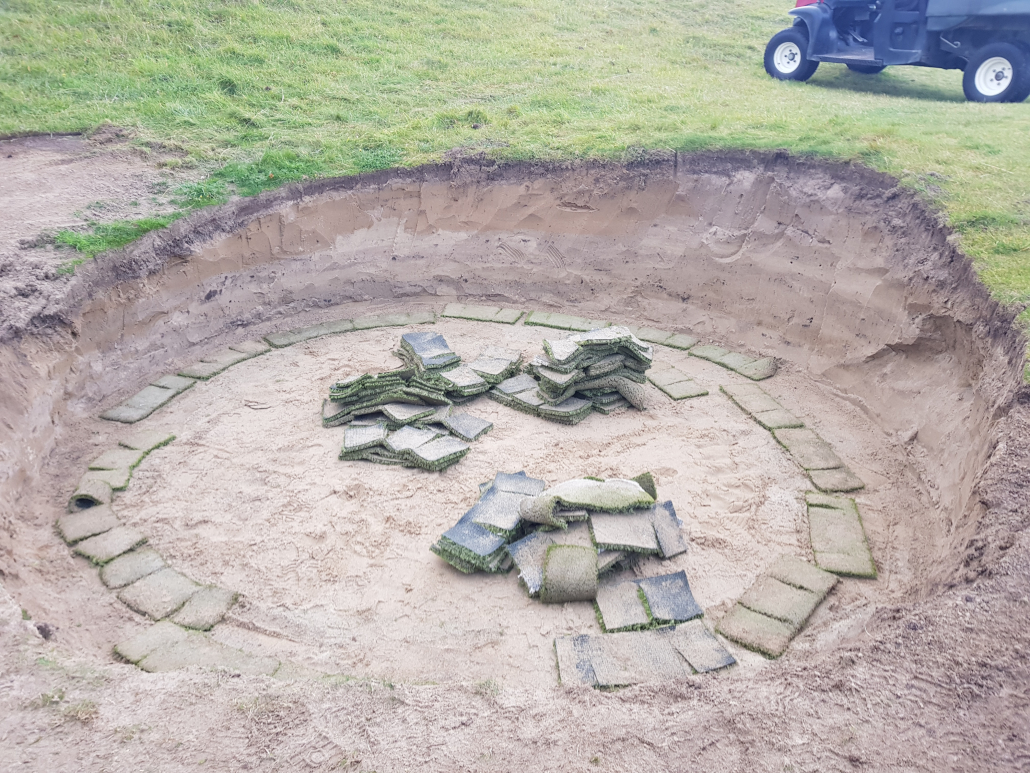
Irish links extends bunker longevity: The Island GC outside Dublin, generally regarded as one of Ireland’s finest courses, has rebuilt a large proportion of its revetted bunkers using a new solution from synthetic bunker solutions provider EcoBunker.

The course, which is currently undergoing a renovation at the hands of architects Mackenzie and Ebert, has adopted a new approached created by EcoBunker inventor and CEO Richard Allen, that sees the bottom six turf layers of the revetted wall built from synthetic turf, while the rest is natural.

Irish links extends bunker longevity

“Revetted bunkers decay from the bottom up, which is only to be expected because it is the bottom of the wall that is most exposed to water,” says Allen. “When the bottom of the wall fails, wind and rain get in behind the revet and remove sand, eventually causing the wall to collapse. With synthetic turf at the base, this will not happen, and the longevity of the wall will be significantly enhanced.”

“Setting the base of a revetted bunker is the part of the build that takes the most time,” says course manager Dave Edmondson. “With the EcoBunker base in place, all we will have to do when it comes to rebuilding the wall is to remove the natural revet with a spade and replace the turf. Six layers of artificial turf is a totally solid base on which to build the rest of the wall. It’s not going to move. Our revetted bunkers normally last between three and five years – south facing ones degrade faster than others – so the improvement using this EcoBunker method could be quite substantial.”

Edmondson says it is hard to see a downside of this new method. “We have to buy in my revetting turf, so putting in a synthetic base will actually make rebuilding cheaper in the future,” he explains. “And there is absolutely zero aesthetic impact. When the sand is ready for play, the synthetic turf is all below the sand line. Everything you can see is natural; it looks just like a normal revetted bunker.”

For the latest industry news visit turfmatters.co.uk/news

Get all of the big headlines, pictures, opinions and videos on stories that matter to you.

Follow us on Twitter and Instagram for fun, fresh and engaging content.

You can also find us on Facebook for more of your must-see news, features, videos and pictures from Turf Matters.
Bunker Washouts Destroying Morale

Bunker Washouts Destroying Morale: The greatest challenge that has faced golf course superintendents over the past several years has been the difficulty of recruiting and retaining staff.

All courses – regardless of budget – are impacted by this labor shortage, but those hit worst are struggling to simply keep up with mowing the entire golf course each week. Unfortunately, Mother Nature isn’t cutting them any breaks this summer.

Common pop-up thunderstorms throughout the Southeast are making it more difficult to complete daily maintenance with an undersized staff. These storms pack heavy winds and significant rain amounts in a short time span – washing out bunker sand, spreading debris throughout the golf course, knocking down trees, breaking irrigation pipe with lightning strikes, saturating soils and much more.

Out of all these challenges, repairing bunker washouts may be the most hated task among golf course superintendents and crew members. Repairing washouts is slow, back-breaking work and the staff could easily be out the next day repairing the very same bunker if another pop-up storm strikes. Simply put, frequent heavy rain events each summer can be a morale killer for a fully staffed maintenance crew and the straw that broke the camel’s back for undersized crews.

Bunker washouts also impact the consistency of bunker sand. The constant movement of sand can create overly soft conditions in the short term, and contamination from washouts can negatively impact playability and sand drainage in the long term. Perhaps the most significant impact to golfers is the logistical challenge that bunker washouts present to the maintenance team. Superintendents must choose which tasks will be performed each day. When bunkers get washed out by a storm, some other aspect of course management must be skipped to repair the bunkers.

What can golfers do to help? Every course’s design and available maintenance resources are different, which greatly impacts a maintenance team’s ability to address issues like washouts. It is important to understand that the maintenance team is doing their best to maintain the golf course with the resources available. Given the current labor shortage, being understanding, patient, and offering a quick “thank you” is the best way to support those who work hard maintaining our golf courses.

What can superintendents do? Document labor-hour allocation to communicate the impact of bunker washouts on course maintenance. This data can be used to communicate the need for a bunker renovation, higher wages or more employees. Also, temporary labor services are a good resource for washout repairs.

Click here to read the original article

For the latest industry news visit turfmatters.co.uk/news

Get all of the big headlines, pictures, opinions and videos on stories that matter to you.

Follow us on Twitter and Instagram for fun, fresh and engaging content.

You can also find us on Facebook for more of your must-see news, features, videos and pictures from Turf Matters.

Capillary Concrete Bunker Upgrade

Capillary Concrete Bunker Upgrade: You know exactly what you’re going to get’, says superintendent of club, one of the hundred oldest golf clubs in America.

New Canaan, Connecticut, 12 November 2018 — The Country Club of New Canaan, one of the oldest golf clubs in America, is three years into a five year masterplanning process with architect Andrew Green. And, according to superintendent Michael Roe, the Capillary Concrete bunker liner system, is an essential part of that project.

Capillary Concrete Bunker Upgrade

The club was founded in 1893, which makes it one of the hundred oldest golf clubs in America, and its first nine holes were designed in 1895 by the legendary Willie Park Jr, twice an Open champion, on his first trip to the United States. Walter Travis designed the second nine in the early 1920s. As well as the course renovation headed up by Green, the club is working on a massive clubhouse rebuild at the moment.

Michael Roe said: “The first year we worked with Andrew, we renovated two holes, using a different bunker liner, and I wasn’t in love with how it performed, because the strength and durability was just not there. After year one, we switched to Capillary Concrete, and I’m certain that we will stick with it for the rest of the course. Concrete is just stronger when all is said and done. The level of oversight during the installation process is just better. With Capillary Concrete, their guys come with a plan and jointly you approve it – you know exactly what you are going to get, which is a two inch solid base right through every bunker.”

Capillary Concrete product expert Rusty McLendon said: “New Canaan has a ton of history and a really neat golf course. But what has impressed me the most from working with them is the attention to detail showed by Mike Roe and his team. Every time I go there, I ride around the course with Mike, and I see something new and different. They worked all winter long building dry stone walls throughout the property, and they are beautiful. To have someone with such an eye for detail telling us our product is the best one out there is very satisfying.”

For the latest industry news visit turfmatters.co.uk/news

Get all of the big headlines, pictures, opinions and videos on stories that matter to you.

Follow us on Twitter for fun, fresh and engaging content.

You can also find us on Facebook for more of your must-see news, features, videos and pictures from Turf Matters.