Tag Archive for: Climate

Germinal launches new Climate Smart ‘A Range’

Germinal launches new Climate Smart ‘A Range’: Germinal Amenity – a market leader in the development and supply of specialist seed products for the amenity sector – has launched a new range of Climate Smart seed products specially formulated for landscape projects, architecture, golf and sports turf applications. 

This new range – called the ‘A Range’ from Germinal – places sustainability centre stage to meet the full breadth of requirements of landscape architects and turf professionals. The new range combines trusted performance grasses with new, resilient clovers and nature-positive wildflower mixes that support the transition to greater sustainability in landscape projects, amenity grass and sports turf management.
Germinal launches new Climate Smart ‘A Range’

Germinal launches new Climate Smart ‘A Range’

The A Range includes four new Climate Smart seed products that incorporate cutting-edge innovations in plant varietal development from Germinal’s R&D division, Germinal Horizon. These include DoubleRoot, a hybrid clover that produces both stolons and underground rooting stems called rhizomes. DoubleRoot fixes free atmospheric nitrogen for companion grasses, can withstand extremes of temperature and drought, and holds up under mowing. DoubleRoot combines low-maintenance with significant environmental benefits.

The new Climate Smart A Range products are:

ASustain – a low maintenance, self-sustaining grass seed mixture that contains the DoubleRoot hybrid clover providing a sustainable surface for landscape projects, solar farms, domestic lawns, road verges and green roofs.

A18 Road Verge & Embankments – especially developed for road verges and embankments which includes resilient grass varieties and DoubleRoot; this mixture revitalises grassed areas and enhances both wildlife habitats and soil health.

A35 Sandy Soils – a hybrid mixture of grasses, selected herbs and wildflowers formulated for road verges on sandy soils to deliver exceptional environmental performance.

A36 Loamy & Clay Soils – a versatile mixture for more productive loamy and clay soils that combines durable grasses, herbs, and wildflowers to deliver exceptional biodiversity and sustainability for a range of amenity areas.

Commenting, Richard Brown, Germinal Amenity Director UK & Ireland, said:

“The challenges around how we achieve Net Zero and adapt to changing climatic conditions has brought environmental sustainability into sharp focus. It has become a key concern for landscape architects, greenkeepers and the wider turf community.  Designers and grounds keepers are looking at how we use scarce resources such as water, and how we can lower or even eliminate the need for fertilisers and pesticides, and support greater biodiversity in our turf management. The plants we grow also need to be resilient in the face of a changing climate.

“The A Range has been developed with sustainability at its core, but without sacrificing performance. It includes tried and trusted mixes together with our new Climate Smart products in new formulations that incorporate significant innovation.

“We are also backing the breadth and innovation at the heart of the A Range with experienced technical advice and information resources available directly from our Ireland and GB sales teams and online through the Germinal Knowledge Hub.”

The A Range includes the full range of Germinal’s trusted and proven seed products for all landscape, golf and sports turf applications including ForeFront Greens, AberMajesty Blend, A5 Golf Tees and Tour Leader.

The A Range also offers Germinal’s pollinator-friendly wildflower products, including True Meadow. These mixtures have been formulated for a wide range of developed areas and natural habitats. They also include Regional Environmental (RE) mixtures which meet the requirements of government-sponsored biodiversity schemes in the UK.

The new A Range catalogues from Germinal offers a guide to this unique range of grass, clover and wildflora amenity seed products and are available at germinalamenity.com.

Celebrating 200 Years of Innovation

In 2025, Germinal, Germinal Amenity and their parent group, Openfolde, celebrate 200 years of operations as family-owned businesses. Their mission is to support farming and the amenity sector with innovative products that are developed with a passion for science, research, technical advice and the considerable time needed to develop high performing plant varieties that meet their customers’ requirements for performance and sustainability.

Germinal is a market leader in developing and supplying seeds and climate smart seed mixtures in Great Britain, Northern Ireland, the Republic of Ireland and New Zealand. Its R&D division – Germinal Horizon – develops plant varieties in collaboration with the Institute of Biological, Environmental and Rural Sciences (IBERS) at Aberystwyth University and at its field trials centre in Wiltshire.

Germinal is also a lead partner in Project NUE-Leg, the UK government-funded multi-partner and multi-location project that seeks to maximise the nitrogen-fixing potential of legumes to reduce emissions in grassland farming, and reduce the need for bought-in nitrogen fertilisers.

For the latest industry news visit turfmatters.co.uk/news

Get all of the big headlines, pictures, opinions and videos on stories that matter to you.

Follow us on Twitter and Instagram for fun, fresh and engaging content.

You can also find us on Facebook for more of your must-see news, features, videos and pictures from Turf Matters.
DLF Seeds a top 20 ‘Climate Friendly Company’

DLF Seeds a top 20 ‘Climate Friendly Company’: DLF Seeds have been recognised as one of the top 20 most ‘Climate Friendly Companies’ of 2021 in a recent list compiled by European Seed Magazine.

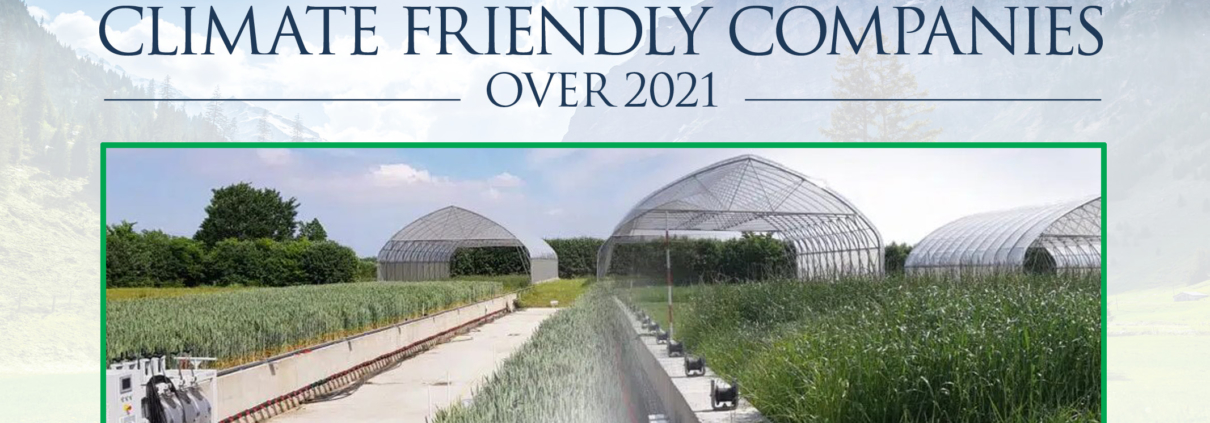
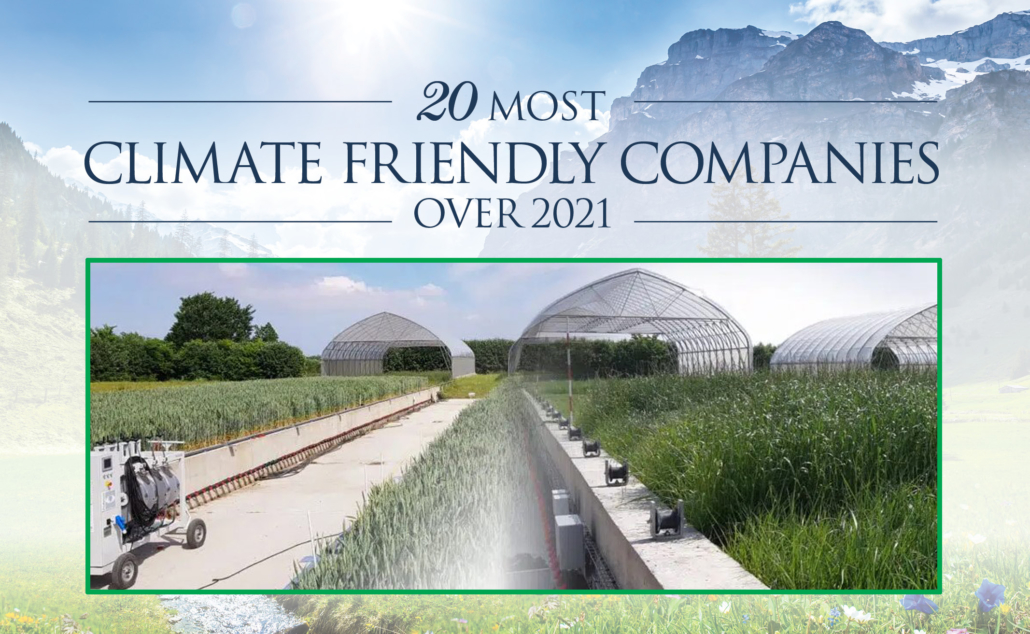
Particular mention was given to DLF’s RadiMax facility in Denmark – the world’s largest open-field root screening facility – that is leading the way in the research and development of sustainable varieties to tackle one of the most pertinent climate threats, drought.

DLF Seeds a top 20 ‘Climate Friendly Company’

DLF Seeds a top 20 ‘Climate Friendly Company’

Years before the climate agenda hit the breeding companies, DLF took the bold move of assembling breeders and scientists from across the public and private sectors in the pursuit of advancing seed breeding to suit future climates. Through this consortium DLF built their RadiMax facility, which can test up to 600 plant lines simultaneously in four V-shaped pits, each equipped with a unique irrigation system designed to simulate specific conditions and, in turn, identify the deepest rooting varieties.

With more than five years of research now under their belts, DLF have been able to supply turf and amenity customers with varieties with verified deep rooting and drought stress tolerance. A deeper rooting plant is not only better placed to withstand extended periods without water, it delivers a stronger and more stable sward with lower reliance on inputs. This is because the significant root growth enables the grass to better utilise the water and nutrients naturally found in the soil profile, improving overall nutrient and Nitrogen efficiency.

Of specific interest to the amenity market is the notable developments with key Fescue and Perennial Ryegrass species which have led to the introduction of more sustainable and drought tolerant mixtures such as Johnsons Sports Seed J Fescue mix for golf. The unique combination of cultivars in this 100% fine fescue blend have been chosen specifically to provide high drought and salt tolerance, resistance to disease and a sward that requires lower inputs of water and fertilisers.

The trials at RadiMax also demonstrated how DLF’s 4turf® tetraploid perennial ryegrass roots faster and deeper when compared to traditional diploid ryegrass. Its rapid root growth and larger root mass makes for a more resilient plant, suited to a wide range of sports turf applications. 4turf® varieties are incorporated into a number of Johnsons mixtures, including the new Johnson’s J Premier 4Turf, combining 4turf® tetraploids with traditional perennial ryegrass to create the ultimate winter sport renovation mixture.

For the latest industry news visit turfmatters.co.uk/news

Get all of the big headlines, pictures, opinions and videos on stories that matter to you.

Follow us on Twitter and Instagram for fun, fresh and engaging content.

You can also find us on Facebook for more of your must-see news, features, videos and pictures from Turf Matters.
Control your climate with CAB CLIMA

Control your climate with CAB CLIMA: The Corvus Terrain range of 4×4 utility vehicles was introduced in the UK in 2019.  Since then the Terrain has gone from strength to strength to create a UTV that adapts to the user and their work environment.

Corvus, Europe’s first manufacturer of 4×4 Side by Side vehicles, offers an efficient Yanmar Diesel engine, market-leading onboard storage capacity and a well-designed full cab option.  Now they have increased the Terrain’s comfort levels with the new CAB CLIMA package. Starting from the current integrated system of doors, air conditioning and heating found on the Terrain DX4, CAB CLIMA improves the vehicle’s working conditions and comfort with a central console to control heat, ventilation and air conditioning (HVAC). Now you can carry out any task safely protected and isolated from the weather outside, all-year-round. The air conditioning system with electronic control is simply operated through the central console with airflow control in three positions. There are front windscreen and anti-fogging diffusers to keep your forward vision clear and safe. With a total of eight diffusers, four of them are able to rotate through 360º.

Control your climate with CAB CLIMA

Control your climate with CAB CLIMA

CAB CLIMA joins the other Terrain high specification levels of full instrumentation, 3-cylinder 993cc Yanmar Diesel engine, which is Euro 6 compliant and gives excellent fuel efficiency and range, and homologation Type EU T1b. Other standard equipment includes two adjustable seats, skid plate, 4×4/4×2 system, 2-point safety belt, adjustable suspension and 244-litre onboard storage with 450kg cargo box. Pro and cab packages are available together with a range of original manufacturer accessories. The Corvus Terrain models come with a 2-year warranty.

For more information about the Corvus Terrain range, you can call 01597 810188, E-mail: sales@bossorv.co.uk or visit www.bossorv.co.uk

For the latest industry news visit turfmatters.co.uk/news

Get all of the big headlines, pictures, opinions and videos on stories that matter to you.

Follow us on Twitter and Instagram for fun, fresh and engaging content.

You can also find us on Facebook for more of your must-see news, features, videos and pictures from Turf Matters.

Climate Change In Cricket

Climate Change In Cricket: Cricket has always been a sport at the mercy of the weather.

In the 1930s, county cricket clubs in England were headed for financial ruin after a succession of wet summers. Twenty years later, persistent rain saw desperate clubs experiment with blankets, rubber mats and suction machines.

As recently as the summer of 2012, three of England’s 13 ODIs were abandoned due to rain, while no result was possible in two of their seven Test matches with West Indies and South Africa.

That’s why the sport must take notice of a report published by Climate Coalition, the UK’s largest climate change action group, in February.

The document names cricket as the sport that will be hardest hit by climate change in England, stating that “wetter winters and more intense summer downpours are disrupting the game at every level”.

That was reiterated by Glamorgan Head of Operations Dan Cherry, who warned that climate change could “fundamentally change the game”.

“The less cricket we play, the fewer people will watch it, the less they will come to the ground and pay to enter, the less chance there is for young people to be inspired,” said Cherry.

This change, it seems, has already begun.

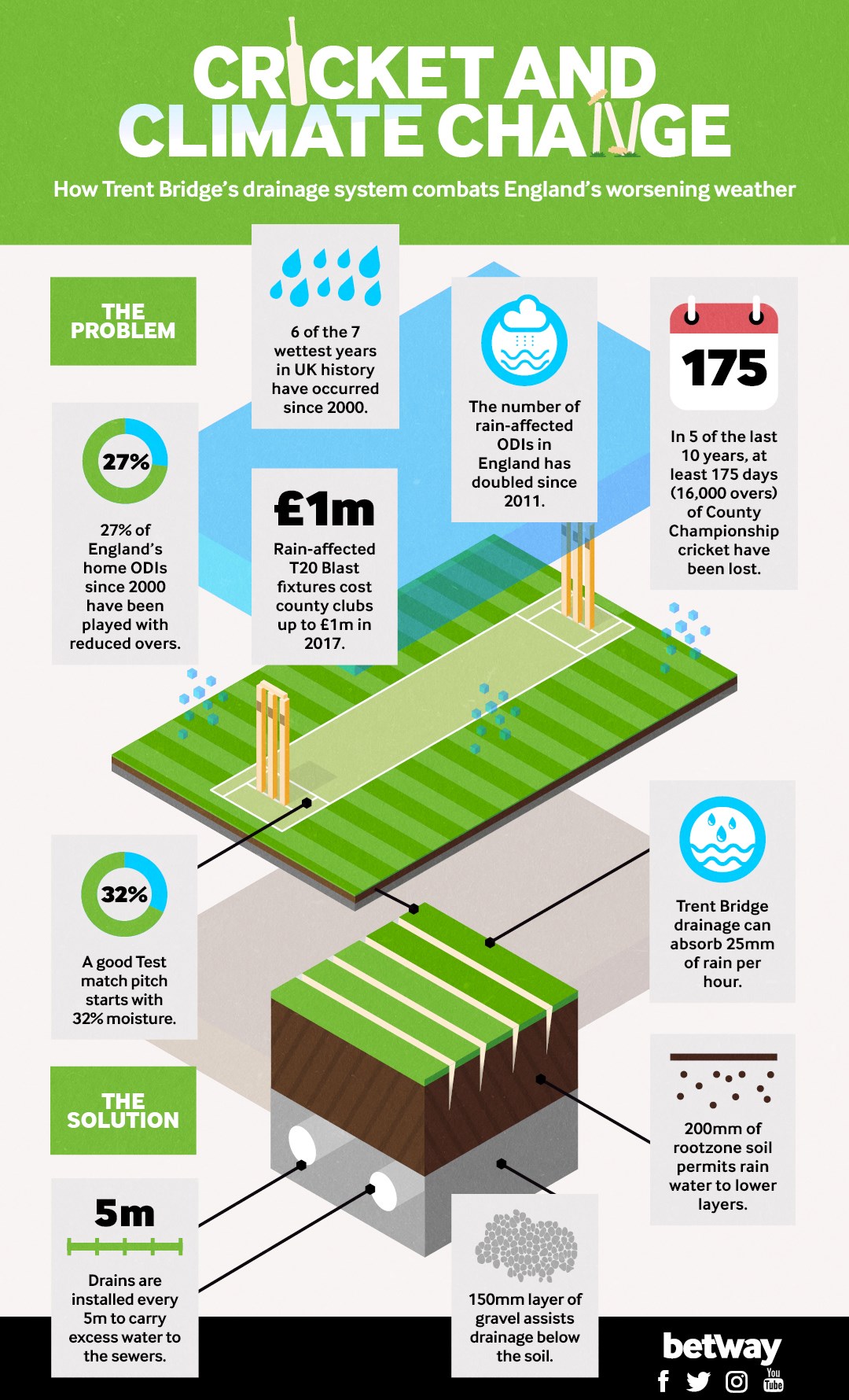
In international cricket, 27 per cent of England’s home one-day internationals since 2000 have been played with reduced overs because of rain delays. The rate of rain-affected matches has more than doubled since 2011, with five per cent of matches abandoned completely.

Part of the problem with climate change in England, though, is that it’s not always straightforward to identify.

“In this country, you’re relying on the weather,” says Steve Birks, head groundsman at Nottinghamshire, who are available at 5/2  to win the 2018 County Championship in the latest cricket betting.

Climate Change In Cricket

“One week it’s 27 degrees, and the next its central-heating weather again. You can’t rely on it being red hot for a week.”

British weather has always been famously unpredictable. Yet Birks, who will prepare the Trent Bridge pitch for England’s Test match with India in August, reveals there are subtle differences now.

“The rain is getting tropical, it is getting heavier,” he says. “We’re getting thunderstorms more often when it rains – I think that’s when you can tell the difference. But then that’s when the new outfield comes into its own.

The new outfield Birks is referring to is the product of a £600,000 grant from the ECB to Trent Bridge – plus the Swalec Stadium and Headingley – to renovate its outfield in 2008, including a new turf surface, drainage and sprinklers.

“The drainage at Trent Bridge is now second only to Lord’s,” he says. “It can take up to 25mm per hour in most places on the square.

“Beforehand, it was just a clay-based outfield with land drains in. Now it’s got a root zone up to 150mm, drains every five metres, and pop-up sprinklers in between drainage. It really takes it away.”

The new drainage system is too efficient, according to ex-England captain Kevin Pietersen, who claimed in 2014 that it resulted in the pitch for England’s Test match with India becoming “dry and lifeless”. He was not the only one, either, with other players and pundits declaring the surface to be slow and unfavourable to entertaining cricket.

Birks apologised at the time but says it had nothing to do with the drainage, which allows the surface to retain as much moisture as is required.

“We knew the 2014 pitch was coming to the end of its life, but it’s trying to fit in when you’re going to dig it up,” he says. “When you dig it up and take it away, you can’t play on it for two years.

“They deal with it in Australia, where the temperatures are twice as hot as here. Last year we mowed the square slightly longer, so that plenty of moisture stays in it.

“Our pitches start with maybe 32 per cent moisture in. That’s plenty.”

Birks understands, however, the extra scrutiny that comes when the national team is in town. “There is a lot more pressure when you’re dealing with England,” he says. “You want the pitch to be fair. Whatever England ask for you try and give them.”

The importance of delivering the right pitch is as much financial as it is tactical. Weather swings have the power to cruelly impact on a country’s finances, while international cricket – especially Test matches – must entertain if it is not to be squeezed out of the cricketing public’s consciousness.

“We lost our first ODI last year because it rained all day,” says Birk. “It’s a massive financial hit, particularly if it’s an ODI.”

Birks says that measures against climate change are likely to increase in years to come, but – for now at least – he is confident that Trent Bridge’s infrastructure can withstand the elements.

“Our new drainage system can take most of the storms we’ve had so far,” he says. “Whatever gets thrown at us, it’s our job to deal with it.”

Click here to read the original article

For the latest industry news visit turfmatters.co.uk/news

Get all of the big headlines, pictures, opinions and videos on stories that matter to you.

Follow us on Twitter for fun, fresh and engaging content.

You can also find us on Facebook for more of your must-see news, features, videos and pictures from Turf Matters.