Tag Archive for: EcoBunker

EcoBunker enhances links feel at Golf Valley

EcoBunker enhances links feel at Golf Valley: Built between 2007-8 by architect David Krause, Golf Valley is a major development, around 35km south of Munich.

Created by developer Michael Weichselgartner with the aim of hosting major tournaments and the Ryder Cup, Golf Valley was built in a links-style, with over 3,000 sq m (32,000 sq ft) of bunker sand area and, according to Andy Matzner, the club’s first course manager, who now works there in a consulting capacity, has always struggled with the impact of rain on its bunker faces.

EcoBunker enhances links feel at Golf Valley

EcoBunker enhances links feel at Golf Valley

“With such a massive area of sand, it was always a huge workload every time there was serious rain,” says Matzner. “In Bavaria, in the early summer, there are regular lightning storms, and every time there was a rain event, the whole greenkeeping crew would be occupied pushing sand back up the faces. And then the next day, it would happen again! I had real difficulty motivating my staff to keep shifting sand, and obviously the impact on our maintenance costs was huge.”

Matzner, by then consulting at Golf Valley, met Richard Allen, founder of synthetic bunker edging solution provider EcoBunker, in 2017. “By that time, I had realised that the bad weather, and the consequent washouts, were just something we had to deal with,” he says. “Golf Valley has no trees, and the course is quite links-like in look and feel, and it occurred to me that revetted walls, sensitively installed, would fit in nicely, and would give the place a more authentic links character. Richard visited and assessed the bunkers, and agreed with me that revetting would improve both their appearance and their performance, so we commissioned EcoBunker to install its product on an initial 200 sq m of bunkerfaces.”

That project, in spring 2018, was handled by EcoBunker construction manager Llewelyn Matthews. Covering thirteen bunkers, Matzner and the Golf Valley team were impressed by the results. “A revetted wall in sunlight and shadow looks very impressive,” he says. “But the most important thing was the prevention of washouts. A flat sandy bunker never washes out. It may fill up but so long as the drain operates effectively, the bunker will always work.”

In late 2019, Golf Valley was hit by a huge rain event. Almost every bunker, apart from the ones that had been rebuilt by EcoBunker, was virtually destroyed. The EcoBunkers survived the storm completely intact. At this point, owner Weichselgartner decided that as many as possible of the course’s bunkers should be rebuilt using the EcoBunker solution. The EcoBunker team came back on site in October 2020 to build the next set of bunkers. That project was substantially completed in December, and Matzner says the results are impressive. “The course looks much more like a real links now, and the bunkers perform far better,” he explains. “And that is all down to EcoBunker.”

For the latest industry news visit turfmatters.co.uk/news

Get all of the big headlines, pictures, opinions and videos on stories that matter to you.

Follow us on Twitter and Instagram for fun, fresh and engaging content.

You can also find us on Facebook for more of your must-see news, features, videos and pictures from Turf Matters.

Ecobunker enables Sandbelt style bunkers

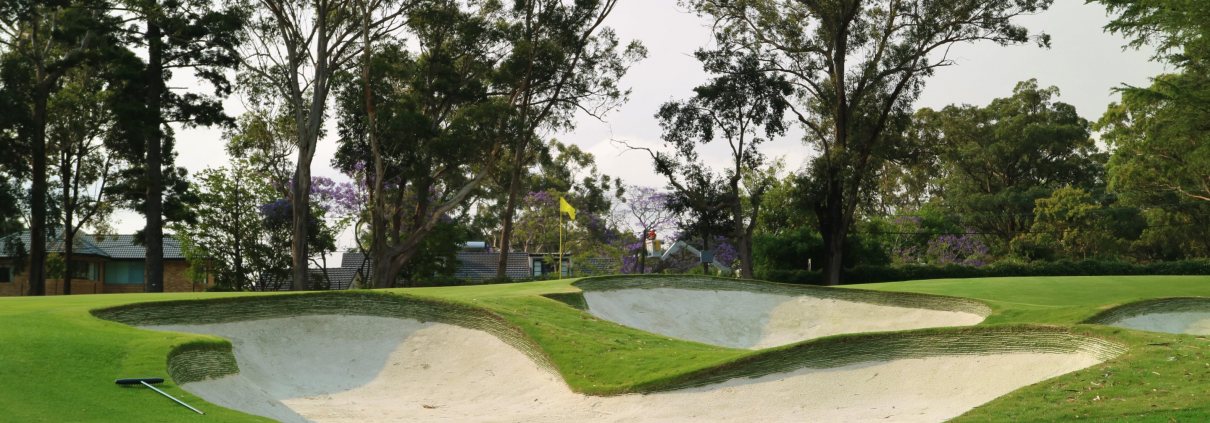
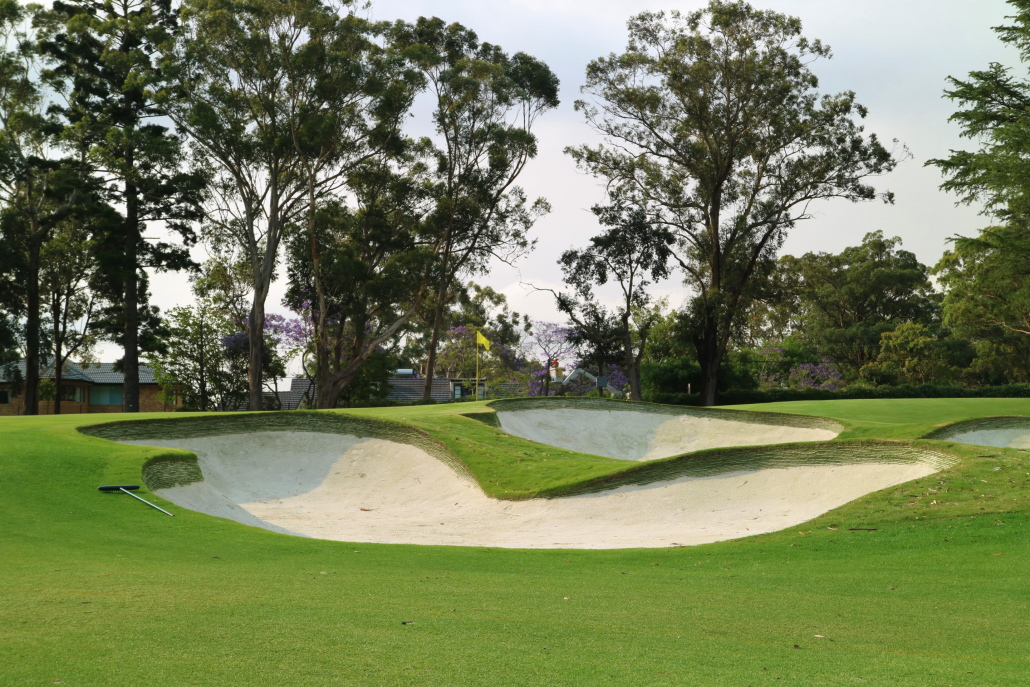
Ecobunker enables Sandbelt style bunkers: The famous courses of the Melbourne Sandbelt, notably Royal Melbourne and Kingston Heath, are distinctive for many reasons, but one of the most important is the characteristic bunker style created by Dr Alister MacKenzie and his collaborators Alex Russell and Mick Morcom. 

Sandbelt bunkers are characterised by their size, by their swooping shape, with capes and bays dividing them up into different compartments, by their flashed sand faces, and by the fact that they cut so deeply into fairways and greens – and are typically presented with short grass – fairway or even green cut – right up to the edge of the bunker, with no collar of longer grass that can interfere with the architect’s desired short game playability, and create visual interference in an otherwise extremely ‘clean’ look.

Ecobunker enables Sandbelt style bunkers

That look has been enormously influential around the world of golf. Gil Hanse’s Olympic course in Rio de Janerio and Tiger Woods’ first American design, Bluejack National in Texas, are only two in a long list of courses said by their designers to be influenced by the Sandbelt look. But replicating those trademark Melburnian bunkers is hard. The soil on the Melbourne courses, though sandy, contains a lot of fine particles and grey organic matter that mean it binds together to create a hard surface. Coarser sand – and even more so, clay soil – does not bind the same way, and creating that hard, vertical lip so characteristic of Melbourne is basically impossible; the soil gets wet and crumbles away.

The recent President’s Cup at Royal Melbourne showed very well how the Sandbelt bunkers work. As well as the clean edge, the sand packs down so hard that Melbourne clubs do not rake their bunker faces, rather using a ‘flat rake’ to create extremely firm conditions on the bunker faces, ensuring that all balls that enter the bunker run down to the prepared base, removing the problem of plugged lies.

So Sandbelt bunkers are desirable, but they depend completely on the particular conditions on the Sandbelt to make them possible. Sydney-based golf architect Harley Kruse has found a way round this problem. At Killara Golf Club, in the northern suburbs of Sydney, a successful 1800 member club whose golf course was basically untouched since the 1960s, Kruse was hired to do a significant course renovation. After careful planning, the works were agreed: reconstruction of all eighteen green complexes, reversing two holes, rebuilding some fairway bunkers and eliminating one par three while bringing a spare hole into the normal rotation.

“Greens were suffering; the rootzone wasn’t good and they were all poa,” Kruse says. “They were small, averaging 370 sq, and basically flat, with very limited strategic value. We have increased them to an average size of 500-550 sq m, with lots more interest; we’ve also taken out 300 big trees and opened up the vistas.”

Kruse and the club wanted sandbelt-inspired bunkers, but the clay soil at Killara meant that was going to be difficult. However, they found a solution via a good friend, Rod Hinwood, course manager at the exclusive Ellerston GC in rural New South Wales. Hinwood demonstrated the successful results that EcoBunker was delivering on his pronounced bunker edges, which had previously been vulnerable to erosion. “It occurred to me that we might be able to do something similar at Killara, and thus be able to get the edging treatment that we wanted,” said Kruse.

The new bunkers are lined with Capillary Concrete, and feature a 40cm high lip constructed using EcoBunker Advanced patented synthetic bunker edging system. The sand is then flashed up the EcoBunker wall – and is held in place by the Capillary Concrete – and the bunker surrounds can be mowed short right to the edge, because of the strength the EcoBunker and Capillary Concrete underpinnings provide.

“EcoBunker was designed from the outset to give architects the maximum freedom to create the bunker shapes they wanted,” says EcoBunker inventor and CEO Richard Allen. “The work that Harley has done at Killara is a classic example of that. When I first went to Melbourne last year, the principal reason was to see the Sandbelt bunkers up close; the fact that our product has allowed a great architect to create similar bunkers on unsuitable soil is fantastic. This style of bunker has long been something of a ‘holy grail’ for a lot of golf courses that simply haven’t been able to implement it because of their soil conditions. Now, they can see a proven solution that will allow them to do so.”

“If we had tried to do that edge using the site soils, it would crumble away,” says Kruse. “Getting that stable lip in clay soils is very difficult to achieve. But EcoBunker allows us to do it.”

For the latest industry news visit turfmatters.co.uk/news

Get all of the big headlines, pictures, opinions and videos on stories that matter to you.

Follow us on Twitter and Instagram for fun, fresh and engaging content.

You can also find us on Facebook for more of your must-see news, features, videos and pictures from Turf Matters.
EcoBunker at unique ‘golf lounge’

EcoBunker at unique ‘golf lounge’: One of the most unusual and innovative golf projects in the world is taking shape in Mexico City, and EcoBunker technology is playing a critical role.

Architect Agustin Piza was commissioned by his client, a leading Mexican executive, to build a golf practice facility in the grounds of the client’s under construction new house. “I think my client had a regular putting and chipping green in mind, but I don’t do regular things,” says Piza.

EcoBunker at unique 'golf lounge'

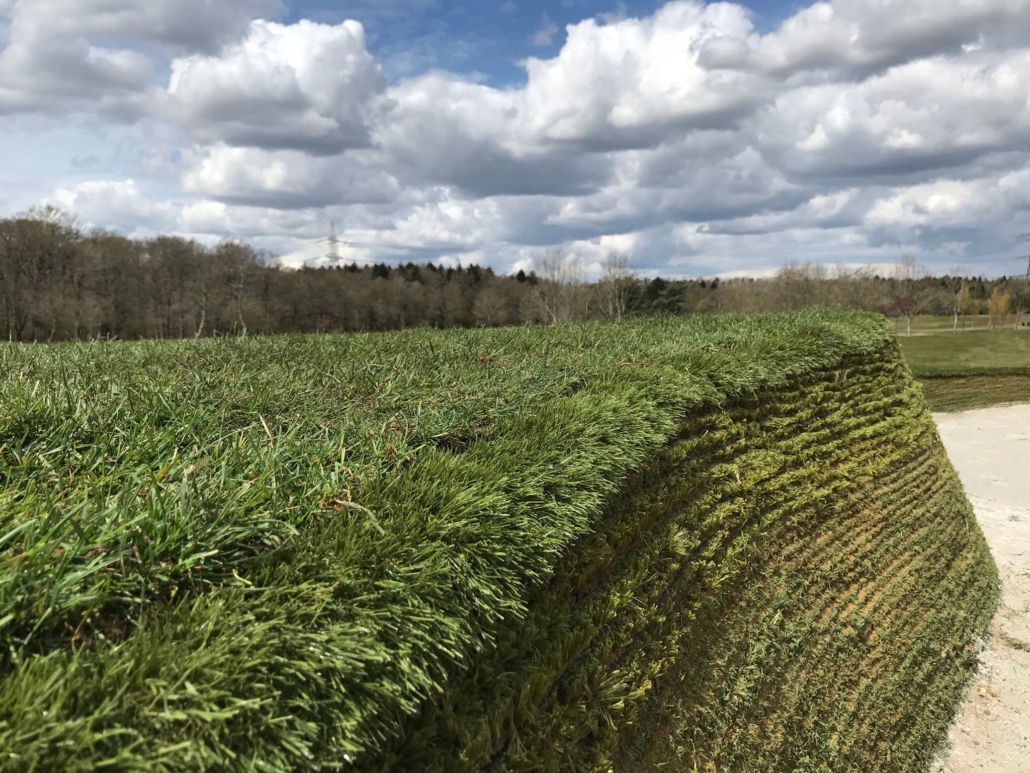
The architect conceived something he calls the ‘Golf Lounge’, a large, freeform putting green and surrounds that enables users to practice any golf shot they like from up to 70 yards. At the centre of the construction is a large revetted sand bunker, which is where the EcoBunker solution is deployed. And, in the heart of that bunker is to be found the centrepiece of the whole ‘Golf Lounge’ concept – a fire pit.

“The central bunker is key to the entire composition,” says Piza. “During the day you can practice all types of shots from 70 yards in. Flops, bump and runs, lag putts. Anything you want to create, it’s there. It is a multi-purpose area – during the day the family can enjoy either practicing golf or playing in the sandbox. In the evenings, you turn on the music, turn on the lights, turn on the firepit and relax. You can still putt around it, have a putting contest, whatever you like. I knew I needed the central sandpit to be revetted. I did my research and with the evidence available to me EcoBunker is the most proven system in the world for constructing revetted bunkers, especially in climates like Mexico City’s. I spoke to Richard Allen, the inventor of synthetic revetting, who I had met several times at EIGCA functions and said ‘Send me your best installer’. He sent me Llewelyn Matthews who did a fantastic job.”

Piza says that this job, because it is in a domestic environment, was rather different to most architectural projects. “The safe rule in architecture is that form follows function, but in this case I wanted the function to follow the form. This meant extra detail to creative and engineering work,” he explains. ”I wanted the client and his family to fall in love with it just by seeing it through the windows of their home, whether or not they were golfers. So I conceived it as a kind of ‘grass sculpture’ that would be both beautiful to look at and functional. If it is just a golf facility, it is a waste of space to anyone who doesn’t play golf. This way, it is something for the entire family to enjoy.”

For the latest industry news visit turfmatters.co.uk/news

Get all of the big headlines, pictures, opinions and videos on stories that matter to you.

Follow us on Twitter and Instagram for fun, fresh and engaging content.

You can also find us on Facebook for more of your must-see news, features, videos and pictures from Turf Matters.

Capillary Concrete & EcoBunker At Ryder Cup Venue

Capillary Concrete & EcoBunker At Ryder Cup Venue: The first phase of construction work has been completed on the rebuild of the Marco Simone Golf & Country Club course outside Rome, the venue for the 2022 Ryder Cup. This phase has seen the back nine of the golf course reconstructed, and the holes are now growing in. The front nine is to be rebuilt at a later date.

The construction crew provided by contractor SOL Golf, finished its work at the end of May. For the last three weeks of work, a specialist subcontract team from EcoBunker was on site installing about 500 metres of the company’s AquaEdge lake edging product on two separate ponds, one on the left of the home green, and the other to the front right of the sixteenth, with logistic and labour support from SOL. EcoBunker CEO Richard Allen, the creator of AquaEdge, says: “Dave Sampson, the course architect from European Golf Design, wanted to make the sixteenth into a feature hole, as he knows that more Ryder Cup matches end at the sixteenth than anywhere else. It’s a pretty drivable par four, downhill, with a huge spectator area around the green.”

Capillary Concrete & EcoBunker At Ryder Cup Venue

The bunkers of the back nine are shaped, but are planned to be finished in September, when they will be lined with the Capillary Concrete system and then filled with sand. Sampson himself specified Capillary Concrete for the course’s bunkers, having seen its performance elsewhere – including at Le Golf National in Paris, host to the recent 2018 Ryder Cup.

“The first phase of bunker works amounts to about 5,000 sq m of Capillary Concrete,” said the company’s European representative Kneale Diamond. “Construction of the second nine is expected to start as soon as the first nine holes are open – and to be finished by next May.”

For the latest industry news visit turfmatters.co.uk/news

Get all of the big headlines, pictures, opinions and videos on stories that matter to you.

Follow us on Twitter and Instagram for fun, fresh and engaging content.

You can also find us on Facebook for more of your must-see news, features, videos and pictures from Turf Matters.

Two Ryder Cup Courses For EcoBunker

Two Ryder Cup Courses For EcoBunker: Working on a course for a Ryder Cup is a great achievement for any golf construction professional. To work on two in the space of a week, though, is pretty remarkable. But that’s what EcoBunker site manager Louis Palser will have done by the end of next week.

Louis has spent the last two days at Le Golf National in Paris, supervising EcoBunker’s part of the construction of the 2018 Ryder Cup venue’s new state of the art practice facility, which is being managed by golf consultant Alejandro Reyes (the former superintendent of Le Golf National). Flying directly from Paris to Rome, Louis moves on to the Marco Simone club, currently under reconstruction at the hands of European Golf Design architect Dave Sampson, in advance of its starring role in the 2022 Ryder Cup. There, for ten days, he will be working alongside EcoBunker’s top construction specialist Llewellyn Matthews installing EcoBunker’s AquaEdge lake edging product on the sixteenth and eighteenth holes.

Two Ryder Cup Courses For EcoBunker

Quite some going for a young man who is new to the golf business. Louis joined EcoBunker last year after studying civil engineering at Salford University, because ‘he wanted to use his construction knowledge, work outdoors and gain plenty of travel opportunities’, and spent 18 weeks last year on the company’s job at the new Dumbarnie Links in Fife, where he rose to be deputy site manager under Llewelyn Matthews. Now, he’s comfortable leading jobs, and has worked on EcoBunker projects in the UK, Germany, Switzerland, Belgium and France.

EcoBunker CEO Richard Allen says: “With our contracting business growing rapidly we’ve had to invest in new construction management talent, and Louis has rapidly become an important part of our growth.”

For the latest industry news visit turfmatters.co.uk/news

Get all of the big headlines, pictures, opinions and videos on stories that matter to you.

Follow us on Twitter and Instagram for fun, fresh and engaging content.

You can also find us on Facebook for more of your must-see news, features, videos and pictures from Turf Matters.