
Tag Archive for: For

ICL the ‘one stop-shop’ for Bradford City

ICL the ‘one stop-shop’ for Bradford City: ICL’s ProSelect grass seed supported by a monthly nutritional programme has resulted in Bradford City’s pitch being in the best condition ever – according to Head Groundsman Mick Doyle.

If anyone knows the pitch at Bradford City’s Utilita Energy Stadium – it is Mick. He has been working at the club for an incredible fourteen years and in that time, it is safe to say that he has single-handedly kept the pitch in excellent condition.

ICL the ‘one stop-shop’ for Bradford City

ICL the ‘one stop-shop’ for Bradford City

However, he claims that the bar has now been raised and that it all started with ICL’s ProSelect grass seed.

“The bottom line is that I needed a new seed,” he said. “The seed I used previously just didn’t work for me – it was patchy and did not germinate. Therefore, when it came round to pitch renovations last year, I used ICL’s ProSelect 1 Premium Pitch which I had first heard about at an ICL educational day and after speaking to other groundsmen.”

Combining four top-ranked perennial ryegrasses, ProSelect 1 Premium Pitch, provides a fast-recovering, dense, hard-wearing surface. Furthermore, Mick decided that he would like to explore a full ICL nutritional programme because in his words, it would be a “one-stop shop which could deliver on all fronts.”

Prior to sowing the ProSelect seed, Craig Lalley, Technical Sales Manager for ICL visited Mick at the stadium and took some soil samples. Craig then proceeded to devise a plan tailored to Mick’s environment – taking into consideration his stadium, his machinery, his staffing levels, his time restraints and he ultimately put a programme together based on what Mick was trying to achieve.

“My biggest concern was that I could never get any root down but Craig assured me that I would with his programme,” said Mick. “True to his word – he was absolutely right.”

The key was getting the pitch off to the best possible start. After sowing the ProSelect grass seed, Mick immediately followed with 10 litres of H2Pro TriSmart, in a bid to absorb more moisture around the seed and aid germination.

It turned out to be a winning combination: “The seed was coming up beautifully in just six days,” said Mick.

On that sixth day after seeding, and based on Craig’s advice, Mick went one step further by applying Sierrablen Plus Renovator 20-20-8 at a rate of 35g/m², the mini-granules ensuring even distribution for young seedlings while its high phosphate levels encourage strong root growth.

Since then, the nutritional programme has been based on providing the right nutrient at the right time, according to Craig.

“A lot of the programme has been designed to really focus on root establishment to assist with pitch playability. Therefore, Mick has been using Vitalnova SeaMax (seaweed extracts) and Vitalnova Blade along with Primo Maxx II growth regulator.

“Mick has produced a great surface this season and that has carried through the challenging winter months. To work alongside his good cultural methods over this testing period, Mick incorporated H2Pro FlowSmart into his monthly ITM programme. This is a superb penetrant to help with water percolation through the profile.”

Mick was also in agreement:

“I’ve had fourteen seasons here and I can honestly say that this is the best condition the pitch has ever been at this time of year. I put that down to the products.

“The pitch is holding up incredibly well and you can hardly tell that players have been on the pitch after a game. In years gone by where we have had shallow rooting a lot of remedial work was needed following fixtures. This is no longer required so we are saving time and benefitting from good plant health.

“It’s just been consistently good all year.

“The programme is very straight forward to follow – it’s all on my wall planner in my office and reminds me of what’s going on at all times. I can also call Craig and get advice which is a real benefit.

“Overall, I’m incredibly pleased that I decided to go down the ICL route because it really has made such a difference to the pitch – not just aesthetically and from a playability point of view, but also from what is going on below the surface.”

Please contact ICL on 01473 237100 or visit www.icl-sf.co.uk or www.icl-sf.ie if you are in Ireland.

For more news and insightful views, you can follow ICL on Twitter @ICL_Turf

For the latest industry news visit turfmatters.co.uk/news

Get all of the big headlines, pictures, opinions and videos on stories that matter to you.

Follow us on Twitter and Instagram for fun, fresh and engaging content.

You can also find us on Facebook for more of your must-see news, features, videos and pictures from Turf Matters.

Scatter seeds for a brighter year ahead

Scatter seeds for a brighter year ahead: Spring is traditionally seen as a time for renewal, growth, and new life, with warmer days urging us outdoors to enjoy nature. This year we have even more to look forward to, with reunions on the horizon and things returning to a semblance of normality.

With these brighter days and positive thoughts of the year ahead, now is a great time to get outside and scatter some wildflower seeds to ensure that 2021 and beyond is full of life and colour.

Scatter seeds for a brighter year ahead

Scatter seeds for a brighter year ahead

Wildflower specialist, Seedball, has developed a unique way in which to protect scattered seeds until they are ready to look after themselves, creating a mini ecosystem and giving them nutrition as they germinate and grow. The balls are made from a combination of British wildflower seeds, clay to protect from predators such as birds and ants, peat-free compost to provide nutrition, and a little bit of chilli powder to deter slugs and snails. Simply throw the balls onto soil or compost in a garden bed or planter in Spring or Autumn and wait. The seed ball has everything it needs to grow and, once the ball becomes moist and the temperature is right, the seeds will germinate! What could be easier?

While Seedball is famed for its compact tins of seeds that are ideal for gifting, the company also produces larger grab bags, each containing 100 seed balls, make it easy for everyone to create a wildflower patch in their own garden, and what could be a greater symbol of positivity and optimism than that? The range includes bags of curated seed collections, such as the Bee Mix and the Shade Mix, to help people create wildflower havens with ease.

New for 2021 is a collection of Single Flower Grab Bags, each of which contain 50 seed balls of a single variety, allowing even more flexibility for people to design their own outdoor spaces according to individual preferences. The 24 varieties include quintessentially British species such as cowslips, cornflowers, yarrow and camomile.

People will even be able to create their own delicate, blue carpet of bluebells with the Bluebell Grab Bag – provided they are willing to wait for them to flower, which can take up to five years after germination. These native flowers are more than worth the wait, though, and are one of Britain’s most precious and iconic plants. The variety available in the grab bags is the Hyacinthoides non-scripta, with a distinctive scent that is highly attractive to bees.

A simple scattering of seed balls today will result in a brighter, wilder tomorrow!

To find out more about Seedball visit https://seedball.co.uk/

You can also find Seedball on Facebook, Instagram and Twitter

For the latest industry news visit turfmatters.co.uk/news

Get all of the big headlines, pictures, opinions and videos on stories that matter to you.

Follow us on Twitter and Instagram for fun, fresh and engaging content.

You can also find us on Facebook for more of your must-see news, features, videos and pictures from Turf Matters.

Greenkeeper gets legs waxed for charity

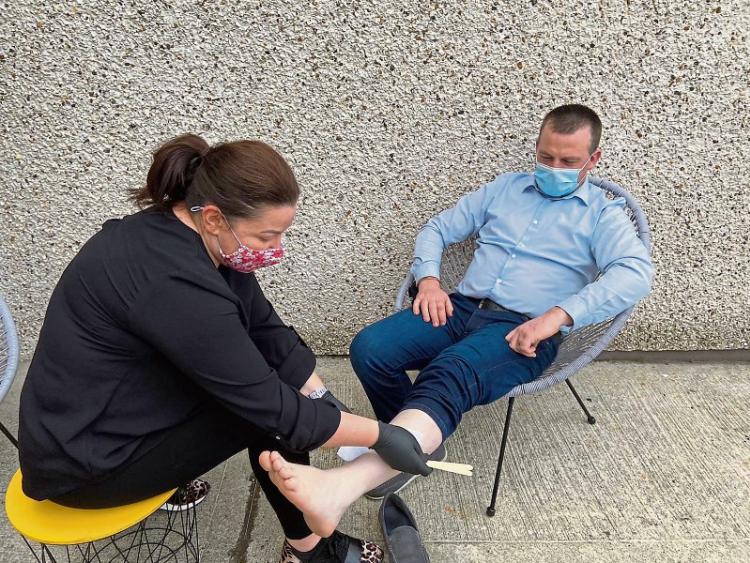
Greenkeeper gets legs waxed for charity: Greenkeeper Brian Dunne shouted something beginning with f when he got his legs waxed and it wasn’t fore!

Read the full article from Limerick Leader here

Greenkeeper gets legs waxed for charity

Greenkeeper gets legs waxed for charity

For the latest industry news visit turfmatters.co.uk/news

Get all of the big headlines, pictures, opinions and videos on stories that matter to you.

Follow us on Twitter and Instagram for fun, fresh and engaging content.

You can also find us on Facebook for more of your must-see news, features, videos and pictures from Turf Matters.

For sustainability, meet the EPG

For sustainability, meet the EPG: Senior Environmental Consultant Dr Tom Young introduces the newest member of the STRI family, The Environmental Protection Group (EPG), and takes a closer look as to how the new partnership can help manage water at sports facilities.

The Environmental Protection Group (EPG), established in 1998, is a leading independent geo-environmental engineering design consultancy delivering cost-effective, sustainable designs focused in the areas of contaminated land remediation and gas protection, sustainable water management, flood risk assessment and structural waterproofing.

For sustainability, meet the EPG

For sustainability, meet the EPG

STRI and EPG have been working closely with one another since 2010 when the two companies worked together on a number of London 2012 Olympics projects. It was formally announced in August 2020 that STRI and EPG had joined forces and EPG is now part of the STRI Group.

Figure 1

Figure 1

EPG has a huge amount of experience in water management plans, site-wide drainage schemes and sustainable water harvesting. Coupled with STRI’s agronomic, research and design capabilities, the Group now has the ability to further assist sports facilities. In particular, EPG has vast experience in designing Sustainable Drainage Systems (SuDS), which are now more commonplace and often required as part of any planning conditions. EPG was actually co-author of the CIRIA SuDS Manual, a key piece of industry guidance, which is the go-to document for any SuDS engineer.

Harvesting water from buildings

  • STRI and EPG can accurately model and predict volumes of water that can be collected from buildings, which can be easily collected and stored for later reuse
  • This solution can be ideal for small sports facilities that currently rely on mains water
  • Water collected can easily be incorporated into a small-scale irrigation system with the pump station preferentially using collected rainwater before mains water
  • In the example in
    Figure 2

    Figure 2

    Figure 1, a small cricket club in London could potentially harvest nearly 270m3 a year from their clubhouse roof and 400m3 a year from the club car park. This could potentially reduce the club’s mains water requirements by 20-50%. The design of the storage tank is critical in these situations; in order to provide a cost effect solution, but to also be large enough to take advantage of large storm events

Harvesting water from whole sites

  • STRI and EPG can also produce much larger water models for whole sites. This allows us to predict:
    a) how much water falls across an whole site and when
    b) where this water ends up
    c) how much of this water can be transported and stored for later reuse
  • This detailed approach is very much cutting edge, with STRI and EPG optimising hydraulic models based on experience from other sectors and making them appropriate for sports turf situations
  • Key issues to consider include detailed analysis of site drainage systems, rootzone composition, = effect of vegetation on runoff and effect of climate change on future rainfall events
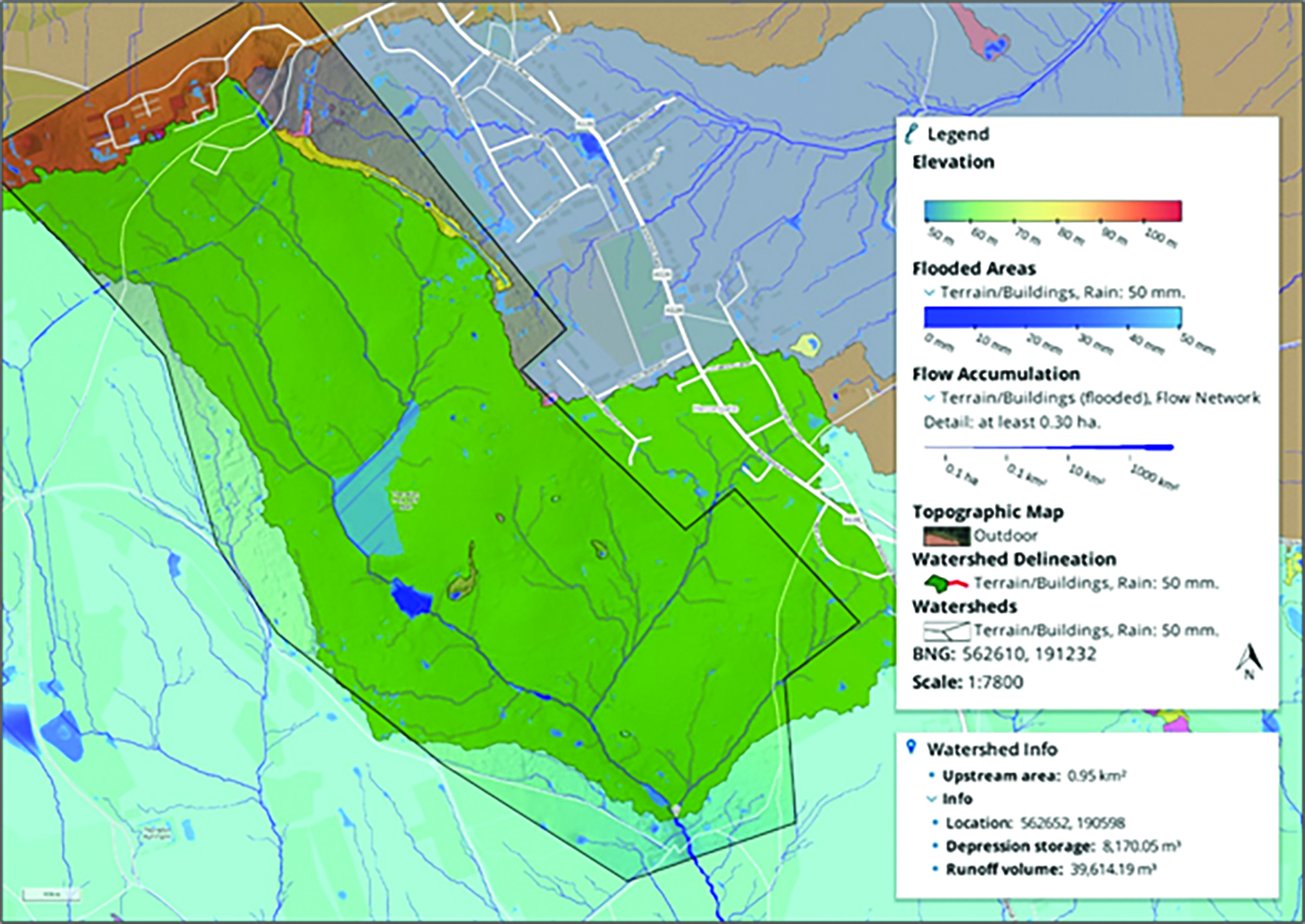
  • In the case study shown in Figure 2, STRI and EPG were able to accurately model the entire drainage network of an 18-hole golf course
Figure 3

Figure 3

  • It was found that an average volume of 3750m3 a month was potentially available for the club once local topographical issues, losses in ground infiltration and inherent water capture by
    vegetation were taken into account
  • With a current demand of 10,000m3 a month, water harvested from the course easily accommodates all the club’s irrigation demand, and also allows the club to seriously look into the addition of fairway irrigation
  • Runoff from the winter when demand is low can be stored to create a surplus of water for the summer when the irrigation demands are at their peak. Therefore, the club would require a reservoir largeenough to not only meet demand throughout the year but also to build up surpluses during the winter
  • The club is now looking into the concept in more detail, with STRI and EPG supporting with detailed designs, reservoir sizing and help with Environment Agency permission

Flood risk Assessments/ mitigating effects of flooding

  • In some situations, flooding of certain areas of buildings is problematic and STRI and EPG are required to design sites to accommodate water from elsewhere
  • EPG is very experienced in running detailed Flood Risk Assessments (FRA) for sites and then designing solutions if flooding is predicted
  • In Figure 3, a site was predicted to undergo serious flooding on a regular basis. EPG was able to mitigate against this by designing the site to accommodate water elsewhere. This was achieved by a simple depression across the site that could accommodate additional flood water (Figure 4)
Figure 4a & 4b

Figure 4a & 4b

Green/Blue roofs

  • The runoff from most new buildings needs to be slowed down in order to reduce the amount and speed of runoff from the building. This can be achieved via the use of rainwater storage tanks as shown in Figure 1. However, sometimes it is more appropriate to store the water on the roofs of buildings (for example in more built up areas or when excavation for tanks is expensive). This can also be combined with vegetation of a roof. Known as Blue (storage of water), Green (vegetation) or Blue-Green (water storage with vegetation) roofs, this method can really improve the look as well as environmental credentials of most buildings
  • In the example given in Figure 5, STRI and EPG were tasked with reducing the runoff from the roof of a new building, whilst storing the water for later reuse in irrigating large planters placed on the roof to provide screening for the building
  • The innovative design stored water across the entire roof level in a shallow modular tank (85mmdeep) which was located across the entire roof slab removing the need to have a large storage tank located in the development boundary. Each roof on the building is connected so once one tank is full, it cascades into the one below
Figure 5

Figure 5

  • Underneath the planters, subsurface irrigation ‘wicks’ were installed to passively wick water from the shallow storage area into the rootzone above. This provides sufficient water for the plants to survive, whilst reducing the need for potable water across the site
  • The design allowed the site engineers to save significant amounts of money by removing an entire large soakaway tank (50m x 4m x 2m)

These examples only demonstrate a small amount of the joint expertise that the two companies have now combined. If you are interested in any of the problem-solving methods discussed, please get in contact with Tom Young at tom.young@strigroup.com

Reproduced from the STRI Bulletin, September 2020, with thanks.

Learning LIVE 2021 – Call for Papers

Learning LIVE 2021 – Call for Papers: Organisers of SALTEX are looking for the best speakers in the grounds management industry to showcase their knowledge at the show, which takes place at the NEC, Birmingham on 3 and 4 November 2021.

Learning LIVE, SALTEX’s all-encompassing education programme, provides advice, insight and real solutions to the biggest issues that the grounds management industry care about most. Organisers aim for the seminar programme at SALTEX to be engaging, informative and educational for attendees.

Learning LIVE 2021 – Call for Papers

Learning LIVE 2021 – Call for Papers

Since its creation in 2015, the most popular Learning LIVE sessions have been case studies and presentations from companies or individuals who are prepared to share personal experience and learnings.

If you have a story to share or consider yourself a field specialist, then we want to hear from you.

Each proposal will be evaluated and those that most closely match the needs of the attendees will be selected.

To submit a proposal, please click here

Please note that Learning LIVE is an educational, editorial opportunity – to discuss commercial or promotional opportunities at SALTEX please contact Charles Neale charlesneale@rabdf.co.uk or Matthew Knight matthewknight@rabdf.co.uk

For more information visit www.gmasaltex.co.uk

To view further industry support and quotes visit – https://www.gmasaltex.co.uk/industry-shows-support-quotes-for-new-saltex-dates/

Follow SALTEX on Twitter @GMA_SALTEX and Facebook – www.facebook.com/GMASALTEX

For the latest industry news visit turfmatters.co.uk/news

Get all of the big headlines, pictures, opinions and videos on stories that matter to you.

Follow us on Twitter and Instagram for fun, fresh and engaging content.

You can also find us on Facebook for more of your must-see news, features, videos and pictures from Turf Matters.