Tag Archive for: Hit

Football Club Furious As Vandals Hit

Football Club Furious As Vandals Hit: Bosses at a football club have been left furious, and have hit out at vandals who tore up their pitch.

Yobs used a vehicle to churn up the pitch used by Bishopton FC, which runs teams for men, women and kids.

The site, which is operated by Renfrewshire Leisure, is also home to several other clubs in Bishopton and neighbouring Erskine.

However, the mindless vandalism means it may now be out of action for weeks.

Nori Fian, Bishopton FC’s vice-chairman, said: “We think this may have happened on Friday night and I reported it to the police on Saturday afternoon.

“It looks as if someone has got on something with two wheels and driven round the pitch several times.

“I was filled with revulsion when I saw it. There is a lack of facilities already in Bishopton and now one of its only pitches has been vandalised.

“I don’t think we will be able to use it for the foreseeable future but I’m hoping repairs can be made before we play at home again next month.”

Joyce McKellar, Renfrewhire Leisure’s chief executive, said the damage is being assessed.

She said: “Hopefully repairs can be carried out so the park can be made playable by this weekend.

“The pitch is used by several teams from the Bishopton and Erskine areas and, if repairs cannot be completed by the weekend, other parks are available.

“We don’t expect any games to be cancelled because of the damage to the pitch.”

Click here to read the original article

For the latest industry news visit turfmatters.co.uk/news

Get all of the big headlines, pictures, opinions and videos on stories that matter to you.

Follow us on Twitter for fun, fresh and engaging content.

You can also find us on Facebook for more of your must-see news, features, videos and pictures from Turf Matters.

Biochar Trials Hit Hole In One

Biochar Trials Hit Hole In One: Okehampton Golf Club, Dartmoor National Park, trials enriched biochar to eliminate fungicide use.

A new turf improver with roots in traditional green keeping is arming Course Managers with a natural alternative to ever restricted fungicides and chemical fertilisers.
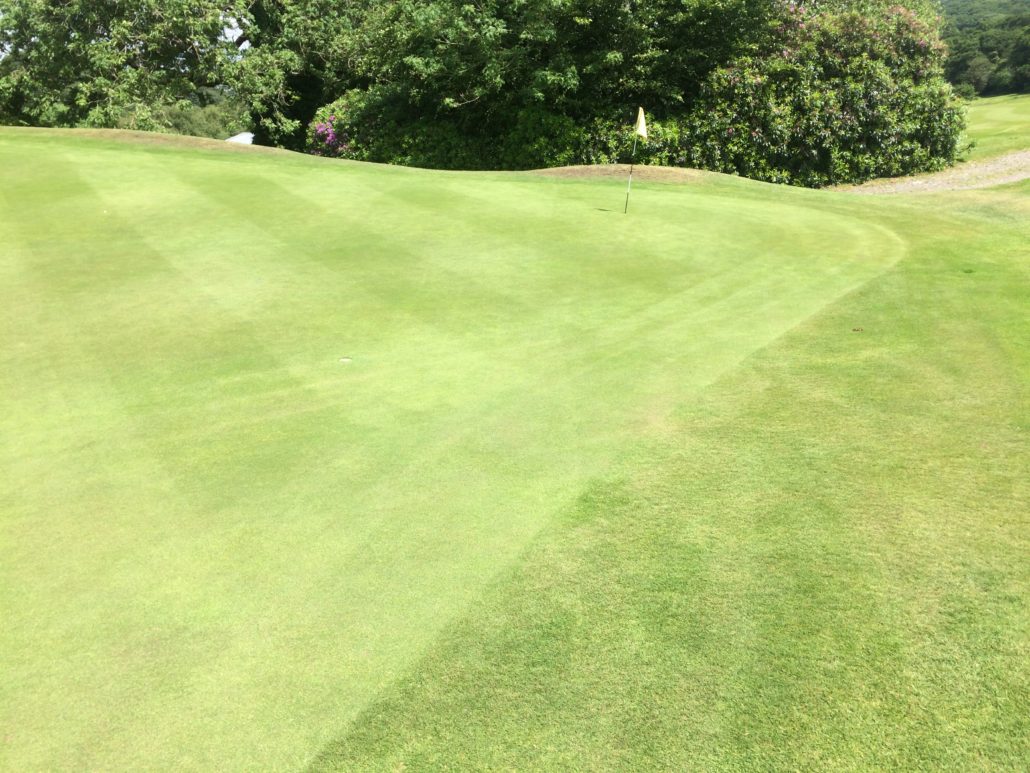
Biochar Trials Hit Hole In One

Carbon Gold’s Enriched Biochar Soil Improver is a horticultural form of charcoal blended with optimum levels of fungi, bacteria and trace minerals, and is approved by EU certification bodies for organic growing. It was common practice a century ago to use charcoal to keep greens porous and firm, and to improve the appearance and colour of turf. Now, innovative Greenkeepers are ‘rediscovering’ the benefits of biochar – using it to eliminate fungicides completely, and reduce chemical fertiliser use significantly.

David Chammings, Amenity Specialist for Sherriff Amenity, a division of Agrovista UK, has been the Chairman of Greens at Okehampton Golf Club for the past 3 years. His position and experience allow him to trial innovative techniques on different areas of the course, and he approached Carbon Gold, keen to be the first to trial biochar on golf course greens.

The club, established in 1913, has been through significant changes in the last 5 years, adapting to an ever-evolving industry and stricter demands, such as the revocation of insecticides and the withdrawal of many fungicides under ever tighter EU regulations. In 2016, Stuart Entwhistle joined as Course Manager, and together he and David devised a trial outline to test how Carbon Gold’s enriched biochar would perform on specific areas of the course, in the hope of finding a new solution to old problems.

The Okehampton trials

Locations and issues:

The 5th green – a very sandy newly-extended area of the green, which leaches nutrient heavily.

The 12th green – the ‘disease indicator’ green, placed in the Ockment Valley. It is surrounded by trees and receives very little winter sunlight.

Application:

Enriched Biochar Soil Improver was applied in March 2017. Both greens were 13mm hollow tined to a depth of 100mm. 1kg per m2 of Carbon Gold’s Enriched Biochar Soil Improver was brushed in – in the same way sand is commonly brushed into turf – over an area of 100m2 per green.

Outcomes

20% fertiliser reduction

Okehampton currently fertilise the greens five times a year.

They continued to fertilise the trial areas, at the same rate as the rest of the greens, but found that in the summer the 5th green looked healthier and was holding nutrient a lot more efficiently so decided to miss an application on this area. Three weeks later it was not evident that a feed application had been missed, and the trial area looked as healthy as the rest of the green. There is a definite increase in nutrient holding capacity in the sandy rootzones, and a 20% reduction in fertiliser use overall.

100% fungicide reduction

The fungal disease being treated in the Okehampton Carbon Gold trials is fusarium patch (Microdochium nivale) – common to golf courses across the world. They currently apply fungicide to all of the greens on the course twice a year, sometimes up to four times a year. To treat the whole 7000m2 course costs £700 per application – Okehampton’s annual fungicide bill alone can reach £2800.

No fungicide was required on either of the trial areas for the whole of the year, meaning Carbon Gold’s enriched biochar delivered an impressive 100% reduction in fungicide use.

Water retention & drainage

Water retention and drainage was another factor that David and Stuart were keen to address. Summer 2017 was relatively wet, however the treated greens performed well. The trial areas drain better and faster than before when needed, but also hold on to the moisture in prolonged hotter weather.

The trial greens were more resilient over the course of the year – whatever the seasons threw at them – during the hot dry periods they held onto the moisture better and were visibly healthier. In wetter periods they did not flood, were firmer, dryer and remained playable. This is a great advantage for the club during the wet months – if there is too much rain the course can flood and the greens become un-playable, which leads to closure and loss of revenue. With the use of Carbon Gold’s enriched biochar, this can now be avoided.

Next steps

David is keen to step up his trials to cover two entire greens which they will monitor throughout 2018.  Application of the product would normally take place during the maintenance times of spring and autumn. Due to significantly reduced requirements of fungicides, fertilisers and irrigation, he believes they would soon see a return on investment.

These enlightening trials show an optimum application rate of 1kg/m2, which equates to £1 per m2. As enriched biochar is a one-off application that remains in the soil indefinitely, and has proven to deliver up to 100% reduction in fungicide and 20% reduction in fertiliser inputs, it’s a hole in one for any discerning Course Manager.

David’s has great confidence in his new discovery – he says he would “highly recommend the use of Carbon Gold’s enriched biochar to all Greenkeepers & Groundsmen for the wider benefits of the product.” He even goes so far as to say, “I believe that biochar will be used throughout this industry in the not too distant future.”

For the latest industry news visit turfnews.co.uk

Get all of the big headlines, pictures, opinions and videos on stories that matter to you.

Follow us on Twitter for fun, fresh and engaging content.

You can also find us on Facebook for more of your must-see news, features, videos and pictures from Turf Matters.

New Pitch A Hit At Castle Park

New Pitch A Hit At Castle Park: Several hundred thousand pounds was spent by Doncaster Knights on a brand new main pitch at Castle Park over the summer and it’s proving to be money well spent.

“We are into February now and the pitch is still looking good in the areas where you traditionally get some wear and tear despite Doncaster Phoenix also playing on it,” said head groundsman Lee Blagden.

“Whereas with a traditional grass pitch the grass roots are just below the surface the roots on our pitch go into a synthetic matrix mat and that makes them much stronger and less prone to damage.

“Everyone loves playing on a well-grassed pitch at the start of the season and what the new pitch – which is 100 per cent natural grass – is designed to give you is a similar surface throughout the season even though you do lose some of the grass.

“Due to the fact that we open the pitch up with a machine called a procore, which goes down five inches, it helps to avoid compacting the soil and softens the blow when players are tackled and hit the ground hard.

“The work we do also helps players’ boots dig in a bit more and gives them a better footing. With the pitch also being level and having no ruts it should help reduce ankle and knee injuries.

“We’ve been lucky with the weather so far this winter. We’ve had the rain but because of the new drainage system, which is absolutely fantastic, the rain drains away very quickly and we’ve had no puddles or soft areas.”

This week’s weather, as was the case in late December, has posed different problems.

“Because it is 100 per cent grass you have exactly the same situation as with a traditional pitch if you’ve got frost,” said Lee.

“As we’ve done in recent years we cover the pitch with covers, which we’ve done this week, if frost is forecast.

“The covers we use will generally protect against frost down to around minus 5.

“We also use them if snow is forecast.”

Although the end of the season is almost three months away, Lee and his team don’t intend to let the grass grow under their feet whilst doing just that.

“We are looking at doing an over-seed later this month at a time when the team haven’t got a home game which will probably take about two weeks to come through,” he said.

“We use a dimple seeder and that opens the ground up and lets you put a couple of seeds in and then it covers it to keep the birds away.

“We’ve already started to see some growth when we had a few warmer days towards the back end of last month.

“If I come across any areas showing wear during the winter months, and the weather is warm enough, then because of the new sprinkler system we’ve installed under the pitch we can put some new seed on the surface and it will germinate and grow.”

Although Lee and his staff are delighted with the way the pitch is looking, he says there is more work involved than with a traditional pitch.

“I would say there is double the work,” he claimed. “For a start you’ve got to make sure that the pitch is clean both after training and after matches.

“We’ve some mowers which are like a basic home mower and we go up and down and clear all the debris (old grass, mud) off the pitch so all the root base and leaf is all clean

“With it being a sand-based pitch you’ve got to try and keep your sand and plant clean.”

Lee and his staff are also charged with the upkeep of the five other pitches on the Castle Park site used by the junior section and the various senior teams below Championship and Midlands Premier level.

Knights also train on the outside pitches during the week in addition to two 40-minute sessions on the main pitch (weather permitting) and the weekly captain’s run on a Friday.

Doncaster RLFC have also used the facilities, though not the first team pitch, during the last couple of months for pre-season training

Click here to read the original article

For the latest industry news visit turfnews.co.uk

Get all of the big headlines, pictures, opinions and videos on stories that matter to you.

Follow us on Twitter for fun, fresh and engaging content.

You can also find us on Facebook for more of your must-see news, features, videos and pictures from Turf Matters

ClearWater A Hit At BTME

ClearWater A Hit At BTME: ClearWater proved to be popular at a very successful BTME for Acumen Waste Services Ltd. with a good number of enquiries taken. 

ClearWater’s sales and development manager, Matthew Mears, was most impressed with the first show he was responsible for and commented: “A great show that served two purposes; a chance for former Highspeed directors Andy Vincent and Dave Mears to say their goodbyes after a 25 year stint at BTME and also, for Acumen to establish themselves as part of BTME and demonstrate commitment to the future of ClearWater with customers old and new!”

ClearWater A Hit At BTME

The stand was certainly busy and footfall up on last year with more overseas interest too. The latest ClearWater display unit was on hand and proved useful to explain the virtues of the system (as our photo shows). There were many visits from Greenkeepers and others with specific interest in washpad compliance and had seen pre-show publicity for ClearWater.

Towards the end of the last day the big event was the Prize Draw. Steve Lloyd (seen here), course manager of The Worcestershire GC and last year’s winner was happy to make the draw. The system was won by Crosland Heath GC, a heathland course with stunning views located on the outskirts of Huddersfield, designed by Dr Alister MacKenzie and formed in 1914. The winning entry was placed by head greenkeeper Richard Holmes. Richard was delighted to learn of the win and said: “Very happy to be compliant now. ClearWater is what we have wanted for a long time; something we have strived towards”. A new ClearWater system will be on its way to Crosland Heath very soon!

A great show for Acumen and ClearWater and with impressive organisation and support from the BIGGA team!

For more information go to www.clearwatertv.co.uk

For the latest industry news visit turfnews.co.uk

Get all of the big headlines, pictures, opinions and videos on stories that matter to you.

Follow us on Twitter for fun, fresh and engaging content.

You can also find us on Facebook for more of your must-see news, features, videos and pictures from Turf Matters.