Tag Archive for: Not

An offer not to be refused

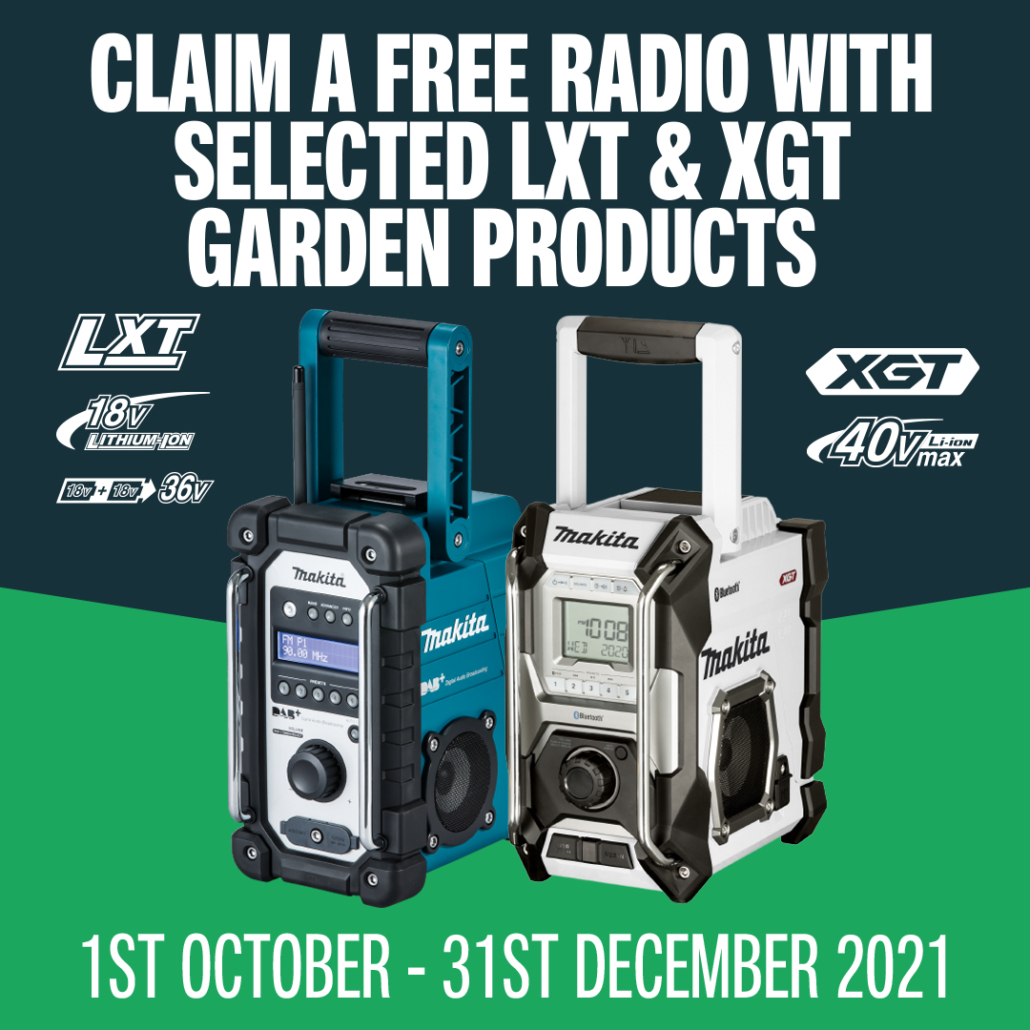
An offer not to be refused: Leading power tool manufacturer Makita UK is giving end users the chance to get their hands on a free DMR110 DAB+ Site Radio or MR002GZ01 XGT Bluetooth Radio when they purchase selected garden machines between 1st October and 31st December 2021.

Makita radios are fantastic for keeping you entertained on site or at home in the garden – and thanks to the company’s latest redemption offer end users have the chance to redeem a free DMR110 DAB+ site radio when they purchase from a chosen selection of 18V LXT and Twin 18V LXT garden machinery products. In addition, those who purchase any of the qualifying XGT 40VMax outdoor products can redeem the MR002GZ01 XGT Bluetooth Radio.
An offer not to be refused

An offer not to be refused

The DMR110 is compatible with Makita’s LXT, CXT and 7.2V Li-ion batteries, making it the ideal addition to any professional’s existing collection of Makita products. It features a two speaker stereo system for maximum output and has an easy to read digital tuner with an LCD display for ease of use. This model has also been designed to endure tough on-site conditions with elastomer bumpers to protect it against knocks and scuffs – and it is IP64 rated for being dust and shower proof.

Alternatively, the durable and easy to use MR002GZ01 Bluetooth Radio is compatible with Makita’s XGT, LXT, CXT batteries. Thanks to its Bluetooth capabilities, the MR002GZ01 can be easily connected to mobile devices within a 10m range – it even has a USB output port for charging devices on site. Impressively, the MR002GZ01 can run for up to 27.5 hours when powered by a 4.0Ah XGT 40VMax battery.

Kevin Brannigan, Marketing Manager at Makita said: “The DMR110 and MR002GZ01 are the perfect job site companions and we are delighted to be able to offer end-users the chance to add some entertainment to the working day. Thanks to the DMR110 and MR002GZ01’s clever design, professionals can use their existing XGT, LXT or CXT batteries to power the radios for convenience.”

Makita is running this promotion from 1st October 2021 until 31st December 2021. Anyone who purchases and registers a qualifying Makita garden machinery product from an authorised Makita dealer during this period can claim a free DMR110 or MR002GZ01 radio. Simply register the claim and proof of purchase within 28 days of purchase, via a dedicated microsite. On successful application, customers will receive their free gift after 30 days.

To find out more about Makita’s latest promotion, including the full list of qualifying products, how to claim and terms and conditions visit: https://makitauk.com/freeradio

For the latest industry news visit turfmatters.co.uk/news

Get all of the big headlines, pictures, opinions and videos on stories that matter to you.

Follow us on Twitter and Instagram for fun, fresh and engaging content.

You can also find us on Facebook for more of your must-see news, features, videos and pictures from Turf Matters.
Not Just Three Numbers

Not Just Three Numbers: Understanding fertilisers: What to use where, when and why

By Chris Humphrey MBPR FQA – Technical Manager, Collier Turf Care

Not Just Three Numbers

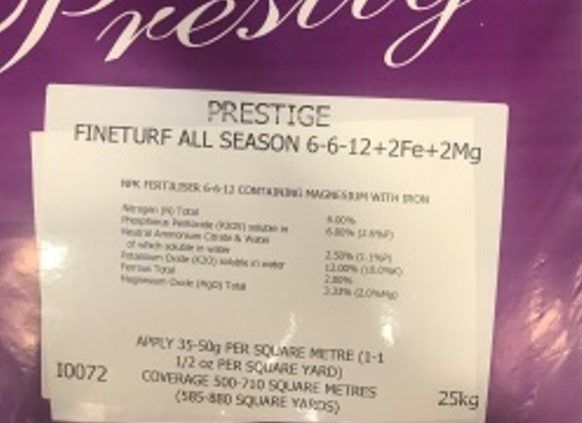
We are all familiar with turf fertilisers being referred to as three numbers (for example 6:6:12) but what does it really mean and what are we putting on our turf? To start, the three numbers are just what is required by legislation to be on the fertiliser. They relate to the percentage of major nutrients Nitrogen, Phosphorus and Potassium (NPK) in the product. But you need to know a lot more.

Read the label and discuss with your FQA (FACTS qualified advisor) your requirements. FACTS is the Fertiliser Advisor Certification and Training Scheme. Is your advisor qualified?
Ask to see their FQA card.

Why do we apply fertiliser?

Turf needs many nutrients to remain healthy and it is important to ensure that they are present in the soil in sufficient quantities and are available to be taken up by the plant.

Typical level of nutrient in grass.

Major nutrients
Nitrogen          – 2.50 – 6.0%
Phosphorus      -0.25 – 0.50%
Potassium        -1.25 – 3.50%

Secondary nutrients
Calcium           -0.40 – 0.70%
Magnesium     -0.05 -0.25%
Sulphur            -0.25 – 0.50%

Micronutrients
Iron                  -60 – 400ppm
Manganese     -50 – 400ppm
Copper             -50 – 400ppm
Zinc                 –  2 –  30ppm
Boron              –  2 –  5ppm
Molybdenum   –  2 –  5ppm

Nutrients are lost through leaching through the soil and clipping removal. But how much should we put on and in what form? Nutrients come in different forms and vary in speed of delivery, potential to scorch the turf, the effect on soil pH, availability at different temperatures, granulation size, longevity of response and physical breakdown. Nutrients also come from different sources. The major nutrient – Nitrogen – can come as Ammonium Nitrate, Sulphate of ammonia, urea, an organic source or as a synthetic nitrogen.

Ammonium Nitrate and Sulphate of Ammonia will release quickly and give a fast response at low temperatures, they will therefore not last as long as other nitrogen forms and do have a higher scorch risk. Sulphate of ammonia is also quite acidic which could be a useful or not depending on your soil pH and requirements. Urea needs bacteria to convert it to nitrate for the plant to take it up, therefore it needs some moisture and the temperature to be above 6 degrees centigrade to get it working. Organic nitrogen comes in any format where organic matter can breakdown with bacterial activity to release nitrogen. The common ones used in turf fertilisers are Bone Meal, Dried Blood, Poultry manure or Leather-meal. By the fact that organic nitrogen scores need to be broken down, they are a fairly slow release of nutria and do require some moisture and temperature to help them. The exception is Dried Blood that does break down quicker than the other organic forms. Because Organic fertilisers are slow they have a very low scorch potential. Most fertilisers that call themselves organic are actually only organic based and have a degree of inorganic nitrogen in them. Check the label or ask your FQA. The final source of nitrogen is the synthetic nitrogens such as Methylene urea, IBDU, Resin coated urea or Sulphur & Resin coated urea. These are designed to give you a slow release over a set period, often up to 9 months. They generally therefore have a lower scorch potential. It is important when using any coated product that the granulation is a suitable size for the turf area where you plan to use it and maintenance operations do not break the coatings.

How much nitrogen should you put on? This will vary on many things such as soil type, leaching potential, grass type and growth rate. You should prepare an annual fertiliser programme based on your individual requirements and the results of a soil test.

To work out how much nitrogen you are applying use the following formulas to give you the Kg/Ha you will be applying.

For Granular products

(Application rate x % Nutrient) divided by 10

Example – Apply a 4:0:8 fertiliser at 35g/m2
(35 x 4) divided by 10 = 14kg/Ha of nitrogen.

For Liquid fertilisers

(Application rate x specific gravity x % Nutrient) divided by 100
(specific gravity is the weight of a known volume of liquid fertiliser vs the same volume of water)

Example – apply a 15:0:12 liquid fertiliser at 60ltr/Ha. The liquid fertiliser has a specific gravity of 1.2 (i.e. it is 1.2 times heavier than water).
(60 x 1.2 x 15) divided by 100 +10.8kg/Ha of nitrogen.

Every site will vary and many things need to be taken into consideration when planning your fertiliser programme but as a rough outline of common nitrogen inputs are:

Golf Green/Bowls/Ornamental Lawns 80 – 120kg/Ha
Soil based Golf Tees 80 – 160kg/Ha
Sand based Golf Tees 200 – 240kg/Ha
Cricket Square 80 – 120kg/Ha
Soil based Football 80 – 120kg/Ha
Sand based Football 200 – 800kg/Ha or even more.

For the latest industry news visit turfmatters.co.uk/news

Get all of the big headlines, pictures, opinions and videos on stories that matter to you.

Follow us on Twitter for fun, fresh and engaging content.

You can also find us on Facebook for more of your must-see news, features, videos and pictures from Turf Matters.

Cricket Groundsman 50 Not Out

Cricket Groundsman 50 Not Out: A fun-filled evening of cricket was held at Duncombe Park Cricket Club on Friday, July 20.

A match between ex-players, known as The Legends, who were captained by Pete Humpleby, took on the current players, captained by Jonathon Leckenby.

Following the match, a presentation of an engraved tankard was made to Alan Kent for 50 years as groundsman.

The chairman thanked Alan, on behalf of the club, for all his dedication and hard work over the years.

Thanks went to everyone who took part or supported the evening in any way.

Click here to read the original article

For the latest industry news visit turfmatters.co.uk/news

Get all of the big headlines, pictures, opinions and videos on stories that matter to you.

Follow us on Twitter for fun, fresh and engaging content.

You can also find us on Facebook for more of your must-see news, features, videos and pictures from Turf Matters.