Tag Archive for: Of

The true cost of cutting costs?

The true cost of cutting costs?: When a machine is operating at optimum performance and being utilised in the correct conditions, professional groundskeepers or operators can expect to see healthy and pristine looking turf. But performance could be hampered if a mower isn’t properly maintained and that includes the choice of replacement parts.

Currently, we’re in the thick of the core mowing season, and it’s likely that replacement parts will be required to maintain that optimum experience and result.

The true cost of cutting costs?

The true cost of cutting costs?

Here, Franck Pillittieri at The Toro Company, shares some reasons why it’s essential to consider true lifetime value and not just a low price point when it comes to purchasing replacement parts.

“We know that for many in our industry, as in many others, there is a need to try and reduce cost when it comes to maintenance work on equipment. In the current climate especially there is likely to be more pressure than ever to cut costs in the short term – but what is the true cost when the price is lower?

“As a premium manufacturer, our parts are not the lowest price on the market. We offer our customers the Toro Genuine Parts solution for a Genuine performance. Below are the top reasons we recommend buying discerningly when replacing parts in your mower.”

Quality fit

Our Toro Genuine Parts are custom designed for each machine, so when one needs replacing it makes sense to fit a like for like piece. Cost demands though, could lead people to consider a cheaper alternative. However, not only could the lower cost part not fit correctly, but it could also compromise the machine going forward, increasing wear and general run down of the machine.

Durability

Whilst a cheaper price may seem like a great saving at the time, it is likely to prove a false economy in the long run if the part isn’t built to last. Not only may you have to incur the expense of replacing non-genuine parts more often, you also may experience longer downtime for your machine, impacting your productivity.

Safety

With any replacement product that is not designed for the machine there is a risk to the safety of the user and the lifetime of the machine. Often, cheaper replacement parts come from manufacturers who focus more on cost than safety. We, at The Toro Company, place the safety of the users and the performance of the machine at the top of our priorities.

Machine damage

When parts are purchased from a Toro-approved channel partner, the consumer can trust that the channel partner is committed to the care of the machine. We cannot expect this to be true for unrelated suppliers that may offer the cheapest parts on the market. Cheap parts could damage to the machine, resulting in a cost that could counteract any potential savings. Downtime for repairs can also result in lost income. For example, belts and filters go into the core of the equipment, and there is a risk of causing a break down or technical issue by using non-genuine parts.

Time efficiency

If certain parts of the mower are replaced with non-genuine replacements there is a possible impact on the time it takes to complete a job. For example, all Toro blades are engineered for our specific machines to increase efficiency. A replacement blade could be less effective and require more frequent cutting, again incurring more overall costs and decreasing efficiency.

Poor results

There is also the possibility with cheaper parts that you could achieve a poorer cut with your mower. When using cheaper tines, for example, you may damage the turf and have a reduced result.

“At The Toro Company, we offer a high-standard after-service experience in collaboration with our channel partners. This includes 24-48 hour delivery, meaning less downtime for your machine, knowledgeable service technicians if you need help installing parts or require information on your mower, a 90-day warranty for peace of mind, and a guarantee that we are investing in innovation to benefit customers now and in the future.

“So, whilst we appreciate the current situation that many of our customers are in, we encourage everyone to consider the longer-term view for the best outcome for their machines.”

For more information please visit www.toro.com/en.

For the latest industry news visit turfmatters.co.uk/news

Get all of the big headlines, pictures, opinions and videos on stories that matter to you.

Follow us on Twitter and Instagram for fun, fresh and engaging content.

You can also find us on Facebook for more of your must-see news, features, videos and pictures from Turf Matters.

Greenkeeper shares 40 years of memories

Greenkeeper shares 40 years of memories: A dedicated greenkeeper thought to be one of the longest serving in the industry is celebrating spending 40 years at the same golf club.

Terry Wharton joined Haydock Park Golf Club in April 1980 as a young man and is now head greenkeeper

He said: “The 40 years have gone quickly and I’ve been very fortunate to spend most of my working life in a beautiful landscape, working with good greenkeepers and staff trying to raise the standards and the playability of our course.”

There have been plenty of changes since he first took up his role at the club.

“The early years saw limited machinery on the course, with most surfaces cut with hand machines, except for fairways and rough that were cut with tractor and gang mowers,” he said.

“The top-dressing facility of a self-contained hopper supersedes the tractor, trailer and wheelbarrow that in the early 1980s you’d be lucky to dress greens with 20 tonnes throughout the year, against 120 tonnes delivered in a two-month period in the spring at the present time.”

With the advancements in technology and more televised golf events, Terry has seen many changes during his career.

He said: “The golfers’ desire for better surfaces has seen the staffing levels raised at most clubs compared to the early years, with busy clubs realising the work programme for the day needs to be completed quickly and efficiently before the golfers start their round, with only the basic tasks being completed early afternoon. This point can be shown with our start times in the summer of 1980 – we had an 8am start with a 5pm finish against present start time 6am with a 2pm finish, allowing the greens team to complete most of the course set-up before the course gets busy.”

Terry said his favourite part of the club was its members, remembering one in particular.

He said: “We’ve had some real characters playing the game at Haydock Park, none more so than Jack Padoue, who was one of the ‘old guard’.

“On arrival at the club one Monday dinner, Jack was met with builders in the men’s locker room.

“Jack looked surprised, ‘how dare they work’ on the day he played, and it may affect his preparation on setting up for his four ball. Jack’s four ball was run to military precision and woe betide anyone getting in Jack’s way!

“So the builders were told by Jack what was expected from them – he wanted a ‘quick clean efficient job and by the way turn that radio off, don’t you realise you’re working at a private members’ golf club?’

“The builders came across Jack a few more times before they finished the work and were met with the same abruptness.

“On the builders completing the locker room Jack realised his key wouldn’t open his locker. On further inspection someone had accidentally spilled some super glue into the lock, we wondered who….”

Stephen Nicholson, the club’s business manager, paid tribute to Terry’s loyal service.

He said: “Wow, 40 years – that’s longer than I’ve been on this planet. It’s a feat that’s rarely matched these days, with more and more people opting to move from position to position to progress their careers. Terry’s loyalty has been at the heart of his longevity here.

“Alongside this what I am impressed with the most about Terry is his enthusiasm to continue to learn and develop.

“We’ve sent him down to Oxford to see how a different style of greenkeeping works, we’ve updated our systems so he now has a computer in his office, has access to Word, Excel and email whilst updating everything in the cloud along with an online planner in the form of Turfkeeper that tracks all shifts, financial planning of stock, seed, fertiliser applied etc.

“It’s great that Terry continues to push for more and we look forward to continuing to work together for the next 40 years! You are a credit to the club, your profession and your family. Once this crisis is over we will no doubt have a proper celebration for Terry – in the meantime, thanks again for all that you do and keep up the great work.”

Click here to read the original article

For the latest industry news visit turfmatters.co.uk/news

Get all of the big headlines, pictures, opinions and videos on stories that matter to you.

Follow us on Twitter and Instagram for fun, fresh and engaging content.

You can also find us on Facebook for more of your must-see news, features, videos and pictures from Turf Matters.

Celebrating 10 years of seminars

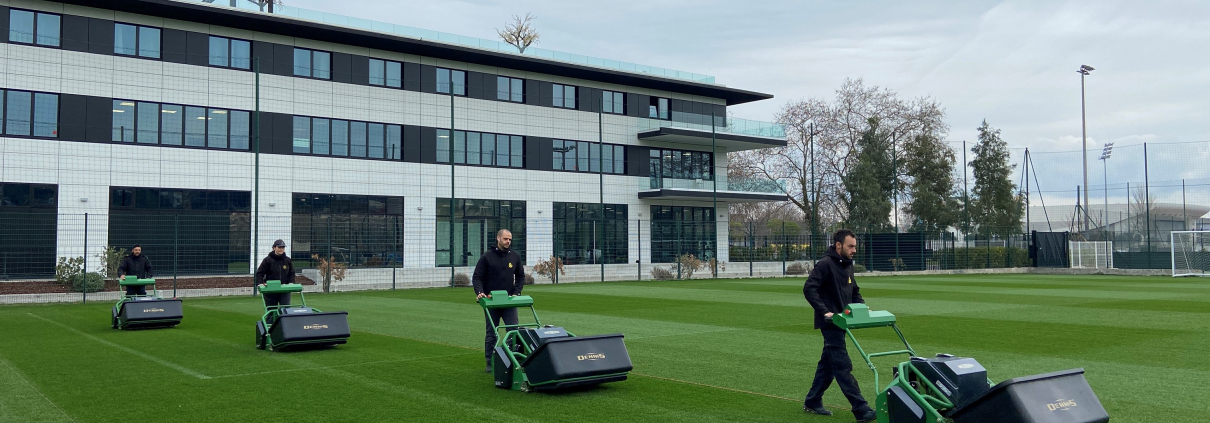
Celebrating 10 years of seminars: Dennis and SISIS are celebrating an impressive decade of groundcare seminars this year. In this article, we look at the history and development of the seminars and how they have proved to be so beneficial for so many of the unsung heroes in a wide variety of sports turf sectors.   

The ever-popular Dennis and SISIS groundcare seminars, are first and foremost, education-based events, supported by expert speakers with both indoor presentations and outdoor practical sessions. The seminars aim to connect like-minded people where they can find advice, learn new skills and techniques as well as offer fantastic networking opportunities. A large number of groundcare individuals have significantly benefitted from attending the seminars over the years including volunteers and professionals representing schools, sports clubs, local authorities and contractors.

Celebrating 10 years of seminars

Celebrating 10 years of seminars

The humble origins of the seminars can be traced back long before this ten-year period when both Dennis and SISIS were operating as separate entities and hosted educational groundcare events for their respective customer bases.  However, in 2011, SISIS was acquired by the Howardson Group to sit alongside Dennis as a division to provide the groundcare industry with a truly comprehensive range of British manufactured turf maintenance products. It was at this point in history that the two manufacturers combined their extensive knowledge and expertise and the groundcare seminars were taken to another level.

This monumental year saw a series of seminars addressing a wide range of sports turf topics including a dedicated bowls seminar which took place in North Kessock, Scotland; and a cricket themed seminar which took place at Uxbridge Cricket Club in Middlesex, London.

These early seminars set the precedent and over the years, they continued to evolve. From winter pitch maintenance, to early spring maintenance; from renovations to soil core clinics – the seminars have, and continue to, offer advice in a number of groundcare aspects.

As the seminars grew in stature, support and reputation, so too did the illustrious and extensive list of expert speakers. Take for example the expert panel at the most recent seminar held at Durham County Cricket Club’s Emirates Riverside which included Vic Demain (Durham CCC), Karl McDermott (MCC, Lord’s), Jim Dawson (BT Murrayfield) and Keith Kent (Head Pitch Advisor to Rugby Groundsmen Connected).

From the first seminar in North Kessock to the most recent at the Emirates Riverside, the series of seminars have accumulated some truly astonishing statistics.

  • 87 venues across the country
  • 550 hours of education
  • Expert speakers covering 300 informative sessions
  • Over 4,800 delegates

Whether a groundsman or a greenkeeper in employment or a volunteer; whether highly experienced or just starting out in the industry; throughout this ten-year period so many people associated with the maintenance of sports turf have benefited from attending the Dennis and SISIS seminars. One look at some of the testimonials which have been gathered over the years are certainly testament to this.

Vic Demain has been a long-term supporter of the seminars and has been a speaker at many over the years: “Having been involved with the Dennis and SISIS cricket groundcare seminars since their launch in 2011, it has been fascinating to see the growth of the events, together with the interest shown by the industry.

“The beauty of many of these events is being able to share time with likeminded folk, making new contacts and discovering that no matter what level one works at, we all have the same passion. The interaction between presenters and delegates at these events will give the audience a desire to get back onto their grounds.”

Commenting on the seminars, Keith Kent explained why he feels they are so valuable: “I think that as part of everybody’s education, every day should be a school day and these seminars, where there are such high-quality speakers, are a vital opportunity to progress.

Commenting on a bowls seminar held at the Backworth Miners Welfare Bowls Club in Newcastle upon Tyne, Robert Blacklock from North Tyneside local authority said: “I’ve found the day to be extremely useful and informative with excellent presentations. I do not have a lot of experience in this field and have recently started some courses on turf maintenance. The seminar was not overwhelming, and it was pitched at the correct level.”

Nigel Pearce, Head Groundsman at Lechlade Cricket Club, attended a seminar at  Gloucestershire County Cricket Club along with his chairman and revealed that it was beneficial for the both of them: “For me it was great to catch up with a number of fellow groundsmen who I already knew and it was good to meet new ones as well. It was also really interesting listening to speakers like Chris Wood and having the opportunity to go out and look at the square. My chairman also came along with me today and I’m really pleased because he has learnt a lot about what I do and received an insight into the issues I may encounter on a day-to-day basis.”

Speaking at a renovation seminar held at St Albans School, Woollam Trust Playing Fields, Lee Marshallsay, Grounds Manager at Charterhouse School said: “It’s been very beneficial for my team and I like the fact that it is aimed at everyone – it’s not just for those in the top positions. To get everyone together from grass roots upwards works really well. I think the indoor seminars and the outdoor practical demonstrations have provided a good mix. You get to see the machines in action and many people here wouldn’t have seen that before so for them to have more of an idea of what equipment is out there is ideal.”

Derek Traill of Cricket Scotland, summarised the seminars perfectly after attending the most recent event in Durham: “The key message coming out of today’s event is that it is all about communication and to strive to learn off one another – we learn from one another’s experiences, failures and successes and from these we can build on them and improve as one,” he said.

Although we are currently facing testing times, Dennis and SISIS are looking forward to resuming the seminars with the groundcare community.

“I’m extremely proud to be celebrating ten years of groundcare seminars – they have a long history and a great tradition,” said Roger Moore, Sales and Marketing Manager. “The seminars are about attendees getting as much information as they can and making the day enjoyable. They can go away with some excellent knowledge which they can then put into practice on their own sites. Over the years the events have been a tremendous success and I am looking forward to continuing our support for the groundcare community.”

Further information about the range of maintenance products available can be found by visiting www.dennisuk.com / www.sisis.com.

For more news, reviews and insightful views, you can follow Dennis on Twitter and Instagram @DennisMowers and SISIS @SISISMachinery. You can like the Facebook pages – www.facebook.com/DennisMowersUK and www.facebook.com/SISISMachinery. You can also view the latest Dennis and SISIS videos by visiting www.youtube.com/DennisMowers and www.youtube.com/SISISMachinery.

For the latest industry news visit turfmatters.co.uk/news

Get all of the big headlines, pictures, opinions and videos on stories that matter to you.

Follow us on Twitter and Instagram for fun, fresh and engaging content.

You can also find us on Facebook for more of your must-see news, features, videos and pictures from Turf Matters.

The growing role of PGR’s

The growing role of PGR’s: Plant Growth Regulators (PGR’s) are a longstanding programme component for those maintaining all types of amenity grassland and managed amenity turf.

Clipless NT® from Headland Amenity’s is a Trinexapac-ethyl PGR, which is typically applied from mid-April on outfield or course turf and mid-late May on fine turf. Alex Hawkes, Headland’s Sports Turf Manager explores how PGR’s work and how many are now finding additional benefits of their use.

The growing role of PGR’s

The growing role of PGR’s

PGR’s effectively block the production of gibberellic acid – the plant hormone responsible for cell elongation. By lowering levels of the hormone within the plant leaf, PGR’s reduce cell elongation and vertical growth and, instead, redirect the energy within the plant to generate enhanced root development and lateral growth. In its simplest capacity, it can contribute towards a sward that requires less frequent mowing, saving manpower and associated machinery costs. They can be particularly useful for reducing mowing in difficult or dangerous areas such as steep banks.

Because growth is redirected from vertical to horizontal, PGR’s are often employed by greenkeepers and groundsmen alike to increase the density of a given area. Moreover, they have also been shown to optimise the conditions for seeding operations – particularly those in or near competitive swards. With the regulated growth and lower energy consumption of the existing plant, nutrition from the soil profile is optimised for germination and establishment of the new seedling.

At Trent College in Nottingham, Head of Gardens and Grounds Peter Flewitt trialled Clipless NT® in this capacity, on the schools four cricket squares. “In our environment, we are able to renovate the squares much earlier in the growing season than perhaps other local clubs or the county grounds would. We applied Clipless NT® at the end of July, a week before we started our renovations and we nicknamed this area our ‘old grass’. We were interested to see if by regulating the growth here, the new seed sown in the vicinity would germinate better due to lower competition – and it worked well.”

Peter continues, “We left the ‘new grass’ to grow through and the difference in their comparative growth speeds was evident – particularly when we mowed for the first time that it was just this new grass being cut. With the Clipless NT®, used in conjunction with H-Cote™ (slow-release fertiliser) we were able to then manage and sustain the healthy, dense sward we achieved in our renovations through the autumn and winter period when our workload shifts focus onto our winter sports areas. With the wet winter we had, the Clipless NT® application kept growth in check meaning we didn’t have to take any mowing equipment out onto the soft ground at any stage.”

For the latest industry news visit turfmatters.co.uk/news

Get all of the big headlines, pictures, opinions and videos on stories that matter to you.

Follow us on Twitter and Instagram for fun, fresh and engaging content.

You can also find us on Facebook for more of your must-see news, features, videos and pictures from Turf Matters.

Groundsman’s sense of normality

Groundsman’s sense of normality: Amid all the uncertainty brought about by the coronavirus pandemic, it is reassuring to know that some routines have hardly changed.

“The grass doesn’t stop for coronavirus,” Scott Humphries, groundsman at Oxford United’s training ground says.

This is the start of the third week without players working on the pitches at the club’s headquarters near Horspath.

But while the squad are cooped up, Humphries cannot work from home.

Instead, he is isolated in his tractor, trundling up and down the vast expanse of green, keeping it in shape for when the season can restart.

He said: “It’s just about giving the pitches some tender loving care.

“Grass is like a human, it requires food, drink and oxygen.

“People don’t see it like that, but to me it’s my second baby.”

Other than not marking out the pitches, his job has barely changed in the last fortnight.

The lack of wear and tear, coupled with the sudden burst of sunshine, has helped restore the pitches to pristine condition.

But there is a snag to this unscheduled break, which is centred around just how long life will be on hold.

Groundstaff count on the long summer break to give them enough time to undertake essential major pitch renovation works.

But with the current campaign set to be extended, it is likely the gap between seasons will be shorter.

Humphries said: “We all need a holiday now and again because otherwise we burn out – and pitches are no different.

“You would normally rip the surface off and then it’s about six weeks to grow.

“The training pitch is vital, especially with the way our boys want to play.

“The community use the facilities as well and you want them to have a good surface when they’re allowed to come out.

“It’s so frustrating because we can’t plan anything – and it needs to be ready for Championship players next season.”

A lifelong United fan, Humphries has lived the dream since arriving in August 2017.

And although he is working separately to the rest of the club at the moment, the connection is still there.

“Derek Fazackerley (first team coach) rang me up the other night, just to see how things were,” he said.

“That’s brilliant and it just makes you feel part of it.

“Faz is a football legend and he’s taken ten minutes out to give me a ring.

“It’s the club I love and you are always going to go the extra mile in that situation.

“It’s brilliant to see it on the Saturday. At 5pm you can say ‘I’ve played a little part in that’.”

In that context, the current situation – surrounded by pitches, but without any football – is torture.

“I can’t wait for football to be back,” he said.

“I just keep thinking about that first game and how much we’ll all be looking forward to it.

“We took a Tuesday night in Rochdale for granted, but everyone will be buzzing to go now.”

Click here to read the original article

For the latest industry news visit turfmatters.co.uk/news

Get all of the big headlines, pictures, opinions and videos on stories that matter to you.

Follow us on Twitter and Instagram for fun, fresh and engaging content.

You can also find us on Facebook for more of your must-see news, features, videos and pictures from Turf Matters.