
Tag Archive for: Project

Trencher Hire keeps project costs down

Trencher Hire keeps project costs down: When a customer of broadband and telecoms provider 2020 Networks took the decision to transfer their phone system over to VoIP (Voice-Over Internet Protocol) they could never have envisaged the potential costs involved.

For BT Openreach quoted an ‘eye-watering’ £13,000 to undertake the associated engineering works in order for the new fibre to be installed. Mick Clarke, Partner with broadband and VoIP provider 2020 Networks, said that not surprisingly another way forward was needed and Trencher Hire UK was instrumental in helping cut costs by many thousands of pounds.
Trencher Hire keeps project costs down

Trencher Hire keeps project costs down

“Our customer was located on the edge of an industrial estate in Simonswood near Kirkby in Liverpool and, because their existing broadband connections were so poor, wanted to move over to VoIP, which is the future of telephony.

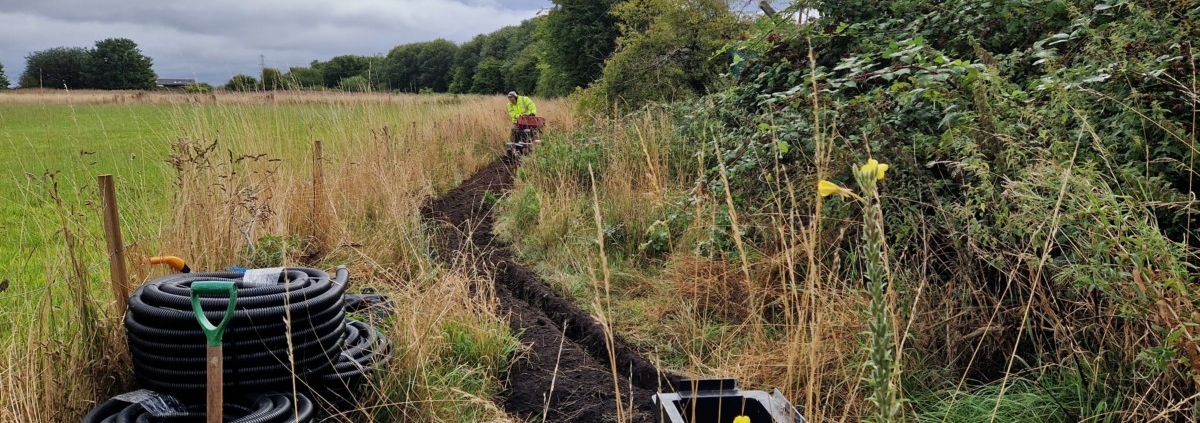
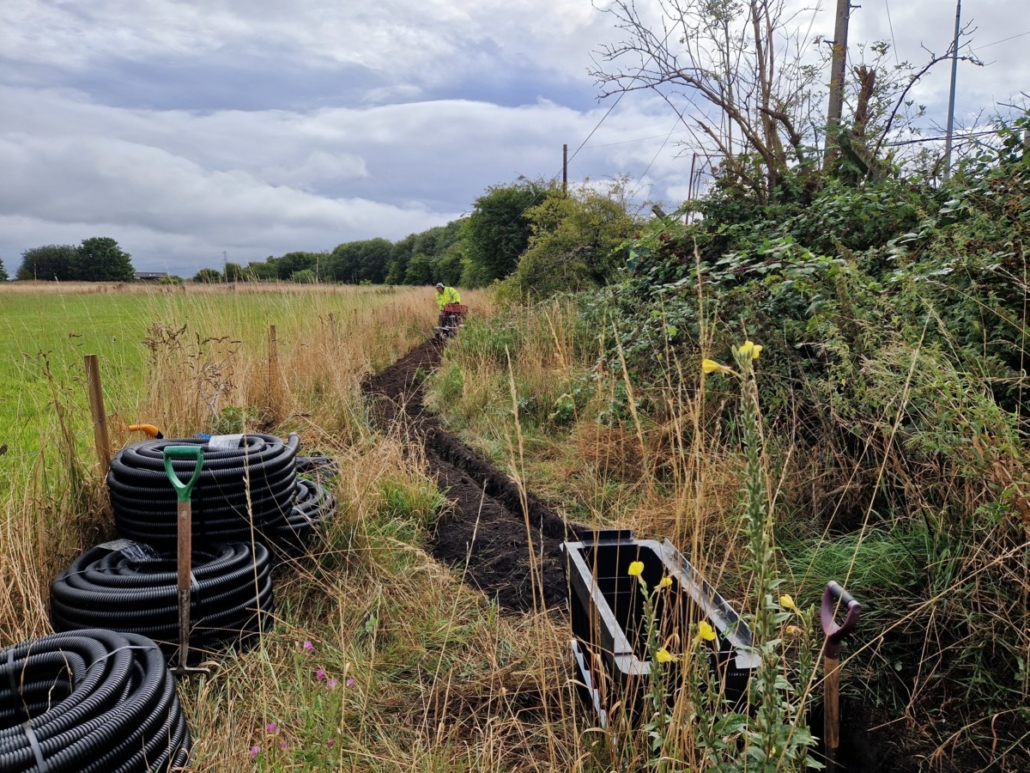
“We proposed a 150mb leased line, but Openreach quoted over £10k in ECCs to get the fibre in. We therefore decided to arrange the civils ourselves. The cost of hiring a mini-excavator with operator would have been around £2k. However, we found a much more efficient and cost-effective option by hiring a Toro TRX-16 pedestrian trencher with operator from Trencher Hire UK.

“A 170 metres long trench was dug-out to a depth of around 400mm, with 170 metres of 50mm duct being installed, as well as three chambers. The cost of all the civils, which included the hiring of three labourers over a couple of days, cost just £1,500. I also undertook some of the work myself.

“The Toro TRX-16 was a tremendous piece of kit and the work was undertaken in just three hours. The service from Trencher Hire UK was really excellent with clear responses and the unit delivered on time and was extremely good value.”

2020 Networks offers two hosted VoIP and SIP platforms that provide services either on a ‘per channel basis,’ or via extensions with inclusive minutes.

VoIP uses a dedicated broadband line to process voice traffic. In simple terms, it turns your voice into data packets and sends them instantly over your existing broadband network to the person you’re calling. The callee won’t notice anything different, they still hear your voice as normal. The call quality will be the same as, or better than, any existing landline service.

To find out how Trencher Hire can help you, contact us on 0121 751 9319 or email: team@trencherhire.com or visit us at: www.trencherhire.com

For the latest industry news visit turfmatters.co.uk/news

Get all of the big headlines, pictures, opinions and videos on stories that matter to you.

Follow us on Twitter and Instagram for fun, fresh and engaging content.

You can also find us on Facebook for more of your must-see news, features, videos and pictures from Turf Matters.

New sustainable project at Brondby IF

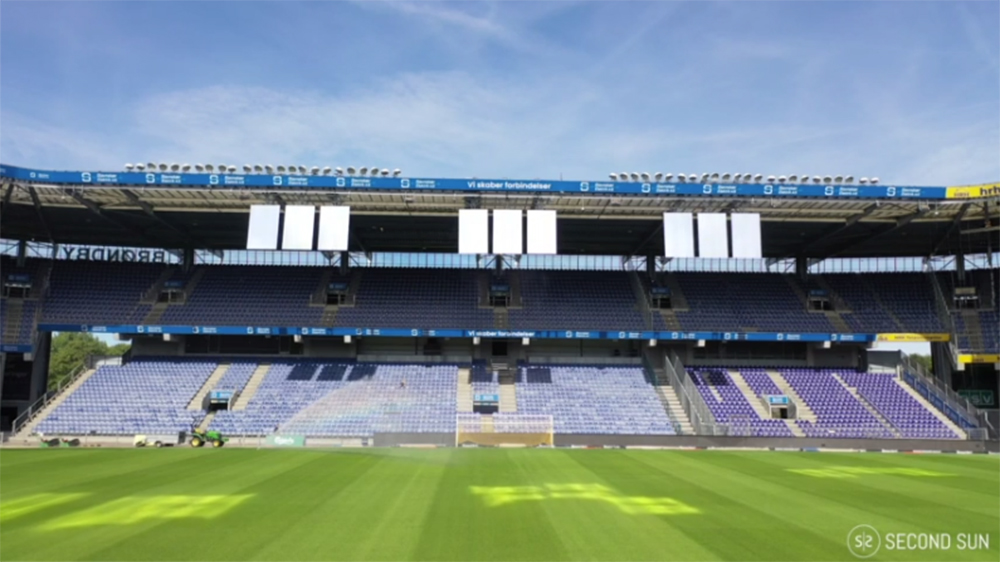
New sustainable project at Brondby IF: Brondby IF’s stadium is the first in the world with a 100% sustainable and economical solution in the form of 100 m2 sun mirrors that add the missing sunlight to the grass.

Brondby IF and Second Sun have in recent years collaborated to establish this solution, and now several clubs in Denmark, Spain, Germany, United Kingdom and Australia are also joining the fray to become part of this green future.

New sustainable project at Brondby IF

New sustainable project at Brondby IF

The team, who is responsible for the grass on the field on a daily basis and won the “best pitch in Denmark 2021 and 2022”, is also pleased with the new solution. Chris Hague, head groundsman at Brondby IF: “There are parts of the southern half of the course that need more light than the natural daylight it receives today. Nothing is better for growing grass than sunlight. Second Sun contributes sunlight to the half of the field that is missing, and is part of the solution that solves the problem.”

Ole Palmå, CEO of Brondby IF, says: “Innovation and new technology are part of Brondby IF both on and off the field. With the installation of Second Sun’s solar reflector system at our stadium, we can beat several flies with one swipe: Support a skilled technological entrepreneurial company, act sustainably and also through the system achieve a saving on the artificial lighting on the pitch.”

Great international focus

Second Sun is an entrepreneurial company in Copenhagen with CEO Nicolai Moustgaard at the helm, and he is happy with the collaboration with Brondby IF.

He says: “We are very pleased with the collaboration with Brondby IF, which has welcomed our ideas and innovative solutions. We have thoroughly tested the system and the results show that the reflection of the sunlight from our mirrors actually benefits the growth of the grass. We have now expanded with 100 m2 solar reflectors set up on the north stand. The set-up here has resonated in the football world, and we have received several inquiries from other stadiums in Europe and as far away as Australia.”

Media video of the system

https://vimeo.com/605470378 (Danish National Broadcasting feature)

For further information, contact CEO Nicolai Moustgaard on +45 5360 3638 nm@secondsun.dk or press adviser, Susanne Louw on +45 3150 9031 sl@secondsun.dk

Visit our website: https://www.secondsun.dk/

For the latest industry news visit turfmatters.co.uk/news

Get all of the big headlines, pictures, opinions and videos on stories that matter to you.

Follow us on Twitter and Instagram for fun, fresh and engaging content.

You can also find us on Facebook for more of your must-see news, features, videos and pictures from Turf Matters.
Capillary Bunkers project at Marienburger

Capillary Bunkers project at Marienburger: Germany’s largest Capillary Bunkers installation so far has just been completed at the Marienburger Golf Club in Cologne, by architect Christian Althaus and contractor Sommerfeld.

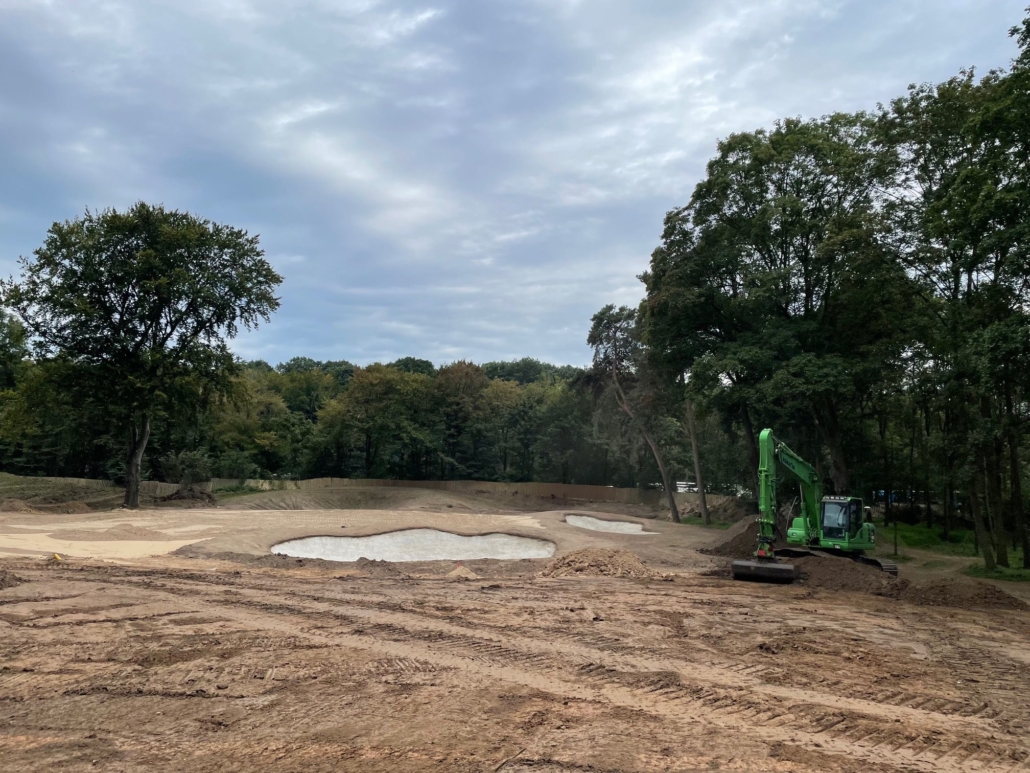
Founded as Cologne Golf Club in 1906, the club moved to its current site in Marienburg in 1909. The construction of an autobahn (motorway) to Aachen in the thirties saw the course reduced to nine holes, which it has remained ever since. The club called in architect Althaus to advise on course improvements several years ago, and in 2021, the upgrade project got underway, incoporating the reconstruction of all nine greens – which were not properly drained – as well as bunkers, and the regrading of fairways to provide better drainage and more interest.

Capillary Bunkers project at Marienburger

Capillary Bunkers project at Marienburger

“The course is within a kilometre of the Rhine River, and is thus partially sandy, but even so it was clear that we needed a bunker liner,” says Althaus. “Even on the parts of the site that have a sand base, the steep faces of the bunkers would erode quite badly without it, and also the sand of the sub-base and the bunker sand would intermingle and contaminate the bunkers.”

Althaus considered various liner options, but was led to select Capillary Bunkers on environmental grounds. “We considered various liner options, but I knew I needed a very strong and stable liner on environmental ground, which led us to choose Capillary Bunkers,” he explains. “The strength and neutrality of the Capillary Bunkers product made it the right choice.”

Construction work is complete, and the project is growing in – the course will reopen in spring 2022.

For the latest industry news visit turfmatters.co.uk/news

Get all of the big headlines, pictures, opinions and videos on stories that matter to you.

Follow us on Twitter and Instagram for fun, fresh and engaging content.

You can also find us on Facebook for more of your must-see news, features, videos and pictures from Turf Matters.

Makita tools power the Eden Project

Makita tools power the Eden Project: Makita UK has exclusively supplied the Eden Project with a range of its cordless outdoor power equipment to assist with the maintenance and redevelopment work at the famous site.

By adopting Makita’s battery-powered machinery, Eden Project is able to reduce emissions and ensure the maintenance team can work safely and efficiently – even when visitors are on site.

Makita tools power the Eden Project

Makita tools power the Eden Project

The Eden Project near St Austell in Cornwall is an educational charity and visitor attraction dedicated to showcasing the power of nature and inspiring visitors to think more sustainably. The site is famous for its bubble-like Mediterranean Biome and Rainforest Biome that house a wide range of plant life that all require regular care and maintenance to thrive.

As well as the Biomes, the Eden Project Living Landscapes team are responsible for maintaining the over 20 acres of outdoor gardens and over 140 acres of nursery grounds, parking areas, woodlands and wildflower fields. In order to do this, the team require a range of reliable, durable and high-power machines that can tackle any task, as well as allow the flexibility to move around the large site with ease.

Robin Lock, Head of Living Landscapes at the Eden Project explains: “At the Eden Project we are dedicated to using sustainable methods which is why we wanted to update our tool kit with more environmentally friendly alternatives. With Makita’s expertise in battery-power and its wide range of high-quality garden machinery and construction tools, we are able to complete day-to-day maintenance tasks in a safer, quieter and more efficient way.

“With battery-powered machines there is no need for the team to transport petrol around site and no emissions are produced, which is key. What’s more, the machines also produce lower vibration levels so the team can comfortably and safely use the machines daily and for extended periods. With no fuel or power leads to worry about, the machines can also be used when visitors are on site – and the low noise levels mean disruption is kept to a minimum.”

For example, Makita’s DUH601RT LXT 18V Hedge Trimmer is used to ensure the 100s of metres of hedge at the Eden Project remain neatly trimmed back. With such a large area to cover, the DUH601RT is ideal as the team require a lightweight, low vibration machine that is safe to use for extended periods of time. The DUH601RT features a five-position rotating rear handle so operators can easily adjust the angle of the machine to make the work easier and safer.

What’s more, the DUH601RT includes Makita’s triple-edged asymmetric blade design. The back tooth is square, which means it can easily hold the material and the front tooth is at an angle to ensure that it can easily slice through and create an efficient and clean cut. In addition, both top and bottom blades have sharpened edges and the whole system is double reciprocating to reduce vibration. The curved blade profile also reduces friction resistance so less energy is lost through heat production and run time is increased.

In addition, the DUB363 LXT Twin 18V Blower is ideal for keeping pathways clear of leaves and debris to ensure visitor safety. As there are no trailing cables, the team can use the DUB363 across the whole site – even in the Biomes. It is powered by two 18V LXT batteries, so operators can experience high air volume and speed, as well as long run times for maximum efficiency. The DUB363 is also compatible with Makita’s PDC01 and PDC1200 backpack batteries which offer extended run times for larger tasks, such as clearing pathways throughout the Rainforest Biome.

Mark Earles, Business Development Manager for garden machinery at Makita said: “We are delighted to be working with Eden Project to assist the team with everyday maintenance and larger redevelopment work at this prestigious site. With over 270 models in our LXT range alone, the team have a huge selection of our battery powered tools and equipment to hand, to tackle any task with the simple switch of a battery.

Our partnership with Eden Project is also a great opportunity for us to get feedback on how our machines perform in unique environments like the Rainforest Biome – and we are excited to be able to utilise this as part of future product development to ensure that the Makita products can perform at their optimum, regardless of the conditions.”

To find out more about how Makita’s machines have transformed groundscare at Eden Project, watch this video: https://www.youtube.com/watch?v=kucXboNDi_M

To find out more about Makita and its range of cordless machines visit: www.makitauk.com

For the latest industry news visit turfmatters.co.uk/news

Get all of the big headlines, pictures, opinions and videos on stories that matter to you.

Follow us on Twitter and Instagram for fun, fresh and engaging content.

You can also find us on Facebook for more of your must-see news, features, videos and pictures from Turf Matters.
In-house bunker project

In-house bunker project: Somerset Hills CC in New Jersey is close to finishing a bunker project involving the installation of the Capillary Bunkers lining system across the course, which was originally designed by legendary architect A. W. Tillinghast in 1918. 

“I started here in 2009 and the bunkers here were in bad shape then,” says course superintendent Ryan Tuxhorn. “We were looking at doing a bunker project then, and when we had a meeting with our architect, Brian Slawnik of Renaissance Golf Design, we discussed it and he told us he did not like the idea. He said that bunkers should be a finishing touch and it was more important to get mowing lines and playing surfaces right.”

In-house bunker project

In-house bunker project

Several years on, though, with Tuxhorn having the course mostly where he wanted it, the question of bunkers came up again. Although Somerset Hills’s bunkers, built fairly early in his career, are not the enormous, high-flashed traps often associated with Tillinghast, Tuxhorn knew he needed a liner, and also that, ideally, he wanted to do the work in-house.

That desire to fix the bunkers with his own crew led Tuxhorn to Capillary Bunkers. “Three years ago, we installed a few Capillary bunkers as a test, and in August 2019, we were more aggressive, opening up 16 smaller bunkers in advance of a visit by Brian, to check that we could install the liner in-house and complete the bunkers in timely fashion while still maintaining a golf course. And we found it was a comfortable process,” he says.

With Slawnik’s help, Tuxhorn divided his bunkers into three grades – going from one, which meant no work was needed to the outside at all and the only work was to the sub-grade including new drainage and installation of liner and move on to three, which meant a complete redo.

“By the end of next year we should be 95 per cent done,” he says. “At the moment we only have one green’s worth of bunkers to do and we have done some of the fairway bunkers too. The work is coming out great and the members are really happy with it. Last year, the workload was fine – we were pretty well staffed and my then Senior Assistant is a really good project manager. This year has been a little bit more difficult as he got a superintendent’s job and it has been really difficult to get staff. But I have been here a while and we’re pretty efficient with our practices. We have the golf course largely where we want it and it gives us some time to take on other projects. In August while we had college and high school help, we pushed pretty hard on it. It’s been a great project for us and I’m very proud of the results.”

For the latest industry news visit turfmatters.co.uk/news

Get all of the big headlines, pictures, opinions and videos on stories that matter to you.

Follow us on Twitter and Instagram for fun, fresh and engaging content.

You can also find us on Facebook for more of your must-see news, features, videos and pictures from Turf Matters.