Tag Archive for: To

Fields in Trust bringing parks to you

Fields in Trust bringing parks to you: Whilst we’re all staying home and less able to get out to enjoy our nation’s parks this spring, green space charity Fields in Trust are bringing parks to people with a virtual tour of the UK, discovering beautiful parks and green spaces which are much loved and valued by their communities along the way.

At a time when communities across the country are revaluing the benefits their local parks usually provide for sport, nature and play, the tour will be moving around the UK exploring locations online by showcasing town and city parks which you can “visit” from your home and get a little virtual wellbeing boost in these challenging times. It’s an opportunity to experience, not just the local green spaces on your doorstep, but to discover new parks across the nations and regions of the UK.

Fields in Trust bringing parks to you

Fields in Trust bringing parks to you

The Fields in Trust website at www.fieldsintrust.org is the start point of the tour which begins by exploring the locations of the Home Nation winners in 2019’s UK’s Best Park award, Blackpool, Antrim, Dunfermline and Merthyr Tydfil. After that, the direction of the tour will be determined by park users who are invited to share their green space stories and suggest new areas to investigate. Whether you think your town or city has great parks that the rest of the country should know about, or perhaps you’re a Park-Friends-Group group or a community organisation who’d like to tell their story, let Fields in Trust know where the tour should visit and why!

Along the way, Fields in Trust will be finding out a bit more about how our usage of parks has been affected at this time with, a short survey of park users on the website www.fieldsintrust.org.

Research conducted by Fields in Trust has demonstrated clear physical health and mental wellbeing benefits from regular use of the UK’s parks and green spaces, yet these vital community assets are not equally distributed. Around 2.6million people in Great Britain live more than a ten-minute walk from their nearest park and are missing out on the physical health and mental wellbeing benefits as well as opportunities to connect with their neighbours.

Fields in Trust Chief Executive, Helen Griffiths, said: “The last few weeks have reminded everyone that the UK’s parks and green spaces are highly valued parts of our local neighbourhoods and shown us just how sorely they’re missed when they are not easily accessible. During these changed and challenging times, we must adapt how we use and enjoy them, in line with Government guidance. We are all experiencing what life would be like without access to these much-loved local spaces. Thankfully right now the loss is temporary, but it serves as a reminder that many of these spaces are lost forever. We hope that bringing the park to you this spring will provide a little virtual wellbeing because green spaces are good, they do good and they need to be protected for good.”

The average amount of green space per person in Great Britain is just over 35 square metres, less than half the size of a six-yard box on a football pitch; however, only 5.7% of the park and green space provision in Great Britain is legally protected with Fields in Trust. It is up to all of us to act to stem the decline and disappearance of our nation’s cherished parks and green spaces. Fields in

Trust are calling for the current level of park and green space provision to be maintained and encouraging communities to fight for those green spaces vulnerable to loss or development.

For the latest industry news visit turfmatters.co.uk/news

Get all of the big headlines, pictures, opinions and videos on stories that matter to you.

Follow us on Twitter and Instagram for fun, fresh and engaging content.

You can also find us on Facebook for more of your must-see news, features, videos and pictures from Turf Matters.
How to help rainfall rescue project

How to help rainfall rescue project: If you’ve some time on your hands, here’s a UK rainfall project that’s caught our eye at Rain Bird Golf.

The weather is always a topic of conversation for Brits.  Can you, your staff or family members take part in the Rainfall Rescue project and add to our UK rainfall know-how?

How to help rainfall rescue project

How to help rainfall rescue project

The UK has rainfall records dating back 200 years or so, but the vast majority of these are in handwritten form and can’t easily be used to analyse past periods of flooding and drought. Professor Ed Hawkins is a Reading University scientist who has run a number of “weather rescue” projects but this is the biggest yet.

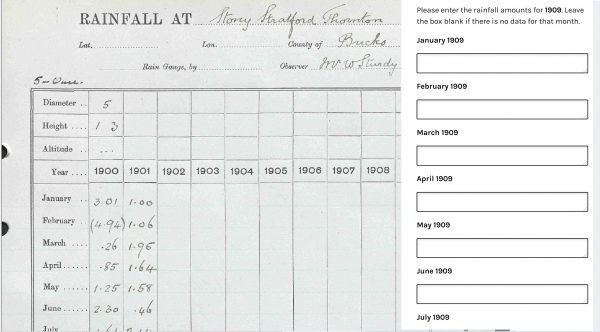
The Rainfall Rescue Project is seeking volunteers to transfer hand-written data to online spreadsheets.

The project is looking to fill the yawning gap in UK digital rain gauge records between the 1820s and 1950s.

Each of the 65,000 scanned sheets contains monthly rainfall totals for a particular decade at a particular station, approximately three to five million data points in all. If Prof Hawkins’ team can convert this information to a digital format, it could lead to a much better understanding of the frequency and scale of big droughts and floods. And, that will assist with planning for future flood and water-resource infrastructure.

For example, many across the country had a sodden start to the year because of heavy rainfall. Meteorologists suspect October 1903 was just as bad, if not worse, but unfortunately, because all the rainfall data from that time was hand-written, it’s not possible to analyse this data. Likewise, there were some very dry springs and winters in the 1880s and 1890s. Britain had six or seven very dry winters and springs on the trot. If that happened today, it would probably cause serious problems for water companies because they rely on wet winters and wet springs to recharge reservoirs.

Prof Ed Hawkins explains, “Water companies have to plan for a one-in-100 or one-in-500-year drought but we’ve only got 60 years of very dense digital data, and so it’s very hard for them to come up with reliable estimates. We know there are periods in the past that, if they happened again, would probably break the system. The same is true for very heavy rainfall and floods.

You’re not required to rummage through old bound volumes; the Met Office has already scanned the necessary documents – all 65,000 sheets. You simply have to visit a website, read the scribbled rainfall amounts and enter the numbers into a series of boxes. If you do just a couple of minutes every now and then – that’s great,” said Prof Ed Hawkins. “If you want to spend an hour doing 30 or 40 columns – then that’ll be amazing. But any amount of time, it will all add up and be a tremendous help.”

This can literally take 5 minutes – why not use your tea-break?
Take part in the Rainfall Rescue project here.

If you choose a particular year to work on, why that year? Is it the year your golf course opened or the year you held your most memorable tournament? Share your story on Twitter with #rainfallrescueUK. Tag@rainbirdgolfuk and we’ll share your story too!

Jimmy Sandison – Regional Golf Sales Manager – UK, Ireland, Iceland and Scandinavia

For the latest industry news visit turfmatters.co.uk/news

Get all of the big headlines, pictures, opinions and videos on stories that matter to you.

Follow us on Twitter and Instagram for fun, fresh and engaging content.

You can also find us on Facebook for more of your must-see news, features, videos and pictures from Turf Matters.
INFINICUT to reduce HAV for Loughborough

INFINICUT to reduce HAV for Loughborough: The Loughborough University Stadium is the jewel in the crown of the dedicated ‘football hub’ at the site’s Holywell Sports Complex.

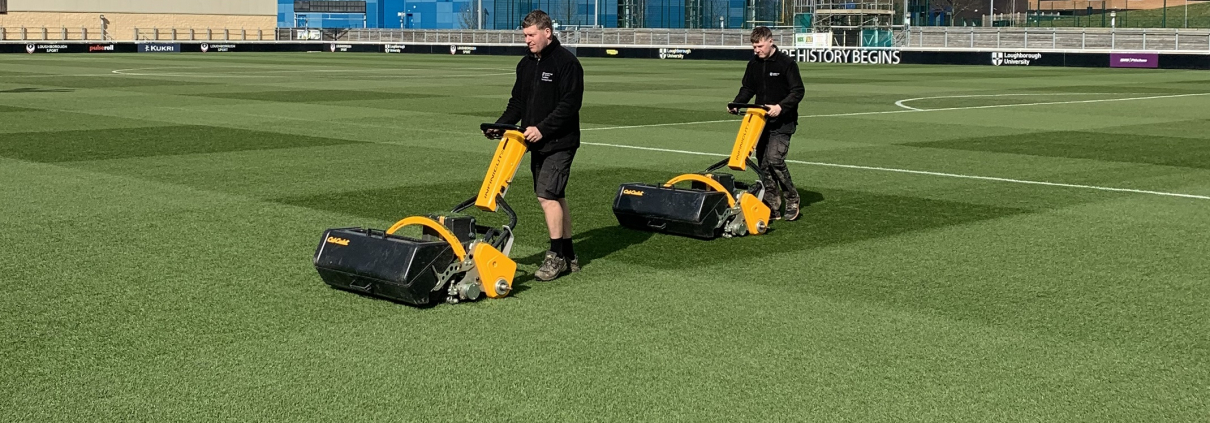
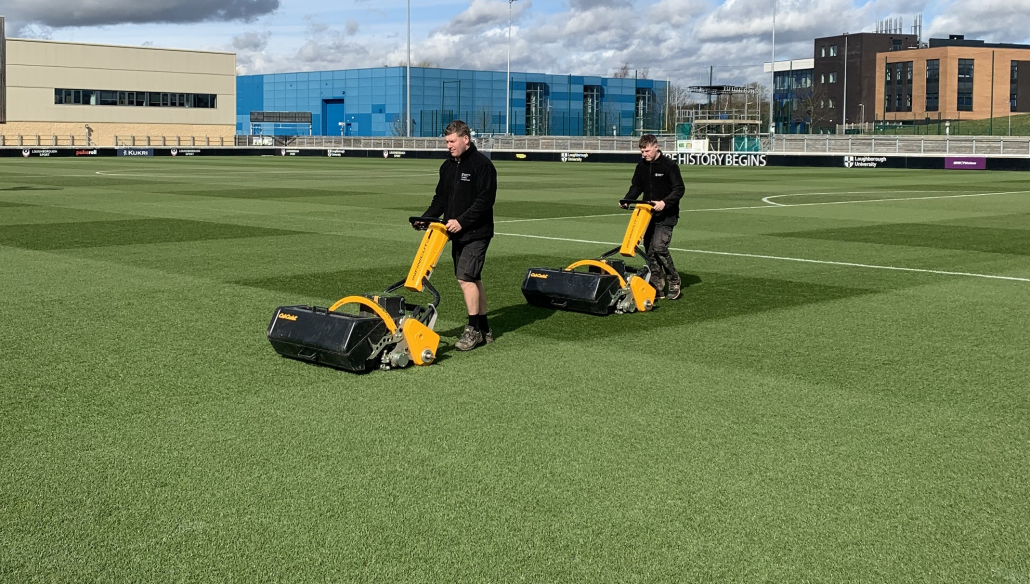
In June 2019, Team Leader of the complex Kris Nurse took delivery of two INFINICUT® 34” FX mowers, together with a set of TurfClean™ cassettes, which have been working hand-in-hand to keep the stadium’s brand-new SIS hybrid pitch in first-rate condition.

INFINICUT to reduce HAV for Loughborough

INFINICUT to reduce HAV for Loughborough

With such a wealth and breadth of sporting facilities at the University, the grounds department is split into teams – with the cricket division being the first to experience the INFINICUT®. “They’ve used a fleet of 22” and 26” INFINICUT® mowers for a number of years and have always sung their praises” explains Kris, who has a team of three working with him in the football hub. “We obviously had an opportunity to use them too and were impressed with how lightweight they are and how simple the mower is to set-up and use, so I spoke to Oliver Hall at MTD about the 34” fixed head version.”

“Together with the quality of cut and finish they deliver, the University were also keen on the fact that they’re battery powered. Because of the amount of large machinery we operate on a daily basis, we have a real issue with Hand-Arm Vibration (HAV) so taking delivery of our duo of INFINICUT® mowers has been a fantastic step forward in improving that.” Since the new hybrid pitch was installed in September 2019, it has hosted over 60 games for student teams, together with a number of external matches including Derby County Under 23’s. To keep the pitch playing at the standard required, the mowers are in use four or five times a week.

Helping with the post-match clean-up, Kris also purchased a set of TurfClean™ cassettes from the renowned TMSystem™. “These have been a god send. We use these after play to rid the surface of any debris and stand the grass plant back up. It then takes less than 10 minutes to swap those out and put the cutting reels in, and we’re straight back out to cut. This has eliminated the wheel lines we used to get by using a rotary mower and gives us a quality of finish that is fitting to the arena and the fantastic level of play that we are lucky enough to host.”

For the latest industry news visit turfmatters.co.uk/news

Get all of the big headlines, pictures, opinions and videos on stories that matter to you.

Follow us on Twitter and Instagram for fun, fresh and engaging content.

You can also find us on Facebook for more of your must-see news, features, videos and pictures from Turf Matters.
JCB joins national call to action

JCB joins national call to action: JCB is poised to re-start production at a factory closed as a result of the Coronavirus crisis in order to join the national effort to manufacture ventilators, the company announced today.

JCB received a direct appeal from Prime Minister Boris Johnson earlier this month to help plug the national ventilator shortage and to help save lives of Coronavirus patients. Following the approach, JCB Chairman Lord Bamford promised to help in any way the company could and immediately mobilised a research and engineering team to examine potential ways to assist.

JCB joins national call to action

JCB joins national call to action

Now JCB is ready to restart production at a factory which has been closed for nearly two weeks as a result of the Coronavirus crisis. But instead of making cabs for JCB diggers, the plant is being mobilised to make special steel housings for a brand new design of ventilator from Dyson. A minimum of 10,000 of the JCB housings are earmarked for manufacture once Dyson receives regulatory approval for its design.

The first prototypes of the housings have been delivered to Dyson after rolling off the production line at JCB’s £50 million Cab Systems factory in Uttoxeter, Staffordshire, which Boris Johnson visited during the election campaign. The factory fell silent on March 18th along with eight other JCB UK manufacturing plants after a fall in demand caused by the Coronavirus crisis. Mass production of the housings could start in a matter of days.

Today JCB Chairman Lord Bamford said: “When we were approached by the Prime Minister we were determined, as a British company, to help in any way we could. This project has gone from design to production in just a matter of days and I am delighted that we have been able to deploy the skills of our talented engineering, design and fabrication teams so quickly at a time of national crisis. This is also a global crisis, of course, and we will naturally help with the production of more housings if these ventilators are eventually required by other countries.”

JCB’s response to the national call to action would see the return to work for around 50 employees affected by an extended company shutdown announced last week. JCB suspended production at its nine UK production plants until at least the end of April as a result of the Coronavirus crisis and furloughed the vast majority of its 6,500 workforce. The company is paying them 80% of their basic pay for the next month, regardless of what they earn.

Employees returning to work to help manufacture the ventilator housings will be paid 100% of their normal pay.

For the latest industry news visit turfmatters.co.uk/news

Get all of the big headlines, pictures, opinions and videos on stories that matter to you.

Follow us on Twitter and Instagram for fun, fresh and engaging content.

You can also find us on Facebook for more of your must-see news, features, videos and pictures from Turf Matters.

Woodhall Spa goes to town

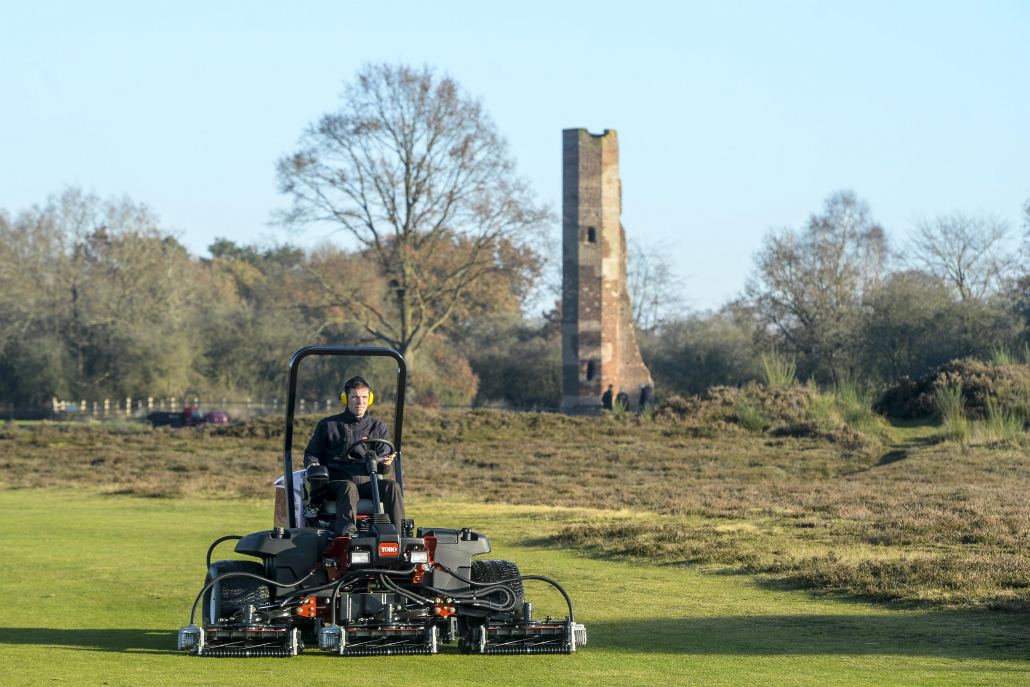
Woodhall Spa goes to town: It’s a relationship over two decades strong, therefore it’s no surprise that when it came to renewing its machinery fleet as it concluded what is widely recognised as the biggest in-house golf renovation project in the UK, that Woodhall Spa chose Toro again.

As the club’s three-year, three-stage restoration project designed to give the Lincolnshire course back its rightful heathland landscape and original character concludes, the focus is now on the quality of the playing surfaces. Hence the latest, significant investment in Toro and Reesink Turfcare.

Woodhall Spa goes to town

Woodhall Spa goes to town

Course manager Sam Rhodes says: “We have so much confidence in Toro. Having Toro on board during the renovations meant there was one less big thing to worry about. There was too much to do as it was, so knowing the maintenance, and irrigation, of the courses was in safe hands was invaluable. And now as the main restoration work is finished, we’re going to town on the quality of the playing surfaces.”

Richard Latham, general manager, explains the reason for the renovation: “It’s accepted that the course found itself in this position because of over 50 years of woodland mismanagement and neglect. Woodhall Spa was fast falling down in the world rankings. It was time to act and safeguard the future of the course.”

A phone call from Richard was all it took to secure the services of Tom Doak, one of the true greats of modern golf course architecture, for the redesign of the home of the governing body of England Golf. One of the biggest changes was the introduction of bigger greens, now 4,000sqm larger, which takes the greenkeeping team an extra two hours to mow every morning, ably assisted by Toro.

Sam says: “We’ve long been a Toro Total Solutions customer and we wanted a full fleet refresh to make sure we were benefitting from the latest technological advancements and to ensure we are ready for the next all-important phase in the course’s future. We’re already seeing the impact of the new design of the cylinder cutting unit of the Reelmaster 5010-H, it’s freeing a man up.”

The new fleet is comprehensive including greens, tees and fairways mowers, aerators, top dressers and bunker rakes. Sam has included hybrid technology in the form of three Reelmaster 5010-H fairway mowers and two all-electric Workman GTXe utility vehicles, and during the renovations the Toro Lynx central control irrigation system and 170 Infinity sprinklers on the greens, tees and surrounds was extended to the fairways covering the Hotchkin and Bracken courses.

Richard says: “We don’t have much water where we are, so we have to be frugal in how much we apply. The installation of the system has allowed us to be entirely accurate and conserve our usage. It also allowed us to avoid damage in the drought of 2018 – we lost the colour but kept the coverage. To have extended the irrigation system to the fairways now means we have complete Toro protection.”

Both Richard and Sam agree this project has been game-changing, Richard says: “To say we have successfully completed the biggest in-house project the country has seen is quite the achievement. Our members are playing a far more strategic game, reminiscent of how it used to be when golf was first played here in 1905. We’ve successfully put all the holes back together again ourselves and we’re moving up in the rankings. We’ve achieved what we set out to do.”


And now as the team embarks on the next phase in the club’s life, Richard considers what happens next. “Now we have the rightful landscape back, playing fantastically, our focus is on ensuring that lasts, and with the combination of Sam, the team and Toro on board we know that’s a realistic ambition.”

For the latest industry news visit turfmatters.co.uk/news

Get all of the big headlines, pictures, opinions and videos on stories that matter to you.

Follow us on Twitter and Instagram for fun, fresh and engaging content.

You can also find us on Facebook for more of your must-see news, features, videos and pictures from Turf Matters.