
Tag Archive for: water

Weedingtech become members of British Water

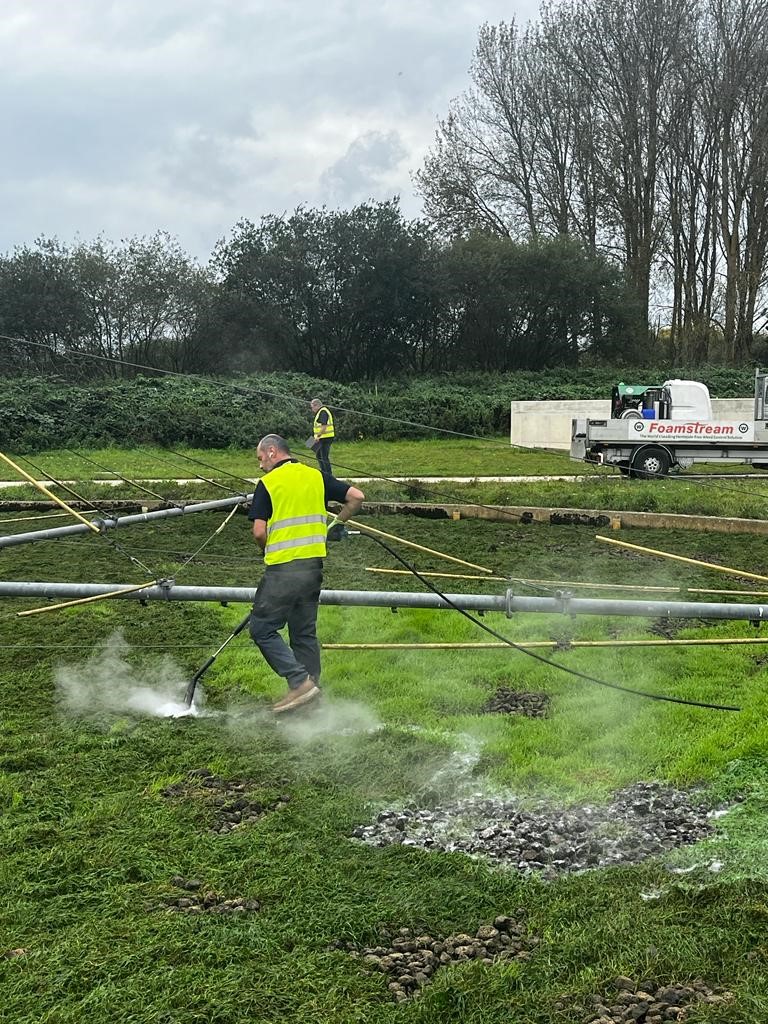
Weedingtech become members of British Water: Weedingtech, founders of the world’s leading commercial herbicide-free weed control solution Foamstream, are pleased to announce they have become members of British Water.

Using the combination of hot water and a specially formulated organic foam, Foamstream is proven to effectively combat unwanted vegetation in a range of situations and is fully approved for safe use within the wastewater sector.
Weedingtech become members of British Water

Weedingtech become members of British Water

Weeds that are left to accumulate can pose a serious risk to successful sanitation, specifically in and around water filter beds. If allowed to grow, vegetation can interfere with the rotation of the machinery, impacting air flow and making the cleaning process inefficient. Together with inhibiting drainage through the filter bed, weeds can also damage the media that fills the filter bed or pass through the bed entirely and contaminate the watercourse.

Currently, many in the wastewater industry rely on manual weeding. The time-consuming nature of hand-weeding frequently means that operations are not conducted frequently enough to be considered effective, while also proving unpleasant and unproductive for the operatives. However, companies including Severn Trent, South West Water, Wessex Water and Anglian Water have already made the switch to Foamstream.

Being 100% organic, Foamstream is approved for use on water filter beds – treating weeds, together with seeds, spores and roots to reduce re-growth and the number of treatment cycles required per year. Together with a reduction in treatments, Foamstream also presents a significant saving in labour treating a 600m2 waterbed in as little as four hours, which would otherwise take a team of four people five days to manually weed*.

“Weedingtech becoming members of British Water is a pledge to promoting best practice and working alongside others to find and provide solutions to challenges facing the sector” comments Foamstream Co-Founder Leo de Montaignac. “We’re delighted to already be trusted by a number of leading water firms and are well placed to provide advice and support to others who may be looking for an environmentally friendly alternative to conventional weed control methods.”

For the latest industry news visit turfmatters.co.uk/news

Get all of the big headlines, pictures, opinions and videos on stories that matter to you.

Follow us on Twitter and Instagram for fun, fresh and engaging content.

You can also find us on Facebook for more of your must-see news, features, videos and pictures from Turf Matters.

STIHL launches new range of water pumps

STIHL launches new range of water pumps: STIHL has launched its first range of petrol 4-stroke water pumps, specifically designed to meet the demanding needs of agricultural, construction and hire markets.

The new range consists of two models, the WP 300 and WP 600. The WP 600 boasts a robust cast iron impeller, a powerful 4.4 kW engine and 3” hose connections for the delivery of large volumes of water up to 63 m3/h, and comes complete with an integrated suction filter to protect the pump from dirt particles.

STIHL launches new range of water pumps

STIHL launches new range of water pumps

With a similar design, its counterpart the WP 300 includes the same features as the WP 600 except for 2” hose connections and a lower 37 m3/h delivery capacity for smaller jobs.

The WP 300 and WP 600 can be fuelled by STIHL’s Moto4Plus, a high quality alkylate fuel specifically designed for small 4-stroke engines. Compared to forecourt fuel, Moto4Plus has a significantly longer shelf life, less harmful emissions and no tank drainage requirement when in storage.

Both pumps offer intuitive technology including low oil protection, meaning the engine switches off when the engine oil level falls below the safe operation threshold. An anti-vibration system also helps to reduces mechanical stress.

Designed with user comfort in mind, the WP 300 and WP 600 offer a sturdy frame for excellent stability and easy transportation, simple controls and toolless access to the air filter for easy maintenance.

All STIHL tools, including both water pumps, are compatible with the STIHL Connected fleet management system. Installing a STIHL Smart Connector allows the runtime to be recorded and sent to the user’s smartphone via Bluetooth for accurate usage and maintenance records.

For more information on STIHL’s new petrol water pumps, please visit www.stihl.co.uk

For the latest industry news visit turfmatters.co.uk/news

Get all of the big headlines, pictures, opinions and videos on stories that matter to you.

Follow us on Twitter and Instagram for fun, fresh and engaging content.

You can also find us on Facebook for more of your must-see news, features, videos and pictures from Turf Matters.

Conserving water for the future of turf sports

Conserving water for the future of turf sports: It’s official – fresh water supplies are dwindling, demand for water is steadily rising, and regulations on how much and for what purpose water can be used are becoming increasingly tightened. Finding ways to use water more efficiently is no longer an environmental nice to have; it’s a fact of life for most turf facilities today and imperative for our industry’s future.

As a turf manager you’ll always need water – it’s a fundamental building block of turf – but there are a number of steps you can take to influence how much water you need.

Conserving water for the future of turf sports

Conserving water for the future of turf sports

One of the biggest potential impacts on your water consumption can be made by redirecting water that already exists.

Plant selection can also play an important role in how much water is needed to keep your property at its visual best. Choose turf varieties such as fine fescues that require less water than others such as perennial ryegrass.

Even with these changes, irrigation is still essential and ongoing maintenance of your irrigation system is an effective way to reduce the amount of water wasted. Moisture sensors, weather monitors and other high-tech tools are also available to help you use your water conservatively.

Even after irrigation, there is still one more hurdle to getting water to your turf as efficiently as possible: your soil. How well your soil performs can have a tremendous impact on how much water you use.

Soil:water repellency interferes with how even the most well-placed water moves, leaving some areas a little too dry while making some a little too wet. This is certainly not a new phenomenon, but research indicates that it is much more common than previously thought.

Water repellency is one of the most pervasive water use issues, and it is also one of the easiest and most cost-effective to fix. Soil surfactants lower the surface tension of water and restore the wettability of effected soils, allowing water to move into and through the profile more efficiently. This reduces the amount of water lost to run-off and preferential flow

“Revolution is one of the very few products that makes a dramatic difference and actually changes the way turf is managed. It affects everything including the turf, the distribution of water, fertilisers, and other materials” – Sam Rhodes, Woodhall Spa GC.

Most courses have best management practices in place for their properties, but not all commit them to paper in a formal document. There are a number of resources available that provide guidance and templates for creating one, but should you bother? Absolutely.

Water conservation is a realistic goal, with both environmental and financial upsides.

Like it or not, the call for sustainability – and the challenges that presents – are going to be big issues for a long time. Doing what you can at your course does more than just protect a diminishing global resource – it protects your course, your job, and the future of the sports turf industry.

Water solutions for all locations

Water solutions for all locations: Award-winning distributor Reesink UK has rebranded its established Irrigation division to reflect increasing market diversity and provide water solutions for all locations.

Reesink Hydro-Scapes encapsulates the long established and industry-leading Toro irrigation systems, controllers, sprinklers and soil sensors. But better represents the growing Otterbine pond and lake aerator business; SRC wall-mounted controllers; Biral lightning detectors and quick-replace Franklin pump systems too.

Water solutions for all locations

Water solutions for all locations

The move represents the company’s support to its existing brands and growth strategy for the future says Robert Jackson who heads up the division: “In recent years the range and breadth of water solutions we offer our customers has expanded exponentially and there’s a focus to grow that even further.

“Our customers encompass golf courses to insect farms, football stadiums to living walls and urban landscapes to fishing lakes and fruit growers – any venue which would benefit from water control, delivery, management and expertise. We’ve built our team to six to encompass sales and marketing, support and backup, technical training and customer relations – all with a specialism in supplying and installing effective and efficient water-based solutions.”

Reesink Hydro-Scapes joins the Reesink UK portfolio which includes Reesink Turfcare, Reesink Agriculture and Reesink e-Vehicles. Diversification into new markets with new divisions is a strategy that allows Reesink to positively respond to market developments. As in the case of electric power, sustainable water solutions are a hot topic, very much evident in Reesink’s 100 percent increase in Otterbine sales in 2021, witnessing far greater demand than had been expected, for example.

Robert continues: “Water is a fundamental part of the matrix in the business we’re all in – caring for the landscape – and as a commodity, its value and importance cannot be overlooked. We’re well aware of the future challenges in managing this precious resource in a sustainable way and providing options for our customers. That has been as much of a driver in launching this new division as anything else.”

For further information, visit reesinkuk.co.uk

For the latest industry news visit turfmatters.co.uk/news

Get all of the big headlines, pictures, opinions and videos on stories that matter to you.

Follow us on Twitter and Instagram for fun, fresh and engaging content.

You can also find us on Facebook for more of your must-see news, features, videos and pictures from Turf Matters.

The science behind healthy water

The science behind healthy water: Water management for clean, healthy water is critical. But how do you know your aerator is a sound investment, delivering the best aeration to tackle poor quality water? Otterbine explains how Oxygen Transfer Rates are essential.

The scientific measure of an aerator’s capability to supply oxygen to water is its ‘Oxygen Transfer Rate’. Defined by The American Society of Civil Engineers, it’s the gold standard for the measure of how much oxygen an aeration system transfers and for addressing all the reasons why aeration is needed.

The science behind healthy water

The science behind healthy water

Any manufacturer serious about helping customers achieve a balanced ecosystem will provide oxygen transfer tests performed by an independent third party. Otterbine’s, for example, are tested by the University of Minnesota and Gerry Shell Environmental Labs, the results from which can be found online at otterbine.com.

Aeration helps with algae and aquatic weed control, reduces odours, eliminates chemicals, reduces phosphorus, eliminates fish kills, helps with the oxidation of iron and heavy metals, acts as a mosquito breeding deterent, benefits aquatic animal life and the ecosystem, prolongs the life of the pond/lake/reservoir and is great for public safety because aeration prevents diseases associated with stagnant water.

By simply adding dissolved oxygen to water, you are supporting the aerobic and oxidative processes of the water. The oxygen attaches to the phosphorus and converts it into an insoluble form, making it unavailable to plants as a nutrient.

So, by simply adding an aerator to the water, you are preventing all 10 reasons for poor quality, smelly, bug-infested, unappealing water – we promised you a hassle-free solution!

You may wonder how the Oxygen Transfer Rate of different aerators vary. Surface spray and diffused aerators are the most common and in terms of the amount of oxygen transferred that can range from 1.59lbs of oxygen per horsepower hour in 8ft of water from a diffused aerator to 3lbs of oxygen per horsepower hours regardless of depth from a surface spray aerator. Which one you choose depends on the size of the body of water you’re looking to aerate;  just remember oxygen transfer rates are the key to success

There are experts in water management at Reesink Turfcare, UK Otterbine distributor, who will be happy to help guide you in the decision-making process. Contact Reesink on 01480 226800, email info@reesinkturfcare.co.uk or visit reesinkturfcare.co.uk

For the latest industry news visit turfmatters.co.uk/news

Get all of the big headlines, pictures, opinions and videos on stories that matter to you.

Follow us on Twitter and Instagram for fun, fresh and engaging content.

You can also find us on Facebook for more of your must-see news, features, videos and pictures from Turf Matters.