Avoiding a sticky wicket: Scott MacCallum speaks with Ian Smith, Sports Turf Consultant for St Alban’s School, about climate change, sustainability – and the days when meeting Elton John was a regular occurrence.
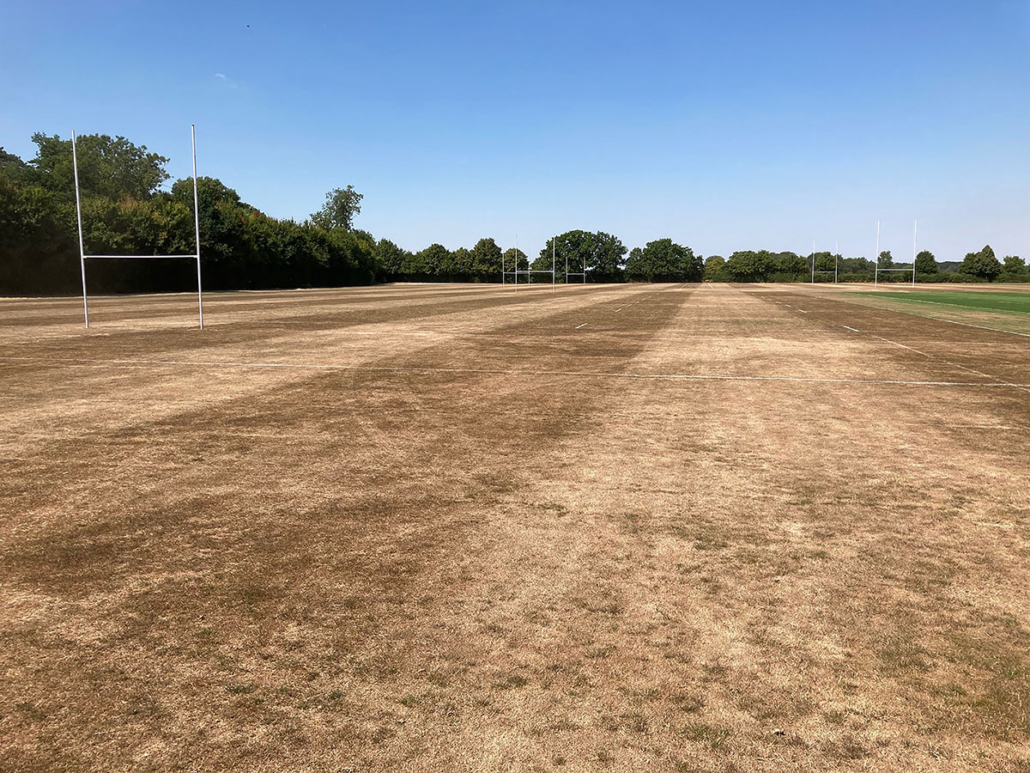
Think back to last summer and the scorching temperatures.

Avoiding a sticky wicket
We hadn’t seen anything like it. For many of us we could get by with desk fans and cold showers but for those working outside, and I’m thinking about those in the sports and amenity turf industry, they not only had to cope with the blazing sun, they also had to keep their surfaces alive. Not easy with water restrictions in place.
One man in the middle of it all was Ian Smith, Sports Turf Consultant for St Alban’s School, who, at the time, was also planning the programme for the annual Dennis SISIS Seminar which had been postponed from the previous two years.
“I was going to go down the environmental route with the programme anyway, but then we had the drought last year which made it even more relevant,” explained Ian.
“I had seen (Met Office Meteorologist) Aidan McGivern’s presentation on the 2050 weather forecast and when I was able to get Aidan to appear at the seminar it tied everything in.”
What made Aidan’s presentation all the more impactful was that the “shock factor” of the 2050 forecast was 40-degree temperatures in the UK and what would be the consequences of such heat. Those temperatures were reached in southern England last year – 28 years ahead of Aidan’s schedule.
“That really brought it to a head,” admitted Ian.
That led him to look to shape the day’s programme, which he widened to water resourcing, water capture and recycling, as well as how we should build pitches in the future to retain moisture rather than drain it away and what diseases might become more prevalent in a hotter, drier climate.
The Seminar, which attracted well over 200 turf professionals from around the country, was a huge success but left delegates with a genuine sense of foreboding about what the future will have in store if nothing is done imminently to change from the current course.
But Ian works at a school which has already shown its desire to do the right things when it comes to a sustainable model.
Avoiding a sticky wicket
“It is something that the school governors are embracing. When we first set up the new site here at the school in 2000 I wanted to install irrigation with recycled water, but at the time mains water wasn’t that expensive and it was felt that with the hassle of cleaning and filtering etc, mains water was the way to go. Obviously in the 20 years since, things have changed.”
Now the school has plans for maximising the water at its disposal including capturing and harvesting rainwater which is something all facilities are going to have to investigate given that the Environment Agency is going to be clamping down on extraction licences for bore holes in legislation which is earmarked for 2028.
“We are looking to capture water from the pavilion roof which should help to reduce what we are drawing off the mains. ln future we are looking at the water which currently disappears in to a soak away on our artificial pitch.
“If we can store that water and re-use it on the sports field or in the pavilion it would be a good way of maximising our water usage,” explained Ian, who added that in an ideal world they would tap into grey water from water treatment plants, but sadly the school is too far away from the nearest one.
Much of the school’s drive towards a more sustainable future is led by the pupils, who have their own Green Council.
“We have meat-free Mondays and they have ensured all our lightbulbs are eco-friendly. From our perspective all our hand tools are now battery powered and when
the bigger pieces of kit come up for renewal, we have been told to look at the battery option if we can.”
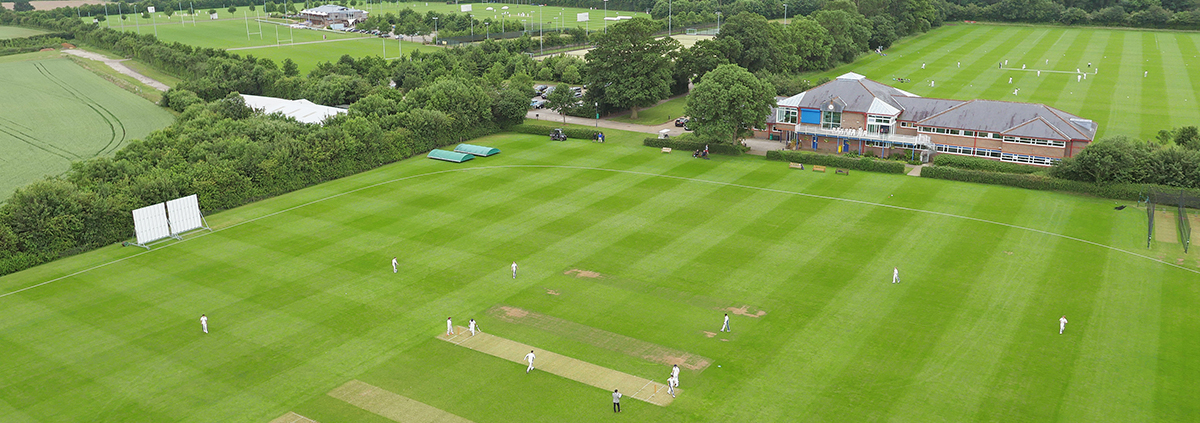
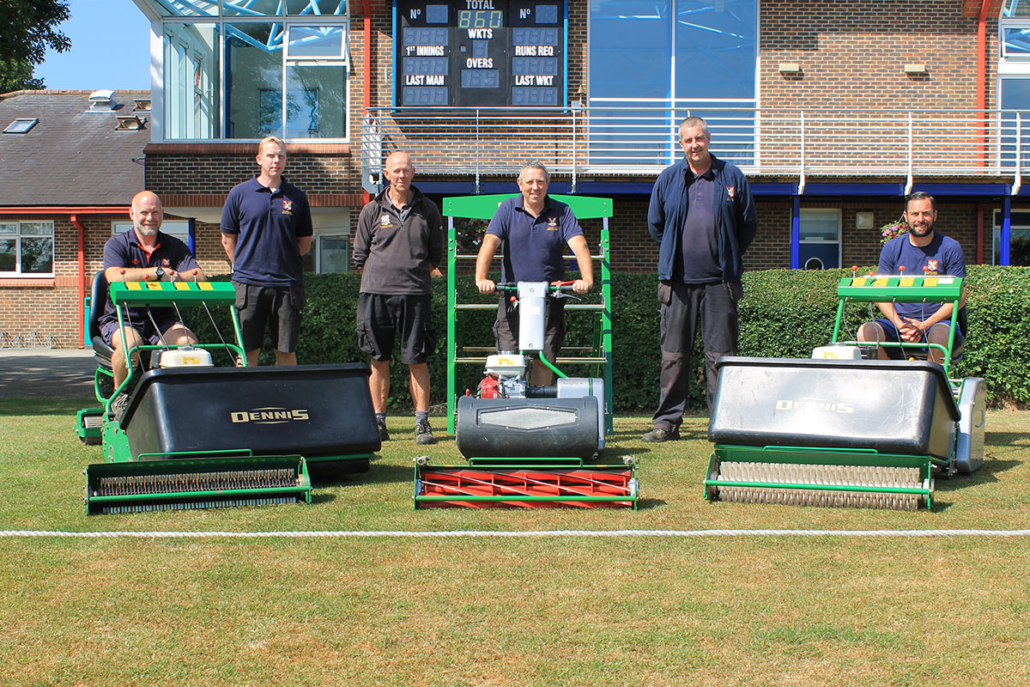
There are 23 hectares (73 acres) of pitches at Woollams to be maintained by Ian and Head Groundsman Steve Ascott, Mark, Jason, Riz and Richard. “We are in the same position as most in that
we struggle to find staff . Our last two members of staff employed have not been experienced groundsmen and are of a more mature age, one laid tarmac and the other was a firefighter who had retired at 60 but wanted to keep working. They have both been brilliant.”
It is not just the pupils of the school that use the pitches. The Old Albanians, the school’s old boys’ club, have 30 of the 73 acres some of which they sub-let to Saracens Rugby, with the professional club spending quite a bit of money ensuring their two pitches were well-watered during the drought.
Ian’s own path to a top grounds management job started in familiar fashion, and familiar surroundings – an unhappy school classroom. So many successful turf professionals struggle academically until a light goes on in their heads when they discover a subject which really makes them click.
“It was classic really. I was no good at school. Both my kids are dyslexic and I think I was too. But I was just told I was stupid as pupils were told bluntly then. I was the invisible kid in the classroom who spent his time looking out of the window, because I’d far rather have been outside,” he recalled.
Avoiding a sticky wicket
“I’d have loved to have been a professional sportsman, but I never made the grade. However, Watford FC was my big passion and in the school holidays they used to take kids on to do jobs, like painting the crash barriers. Some of the jobs were just horrible but rather than get £2 a week doing a paper round, I was getting £25 a week.”
There is one particular job which remains stuck in Ian’s memory – and not for any good reasons!
“There was an old wooden stand, and this was just before the fi re which burned down the wooden stand at Bradford and people had been dropping rubbish through the gaps in the floorboards. The Fire Officer said that it was a real fi re risk and that we had to clear it out.
“So I spent six weeks, the whole of the school holidays, being lowered down between some floorboards that had been removed and picked up rubbish. The pile was taller than I was. I had to pick it up, put it in a bin and then pass it back up through the floorboards. I looked like a panda when I got out.”
He loved all the work maintaining the stadium, but particularly when he got out onto the pitch.
When he got to 16 and everyone else returned to school or went into sixth form he just turned up again at Vicarage Road.
“They asked why I wasn’t going back to school and I just said I didn’t fancy it. So they said that they might as well keep me on then. I signed a contract and that was that.”
Ian was at Vicarage Road for two and a half years before moving on to North London Polytechnic which was the Watford Training Ground where he worked for a further six years.
There can’t be many who get a reference from an England football manager, but Ian did – from Graham Taylor, while he was also on-hand to see that famous football club owner Elton John at first hand.
“Elton had a football pitch in his back garden which we used to look after. He was always around the club, popping into the tearoom. He liked it because we all treated him like a normal person and took the mickey. He loved that we treated him like one of the lads.”
Ian used to cycle the 18 miles each way from Luton to Watford to work and it was this journey which was to open the door to his links with St Alban’s School.
“I used to cycle past this beautiful little sports ground which belonged to St Alban’s School and I always looked at it with envy. Then I heard on the grapevine that the school wanted a bigger site – this one was just 16 acres – and being the cocky, confident person, I was I went to the school and said that I gathered that they wanted to build a new sports ground. I was the man to do it for them. I was 23 or 24 at the time.”
The bravado paid off as, armed with his Graham Taylor reference, the school bursar was impressed and said that there was a deputy groundsman job available and that the Head Groundsman, had two years until he retired.
“That would give me two years to prove that I could do what I said I could do.”
All went to plan up until the part about moving to the new site when three public inquiries stood in the way of a swift build. It wasn’t for a further nine years that it was finally finished.
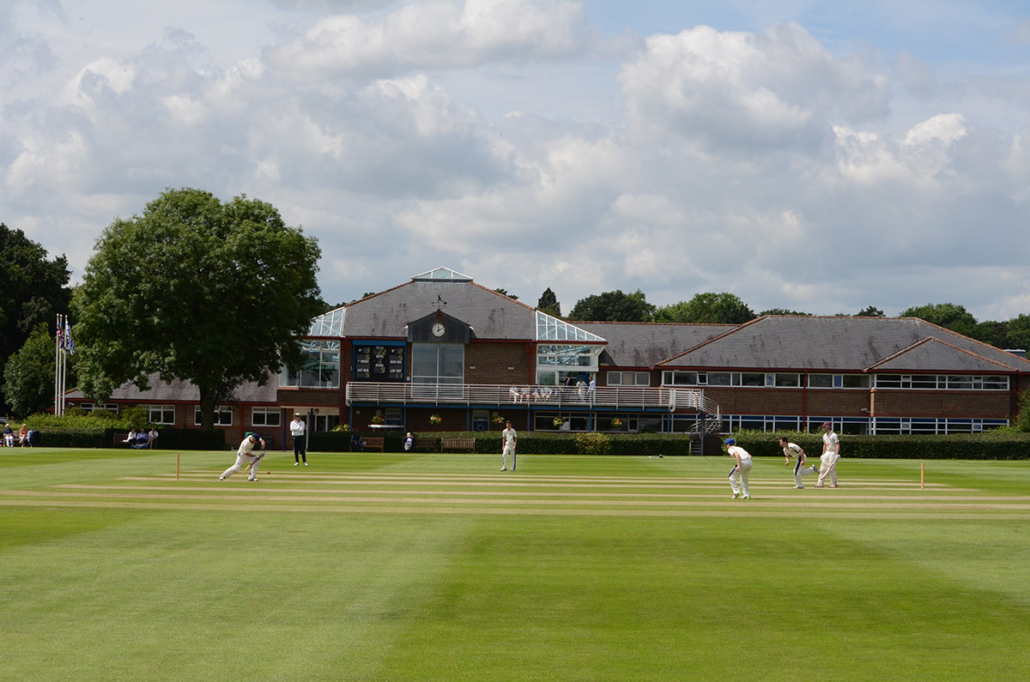
“I was involved right from the start, working with the STRI and the Head of Sport to decide the requirements of the new facility and where everything should go,” said Ian.
He was also to sit in on all three inquiries alongside the school’s barrister so, if required, they could counter the arguments put forward by the local council.
Avoiding a sticky wicket
“It was a fascinating few years,” he said with genuine understatement. Such heavy involvement did mean that when construction finally got underway, he was front and centre when it came to pitch construction so what he was left to maintain was exactly what he had specified.
Construction started in 2000 and finished in 2002.
“The pitches are still performing 21 years on. We did think that they would start to give us problems by now but we have installed secondary drainage and Sand master a couple of pitches each year. In many ways its strength is also its weakness because it drains so well all the time, drains are at four metre centres and we ameliorated lot of sand and then top dress every year. So we do get the situation we found last year with the drought. But you very rarely call a match off because it’s too dry.”
Ah yes, that drought. With Saracens using two of the pitches, the grounds team were using mobile sprinklers for two pitches on the old Albanian side and two on the school side, every school match was played on those two rather than the usual six they would have at their disposal.
“They had to amend match timings and they were played one after another starting at 9am and going on well into the afternoon.”
So, what happened to that original playing field which caught young Master Smith’s imagination and caused him to move away from his beloved Watford?
“That’s sad. I worked on it for 13 years before we moved to the new site and I put my heart and soul into it. It’s covered in houses now. The day the diggers came in, as a joke, I lay across the square with banners saying, ‘Save My Square’,” he laughed.
But for now, Ian is planning how to save his newer responsibility from the ravages of climate change and the rapidly increasing temperatures.