Tag Archive for: With

Potters Point keeps pace with new technology

Potters Point keeps pace with new technology: Having been loyal to John Deere for the past 25 years, it was perhaps no surprise which brand would be chosen to upgrade the existing golf and turf maintenance fleet at Potters Point holiday and golf resort in County Wicklow.

Overlooking the idyllic Brittas Bay on Ireland’s east coast, south of Dublin, Potters Point is an exclusive luxury mobile home park owned by the Stone family and was established in 1957. Guests that are lucky enough to stay there have free access to the nine-hole parkland golf course extending to 40 acres that was developed in 1987.

Potters Point keeps pace with new technology

Potters Point keeps pace with new technology

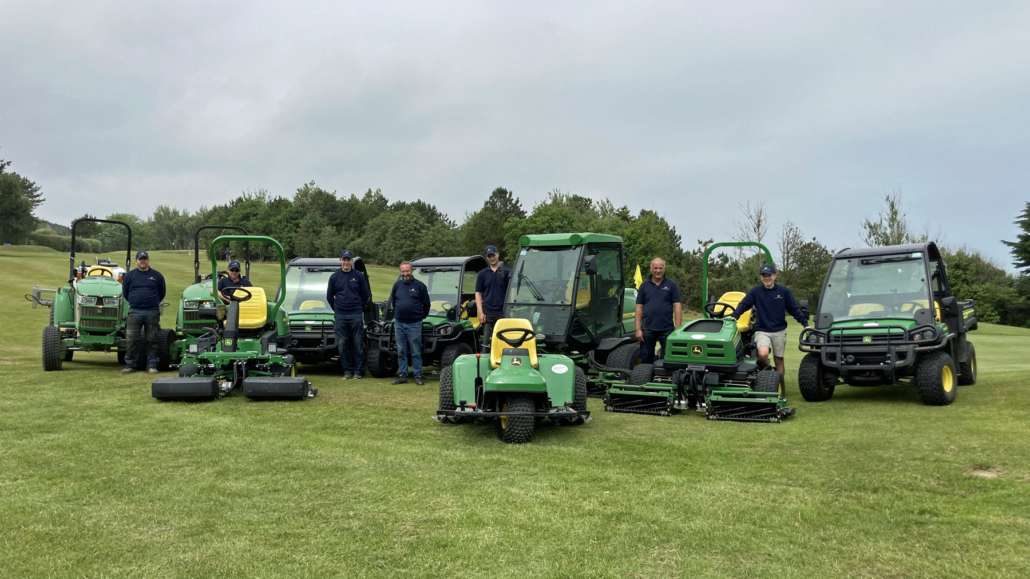
When the existing John Deere equipment fleet was due to be updated, Potters Point manager Irene Lacey called on dealer Dublin Grass Machinery to supply the range of new machines. These include an 8700A PrecisionCut fairway mower, 2653B PrecisionCut utility triplex mower, 2550E hybrid electric triplex greens mower, 220SL walk-behind greens mower, two 3039R compact tractors and three HPX 815E Gator utility vehicles.

“We bought our first John Deere machines in 1997 and have used the brand ever since,” says Irene. “These new models have replaced older equipment, as we want to keep the fleet as fresh and new as possible and equipped with the latest technology, and we are very pleased with them.

“There is great security in having new equipment and therefore no worries about breakdowns. The machines are now all working very efficiently both on the course and in the holiday park.”

The local John Deere golf and turf dealer, Dublin Grass Machinery (DGM), was established in 1981 and is now led by managing director Robert Mitchell. Having enjoyed such a long-term relationship with the dealership, Potters Point relies on DGM for its essential backup service.

“Our equipment has always been fully serviced by Dublin Grass Machinery, and we have found the team there over the years to be very efficient and reliable,” says Irene. “Their backup service is second to none – getting anything repaired or replaced is always done in a very timely manner. DGM has proved to be a very good partner to have in this business.”

Potters Point has plans to invest in additional John Deere equipment, particularly to replace a larger tractor that has been working faithfully at the resort since the very first machines were ordered in 1997.

“Having enjoyed such a long relationship with Potters Point, we were naturally very pleased to be asked to supply them with this new machinery package,” adds Robert Mitchell. “We appreciate their business and will continue to provide Irene and head greenkeeper Eamonn Delaney and his team with first class after-sales support.”

For the latest industry news visit turfmatters.co.uk/news

Get all of the big headlines, pictures, opinions and videos on stories that matter to you.

Follow us on Twitter and Instagram for fun, fresh and engaging content.

You can also find us on Facebook for more of your must-see news, features, videos and pictures from Turf Matters

First tournament with synthetic bunkers

First tournament with synthetic bunkers: The Trust Golf Women’s Scottish Open, which takes place this week on the new Dumbarnie Links course in Fife, will be the first tier one professional event in Europe ever to be played at a venue with synthetic-edged bunkers.

Dumbarnie, which was designed by Clive Clark and opened last year will play host to its first major event as the Ladies European Tour descends on the course as part of a two-week links swing that will be completed by next week’s Women’s British Open at Carnoustie.

First tournament with synthetic bunkers

First tournament with synthetic bunkers

“Dumbarnie features some really impressive, bold revetted bunker walls, some of which are in the region eight to nine feet high,” says Richard Allen, CEO of EcoBunker Ltd. “Back in 2007 my original aim was to invent a resilient and affordable system for low edge bunkers, but soon I was designing solutions for higher and higher links style bunkers. The change in design parameters prompted me to invent a new construction method, which is now Patent Pending, using a cement modified backfill for increased stiffness and stability. It was the perfect solution for Dumbarnie, and the EcoBunker walls built by our team in 2018 are maturing naturally and beautifully.”

The course’s fairway bunkers are built in a naturalistic style, with a ragged fescue edge, but the majority of bunkers are hard against greens, or surrounded by short grass, and these are fully revetted using EcoBunkerʼs synthetic solution.

Dumbarnie, promoted OB Sports and Landscapes Unlimited, was one of EcoBunker’s first and largest contracting jobs. Construction manager Llewelyn Matthews – like architect Clark a former Walker Cup player – led a five-strong construction crew to build the bunkers, over a eighteen week period.

EcoBunker CEO Richard Allen, the inventor both of synthetic revetting and of the later Ecobunker Advanced method, says: “All our team look back with immense pride on the Dumbarnie job. It was truly the job on which Llew Matthews came of age as one of the world’s best bunker builders, and we are delighted to have played a part in the construction of such a stunning course. To see the world’s leading women professionals playing over the course this week will be wonderful, and I’m prepared to bet that course manager Grahame Taylor will spend less time worrying about his bunkers than most people who are hosting a tournament of this stature.”

Richard Allen, the inventor both of synthetic revetting and of the later Ecobunker Advanced method, adds: “All our team look back with immense pride on the Dumbarnie job. It was truly the job on which Llew Matthews came of age as one of the world’s best bunker builders, and we are delighted to have played a part in the construction of such a stunning course. To see the world’s leading women professionals playing over the course this week will be wonderful, and I’m prepared to bet that course manager Grahame Taylor will spend less time worrying about his bunkers than most people who are hosting a tournament of this stature.”

Architect Clive Clark says: “As the golf course matures, seeds fly into the tiny crevices in the bunker walls, and just like a natural sod bunker, you get grasses in the face that dominate. If 100 golfers played this course, I doubt if five would notice that the bunkers weren’t natural sod.”

For the latest industry news visit turfmatters.co.uk/news

Get all of the big headlines, pictures, opinions and videos on stories that matter to you.

Follow us on Twitter and Instagram for fun, fresh and engaging content.

You can also find us on Facebook for more of your must-see news, features, videos and pictures from Turf Matters

Aylesbury Vale Dynamos score with Automower

Aylesbury Vale Dynamos score with Automower: With a large football pitch to maintain, Aylesbury Vale Dynamos, with 32 teams under its belt, has turned its attention to autonomous mowing, to help the growing club maintain its vast football pitch. Crediting Husqvarna Automower® Club Solution, the club has noted great benefits of Automower®, in just three months.

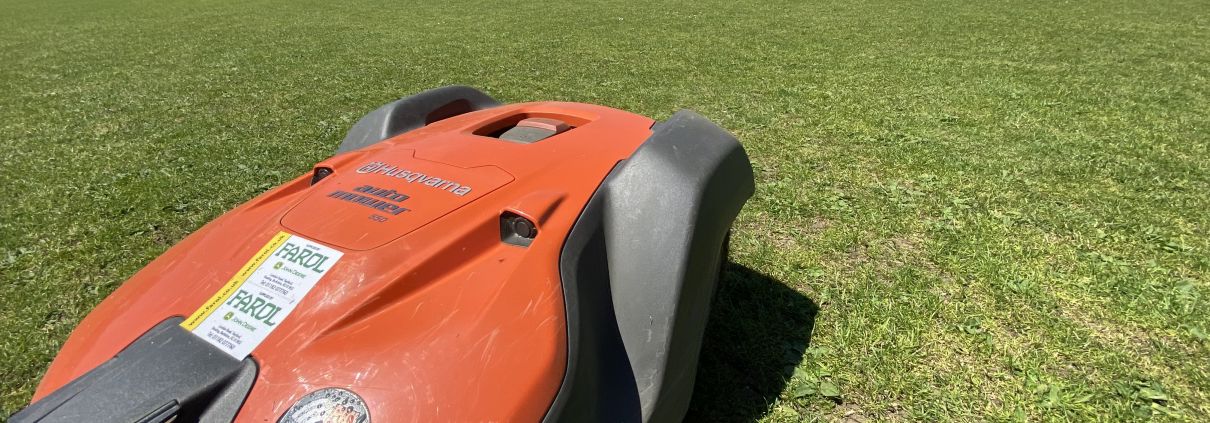
With a stadium pitch to maintain, the Aylesbury Vale Dynamos team and its chairman, Mike Borrett, discussed moving to Husqvarna Automower® Club Solution, following a recommendation from Farol Ltd, which is a specialist dealer with a dedicated Automower® sales and installation team. Their recommendation would allow two Automower® 550 to work simultaneously alongside each other, now using just one boundary wire.

Aylesbury Vale Dynamos score with Automower

Aylesbury Vale Dynamos score with Automower

With a pitch and stadium to maintain, Aylesbury Vale Dynamos relies heavily on volunteers to help run and sustain the club, which has always brought about its own set of challenges, including limited time, resource and finance. Thanks to their two Automower® 550 and the use of Automower® Club Solution, installed in April 2021, the football club has been able to combat many of their previous challenges.

Mike Borrett, chairman of Aylesbury Vale Dynamos, discussed the club’s switch to Automower®: “Making the move to Automower® has been a brilliant decision for the club, that has paid off multiple times over. Following discussions with Husqvarna and our Automower® dealer, Farol Ltd, it quickly became evident that Automower® Club Solution could solve many of the challenges we were facing.

“Like many football clubs, we rely heavily on the assistance of volunteers to maintain our grounds and stadium. We’re incredibly grateful to all our volunteers, but it does provide its own set of challenges. Whether it’s raining or beaming with sunshine, the grass requires twice-weekly cutting, and if no one is able to do it, we end up with grass that’s too long and debris on the pitch, both of which cause problems when the teams go out to play.

“Thanks to Automower® we’re able to redeploy our volunteers to more skilful tasks, saving ourselves hours of time each week, and with Automower® being battery powered, we’ve also been able to eliminate the need for petrol, which has been great for reducing our CO2 emissions, and the club’s finances.”

Ever since the first Automower® was introduced in 1995, Husqvarna has been known as the world leader in robotic mowing. With over 2 million sold worldwide, Automower® is renowned for its low energy consumption, zero emissions, low noise and high productivity, whilst featuring the ability to withstand a busy match schedule and hours of intense training.

As Automower® cuts the grass every day, the impact on the turf and ground is minimal. The very small, quick-composting clippings provide a constant source of fertilisation and moisture, creating greener and denser turf. Research also shows that the constant cutting allows grass roots to grow 25% deeper, resulting in a healthier and stronger pitch.

Mike discussed the club’s use of Club Solution: “Automower® Club Solution has continuously impressed us with its innovation. The system has allowed our two 550 mowers to be used simultaneously on one pitch, without wires intersecting the playing surface.”

With Automower® Club Solution, two or three mowers are able to mow the pitch simultaneously, with only a single boundary wire outside the playing surface, eliminating the risk of a damaged boundary wire during turf treatment such as aeration or scarification.

Mike continued: “In just three months we can already see the difference Automower® has made to our turf quality, with turf professionals even commenting that they can’t believe how well and healthy the grass looks.

“Thanks to the Automower® Connect app we’re able to control the mowers no matter where we are, which is a great benefit when the weather isn’t pleasant or when we’re away from the stadium. From the app we’re able to programme them to park at the side of the stadium when a match is on and redeploy once it’s finished.

“The Dynamo’s team are big fans of the mowers, naming them ‘Dyna’ and ‘Mo’, and the fans are even more so. Each match spectators ask us about them, and we can’t blame them, they really are fascinating, and we can’t imagine switching back to manual stadium mowing.”

For more information on Husqvarna Automower®, visit: https://www.husqvarna.com/uk/products/robotic-lawn-mowers/

For the latest industry news visit turfmatters.co.uk/news

Get all of the big headlines, pictures, opinions and videos on stories that matter to you.

Follow us on Twitter and Instagram for fun, fresh and engaging content.

You can also find us on Facebook for more of your must-see news, features, videos and pictures from Turf Matters

Anthracnose: Interactions with the disease triangle

Anthracnose: Interactions with the disease triangle: Anthracnose of turf is caused by the pathogen Colletotrichum cereale. The disease primarily affects intensely managed turf surfaces because of the considerable stresses that these environments place on the host plants.

This article describes phases within the lifecycle of anthracnose of turf (figure 1) in the context of the three aspects of the disease triangle; pathogen, host and environment.

Biotrophic phase

Simplified lifecycle of Colletotrichum cereale, the anthracnose pathogen that affects turfgrass.

Simplified lifecycle of Colletotrichum cereale, the anthracnose pathogen that affects turfgrass.

The pathogen establishes within the host without causing symptoms of disease.

  • Pathogen

During the biotrophic phase of the anthracnose lifecycle, the pathogen establishes itself within the host plant without alerting the plant to the requirement to respond defensively. It does this by extending primary hyphae, root-like filaments, between the plant cells without actually entering the cells. The pathogen further disguises its presence from the plant using a process called deacetylation, in which chitin on the hyphae is converted to chitosan (Muench, et al., 2008).

  • Host

The plant does not respond defensively to the pathogen because the hyphae do not enter the plant cells and the presence of chitin, which primes plants to activate defensive mechanisms, is hidden. However, even at this early stage of infection, the pathogen may affect its host negatively by creating a nutrient sink at the site of infection; thus, increasing the nutrients availability for the pathogen whilst reducing the nutrients that are fulfilling plant functions.

  • Environment

Extended periods of leaf wetness allow the pathogen to penetrate the host plant and for the biotrophic phase of development to commence. Practices that reduce leaf wetness; such as use of surfactants and physical removal of dews will help to reduce pathogen establishment at this stage.
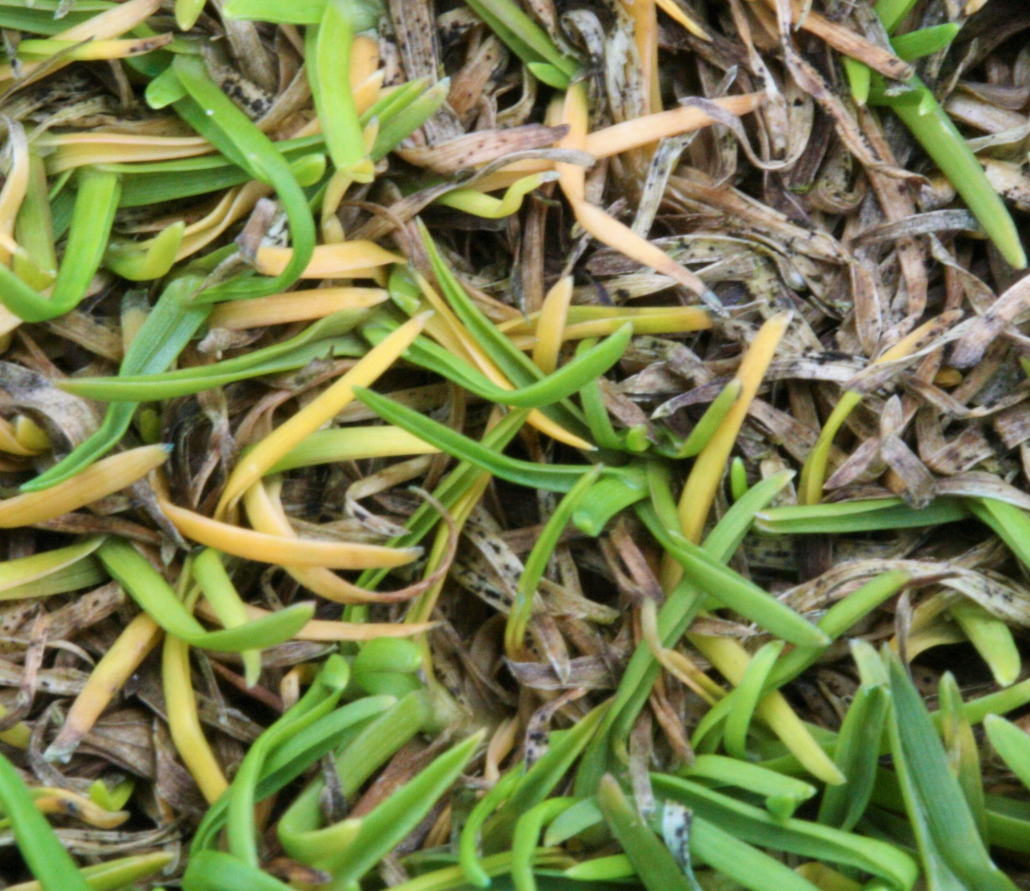
Foliar blight on a Poa annua sward showing the characteristic yellowing of leaves and diagnostic black setae.

Foliar blight on a Poa annua sward showing the characteristic yellowing of leaves and diagnostic black setae.

Necrotrophic phase

The pathogen penetrates into plant tissues and disease symptoms are observed

  • Pathogen

Necrotrophic growth is characterised by the development of secondary hyphae which penetrate into plant cells. This growth is accompanied by the production of phytotoxins which degrade plant tissue, providing the fungi with a further nutrient source. This phase of growth for anthracnose pathogens which affect other plants typically occurs within 72 hours after the initiation of the biotrophic phase  (Mims & Vaillancourt, 2002). The exact timing is not yet known for Colletotrichum cereale, the pathogen that infects turfgrass.

  • Host

There are two distinctive forms of anthracnose infection during the necrotrophic phase; basal rot and foliar blight (figure 2). It is likely that this symptomatic variance is caused by infection occurring in different parts of the plant.

Foliar blight is characterised by yellow (Poa annua) or reddish (Agrostis stolonifera) lesions on leaves and a water-soaked appearance.

Basal rot is characterised by symptoms in the lower stem or root. The infected tissue at the base of the plant appears dark brown to black with the leaf sheaths above appearing orange to yellow but without foliar lesions.

  • Environment

Development of the disease into the necrotrophic phase is favoured by conditions that put the grass plant under abiotic stress; including low fertility, close mowing, compaction, heat, drought, low light levels and poor drainage. Historic records and weather forecasts are essential to determining when to undertake actions which will minimise the impacts of potential stressors on the plant.

Relevant stresses may be current or historical. For example, the considerable metabolic requirement in spring of Poa annua to produce seedheads takes photosynthate away from roots and shoots prior to a stressful time in the growing season and could weaken the host increasing its susceptibility to infection.
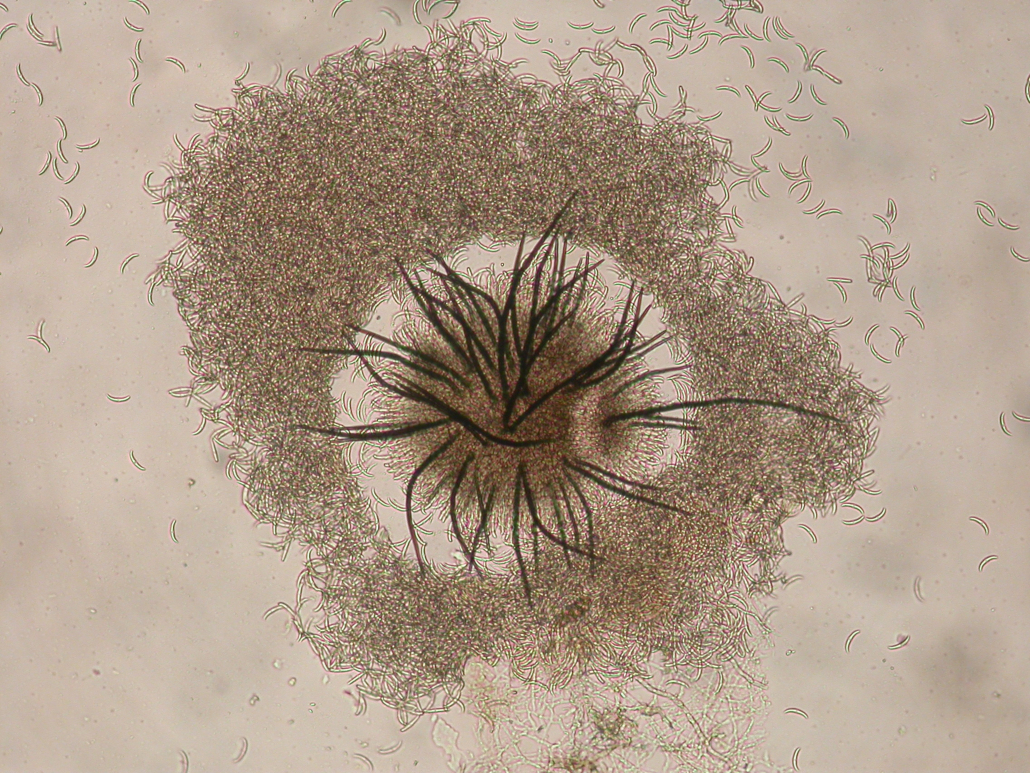
Colletotrichum spp grown in laboratory conditions on potato dextrose agar showing acervuli with diagnostic black setae producing conidia.

Colletotrichum spp grown in laboratory conditions on potato dextrose agar showing acervuli with diagnostic black setae producing conidia.

Reproductive phase

The pathogen spreads infective material to other areas

  • Pathogen

The reproductive phase begins with the development of fruiting bodies called acervuli within which the conidia, or spores, are produced (figure 3). Conidia can be transported on the wind or mechanically. Following contact with another susceptible plant, they can adhere to it by producing a suction cup called an appressorium. The pathogen then forces a highly specialised hyphae called a penetration peg into the plant resulting in the initiation of the biotrophic phase.

  • Host

During the reproductive phase black hair like structures known as setae which project from the acervuli on infected plant tissues are visible with a x10 hand lens. These structures are key diagnostic features for this pathogen when it develops as foliar blight (figure 2 & 3).

  • Environment

Warm, humid weather and increased light intensity are the primary environmental factors controlling the development of conidia. Laboratory studies indicate that Colletotrichum cereale produces conidia at temperatures between 24-32°C with increased maturity of conidia observed at 28°C compared with lower temperatures (Wang & Kerns, 2017). Once conidia have been excreted from the acervuli in a water-soluble matrix they can be spread by wind, water, or human activity but need continued leaf surface moisture to establish.

Research shows that wounding of the host plant through maintenance practices such as verticutting, top dressing and rolling does not increase the incidence of disease as the pathogen does not rely upon entry through wounds or weakened tissues due to its ability to develop a penetration peg.

This article has been written in conjunction with Dr Abigail Graceson and Tom Wood.

Dr Abigail Graceson

As a Technical Manager within the Agrovista Amenity Technical Department, Dr Abigail Graceson draws upon both her practical skills and academic research experience. In addition to her eight years’ experience as a professional gardener & horticulturalist; Dr Graceson spent nine years as a researcher specialising in horticulture, growing media and green roofs.

Tom Wood

Amenity specialist for the Yorkshire region, Tom Wood holds a first class bachelor’s degree in Sportsturf Science and Management (UCLan) which he combines with over ten years’ practical turf management experience. Over this time Tom has amassed a broad range of knowledge and skills sourced from a variety of fields including education, golf courses and technical sales.

References

Mims, C. W. & Vaillancourt, L. J., 2002. Ultrastructural characterization of infection and colonization of maize leaves by Colletotrichum graminicola, and by a C. graminicola pathogenicity mutant. Genetics and resistance, 92(7), pp. 803-812.

Muench, S. et al., 2008. The hemibiotrophic lifestyle of Colletotrichum species. Journal of plant physiology, Volume 165, pp. 41-51.

Wang, Y. & Kerns, J. P., 2017. Temperature effects on formation of appressoria and sporulation of colletotrichum cereale on two turfgrass species. International Turfgrass Society Research Journal, Volume 3, pp. 123-132.

More information on this subject can be found on the Agrovista Amenity Academy. The Agrovista Amenity Academy is an online learning resource with courses and lessons created on a range of areas of turf management and for all products sold by Agrovista Amenity.

For more information about Agrovista UK, visit www.agrovista.co.uk/amenity

For the latest industry news visit turfmatters.co.uk/news

Get all of the big headlines, pictures, opinions and videos on stories that matter to you.

Follow us on Twitter and Instagram for fun, fresh and engaging content.

You can also find us on Facebook for more of your must-see news, features, videos and pictures from Turf Matters.

Putting service first with Makita

Putting service first with Makita: In a move that reaffirms its commitment to delivering outstanding customer service, leading power tool manufacturer, Makita UK is delighted to unveil its new Factory Service Centre (FSC) in Blakelands, Milton Keynes.

Makita UK has relocated its Milton Keynes Factory Service Centre site (located at the company’s headquarters), to a new, larger location to house regional servicing activity. The new 20,000-sqft premises in Blakelands, which is scheduled to officially open on April 6th, will enable Makita to bolster its customer repair and service support commitments and completes a portfolio of three dedicated centres in London, Glasgow and Milton Keynes.

Putting service first with Makita

Putting service first with Makita

Makita’s Factory Service Centres deliver an exceptional service and repair offering for end-users. Products covered under the company’s warranty agreement can be posted (by arranging a collection) or dropped off (with prior booking), at each FSC for Makita’s technical experts and engineers to perform product servicing, detailed diagnostics and high standards of repair work when needed.

With a focus on improving levels of technical knowledge across the construction sector, the new larger premises in Blakelands will also be used to host Makita UK accredited service training, as well as Authorised Service Agents (ASA) workshops and seminars. Furthermore, Makita will use the new site to host apprenticeship training sessions focusing on the electrical and mechanical service requirements of Makita tools.

Speaking on the FSC opening, Tony Coleman, Technical Manager at Makita UK commented: “Opening this new, larger site is testament to the growing popularity of our tools, as well as our long-lasting commitment to delivering exceptional customer support. We’re now in a better position than ever to deal with service and repair demands, as well as to promote high-quality industry training. The spacious new centre also provides us with ample opportunity to continue growing our operations as we look to develop into new sectors and industries.”

All three of Makita’s FSC sites are currently following COVID-19 guidelines and customers are advised to follow the most up-to date guidance on arranging servicing or repairs, published on the company’s website.

For more information about Makita’s FSC sites, services and procedures please visit: www.makitauk.com/factory-service-centres

For the latest industry news visit turfmatters.co.uk/news

Get all of the big headlines, pictures, opinions and videos on stories that matter to you.

Follow us on Twitter and Instagram for fun, fresh and engaging content.

You can also find us on Facebook for more of your must-see news, features, videos and pictures from Turf Matters.