Tag Archive for: World-Class

The British greenkeeper building a world-class course

The British greenkeeper building a world-class course: Jamie Faulkner’s journey from suburban London to the searing heat of Bahrain has been defined by travel and an enduring love of greenkeeping.

He first got on a mower at 16, working at Bletchingley Golf Club in Surrey. “I just liked using the machines,” he says. “It felt like a fun job at first, but once I started playing golf, I was hooked. I’ve never thought about doing anything else.”
The British greenkeeper building a world-class course

The British greenkeeper building a world-class course

That early enthusiasm has taken him across the world. From his roots in Croydon, Jamie has built a career that’s seen him work on courses in Australia, the United States, India and Saudi Arabia before settling in Bahrain as Director of Agronomy at The Royal Golf Club — the only grass course on the island.

The Royal hosted a DP World Tour event this month, so it’s a venue where expectations are high and presentation is everything. The course is also the country’s golfing flagship, setting the standard for two new developments now being planned elsewhere on the island.

“The players love coming here because it’s such a contrast to the rest of the region,” says Jamie. “Presentation and playing consistency are everything. Our goal for the DP World Tour was for the course to be the best it’s ever been.”

Huge investment

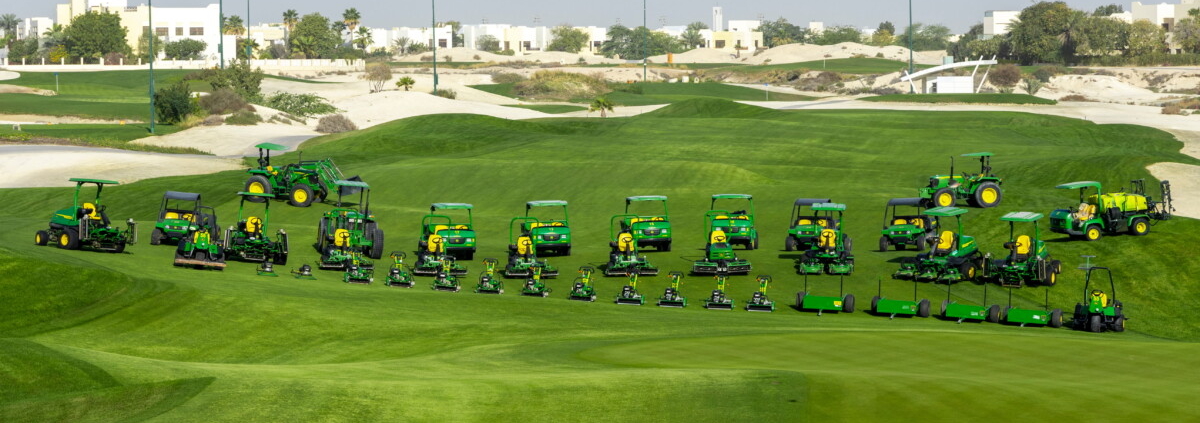
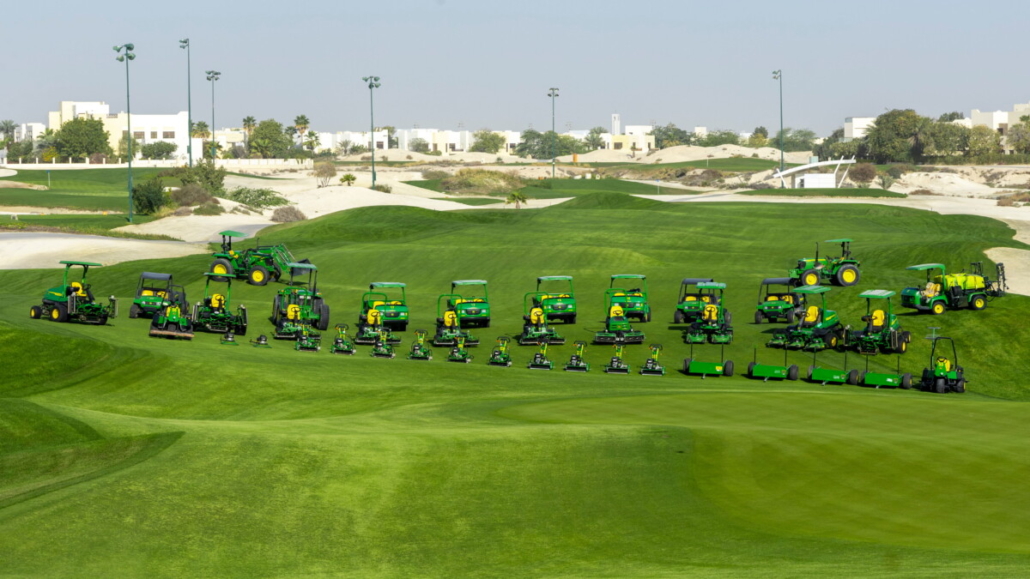
The club recently completed a £1.5 million machinery investment, replacing an ageing competitor fleet with a full suite of John Deere equipment supplied by Orient Irrigation Services.

“The guys love the machines, especially the mowers,” says Jamie. “The kit we had before was 15 years old and completely run into the ground, so these are a huge step up. Everyone’s very happy with them.”

The new fleet includes compact tractors, mowers, and two HD200 sprayers on ProGators. While the purchase was driven by the golf course, the machinery will also support the wider operation, which includes maintaining the nearby horse racing track and landscaping around 1,000 villas that neighbour the club.

“I’ve got 85 staff in the landscape business and 45 on the course,” Jamie explains. “It’s quite normal managing big teams here in the Middle East because the conditions are so demanding. The desert environment means there’s a lot of manual labour, from weeding and raking sand dunes to constant irrigation work.”

Away from home, but the weather still dominates

The heat presents relentless challenges. Temperatures can climb to 50 degrees with 90% humidity, making disease and pest prevention a year-round priority. “It’s a brutal climate,” he says. “We have to stay on top of everything, especially pythium root rot, which can take hold fast in the summer.”

Jamie’s journey to this point has been anything but ordinary. After several years working in and around London, first at Chipstead and then at The Addington, he decided to take his greenkeeping skills overseas.

His first stop was Kalgoorlie Golf Club near Perth, Australia, followed by a posting to Fiddlesticks Country Club in south-west Florida through the Ohio State University internship programme.

He spent three years in Bahrain before taking a superintendent’s role at a course in Bangalore, India, before moving to Riyadh to work for Golf Saudi. When travel restrictions hit during the pandemic, he commuted 600 kilometres between Saudi Arabia and Bahrain every two weeks to see his family.

“I’ve been away from the UK for 12 years now,” he says. “I was desperate to see the world, and I wanted to learn something new with every move. You pick up so much experience working in different climates and with different grasses. I think it makes you a better greenkeeper.”

The Royal’s 450 members are mainly ex-pat golfers, but with two new courses planned in Bahrain, there’s optimism that more international visitors will follow. For now, Jamie’s focus is on perfecting the playing surfaces and ensuring the club continues to set the standard for golf in the region.

Dealer support a major factor 

Dealer support plays a big part in that. Jamie works with Orient’s Harry Pattinson, a former outlet manager at John Deere dealer Thomas Sherriff in the UK. Despite being based an hour’s flight away, Harry provides ongoing technical and parts backup.

“We’ve agreed to do an annual expert check of the fleet,” says Harry. “We’ll spend a week going through every machine, checking for any small warranty issues and making sure Jamie’s team gets the most from the investment.”

For Jamie, keeping things simple is key. “We’ve got a huge workforce with people jumping on and off machines all day,” he says. “They need to be easy to use and reliable, which John Deere delivers. Out here, that’s what really matters.”

From his early days cutting greens in Surrey to preparing a DP World Tour venue in Bahrain, Jamie’s story is proof that passion and persistence can take you a long way. Even to the edge of the desert.

For the latest industry news visit turfmatters.co.uk/news

Get all of the big headlines, pictures, opinions and videos on stories that matter to you.

Follow us on Twitter and Instagram for fun, fresh and engaging content.

You can also find us on Facebook for more of your must-see news, features, videos and pictures from Turf Matters

Can The MLS Be World-Class On 3G?

Can The MLS Be World-Class On 3G?: Reliably unconventional, Zlatan Ibrahimovic spurned a $100m offer from China in order to take a $1.5m-per-year offer from the Los Angeles Galaxy, according to Sports Illustrated. But will the striker be eccentric enough to turn up for an away game against the New England Revolution?

After his matchwinning debut in last Saturday’s Los Angeles derby – the most deranged 90 minutes in MLS history – everyone wants to see the Swede play.
Still, the 36-year-old has recently returned from a serious knee injury, so Ibrahimovic and the Galaxy’s coaching staff will have judgment calls to make later in the season as the league’s most famous name tries to stay healthy. The Galaxy have four MLS fixtures on artificial turf scheduled between June and October (though Ibrahimovic may yet  play at this summer’s World Cup). Fearing injury, some veteran stars have skipped games on artificial surfaces over the years, dealing blows to MLS’s reputation.

The only time Thierry Henry played on the widely-reviled artificial turf of Gillette Stadium, the home of the Revolution, was a play-off game in 2014 that turned out to be the last match of his career. Didier Drogba also sought to avoid fake grass. David Beckham, usually so emollient in interviews, was an anti-turf absolutist: “Every game, every team should have grass, without a doubt,” he told reporters in 2007.

We wait to see whether a man who once slammed France merely because he thought a referee had a bad game will have any thoughts to share on a subject that tends to provoke strong emotions.

The league added to its synthetic collection last year when Atlanta and Minnesota  – who face off last Saturday – joined Vancouver, Seattle, Portland and New England. (Minnesota’s permanent home, set to open next year, will have grass).

This clearly matters to the players. An ESPN anonymous survey of current MLS members published last month asked whether an artificial surface would influence a player’s decision to join a team: 63% said yes. Perhaps not unrelated, another question asked them to name the toughest place to play in MLS and four of the top eight answers were teams with artificial turf.

Turf wars are commonplace in North America. Earlier this month the cost of laying temporary grass at BC Place was reportedly among the factors that caused Vancouver to withdraw from contention as a host city for the 2026 World Cup bid, while the use of artificial fields at the 2015 Women’s World Cup in Canada was the subject of failed legal action.

True or not, artificial fields are perceived to increase injury risk and enhance home advantage in a league in which road results are notoriously poor. They are freighted with memories of the North American Soccer League’s dire surfaces, and away from Portland, where complex factors influence the choice, are a sign of MLS’s subservience to American football in shared venues.

Pitch variations invite us to define what counts as “authentic”: a perennial concern for MLS, which is adolescent and distinctive yet obsessed with tradition and how it stacks up against more established leagues. In a quest for instant credibility, newborn franchises such as Atlanta and Minnesota drape themselves in Anglicized affectations such as “United” and “Football Club”. The branding glances towards England where, as the Premier League’s rules tersely state: “No League Match shall be played on an Artificial Surface”. It’s an homage to the kind of Euro superclubs who insist on temporary grass pitches being installed over artificial surfaces when they visit the US on summer tours.

Like shoppers at an urban farmers market, fans instinctively prefer organic to genetically-modified ingredients. Still, turf versus grass is habitually presented as a binary opposition when the reality is more nuanced. Enhanced hybrid surfaces where artificial fibres act to strengthen the natural grass are ubiquitous in England’s top-flight. The expectation of competitive imbalance on turf, one 2016 study found, does not reflect the truth.

A good artificial surface may play truer than a lousy natural one and technology is far advanced from the “Astroturf burn” eras, when players who attempted sliding tackles in shorts often looked like they’d just spent 90 minutes in the company of an arsonist. As the Portland Timbers owner, Merritt Paulson, told FourFourTwo last year: “There is a massive difference between the quality of turf fields that you can host a soccer game on, just like there is a very big difference on the quality of a grass pitch for a game.”

And the argument that artificial turf is only for unserious soccer nations is hard to sustain given its presence in Mexico and France in recent years, while in 2016-17, one-third of the Eredivisie’s teams had it (which prompted a revolt from the Dutch players’ union).

For Wilmer Cabrera, the Houston Dynamo head coach, artifice is just another hill to climb in MLS’ undulating landscape. “Here in MLS you have to play on turf and you have to play on grass, you have to travel 5,000 miles back and forth, you have to play in humidity or cold weather, snow or wind,” he said. “Pounding on [an artificial] surface it’s gonna get you more tired, the muscles are going to suffer a little bit more and the joints, but we don’t make any kind of excuses.” Cabrera’s team beat the Timbers 2-1 at Providence Park in last year’s playoffs before losing 3-0 to the Seattle Sounders at CenturyLink Field in the Western Conference finals.

Houston is arguably the cradle of fake grass, since the Astros baseball team popularised it by using AstroTurf in the Astrodome in the 1960s. Despite the city’s brutal summer weather and the multiple teams that use BBVA Compass Stadium, the Dynamo play on grass that, by last year’s postseason, was so badly cut up that it looked like the field had hosted a tunneling contest for moles.

No stranger to the treatment room, Philippe Senderos would have felt wary about joining Houston if their pitch was plastic. “I think knowing that the Houston Dynamo play on grass was definitely a factor [in me joining the club]. If it would had been on turf I would have had to think about it a little bit more,” he said.

Standing on the Dynamo’s verdant practice field, Andrew Wenger took a pragmatic view. “There’s a lot of aspects that goes into making, or considering, a league the best in the world and that’s probably a very small, minute effect,” the veteran attacker said. “Would you rather have everything be on grass? Yes. But is playing in the climate of North America different from other places in the world? That’s also true. So how do you balance all these balls in the air, and making it the best but also dealing with what we’re presented? That’s a big question.”

Looking to the medium- and long-term, extreme weather from climate change may complicate the use of grass pitches in some parts of the continent, while it’s logical to expect that artificial surfaces will continue to improve, blurring the distinction between synthetic and natural. MLS may never be all-grass, and one day, long after Ibrahimovic is gone, maybe that won’t matter.

Click here to read the original article

For the latest industry news visit turfmatters.co.uk/news

Get all of the big headlines, pictures, opinions and videos on stories that matter to you.

Follow us on Twitter for fun, fresh and engaging content.

You can also find us on Facebook for more of your must-see news, features, videos and pictures from Turf Matters.