Tag Archive for: Your

Don’t lockdown your turf management

Don’t lockdown your turf management: While golf courses are facing unprecedented times, greenkeepers are being urged to keep on top of maintenance to ensure courses are in good condition for when golfers return.

Colin Mumford, technical manager at Bayer, says that seasonal conditions, such as plummeting temperatures and excess rainfall, combined with the challenges posed by Covid19, have affected many courses.

Don’t lockdown your turf management

Don’t lockdown your turf management

“Previous lockdowns prevented planned work from going ahead, and once the courses were open, golfers returned in their masses making the management and maintenance of courses very challenging,” says Colin.

He adds that the cold and wet conditions we’ve experienced this winter could also contribute to long-term turf damage. “Despite being in another lockdown, it’s vital that greenkeepers do all they can to start the year with ‘stress free’ turf, as a healthy course will be less susceptible to weeds, pests and diseases,” says Colin.

Unlike previous lockdowns, at the moment, greenkeepers can undertake maintenance work, which should allow them to catch up from last year, weather permitting.

“Preventative disease methods should be undertaken now to reduce the risk of disease appearing later in the year,” says Colin.

“Keeping surfaces dry by switching or brushing dew off the playing surface should be done daily to help reduce disease outbreaks and ensure a cleaner cut when mowing. And if plant health is a concern, the height of cut (HOC) can be raised slightly, but be mindful that courses may open at short notice, and may require a rapid return to the original HOC which isn’t ideal,” says Colin.

“If it isn’t too wet, aeration or verti-draining can help remove below ground compaction allowing water to move more effectively through the rootzone, preventing waterlogging and surface damage to the course.

“Another job that can be done, is cutting back overgrown trees on the course to minimise shaded, damp environments in these areas,” he adds.

Colin warns that golf courses have been one of the first venues to open following a lockdown and therefore temporary courses may need preparing if the weather is still poor. “Letting players onto frozen courses that are beginning to thaw can result in roots breaking due to surface movement, leading to long-term course damage.

“It’s also worth considering re-routing player traffic flow around the key areas of the course and roping off any high traffic areas to avoid turf getting churned up,” adds Colin.

“Turf stress at this time of year can put the plants under pressure, leaving them more susceptible to problems later in the year, and therefore it’s important to try and keep courses as healthy as possible from the outset,” he says.

For the latest industry news visit turfmatters.co.uk/news

Get all of the big headlines, pictures, opinions and videos on stories that matter to you.

Follow us on Twitter and Instagram for fun, fresh and engaging content.

You can also find us on Facebook for more of your must-see news, features, videos and pictures from Turf Matters.

Control your climate with CAB CLIMA

Control your climate with CAB CLIMA: The Corvus Terrain range of 4×4 utility vehicles was introduced in the UK in 2019.  Since then the Terrain has gone from strength to strength to create a UTV that adapts to the user and their work environment.

Corvus, Europe’s first manufacturer of 4×4 Side by Side vehicles, offers an efficient Yanmar Diesel engine, market-leading onboard storage capacity and a well-designed full cab option.  Now they have increased the Terrain’s comfort levels with the new CAB CLIMA package. Starting from the current integrated system of doors, air conditioning and heating found on the Terrain DX4, CAB CLIMA improves the vehicle’s working conditions and comfort with a central console to control heat, ventilation and air conditioning (HVAC). Now you can carry out any task safely protected and isolated from the weather outside, all-year-round. The air conditioning system with electronic control is simply operated through the central console with airflow control in three positions. There are front windscreen and anti-fogging diffusers to keep your forward vision clear and safe. With a total of eight diffusers, four of them are able to rotate through 360º.

Control your climate with CAB CLIMA

Control your climate with CAB CLIMA

CAB CLIMA joins the other Terrain high specification levels of full instrumentation, 3-cylinder 993cc Yanmar Diesel engine, which is Euro 6 compliant and gives excellent fuel efficiency and range, and homologation Type EU T1b. Other standard equipment includes two adjustable seats, skid plate, 4×4/4×2 system, 2-point safety belt, adjustable suspension and 244-litre onboard storage with 450kg cargo box. Pro and cab packages are available together with a range of original manufacturer accessories. The Corvus Terrain models come with a 2-year warranty.

For more information about the Corvus Terrain range, you can call 01597 810188, E-mail: sales@bossorv.co.uk or visit www.bossorv.co.uk

For the latest industry news visit turfmatters.co.uk/news

Get all of the big headlines, pictures, opinions and videos on stories that matter to you.

Follow us on Twitter and Instagram for fun, fresh and engaging content.

You can also find us on Facebook for more of your must-see news, features, videos and pictures from Turf Matters.

What your lawn needs to eat

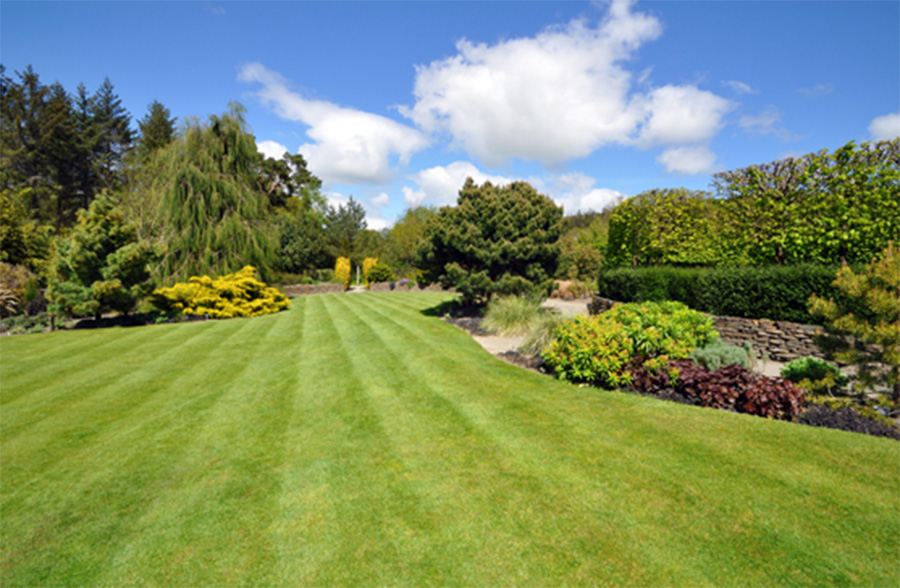
What your lawn needs to eat: The Lawn Association team know that you will be wishing for a lawn like the one pictured this summer!  But to get this result, you need to plan now!

Our latest guest blog is from a specialist who knows exactly what your lawn needs to eat to ensure it is happy, healthy and green.
What your lawn needs to eat

What your lawn needs to eat

Rhys Norville, UK Sales Manager for Terralift UK, has offered his advice below.

We all need food but which is the correct food for your lawn?

Lawn fertilisers contain three main elements to aid grass growth: Nitrogen (N), Phosphate, (P) and Potassium (K). These elements will be listed on the fertiliser container in a way that describes the percentage of each element contained in the mix. For example 6-2-8 contains 6% Nitrogen 2% Phosphorous and 8% Potassium.

There are different mixes for different times of the year, and to understand why we need to consider what each of the three elements actually does.

What are the major nutrients for grass growth?

Nitrogen: the main role is to improve the grass’s growth, but nitrogen also enhances the green colour. More Nitrogen is needed when growth rates are high, so in Spring and Summer, you need a fertiliser with a higher nitrogen content than in Autumn & Winter.

There are different forms of Nitrogen which release at different rates. For example, the readily-available Nitrate form can be absorbed instantly by the plant to boost growth as soon as it is applied. Urea, by contrast, has to break down before the plants can absorb it, taking up to twelve weeks but providing a slower and steadier feed to the plant.

Phosphate: Phosphate helps to maximise the development of new shoots after mowing. Similarly, it is important for helping new seedlings to establish good roots, and so is a useful application after any overseeding.

Potassium: This toughens up the plant’s cell-wall structure and increases its resistance to wear. It does this by keeping the grass blades ridged and upright. As with Nitrogen, Potassium can also boost the colour of the plant. Potassium applications are most common in Spring and Autumn.

What else is in your fertiliser?

It might contain Magnesium for colour hold, and to help the leaves convert nitrate into protein.

You might also find Iron as this helps the grass to develop a dark green. Iron is also used to reduce the impact of moss in grassland areas. However, iron is a trace element and the plant only requires small amounts to grow. Be careful not to over-apply iron as it can cause stress to the plant and reduce the soil’s pH which, in turn, can encourage disease and weed infestation.

Microbial activity

Microbes play a vital role in maintaining healthy soil for your grass. When the microbes within the soil are working well, they help with chelation of nutrients, natural disease suppression and regulating growth rates, so we should aim to support them as much as we possibly can. You need an organic granular fertiliser (more on this below) which contains carbon and humus.

Different types of granular fertiliser

Granular lawn fertiliser is sold as three main types:

1. Mineral-Based;
2. Organic;
3. Coated Mineral Fertiliser.

Mineral-based: This is the most common fertiliser in which different percentages of NPK are bound to an ‘inherit’ carrier such as clay or zeolite. This material helps to distribute the nutrients evenly across the lawn when spread.

Organic fertiliser: This will contain a composted organic material which may be manure or food waste, to which mineral fertiliser is mixed and bound. This creates a two-in-one application as the mineral fertiliser is being applied to support plant growth whilst the organic portion will serve as a soil conditioner to boost root development and to support healthy microbes within the soil.

Coated fertilisers: These are mineral fertilisers which are coated in a polymer to slow down the release of the fertiliser. The advantage is that you don’t have to apply fertiliser quite as often, some lasting up to six months. But of course, that makes it harder to tailor your fertiliser mix to each seasonal requirement – and the polymer may be plastic and pollute the land too.

Liquid fertiliser

There are forms of liquid fertilisers which are applied by spraying, using a knapsack or boom sprayer. The benefit of a liquid fertiliser is that it is absorbed almost immediately by the plant and so can increase growth rates within a few hours. This makes it an instant pick-me-up but of course, the benefit does not last as long as granular fertilisers which go into the soil. Every time you cut your lawn you will be removing some of the liquid fertiliser that was applied, whereas a granular will stay in the soil pool for the plant to absorb it.

Longevity of fertilisers

Typically the effects of a mineral granular fertiliser will last for around 6 weeks whereas an organic can last up to 12 weeks and as mentioned above some coated fertilisers will last up to 6 months. Liquid fertiliser will need to be reapplied after 3-4 weeks for consistent growth patterns.

However, longevity will also depend on factors such as rainfall, temperature, soil type and frequency of cutting. If you live in an area with lots of rainfall, this rain will leach the soil of nutrients, so you may need to apply fertiliser more frequently. And the warmer the soil, the quicker the fertilisers will be broken down (hence summer applications will not last as long as winter applications). Sandy soil will leach nutrients quicker than clay soil.

So these factors also need to be considered when selecting which fertiliser to use.

What does the Terralift expert use? 

Rhys tell us that he only applies Organic Granular Fertilisers, and he uses:

6.2.8+Mg in Spring Time
10.2.4 in Summer
6.2.8+Mg in the autumn usually after scarification and overseeding
3.0.6 as an over-wintering fertiliser.

Our core mission is to make accurate lawn care information freely and readily available via our website and through our Free Membership Scheme for gardening enthusiasts. Go to the @LawnAssociation Facebook page to join the Lawn Enthusiasts Group, and get free association membership via the website, www.lawnassociation.org.uk 

For the latest industry news visit turfmatters.co.uk/news

Get all of the big headlines, pictures, opinions and videos on stories that matter to you.

Follow us on Twitter and Instagram for fun, fresh and engaging content.

You can also find us on Facebook for more of your must-see news, features, videos and pictures from Turf Matters.

Give your mowers the edge

Give your mowers the edge: The hardened tool steel of Toro’s EdgeMax bedknives delivers edge retention that lasts up to three times longer for a sharper, cleaner cut, all season long.

And being the growing season, now’s the time to make sure your machines are in pole position to bring the best quality of cut to your greens and fairways mowers by replacing worn bedknives with Toro EdgeMax.

Give your mowers the edge

Give your mowers the edge

Brought to the UK by Reesink Turfcare, Michael Hampton, parts manager at Reesink, says: “Customers appreciate the precision engineering of Toro’s EdgeMax bedknives. They have a hardened tool steel insert for a cutting edge that exceeds industry standards to last three times longer than a standard fairway bedknife and twice as long for greens. Not only do they last longer, but the hardened steel results in 50 percent less time adjusting, backlapping, grinding and replacing, too.”

Blades that maintain their sharpness ensure a cleaner cut for optimum turf health and as the machine incurs less wear, it works more smoothly and more efficiently. What’s more, because EdgeMax bedknives last up to three times longer, parts costs are also reduced and Toro believes that this combination of longer life and reduced maintenance time can equate to long-term cost savings.

Michael continues: “With genuine Toro parts, you can be sure you’re getting first-rate parts built to fit perfectly with your cylinder mowers, with consistent hole alignment on every bedknife, steels coils and computer-controlled machining and finishing, thanks to Toro’s leading manufacturing process. With Toro EdgeMax bedknives you can be sure you’ll be replacing your bedknives quickly and without the hassle or stress of gambling on likely inferior ‘will fit’ parts.

“It’s not often that there’s a short cut to a longer, better performance, but with Toro EdgeMax bedknives there is, hence this product’s popularity with customers.”

Toro EdgeMax bedknives are available across Toro’s Greensmaster and Reelmaster ranges on models fitted with DPA (Dual Precision Adjustment) cutting units. EdgeMax bedknives bring a 9.5mm and above height-of-cut to fairways and a 1.59mm and above height-of-cut to greens.

Reesink is still open for business and teams in our service centres, warehouses and across our supply chain are working tirelessly to deliver parts for our customers.

Drop them a line at info@reesinkturfcare.co.uk or call Spare Parts: 01480 226854

For the latest industry news visit turfmatters.co.uk/news

Get all of the big headlines, pictures, opinions and videos on stories that matter to you.

Follow us on Twitter and Instagram for fun, fresh and engaging content.

You can also find us on Facebook for more of your must-see news, features, videos and pictures from Turf Matters.

Share your photos with us

Share your photos with us: It’s challenge time!

During this unprecedented period we want you to share your favourite turf-related photo or memory.

Share your photos with us

Share your photos with us

Tag us in your photos on Twitter @TurfMatters and we will re-share to brighten up everyone’s timelines.

Whether it’s a photo from your current course or a previous pitch, we want to see your pics!

For the latest industry news visit turfmatters.co.uk/news

Get all of the big headlines, pictures, opinions and videos on stories that matter to you.

Follow us on Twitter and Instagram for fun, fresh and engaging content.

You can also find us on Facebook for more of your must-see news, features, videos and pictures from Turf Matters.