Husqvarna Announces Broadcaster Sarah Stirk as Brand Ambassador

Husqvarna Announces Broadcaster Sarah Stirk as Ambassador

Husqvarna Announces Broadcaster Sarah Stirk as Ambassador

Husqvarna, one of the industry-leaders in autonomous robotic mowing, has announced a new partnership with British golf broadcaster and presenter, Sarah Stirk, who will join the company as an official brand ambassador throughout 2026.

Husqvarna Announces Broadcaster Sarah Stirk as Brand Ambassador

Husqvarna Announces Broadcaster Sarah Stirk as Brand Ambassador

A highly respected figure in golf media, Stirk has been a key part of the Sky Sports Golf team for more than a decade and is a familiar presence at the sport’s biggest events. Known for her insight, credibility, and ability to engage audiences, she has established herself as one of the most recognisable voices in modern golf broadcasting.

Stirk will support Husqvarna across a range of industry and tournament activations, helping to highlight the role of innovation in modern golf course management. Through the collaboration, Husqvarna aims to further bolster its connection with the golf industry while showcasing how robotics and battery-powered solutions are supporting greenkeeping operations and the long-term sustainability of the sport.

The ambassador role will see Stirk involved in Husqvarna activations around major tournaments, including the Husqvarna British Masters and the AIG Women’s Open, helping to bring greater visibility to the innovation shaping the future of golf course management.

By connecting professional golf with the people and technologies that support the game behind the scenes, Husqvarna is aiming to create new opportunities for industry conversation and continue to grow awareness of autonomous robotic solutions.

Karl Hansell, Marketing Manager (UK) at Husqvarna, said: “Sarah has a deep understanding of the game and the ability to resonate with audiences across the golf world. Her experience and credibility within the sport make her an ideal partner as we continue to highlight the important role that innovation and technology play in supporting golf course maintenance teams in an ever-changing landscape.”

Stirk added: “I’m excited to be partnering with Husqvarna, a brand that is leading the way in innovation within the golf industry. Technology is playing an increasingly important role in how courses are maintained, and I’m looking forward to helping tell that story and bringing greater visibility to the solutions that are driving the game forward.”

As part of the partnership, Stirk will be involved in several key moments across the golf and turf management calendar. Earlier this year, she supported Husqvarna’s presence at BTME (BIGGA Turf Management Exhibition), hosting a live Q&A interview on the Husqvarna stand, bringing together industry voices to discuss the evolving role of robotics and new technologies in golf course maintenance.

For the latest industry news visit turfmatters.co.uk/news

Get all of the big headlines, pictures, opinions and videos on stories that matter to you.

Follow us on Twitter and Instagram for fun, fresh and engaging content.

You can also find us on Facebook for more of your must-see news, features, videos and pictures from Turf Matters

Johnsons Sports Seed delivers performance under pressure

Johnsons Sports Seed delivers performance under pressure

Johnsons Sports Seed delivers performance under pressure

As a busy multi-sport facility, resilience of surfaces at Bristol University isn’t a luxury – it’s a necessity. Helping Grounds Manager Matt Carroll deliver consistent, high-quality pitches for winter and summer sports are mixtures from the Johnsons Sports Seed range, producing performance he and his team of four can rely on season after season.

Johnsons Sports Seed delivers performance under pressure

Johnsons Sports Seed delivers performance under pressure

Matt has been with the University for over 20 years, stepping into the Grounds Manager role three years ago which sees him in charge of 38 acres of grounds, natural and artificial surfaces used heavily by university teams and the local community. “We accommodate a lot of sport – demand is through the roof!” exclaims Matt. “We don’t get much in the way of renovation or turnaround windows so the surfaces need to be resilient, recover quickly and, of course, look good.”

For close to a decade, delivering all of those qualities have been mixtures from the Johnsons Sports Seed range. “We’ve used various mixes over the years but have recently found a combination of J Premier Pitch on our winter sports pitches and two of the cricket outfields, and J Premier Wicket on the squares delivers the reliability we need.”

“We rely heavily on overseeding, often only having a matter of a few weeks when the sporting season changes and with Johnsons, the establishment and uptake we’ve had has been outstanding. Knowing you can get those results in a short timeframe makes a huge difference.” He adds, “Not only that but the colour is vivid year-round and they can stand up to the challenge of back-to back play.”

Reinforcing the quality of Bristol’s pitches, the venue was proudly chosen as a training venue for 2025 Women’s Rugby World Cup. “We were delighted to host the Canadian national team. It was full on but really showcased the best of our surfaces and the products we’re using.”

“Our Regional Technical Manager Ian Barnett has also always been a great help, providing technical advice to help us make the very best selection.” Together with the team, Matt was recently fortunate enough to visit the DLF Living Catalogue and trials centre. “This just shows you’re getting the best product, that’s thoroughly tested and delivers results in every bag and on every surface.”

For the latest industry news visit turfmatters.co.uk/news

Get all of the big headlines, pictures, opinions and videos on stories that matter to you.

Follow us on Twitter and Instagram for fun, fresh and engaging content.

You can also find us on Facebook for more of your must-see news, features, videos and pictures from Turf Matters

We’re in safe hands

We’re in safe hands

We’re in safe hands

Scott MacCallum catches up with two of the winners of the GMA’s 35 under 35 initiative.

We’re in safe hands

We’re in safe hands

It’s not always wise to make predictions. Usually there is one chance to be a hero but many more chances of looking like a fool. But here I am about to do just that. I am predicting that the future of our industry is secure and in safe hands.

I am predicting that the future of our industry is secure and in safe hands.

I say this, confidently, having sat down with two of the ICL’s supported GMA’s 35 under 35s winners and seeing just how wise both are and just how much they care about the industry.

Daniel Puicar is Head Gardener at Middleton Hall Trust in Warwickshire, and Sean Faulkner is Sales and Marketing Director for Kersten UK and one of the country’s leading experts in sustainable weed management.

Daniel and Sean may come from different sides of the industry, but they are equally thought provoking on so many issues.

Asked where they think the industry would be in 10 years’ time Sean felt that it was something very much in the hands of the younger participants currently working within it.

“It’s up to us. Well, to a point,” he said. “Lots of people of my dad’s age (Baby Boomers and Gen X) are starting to retire now and there are a great many of them in our industry. And, at the moment, there are not that many of our generation and younger to fill that gap,” he explained.

“I believe that it’s critical that we encourage the people who are in our generation to take the reins, make a difference and shape the industry into how we want it to be shaped.

Otherwise, we’re going to be left with whatever industry we’ve given.

“So, as I said, in that sense, it’s down to us what it looks like in in ten years’ time,” added Sean.

Daniel has a similar take on the concerning age demographic within the industry.

“I am anxious about the exit from the industry versus the entrance into the industry. We are losing knowledge, and that’s knowledge that you don’t find in books. It’s knowledge that is not passed down,” said Daniel.

“But if you ever work with someone who’s been in the industry for 20, 30 or 40 years, you know that what they know is pure gold. And that is what we’re losing.”

The $64,000 question therefore is, “What can be done to attract young people into the industry?”

Well, Daniel can’t believe that he is lucky enough to be working in a job that he loves so much.

“Doing something creative is often linked to the satisfaction that you get from a hobby, while doing a job is sometimes seen as something much more routine.

When you mix the two together, you are in the lovely position of achieving satisfaction from doing your job.”

Daniel is also one of the few people who takes a positive from the poor wages that are so common place within the industry.

“The fact that the industry is so underpaid actually shows that the people who are in it are not in it for the money. They’re in it because they love it. That to me is a brilliant selling point to the industry.”

Highlighting what great job opportunities are within our industry is something with Sean has been actively working on recently.

We’re in safe hands

We’re in safe hands

He is a trustee of a charity called Managing the Green Planet which builds awareness of career options.

They do it through virtual reality. They’ve got glasses that they give to students and they show them what it’s like to be a day in the life of the guy who managing Lords or Wimbledon or a National Trust estate.

“So that’s exciting and a way of showing just out varied and interesting jobs in our industry can be.”

On that theme Sean highlighted the variety of jobs the industry offers up and the value he gives from his own role.

“It’s an interesting industry with a lot of potential to go places and make big differences. What I’m doing may sound quite boring, but, in reality, I’m solving problems with air and water quality; with surface water; with potholes that everybody complains about, with weeds themselves, So, there’s ways of making a massive impact if that’s what you want.

“For example if National Trust sites weren’t maintained at such a high level, and interesting things done with the gardens and if the paths didn’t look pristine.

“I’m sure the number of visitors would drop alarmingly. People like to see lovely gardens and paths and it is the people within our industry who make them happen.”

“Being a steward of what we have is really important. I think we need to connect more as a country to our history and to our culture and roots,” said Sean.

So, you can see that I’m not exactly going out on a limb to say that we have some pretty smart cookies among the younger generation of industry professionals. While the rest of us are looking back at our careers from the comfort of our armchairs they will be forging forward making things better for the generation which follows them. For me I’m just hoping to sneak into the 65 under 65s before even that is too late!

THE FULL WINNERS OF THE GMA 35 UNDER 35:

  • Luis Arregui – Real Madrid C.F, Deputy Grounds Manager
  • Tom Bacon – Brighton and Hove Albion FC, Groundsperson
  • Alex Brierley – The All England Lawn Tennis Club, Groundstaff and Lead Irrigation
  • Louise Challiss – PAN Publicity Limited, Managing Director
  • Luke Chapman – Brighton and Hove Albion FC, Deputy Head Groundsperson
  • Evan Davies – Swansea City AFC, Head of Grounds
  • Max Drummond Smillie – Fargro Ltd, Head of Amenity
  • Alex Earle – Tennisclub Weissenhof, Head Groundsman
  • Sean Faulkner – Kersten UK Ltd, Sales and Marketing Director
  • Matthew Gibson – The All England Lawn Tennis Club, Groundsperson
  • Flynn Good – Leicester City Football Club, Skilled Sports Turf Operative
  • Matt Harris – Whitgift School, Groundsperson
  • Stanley Hayden – Fulham FC, Deputy Head of Grounds
  • Brad Jefferies – Colchester United Football Club, Head Groundsman
  • Ben Kim – K-League, The member of Pitch Assist
  • Jack Langley – Ashton Gate Stadium, Deputy Head Groundsperson
  • Rob Langley – University of Cambridge Sport, Sports Grounds & Facilities Supervisor
  • Meg Lay – Lord’s Cricket Ground, Groundswoman
  • Jack Leather – Liverpool Football Club, Specialist Groundsperson
  • Oliver Mahon – Bradfield College, Head of Grounds
  • Maritza Martinez – St. Louis CITY SC, Associate Director of Stadium Grounds
  • John Paul McAvoy – Preston North End, Groundsman
  • Santiago Molinaro – Independent Professional, Agronomist
  • Kane Munday – Norwich City Football Club, Assistant Head of Grounds
  • Matthew Noke – Bristol City FC, Groundsperson
  • Daniel Puicar – Middleton Hall Trust, Head Gardener
  • Adam Radley – Stamford School, Deputy Head of Grounds & Gardens
  • Ethan Reed – Nottingham Forest Football Club, Pitch Performance Manager
  • David Ridley – Wiltshire County Football Association, Facility Operations Manager
  • George Sheath – University of Southampton, Grounds Advisor (Head of Grounds)
  • Aaron Stevenson – London Stadium, Deputy Head Groundsperson
  • Bradley Tennant – International Greenkeepers, Director
  • Aaron Tong – Hull City AFC, Head of Grounds
  • Ben Tuckwell – Nuture Group, Grounds Maintenance Operative
  • Dewi Williams – Football Association of Wales, Club Developer

Mastering the water table: The strategic role of sand slitting

Mastering the water table: The strategic role of sand slitting

Mastering the water table: The strategic role of sand slitting

In the world of professional turf management, the battle against the elements is perpetual, says Redexim’s Paul Langford.

Mastering the water table: The strategic role of sand slitting

Mastering the water table: The strategic role of sand slitting

As weather patterns become increasingly volatile, the “shoulder seasons” are no longer defined by light mists, but by high-volume precipitation events that test the limits of even the most sophisticated drainage systems.

For the modern turf manager, the challenge is twofold: maintaining the structural integrity of the soil profile while ensuring maximum surface availability for players.

When traditional aeration is no longer enough to move standing water, the focus must shift to secondary drainage. This is where the Redexim Vibra-Sandmaster enters the fray – not merely as a piece of machinery, but as a strategic intervention for long-term turf health.

THE AGRONOMY OF INFILTRATION: WHY SAND SLITTING?

To understand the value of a machine like the Vibra-Sandmaster, one must first address the “perched water table” and the physics of soil compaction. In high-traffic areas such as golf fairways,
football and rugby pitches, the upper 100mm to 200mm of the soil profile often becomes a bottleneck. Even if the underlying subsoil is porous, a capped or compacted surface layer acts as a seal, trapping water and suffocating the root zone.

Sand slitting is the surgical answer to this problem. By creating narrow, vertical channels and backfilling them with free-draining aggregates, we can create a direct bypass for surface water.

These slits do more than just move water; they facilitate Gas Exchange. By breaking the surface seal, oxygen can reach the rhizosphere, and carbon dioxide can escape which is a process vital for the microbial activity that prevents thatch build-up and promotes deep rooting.

Mastering the water table: The strategic role of sand slitting

Mastering the water table: The strategic role of sand slitting

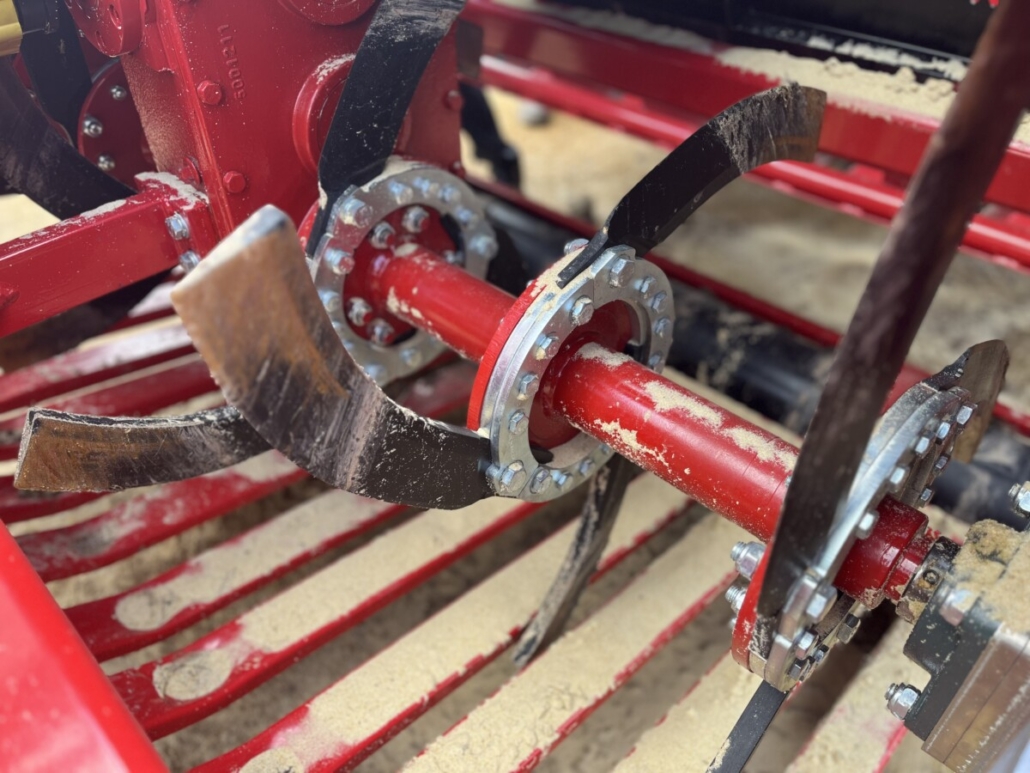
Traditional sand slitting has historically been a multi-stage, labourintensive process: decompacting, trenching, filling, and brushing. The Vibra-Sandmaster redefines this workflow by integrating the VertiQuake 2516 into a seamless, one-pass operation.

1. DECOMPACTION VIA THE VERTIQUAKE 2516

At the heart of the system is the VertiQuake technology. Unlike standard hollow coring or solid tining, the VertiQuake uses a rotary action with offset blades. These blades penetrate up to 250mm deep, creating a “wave” action underground. This lateral movement shatters the soil structure between the slits without the heave associated with traditional deep-tine aerators.

2. VIBRATING COULTER TECHNOLOGY

The “Vibra” in the name isn’t just marketing. It’s the machine’s most critical mechanical advantage. As the sand is delivered from the hopper into the slits created by the Verti-Quake, the coulters vibrate at high frequency.

Technical note: This vibration serves a dual purpose. First, it ensures that the sand (even if slightly damp) flows freely without bridging or clogging the delivery chutes. Second, it “settles” the sand into the slit, ensuring there are no air pockets. An improperly filled slit can lead to surface “slumping” later in the season; the vibrating coulters mitigate this risk entirely.

EFFICIENCY AS A MANAGEMENT TOOL

In the pitch maintenance community, “window of opportunity” is a common phrase. With budgets tightening and fixture lists growing, the luxury of closing a pitch for a week of renovation is disappearing. The one-pass capability of the Vibra-Sandmaster is, therefore, a massive logistical win.

By combining de-compaction and sand injection into a single pass, grounds teams can:

  • Reduce man-hours: Complete a fairway or pitch in a fraction of the time required for multi-machine setups.
  • Minimise surface disruption: Because the machine is precisely calibrated, the “clean-up” required post-operation is minimal. Surfaces are often playable within hours of completion.
  • Monitor with precision: The inclusion of an on-board camera system allows the operator to monitor sand flow in real-time. This prevents the “blind spots” that often lead to inconsistent drainage performance across a site.

While the Vibra-Sandmaster is a staple on the links and parkland courses of the UK, its application in the municipal and winter sports sectors is growing. Local authorities managing public parks and multi-use games areas (MUGAs) face extreme compaction from heavy foot traffic.

Mastering the water table: The strategic role of sand slitting

Mastering the water table: The strategic role of sand slitting

In these environments, the VibraSandmaster acts as a “reset button.” It allows for the introduction of highquality silica sand into native soil pitches, gradually amending the soil texture over several seasons without the astronomical cost of a full pitch reconstruction. Whether it is dry sand, damp sand, or even small-diameter gravel, the machine’s ability to handle various media makes it a versatile asset in a facility’s fleet.

THE LONG-TERM ROI OF PROPER DRAINAGE

Investment in a Vibra-Sandmaster should be viewed through the lens of preventative maintenance. Welldrained turf is more resilient to drought (due to deeper rooting), less prone to fungal pathogens (due to lower surface humidity), and more capable of withstanding the mechanical stress of play.

When a pitch remains playable during a wet November, the revenue generated from fixtures or the satisfaction of golf members provides a direct return on the investment in secondary drainage.

The Redexim Vibra-Sandmaster represents the pinnacle of sandslitting technology. By marrying the deep-channel decompaction of the Verti-Quake with a sophisticated, vibration-assisted sand delivery system, it solves the most pressing issue in turf management: water movement. For the professional seeking to elevate their surfaces and future-proof their facility against the climate, this machine is no longer a luxury, it is a necessity.