
Riptide Plays Key Role At JCB

Riptide Plays Key Role At JCB: ICL’s Riptide, the no1 ranked creeping bentgrass, has been a key player in the development of the greens at the stunning JCB Golf and Country Club.

Set amid the lush green rolling countryside of Staffordshire lies one of the most exciting new golf courses to be built in the UK over the last decade. No stone has been left unturned in the creation of this remarkable 18-hole course designed by British architect Robin Hiseman of European Golf Design.

Riptide Plays Key Role At JCB

“This is a high end facility that people might only visit once a year or even just once in their lifetime. The whole experience has to be there and it is down to us to deliver that on the golf course,” said Callum Wark, Golf Course Manager.

No doubt those who play the course will be fully immersed in the experience and will marvel at the imaginative design concepts of the course. It is also inevitable that the course will provide the backdrop for compelling drama to unfold – history will be made and the finest players in the world will steal the limelight but the unsung heroes responsible for this magnificent course deserve every bit of credit.

The story that will not be told, is that throughout this four year journey, the greenkeeping team at the JCB Golf and Country Club have been involved in the whole construction process from start to finish.

“Myself and four senior greenkeepers were equally involved in all aspects of construction,” said Euan Grant, General Manager. “We had all been around constructions in the past but none of us had ever had direct construction experience. For greenkeepers to jump on excavators and dumpers, and to be ploughing and turning soils over is really quite remarkable. We have been fully engrossed in the project working seven days a week making the best of the weather when we can.

“It is a heavy clay site so we had to work when it was dry. If we got two days of rain then we couldn’t work for ten days and if that meant working at 8 o’clock on a Sunday night then we were working at 8 o’clock on a Sunday night.”

It is no wonder that Euan, Callum and the team speak about their involvement with an overwhelming sense of pride. After all, they have helped to create a world-class golf complex that will stand shoulder to shoulder with the very best. However, these modest greenkeepers are not allowing themselves to get that far ahead…yet.

Riptide Plays Key Role At JCB

“The tournaments will happen but first of all we need to achieve agronomic excellence,” said Euan.

“In order to achieve that, and in order to host tournaments, you have to be in that top percentile of golf course reputation and quality,” added Callum.

With the construction coming to an end, their attentions quickly turned to ensuring that they had the correct suppliers and products in place which would indeed help them to reach that top tier – and the greens were the first port of call.

In order to select the ideal grass seed for the greens, Euan created a trial area and split a nursery into five different rootzone amendments which consisted of a profile product – which was porous ceramic, a green waste product, two zeolite products and a straight sand. Six different grasses from six different suppliers were then applied to the rootzone plots.

“We monitored the germination rates, density, colour and disease to find out which product would be the best for our site,” said Euan. “We didn’t put any fungicides on them throughout winter because we wanted to know which diseases would be more prevalent. Based on all of the results, and also by looking closely at which was the strongest grass coming out of winter, we decided that we would go with ICL’s Riptide on a green waste compost / sand mix as per USGA specification.”

Exclusive to ICL, Riptide is the no1 ranked creeping bentgrass variety, it is ideal for seeding new areas or when used for interseeding as part of a course renovation programme. This fine-leaved, densely-shooting, creeping bentgrass establishes quickly, especially in spring, growing upright but low to the ground with high tiller shoot density and keeping its bright mid-green colour right through autumn and winter.

Riptide responds very well to lower nutritional inputs and less frequent watering, potentially significantly reducing costs involved in a higher maintenance programme and offering a more sustainable approach; less fertilizer, fungicide, scarification and verti-cutting.

Furthermore, Riptide was given top rankings for quality of appearance and disease resistance by the The Sports Turf Research Institute (STRI) and the United States based National Turfgrass Evaluation Program (NTEP).
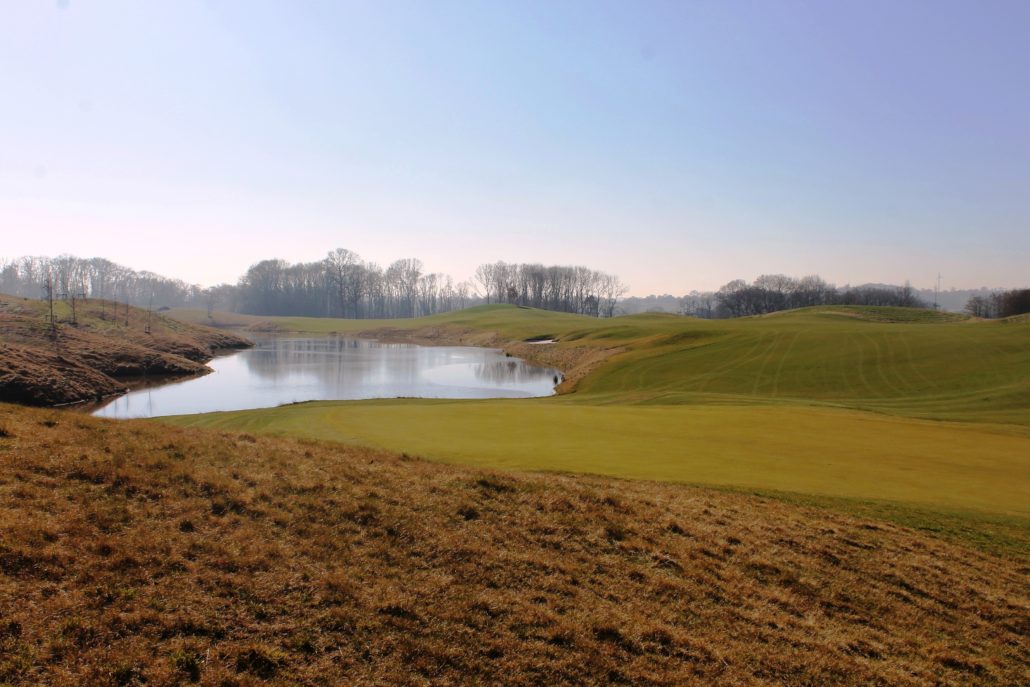
Riptide Plays Key Role At JCB

Sowing at an application rate of between 6-8g/m², the team at the JCB Golf and Country Club used Riptide to seed and grow-in eleven greens in the first year and then nine the following year.

“We were germinating in five days and mowing in ten days,” said Euan. “Because it was our first year and it was a soft opening, we were under no pressure whatsoever to cut the grass down to achieve fast speeds. However, we were still getting 10.5ft without significantly chasing that. It is an incredibly fine grass.”

“We haven’t looked back,” added Callum. “The rooting has been amazing – we are 300mm of rootzone over 100mm gravel and even now, a year on from opening, the roots are way down into the gravel. They are incredibly strong roots.”

Commenting on the use of Riptide at the JCB Golf and Country Club, Emma Kilby, Technical Area Sales Manager for ICL, said: “I’m really proud that Riptide has played a big part in the greens here and the development of our seeds is growing all of the time – you just have to look at the new cultivars we’ve got which have a very high rating within the STRI.

“It has been incredible to be involved from the very start. From coming in here and just seeing clay to where they are now is a fantastic achievement. JCB is a great company to work with, in terms of their history, their ethos and their direction.”

Please contact ICL on 01473 237100 or visit www.icl-sf.co.uk or www.icl-sf.ie if you are in Ireland.

For more news and insightful views, you can follow ICL on Twitter @ICL_Turf

For the latest industry news visit turfmatters.co.uk/news

Get all of the big headlines, pictures, opinions and videos on stories that matter to you.

Follow us on Twitter and Instagram for fun, fresh and engaging content.

You can also find us on Facebook for more of your must-see news, features, videos and pictures from Turf Matters.

Bionema Demo Nematode Application

Bionema Demo Nematode Application: Bionema Ltd, a leading biopesticide technology developer, has released a new case study video for the control of chafer grubs in turf.  The video provides step by step guidelines to greenkeepers, groundsmen and course managers in how to apply the beneficial nematodes (roundworms).

Bionema has seen excellent success in recent nematode field trials conducted on the chafer infestation experienced at the Grove Golf Club, Watford. These eco-friendly and chemical free methods of destroying chafer grubs are shaping the biopesticide industry.

Bionema Demo Nematode Application

We have seen an increase in the success of nematode applications by educating users on correct application techniques” said Dr Minshad Ansari, CEO of Bionema.  Bionema’s pest control products are available through Rigby Taylor, a leading distributor to the turf and amenity sector. “Our goal is to see an improvement in nematode efficacy by educating greenkeepers, groundsmen and race course managers in the correct application of beneficial nematodes”.

The new two-minute video outlines the benefits of training and good application techniques for chafer control in turf, it also explains the importance of product quality, storage and correct handling.

As each female chafer beetle can lay 100-300 eggs in June, this treatment involves beneficial nematodes attacking and destroying the larvae of the chafer grubs therefore preventing them from developing further population.  We recommend combining the nematode application with the BeetlesAttra chafer monitoring traps for optimum results.

Bionema’s NemaTrident® – a range of beneficial nematode products are safe and non-toxic to users and the environment.  It is targeted towards specific pests and thus avoids harming beneficial insects. This safe and environmentally friendly method has a 70-100% kill rates and is on average 20-30% more effective than other nematode products on the market.

Phillip Chiverton, Course Manager at the Grove, said in the video:

“We have seen 80% reduction of chafer grubs in the first year with Bionema’s NemaTrident® solution, with continuous progress in years two and three. The product costs less money than the chemical treatment, it’s more sustainable for the environment and so is a much better way of dealing with this current issue”.

Bionema are one of the few organizations that focus on a chemical-free method of crop protection and bio-control. All products that are developed are natural products, which use fungi, bacteria and nematodes to help reduce the use of chemical pesticides as well as offering an effective treatment for regulating chafer grub as well as other common pests.

The current problem is so serious, that an emergency summit is to be held with the aim of finding industry-led solutions to the threat of Chafer Grubs and Leatherjackets in the turf industry https://bionema.com/emergency-chafers-and-leatherjackets-summit/. The Summit will take place on 9th May 2019 at Burton Albion Football, Staffordshire. Attendance at this industry summit is vital to those in the industry that want to develop a long-term preventative strategy for Chafers and Leatherjackets. There are a limited number of free places available, which can be reserved by emailing info@bionema.com.

To watch the video and learn more about nematode application visit www.bionema.com

For the latest industry news visit turfmatters.co.uk/news

Get all of the big headlines, pictures, opinions and videos on stories that matter to you.

Follow us on Twitter and Instagram for fun, fresh and engaging content.

You can also find us on Facebook for more of your must-see news, features, videos and pictures from Turf Matters.

How Golf Course Can Save Bees

How Golf Course Can Save Bees: The putting greens are perfectly smooth, every blade of grass is polished and preened to perfection. No stray clumps of moss or random dandelion leaf to cause even the slightest bump.

Bunkers of fine sand dazzle under the Georgia sun. The crystal-clear water sparkles. Even Augusta National Golf Club’s fairways’ rough edges would put most ordinary folks’ gardens to shame.

The clock is ticking down to this year’s US Masters tournament, when the lovingly manicured Augusta course almost overshadows the golf and televised HD action leaves armchair players dreaming of putting on the smoothest of greens at one of the world’s most beautiful courses.

It is also when greenkeepers at Scotland’s 550-plus golf courses brace themselves for the annual Augusta fallout from golfers demanding to know why their course isn’t as perfectly polished.

“It’s the ‘Augusta effect’,” says Jonathan Smith, executive director of the Geo Foundation, which works with courses around the world to help them become more in tune in nature and more sustainable.

“Golfers watch the Masters and think their local golf course should look like that. And that can put pressure on greenkeepers to meet these aspirations and increased demands.”

At Augusta, the green staff often stress how the former indigo plantation’s smooth turf and the perfect blooms of the dogwoods and azaleas are largely thanks to good irrigation, perfect timing and Mother Nature.

However, golf has been in a long battle with environmentalists who argue pesticides, fertilisers, heavy use of water and intensive landscaping means golf courses are no more than overworked “green deserts”.

With water resources under pressure from climate change and rising populations, along with mounting concern over the loss of bees, butterflies and other pollinators and the impact on food production, golf is having to strike the balance between raising its environmental score and meeting players’ ever-rising expectations.

“Golf in Scotland is recognised as one of the most environmental and sustainable in the world,” insists Smith, whose organisation offers a certification scheme and green flags for courses which meet environmental and sustainability targets.

“One challenge is biodiversity and habitat, the use of water, fertilisers and pesticides. Another is achieving zero waste to landfill and avoiding or recycling waste.”

At St Andrews’ famous links courses, wildflowers nod in the breeze in fairway buffer zones to help attract pollinating insects, and bee hives have been introduced. Bird boxes and bird feeders are dotted around, and there are sheep grazing on the fringes of the Castle Course.

Last summer, a “bug hotel” for beetles, centipedes and spiders popped up near the seventh hole of the Old Course and at the Jubilee greenkeeping sheds. Golfers who had paid handsomely to play the Old Course even had to avoid the famous Hell Bunker when at least 20 sand martins moved in after struggling to find nesting space in the weed-clogged West Sands dunes.

A telegraph pole at the Castle Course became a nest for a pair of kestrels who obliged by producing a chick, and greenkeepers have worked with RSPB Scotland to encourage corn buntings by laying grain for them to eat and planting wildflowers for food and shelter.

Running alongside is a determined effort to minimise the use of pesticides, ease back on fertiliser and rethink water, energy and general waste.

All of which is particularly important in light of a troubling report from the Centre for Ecology and Hydrology in Oxfordshire, which warned climate change, habitat loss and pesticides had led to widespread losses of wild bees and hoverflies, posing a potential future threat to agriculture.

“Everything we do, we try to do it so we minimise any impact,” says Jon Wood, course manager at the Castle Course. “We’re not using as much pesticide or fertiliser, we’re looking at best practices for waste management.”

While St Andrews Links Trust has been working with agriculture company Syngenta to introduce its biodiversity programme Operation Pollinator, which encourages bee and butterfly-friendly measures at golf courses and farms, clubs around the country are taking steps to raise standards.

Royal Dornock Golf Club used spoil from old buildings as base material and recycled wood and timber for a new shed. Designed to absorb the heat of the sun, the building features self-sustainable LED lighting and solar-heated water, while electric vehicles have been introduced to the fleet.

Outside, a new water feature is home to waterlilies, bulrushes, cattail, heron, moorhen, dragonfly, frogs, newts and insects.

At Trump Turnberry’s Ailsa course, old sleepers have been used to rebuild the Ayrshire Coastal Path, while at Dundonald Links in Troon, environmental work has encouraged small blue butterflies to return to the area.

And in East Lothian, Gullane Golf Club’s green waste is collected for compost, and wetland habitats created to increase biodiversity.

At Fairmont St Andrews, head greenkeeper John Mitchell, has undertaken a beekeeping course and overseen the planting of a “bee lawn” the size of a football pitch in front of the hotel to attract more pollinators. “It helps make people more aware of what we’re doing here because it’s very visual,” he says. “Hopefully by the end of this year we will have our own honey.”

Caroline Hedley, Scottish Golf’s environment manager, says the costs of coping with climate change-related issues such as drainage, drought and water charges are on greenkeepers’ minds.

“Greenkeepers are very keen and very attracted to more sustainable courses,” she says. “That’s from Open venues to even small clubs. They are being more sustainable, frugal and efficient.”

Golf management lecturer Ian Butcher teaches the next generation of greenkeepers at Scotland’s Rural College’s Elmwood campus in Fife, where students recently used the college’s 18-hole golf course as a design template for a course of the future designed around ecological, environmental and sustainability issues.

He says: “We need to make sure that students are aware of water management, wildlife and habitat management, as well as aspects that can enhance the location rather than manicure it.

“Golf is in a process of evolution, not least in working with nature rather than against it.

“There’s a trend in golf industry to bring courses back to a more natural state,” he adds. “The millennial generation want golf to be sustainable and environmentally friendly.”

A crucial element, he adds, involves managing the expectations of golfers weaned on television championship courses, and reminding them that a more “hands off” approach means they may share their round with diseased turf, occasional weeds and more wildlife.

“Less or no pesticides means you will get some diseases,” adds Butcher. “There needs to be a threshold of tolerance. It’s natural and it’s not going to affect the game.

“Even Augusta can’t be in tournament condition all the time.”

The US Masters begins on Thursday with the final round a week today. British hopes rest with Rory McIlroy and Justin Rose. Patrick Reed defends.

Click here to read the original article

For the latest industry news visit turfmatters.co.uk/news

Get all of the big headlines, pictures, opinions and videos on stories that matter to you.

Follow us on Twitter and Instagram for fun, fresh and engaging content.

You can also find us on Facebook for more of your must-see news, features, videos and pictures from Turf Matters.

Amenity Forum’s Recent Events

Amenity Forum’s Recent Events: The management of amenity areas is a vital and important task creating safe and healthy public spaces fit for purpose. It is vital that such tasks are undertaken to the highest professional standards but, as it stands, although there are a number of recognised assurance schemes, there is no overall standard which can easily be recognised as demonstrating those undertaking amenity management operations are professionally competent and using methods at the highest standards of best practice.

Given that, the Amenity Forum is developing a standard for the sector. This will inform the public, and those who place tenders or employ operators that the processes implemented are safe and healthy and fit for purpose. The standard will be akin to the Red Tractor logo which is widely recognised in the food sector. It will be instantly recognisable and will verify that the various assurance schemes in the sector are maintained at the overall standard.

Amenity Forum's Recent Events

In the current climate, cost will always be a key factor when considering amenity management plans but it is vital that quality and standards are an essential element in the final decision. The new standard and accompanying logo will give confidence to all involved.

Those attending London and Belfast recently as part of the popular series of free Amenity Forum Updating events organised welcomed the proposals. It was recognised that many do currently look to employ contractors and the like with assured credentials such as Amenity Assured, there remains others who operate outside such standards. The new Amenity Standard seeks to address this and ensure it is as widely recognised in the amenity sector as the Red Tractor is in food.

Professor John Moverley, Chairman of the Forum, said ‘’I would like to see this standard as an essential requirement when employing anyone involved in amenity management. If employing a gas fitter, I seek to ensure he or she is CORGI registered, a similar requirement should be essential in amenity management. There are a number of well recognised assurance schemes in our sector, this new standard seeks to embrace these and in a simple way, provide everyone of an assured standard and best practice. I would like to see the logo associated the standard to be proudly displayed across the UK in our parks, golf courses, sports grounds and indeed all our public spaces’’

The new standard is due to be launched later this year and in the meantime, everyone is urged to seek evidence of a recognised assurance scheme when employing those charged with amenity management in all its forms.

The Amenity Forum is continuing its free Updating Event series and for details please contact Admin@amenityforum.co.uk

For the latest industry news visit turfmatters.co.uk/news

Get all of the big headlines, pictures, opinions and videos on stories that matter to you.

Follow us on Twitter and Instagram for fun, fresh and engaging content.

You can also find us on Facebook for more of your must-see news, features, videos and pictures from Turf Matters.

Killeen Castle Invest In John Deere

Killeen Castle Invest In John Deere: Killeen Castle Golf Club in Co Meath, Ireland is celebrating its 10th anniversary in 2019, as well as its recent investment in a state of the art golf course equipment fleet deal with John Deere and local dealer Dublin Grass Machinery worth in excess €500,000, with finance arranged through Deere’s partner Bank of Ireland.

The machinery acquisition represents a significant investment on the part of Killeen Castle in the future of the Jack Nicklaus Signature Course, as the club enters its second decade of golf operations. The championship golf course opened in 2009 and was described by the 18-time Major winner and course designer as “one of my proudest designs”.

Killeen Castle Invest In John Deere

The upgraded equipment fleet includes tees, fairway, greens and rough mowers, utility tractors, Gator utility vehicles, sprayers, top dressers and bunker rakes – with the latest John Deere E-Cut hybrid electric mowers now playing an important part in future-proofing the work of course superintendent Mark Collins and his team.

Killeen Castle has hosted The 2011 Solheim Cup between Europe and USA in addition to three Ladies Irish Opens from 2010 to 2012. The 630-acre estate also features a number of signature residential properties, The Dave Pelz Scoring Game School, Fore Golf Custom Club Fitters and a Norman castle dating back to 1181.

The castle will become the focal point of the estate following a recent grant of planning permission for a 177-room luxury hotel, including the renovation and restoration of the original structure which will house 17 suites and a number of luxury dining rooms. The new three-storey structure partnering this renovation will incorporate 160 rooms, a day spa, function rooms and a winter garden restaurant.

The investment in new equipment also included an upgrade and enhancement of the club’s rental golf cars and trolleys to the latest state of the art GPS units, as well as re-kerbing of the entire clubhouse compound. This was in addition to significant works around the golf course and peripheral areas to enhance the sanding and drainage profile of the course, all designed to ensure championship standard golfing conditions for members and visitors alike all year round.

“There were many key factors in choosing John Deere equipment,” said Mark Collins. “The relationship with Dublin Grass Machinery and sales manager Noel Bennett was high up the list, with the excellent technical and back-up service provided for the past 12 years.

“The quality of John Deere machinery is quite simply second to none, and the company’s advances in technology with the hybrid electric mowers made the decision an easy one. The overall package will allow us to continue to improve our work practices and deliver even better standards of course presentation to our members and guests.”

For the latest industry news visit turfmatters.co.uk/news

Get all of the big headlines, pictures, opinions and videos on stories that matter to you.

Follow us on Twitter and Instagram for fun, fresh and engaging content.

You can also find us on Facebook for more of your must-see news, features, videos and pictures from Turf Matters.