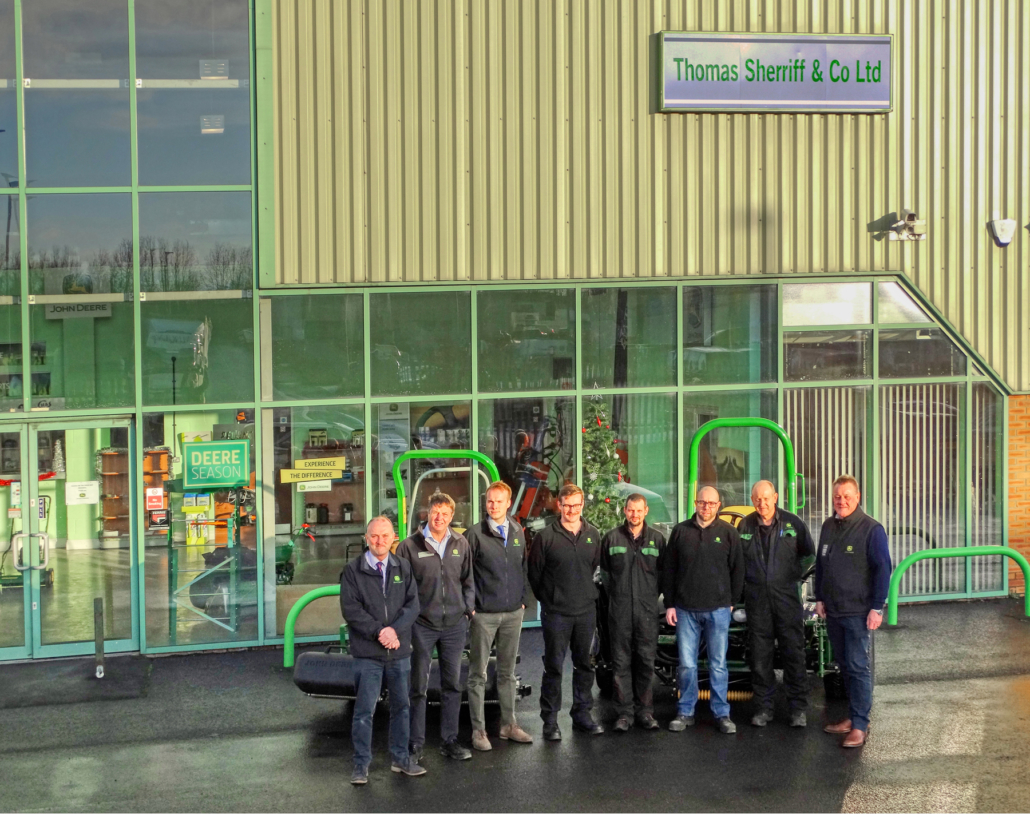
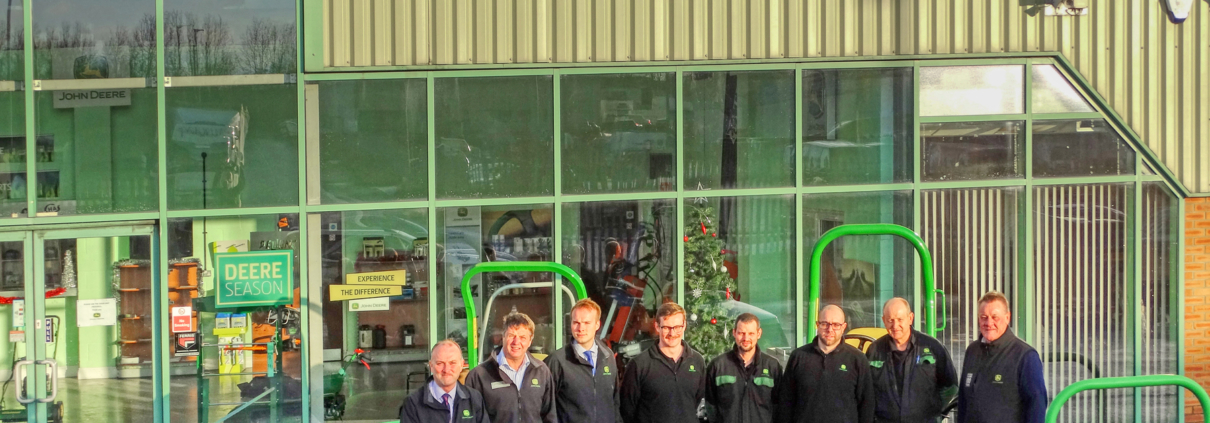
New TDR-15 for Culford School

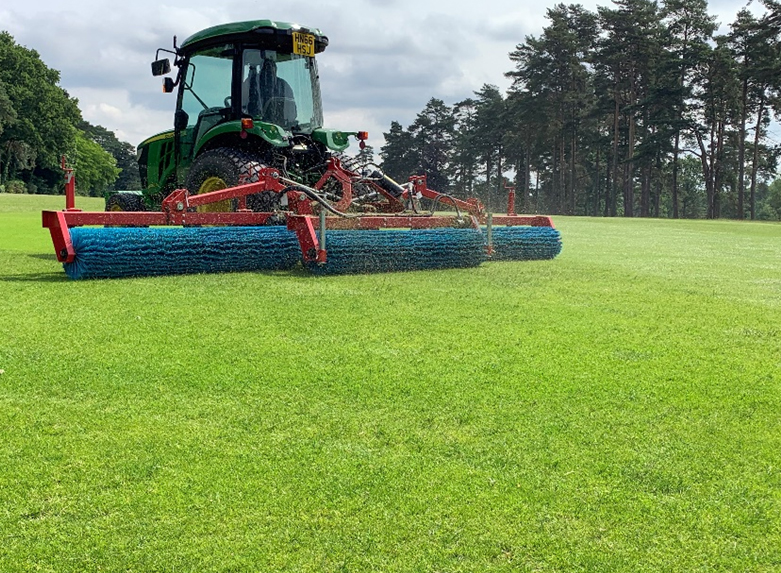
New TDR-15 for Culford School: When Culford School in Suffolk were looking to replace their 10 year old Progressive TDR-15 they had demonstrations of various other roller mowers, but found none of them quite made the cut! Instead they opted for the new and improved TDR-15 model. Set in a 500 acre estate they use the TDR -15 to mow about 100 acres of amenity parkland, playing fields and footpaths per week in the height of the growing season.

Size, versatility and manoeuvrability were amongst some of the main reasons they wanted another TDR-15.Tom Atkinson Head Groundsman at Culford School says “Peoples initial reaction when they see the mower is surprise at how large it is and think that the only place it can be used is in big wide spaces. Our estate has tree plantations with random trees dotted all around and is situated in a river valley. Despite that the mower with a skilled operator can get into small spaces by reversing into small gaps and using the rear deck. Where some similar machines are configured as three abreast, having one deck to the rear with the TDR-15 is a real advantage. All the decks are hinged so they follow the ground independently of each other and as it’s a roller mower that leaves a fantastic finish.”

New TDR-15 for Culford School

They have also found the roller mower really user friendly, “All lubrication points are easily accessible and despite its size there aren’t many. The new mechanical locks mean you can pick the whole machine up to transit over roads or obstacles without shutting off the whole machine and folding it away and we run the mower behind a John Deere 4066R with an economy PTO. Such a robust machine that costs very little to run.”

If you would like to talk to The Grass Group more about your requirements and why the TDR-15 is right for you, give us a call on 01638 720123 or email sales@thegrassgroup.com

For the latest industry news visit turfmatters.co.uk/news

Get all of the big headlines, pictures, opinions and videos on stories that matter to you.

Follow us on Twitter and Instagram for fun, fresh and engaging content.

You can also find us on Facebook for more of your must-see news, features, videos and pictures from Turf Matters.

Green speed more than a number

Green speed more than a number: At The Open this year the green speeds measured at 10’1”, 10’2”, 10’3” and, with the threat of rain on the horizon, were slowed to 9’11” for the final day, with all 18 greens stimping within just 4 inches of each other. With that in mind, Golf Magic teamed up with BIGGA to learn more about green speeds…

BIGGA remains obsessed with the speed of our greens, with the implication for the golfer being that faster greens are saved for special occasions, such as club championships. As such, if you’re able to achieve those high speeds in everyday life, then yours must be a high-quality course, right?

Green speed more than a number

But how important are green speeds? Do they matter?

One of the most important innovations in golf course preparation since the 1970s was the stimpmeter. A stimpmeter is a simple device consisting of a long, narrow metal tray that enables greenkeepers to consistently replicate the roll of a ball across a green. It was introduced by the agronomy department of the USGA and is commonly quoted as an effective means of measuring speeds – you may have heard commentators at events discussing how fast the greens were “stimping” at.

However, measuring speed isn’t actually the stimpmeter’s true purpose. Tellingly, the device’s instruction manual reads: “the variations in speed, whether from one green to the next or on different parts of the same green, can do more to negate a player’s skill than ragged fairways or unkempt bunkers”.

That’s the leading authority for golf in the United States saying that consistent greens are more important than fairways, bunkers and even ‘fast’ greens. In fact, the pursuit of faster speeds by lower cutting heights often leads to the detriment of the putting surface, reducing consistency and “negating a players’ skill”.

The enjoyment of the average golfer also reduces as green speeds increase as nobody wants to keep three or four putting as their ball skids past the hole. In terms of pace of play, as little as a one-foot increase in speed can slow the pace of play by more than seven minutes per foursome.

If speed isn’t important, and consistency is, then what’s a ‘good’ standard of consistency across a golf course?

Well, like most things, that depends on the resources available to the greenkeeping team.

Dr Micah Woods is chief scientist at the Asian Turfgrass Center and he has undertaken a study to discover what the average differentiation is across golf courses. Taking 961 measurements at clubs in East Asia and America, he brought together a database of stimpmeter readings. He made three measurements on at least three different greens to come up with a ‘standard deviation’ of golf speed across each course.

Dr Woods said: “The ideal would be a standard deviation of zero, but that is only going to happen by accident because green speed will always vary, even slightly. But I wanted to find out what difference in speed was reasonable to expect? I discovered that 0.3 was the average, meaning that half of the data I gathered was below 0.3 and half was above it.”

He came up with a magic number of 0.3 feet or 3.6 inches. This means that if a greenkeeper reports a speed of 9 feet, the average speed on the course will actually be between 8.7 feet and 9.3 feet. And that’s just an average number for all 18 holes, so the actual spread will be wider than that.

And half of the golf courses Dr Woods measured had a standard deviation of more than 3.6 inches, with one measuring up to 1.5 feet. Consistency, it seems, takes incredible skill to achieve.

At the Ryder Cup in 2016 at Hazeltine, the green speeds for the three days of play were 12.4, 12.4 and 13.4. These are extreme tournament conditions at an American golf course prepared for one of the most televised sporting events in the world and as such there are an army of greenkeepers and volunteers working to get the course to incredibly high standards.

And yet as the green speed increased, Dr Woods discovered that the variability of speed across the greens also increased and the putting surfaces became less consistent. On the final day, with a reported speed of 13.4 feet, one green was even recorded as having an actual speed of 15 feet. That’s a difference of more than 19 inches!

So faster greens are also less consistent greens.

It was a trend that is echoed across every golf course, no matter the budget or resource. For consistency to be achieved, it’s Dr Woods’ opinion – and an opinion shared by the turf management industry – that we should stop obsessing with green speeds.

Rather than making a demand of your greenkeeper that you’d like to see greens ‘stimping’ at a certain amount ahead of the club championship, wouldn’t you rather see them concentrate on achieving greater consistency across the course?

“In visiting hundreds of golf courses, I’ve observed that green speeds are always given as a single number and I’m actually not going to advocate that we change that,” explained Dr Woods. “For the members and the guests who are coming to play a facility, it’s useful just to report a single number, that’s all they need to know.

“But I believe that turf managers should secretly keep the additional information to themselves. By making an explicit measurement of variability across their greens, they can identify problems and opportunities to improve that uniformity.”

If we’re to look at golfer enjoyment, what level of consistency can players actually perceive out on the course? A study by American professors Thomas Nikolai, Douglas Karcher and Ron Calhoun in 2001 concluded that the average golfer is unable to detect a six-inch variation in speed from one green to another and therefore that is “probably a fair definition of consistency on a golf course”. Anything less than six inches and your regular amateur golfer won’t be able to perceive the difference.

So which was the most important measurement at The Open? Was it the slower speed on the final day? In truth, the most important figure quoted is the 4” differentiation as it highlights an incredible degree of consistency. Across 18 holes on a links venue in changeable weather conditions, the greenkeeping team was able to achieve a margin of error of just four inches.

The greenkeepers at your course almost certainly won’t be able to achieve that level of consistency, and it’s unreasonable to even ask them to strive towards such levels. But the important thing to know is that they’ll have more chance of achieving consistency – and you’ll enjoy your round more – if unrealistic demands for ‘faster greens’ aren’t made.

Click here to read the original article

For the latest industry news visit turfmatters.co.uk/news

Get all of the big headlines, pictures, opinions and videos on stories that matter to you.

Follow us on Twitter and Instagram for fun, fresh and engaging content.

You can also find us on Facebook for more of your must-see news, features, videos and pictures from Turf Matters.

ECHO’s resounding success at SALTEX

ECHO’s resounding success at SALTEX: ECHO put on a real show at Saltex with their range of commercial products for groundscare and landscaping professionals.

The stand largely featured the ECHO X Series line of products which redefine standards with low weight and high power. Two new products in the series were introduced, the ECHO CS-2511WES rear handle chainsaw and ECHO’s latest and most powerful backpack blower, the PB-8010.

ECHO’s resounding success at SALTEX

“We had  ECHO’s busiest ever Saltex over the two days this year,” says Matt Wilson, AriensCo UK Sales Manager, “with great interest in the X Series and 50v battery products we displayed. Visitors to the stand were knowledgeable and the sales leads were good quality.”

Power to weight ratio is where the emphasis lies in the ECHO CS-2511WES professional chainsaw, the lightest and most compact rear-handle chainsaw in the ECHO range. Handling it at the show, visitors were surprised at its light weight. At just 2.6kg (dry weight), it’s ideal for use over long periods without fatigue and yet, with its premium-grade ECHO two-stroke engine, it packs a powerful output of 1.1kW.

The ECHO PB-8010 backpack blower is built for professionals and offers industry-leading power and performance. The 79.9cc engine produces an air volume of  1818m3/h, an airspeed of 94.5m/sec (211mph) and a blowing force of 44N and yet it weighs just 11.2kg with its ergonomic, lightweight frame.

Also featured on the stand at Saltex were ECHO’s ground-breaking high torque brushcutters, with a 1:2 gear reduction ratio, delivering up to 50% more torque at the cutting head compared to previous models. ECHO offers a two-year professional warranty on their petrol and 50V battery tools.

AriensCo distributes the ECHO products across the UK through a network of authorised dealerships. To find out more about ECHO power tools go online at www.echo-tools.co.uk or call 01844 278800.

For the latest industry news visit turfmatters.co.uk/news

Get all of the big headlines, pictures, opinions and videos on stories that matter to you.

Follow us on Twitter and Instagram for fun, fresh and engaging content.

You can also find us on Facebook for more of your must-see news, features, videos and pictures from Turf Matters.
GKB to showcase reliable products at BTME

GKB to showcase reliable products at BTME: For the 5th year running, GKB will be attending the BTME 2020 show to showcase their range of machinery. The show will be taking place on 21st – 23rd January at the Harrogate Convention Centre.

Visitors can expect to see the Sandfiller, Sandspreader and Combiseeder on display at the show and will be impressed with the versatility on turf surfaces throughout the season.

GKB to showcase reliable products at BTME

With last year’s show seeing nearly 9,000 visitors from turf managers, golf club owners and industry decision-makers, the BTME 2020 is a great event from networking opportunities to seeing the latest innovation in the turf maintenance industry.

From perfection from the green until the tee and the perfect combination of maintaining and improving drainage systems, to discovering a fast and efficient way to seed or overseed your golf course. GKB Machines will be encompassing everything you need to maintain your golf courses during the year. Like the much loved Sandspreader enabling you to distribute a great variety of materials, GKB is proud to be presenting a range of our impressive, durable maintenance machines at the 2020 show, perfect for your golf course.

Tom Shinkins, Operations Manager, said “BTME is a great opportunity to exhibit our products for the golf sector.”  Tom adds, “The amount of course managers that attend the event for networking and educational needs is growing year on year and it’s vital that we are there at the show.” Visit us on stand Purple 406 to book your demonstrations.

For more on GKB Machines and their impressive range of machinery for natural, hybrid and synthetic turf, visit www.gkbmachines.com or contact us on 01778 348864.

For the latest industry news visit turfmatters.co.uk/news

Get all of the big headlines, pictures, opinions and videos on stories that matter to you.

Follow us on Twitter and Instagram for fun, fresh and engaging content.

You can also find us on Facebook for more of your must-see news, features, videos and pictures from Turf Matters.

Farol use new Foley Company Grinders

Farol use new Foley Company Grinders: Farol Golf and Turf Machinery Limited has purchased a Foley Company Accu-Pro 633 with Accu-Touch 3 Control and an Accu-Pro 661AT bedknife grinder to bolster their essential grinding operation.

Grinding is an integral part of the company’s business and is fundamental to what they offer to the golf and leisure industries. Their current relief grinder, an Accu-Master 650, has proved popular with technicians and was one of the reasons they decided to go with Foley again and continue working with ProSport UK Ltd. www.prosportukltd.com

Farol use new Foley Company Grinders

When it came time to decide on new grinders, after-sales manager for golf and turf, Oliver Longden, consulted with the technicians and appraised the Foley machines against others on the market.

“We had a look around at what else was available, but there was nothing comparable for what we need to do,” Oliver explained. “Our guys are already familiar with the Foley machines, and we’ve had a good history with our Accu-Master. We’ll continue using it alongside the Accu-Pro 633 during the peak grinding season because it still does exactly what we need it to.

“The most significant benefit with the 633 against other manufacturers is being able to relief grind correctly. We can relief grind any units without having to make massive changes to the machine, whereas with other manufacturers you must take a part off or swap something over and it all takes time.  With the Accu-Pro you can switch from 7 to 11 to whatever number of blades, easily and quickly.

“Once it’s set up everything is automated so the guys can get on with stripping down the next unit while it’s working, because you don’t have to keep coming back to it to make adjustments.

“The training function was another big plus for us. We sometimes get new technicians who haven’t used the machine before. It’s a very good feature because it shows them a step by step set-up and how to work it, so anyone can jump on it straight away and get going.”

The Accu-Pro 633 uses Accu-Touch 3 Control to fully automate spin and relief grinding. It features the automatic reel selector and cylinder height stop which automatically locates the reel for a fast and easy spin and relief grind in one quick set-up. Pre-set relief angles are easily identified on the relief angle adjuster, allowing technicians to effortlessly grind the correct angles and achieve proper clearances for each reel type.

The simplicity of operating the Accu-Pro 633 is mirrored in the Accu-Pro 661 AT bedknife grinder and was another important consideration for Oliver.

He said: “The selling point for us is that it’s a very simple and easy machine to use. We needed a machine that all the technicians with varying skill levels could use. Someone who has little experience of grinding can work just as well as someone with 20-years’ experience, and that ensures consistent quality. And again, once it’s set up and going, you can leave it to do the job and get on with other work, and that’s really the beauty of it.”

Farol recognises that when it comes to cutting, it is ultimately the blade’s that do the job. To achieve the best cut possible, they need to be sharp and restored to how they function best, which is by relief grinding them back to the original manufacturer’s own specification.

For the latest industry news visit turfmatters.co.uk/news

Get all of the big headlines, pictures, opinions and videos on stories that matter to you.

Follow us on Twitter and Instagram for fun, fresh and engaging content.

You can also find us on Facebook for more of your must-see news, features, videos and pictures from Turf Matters.