

Lawn Care Legends – Who, What and Why

Lawn Care Legends – Who, What and Why: John Ryan, Founder of Lawn Care Legends, gives Turf Matters an insight to the thinking behind one of the fastest growing groups in the industry.

I’m John Ryan and I am a self-employed lawn care contractor based in Bangor, Northern Ireland and the founder of Lawn Care Legends, who grew from an idea formed back in July, 2017.

Lawn Care Legends - Who, What and Why

Lawn Care Legends – Who, What and Why

My thinking was that the lawn care community has expanded on social media across the world from YouTube to Facebook and Instagram particularly.

However, an unfortunate aspect of social media in this day and age, is that it creates a platform often with little accountability and, depending on an individual’s position, perhaps anonymity. This makes it easy for those who would choose to belittle or criticise anyone wanting to learn more about their trade, craft or industry to do so without any consequences.

This can typically be seen in Facebook groups across a range of industries. Where someone will ask a question, in the hope that someone with experience and knowledge would be willing to share their knowledge to help a peer achieve better results either in their current project or self-development, but be met with mocking and abuse. (Sometimes as banter, but mostly in criticism).

These prevalent negative attitudes see people holding back from asking questions, or not feeling comfortable to share their views perspectives or to ask questions for fear of being ridiculed.

Lawn Care Legends - Who, What and Why

Lawn Care Legends – Who, What and Why

This prompted me to create Lawn Care Legends, the Facebook group.

Our aims are simple. To create a Facebook group where we try to operate on the basis of respect, encouragement and passion for what we do in a professional environment on social media. An international collective.

One aspect of the lawn care community online is the difference that can be seen across the globe with varying styles and approaches to our respective trades.

Although each country has its own standards for operation in our industry, I felt Lawn Care Legends could benefit from the various perspectives that people from different countries could add as valuable content. In an industry that has a lot of service providers, it can be difficult to stand out and so with the ability to access information shared by people from other countries as well as our own we can gain inspiration and drive for our businesses.

So, Lawn Care Legends allowed the development of a new addition to the community we are all a part of in one way or another. We enjoy members contributions mainly from the UK, Ireland but we have members who contribute from the USA, Norway, France, Australia, Canada, Serbia and more which makes for a lot of variety.

To run a Facebook group is not an easy task and the people behind the scenes that make this possible are the admin team of LCL. A friendly bunch with a wide variety of skills, qualifications and knowledge in all aspects of the lawn care industry.

From the basics of grass cutting, shrub/tree cutting, to treatments, landscaping, pond installations and maintenance, and also insight from the dealers side of the industry.

The admin team is currently made up of: Alan Adams from (NI); Paul McGill (Scot); Ryan Powala Higgins (Eng); Richard Jones (Eng); Kaz Dunsmore (Scot); Robert Ross (Scot); Tom Duchesne (Eng); Jay Chillingworth (Eng); Danny Clegg (Eng); Ben Morrison (Scot), and Di Dodds (Aus).
Lawn Care Legends - Who, What and Why

Lawn Care Legends – Who, What and Why

There have been many people who have contributed to the success of LCL during their time on the admin team before moving onto other projects or priorities. One key individual who really helped LCL become more connected with manufacturers and reps, is Ashley Bevan, from Weston Garden Machinery. His amazing support really played a huge role in get the industry to support the LCL Awards.

As we encountered more and more people on-line, I think we’ll agree that we still enjoy a good meet up with people in the real world. It is hard to replace the benefits of shaking someone’s hand and getting to know others better without giving your thumbs or fingers an ache from typing.

So, one thing that we have tried to do is organise LCL meet ups where possible. We started doing this in early 2018, with our first meet up at Rochford’s Garden Machinery, in Wincanton, and we have gone on to host meet ups in Scotland, Northern Ireland and the Republic of Ireland, with the intention to organise and host more events in the future.

We hope to organise an LCL business training event in 2021 as well as an LCL demo day, then we will combine those events into one event in 2022 for England, Scotland and Northern Ireland. If it proves successful we will look to more locations, with the aim of helping more people.

The purpose is simple really. Everyone loves a good meet up and it is a great way to network, training and education. It allows people, who otherwise wouldn’t get the chance, to demo machinery and get a feel for different brands and their equipment.

Back in January of 2020 we had organised a factory tour and LCL meet up at the Ariens factory, in Oxford, where we were greeted with amazing hospitality and open arms by another manufacturer that wanted to support our community and the desire to connect people better. We had demos of Ariens zero turns as these are now made at the facility.

We also took part in a zero turn challenge with prizes awarded, while Ariens collaborated with Kawasaki Engines Europe to conduct a workshop class on engine maintenance on xero turns. We even had our own pizza van on the day and topped off with a swag bag with gifts and discount vouchers to buy some products.

It took around five months from the time Lawn Care Legends was created, to start gaining traction and membership started to increase. From that point it has grown to over 5,000 members representing.

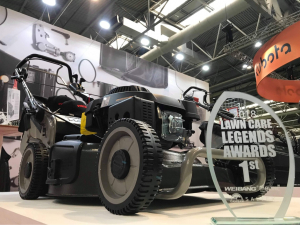
To make the group stand out and to try and bring value to the members, the idea of LCL awards was floated, with the aim of creating our own event within the industry to celebrate the small business owner.

And so the Lawn Care Legends Awards were created. Of course, they would be operated online, in the spirit that this new digital age that has benefited so many in different ways. However, there is still a lot to be said for face-to-face contact and discussions with people.

I then set out to see if it was possible to collaborate with an industry event that would allow us to host our Awards’ presentation.

An obvious choice was to reach out to the IOG, so named at the time, and Saltex. I pitched the idea of a little Awards’ event, that would celebrate the average business owner in our trade. I believe if you don’t ask, you are guaranteed the answer is “No”.

Lawn Care Legends - Who, What and Why

Lawn Care Legends – Who, What and Why

Well, I got an amazing reply that displayed a real desire to work with us.

From originally asking if it was possible to use a little corner of the show, we were being allocated the use of a large private room. Fusion Media also produced a press release about our awards, which got our name out to industry magazines and online media platforms.

In addition, we were featured in the opening letter by the IOG CEO Geoff Webb. So, in 2018, we held our first LCL Saltex Awards. We had an amazing turn out of over 100 members. We had started with a little vision and pitched the idea to just a few companies to gain support on which we could build.

The first company to see the potential of a positive contribution to our community, came from Weibang Ireland. They were so excited about the idea and wanted to be a part of it and offered a lawn mower as the first prize.

Those first Awards began with just three sponsors: The IOG, Weibang Ireland and Blinc NI. By the time we came back a year later we had grown our sponsors to 12: Weibang Ireland and Weibang UK, ECHO, EGO, Hendon Ladders, Kawasaki Engines Europe, Ferris Mowers UK, Wright Mowers UK, Cub Cadet, Jobber, Green Touch Industries and the IOG.

Despite so many things having been disrupted in 2020, we already have over 20 sponsors lined up for the LCL Saltex Awards 2021, with around £10,000 worth of prizes.

We just want to be able to give the average guy in our industry the opportunity to have his picture taken, be praised for his high standard of work, be presented with a trophy and win awesome equipment which will contribute to his business and service for the better.

It is all part of our dream, and with the support and recognition from industry manufacturers, to spur our community on to do better and take pride, we can come together in a positive manner… and that includes everyone from the end user; landscapers; greenkeepers; groundsmen; gardeners; business owners/operators; dealers; distributors and manufacturers.

Some might think that we are just a little Facebook group, but we are determined to be so much more, and have already come a long way.

Perhaps we might see you guys around some day, either in our group or at one of our events – something positive for us all to look forward to.


Superb in Singapore

Superb in Singapore: Sentosa Golf Club is widely respected as one of the world’s greatest golf clubs. 

It is also home to two world-class championship golf courses – The Tanjong and The Serapong – with the latter recently being voted ‘Singapore’s Best Golf Course’ for the second year in a row at the World Golf Awards.

Superb in Singapore

Superb in Singapore

The Serapong re-opened in December after an extensive renovations project, led by the club’s General Manager & Director of Agronomy, Andrew Johnston, to maintain and rejuvenate the world-class standards the course has set in recent years.

The club is also one of the world’s leading environmentally sustainable golf clubs, having implemented a number of initiatives through its two ground-breaking campaigns, #KeepItGreen and GAME ON, and were named the ‘World’s Best Eco-Friendly Golf Facility’ at last year’s World Golf Awards.

We sat down with Andrew Johnston to discuss what makes Sentosa’s environmental vision so unique and how they managed to maintain it throughout The Serapong’s renovations.

Sentosa Golf Club was named the ‘World’s Best Eco-Friendly Golf Facility’ in the latest edition of the World Golf Awards. What does it mean to the club to receive this accolade?

It is an exciting, proud and humbling achievement to be recognised as the ‘World’s Best Eco-Friendly Golf Facility’ by our fellow industry professionals and golf consumers throughout the world.

There is nothing more critical and important than taking care of the world we live in, and the culture we have created and implemented at the club, from our committee all the way down to our guests, is based around our environmental sustainability vision for the future.

Tell us a bit more about the sustainability work that the club has undertaken in the last 12 months?

With everything that has happened in the world over the past year, it definitely would have been the year that we would all look back on and wish we could hit the reset button. However, for the team at Sentosa, it was another ground-breaking year in terms of our sustainability work at the club.

In July, we became a full-time member of GEO Foundation, as well as the first golf club to join the UN Sports for Climate Action Framework, which looks to guide the sports industry on a path to achieving climate goals set out in the Paris Agreement.

We also set out plans for the redevelopment of our herb garden, as well as building and installing electric car charging points through a partnership with Porsche. The development of a floating solar farm is also another initiative that is on our agenda for 2021 and more news will be announced on these initiatives soon.

The Circuit Breaker left us in an awkward position, but we continued to press forward with our plans. The most important thing for the club moving forward now is to establish our carbon footprint number, so that we can work towards becoming carbon zero.

Superb in Singapore

Superb in Singapore

Are there any further sustainability projects that you are looking to implemented in the near future? And what is the ultimate goal in terms of sustainability for SGC?

We hope to convert our energy source from brown to green, as well as develop the carbon free rounds of golf. This involves mapping out each of our golfers at Sentosa and adding one dollar to their games, so that it can be used to purchase local Renewable Energy Certificate.

The club also aims to develop its relationship with GEO Foundation by becoming GEO Certified, a comprehensive modern certification that recognises facilities around the world for their outstanding and ongoing commitment to sustainable golf.

The Serapong was also named ‘Singapore’s Best Golf Course’ for the second year in a row. How do you manage to maintain such high-quality course conditions, while dedicating so much attention to a sustainability agenda?

We are lucky to have such a strong team who are dedicated to achieving excellence day in day out on The Serapong. While it was named ‘Singapore’s Best Golf Course’ for the second year in a row, the course has also previously collected the same accolade at the Asian Golf Awards for 16 years in a row, as well as being named Number One for 18 years out of the past two decades in Golf Digest’s Singapore rankings.

Our sustainability agenda is part of the club culture, so all the staff and team have bought into it ever since we launched our Keep it Green campaign in 2018. In fact, Keep it Green has become a way of life at the club now. As an example, every member of staff is challenged to pick at least 15 weeds a day before they leave the property. It’s measures like these, and others such as our sustainable herb gardens and bee colonies, that help inject energy and fun, as well as a sense of team camaraderie, into our sustainability agenda and day to day life at the club.

Do you have a specific strategy that helps set up the golf courses on a daily basis/for tournaments, such as the SMBC Singapore Open?

Our set up strategy for tournaments, such as the SMBC Singapore Open, takes us nearly four months to follow and prepare the course. This involves a detailed fertility plan that is custom built each year in order for the course to reach peak conditions for event week.

What equipment/processes do you operate to maintain the golf courses and how do these fall in-line with your sustainability agenda?

We have recently acquired six new GPS spray rigs that are extremely high-tech, but also really help us to make a big impact in regard to our sustainability agenda. The rigs are so intelligent they will automatically turn off the nozzles if they cross over any location that has previously been sprayed.

How many staff do you have working in your agronomy/golf course maintenance team? And what does a normal day look like for them out on the golf courses?

We currently have 75 people working in our agronomy and course maintenance team. Every day starts the same for our team with a morning briefing before we head out on the courses early to set them up ahead of the days play. However, in reality, we are always making tactical adjustments to our work in order to be as efficient as we possibly can be.

How do changing weather patterns, especially heavy downpours frequently seen in Singapore, affect the maintenance of the courses?

We are very prepared for handling the changing weather patterns that are often seen in the region. The club invested in a drainage infrastructure that can handle the heavy monsoonal weather very well and allows our members and guests to be back playing golf within 30 minutes of any storm event. Additionally, the SubAir investment in our greens has made for an excellent tool to combat the excessive moisture created.

The club recently re-opened The Serapong after closing it for renovations back in March last year. Can you tell us about the specific works that took place?

As part of the renovations, we removed the existing grass surface on the fairways to rejuvenate them with grading adjustments and improved drainage strategies. We also re-lasered the tee boxes to reinstate a tabletop, flat finish and maintain the grass at a super low mowing height of 3mm.

The bunkers were also renovated with the caps and bays being restored, and a serrated edge look has been introduced to really transform The Serapong deeper into a world-class location.

What was the thinking behind renovating The Serapong?

The Serapong is one of the world’s greatest courses and having to maintain and improve it year on year is a tremendous responsibility. The thoughtprocess behind the renovations was to keep driving excellence, be better than we were the previous year and maintain the high-quality standards that are set 365 days of the year for our members and guests, whilst also looking to find new improvements to the course. We try to instil a mantra into the team of ‘nobody cares about the awards you won yesterday’. That drives us to better ourselves each and every day.

Finally, what would you say to other golf clubs who are looking to implement sustainable initiatives on-site but also want to maintain high-quality course conditions?

There is no substitute for maintaining quality. If you want to become a world-class facility, then this is critical to your business plan. However, while always maintaining quality is crucial, the development of on-site sustainability measures is of even more importance now. Golf clubs can no longer sit on the bench and watch.

Everyone must get onboard and begin to participate, otherwise we will soon reach the point of no return in our fight against climate change. In our view, when it comes to climate change, it isn’t game over. It’s very much game on!

Dew diligence

Dew diligence: Water management is an essential element of every turf maintenance programme. We work hard to keep the soil moisture content at the right level to maintain good turf health and to optimise surface playing qualities. We aerate, top dress, install drainage and try to keep soil organic matter content under control to create a soil profile with the required water retention and drainage properties. We also have irrigation systems to supplement soil moisture deficits and we guide their careful use with the help of accurate moisture probes.

Surfactant technologies are also used to help optimise the penetration, spread and retention of water within the soil profile. Moisture management is of huge importance and it is at the heart of all our modern turf maintenance programmes.

Dew diligence

Dew diligence

But it is not only the soil water content that needs managing. Moisture at the turf surface and within the sward canopy also needs to be controlled. Damp autumn/winter conditions can lead to the deposition of a significant amount of moisture at the turf surface in the form of dew. This condensation of atmospheric water can adversely affect playing qualities, it can reduce the effectiveness of maintenance operations and it can encourage the rapid development of fungal disease activity.

These are the reasons that we commonly employ switching, brushing, blowing and surfactant-based dew dispersants to remove the moisture from the surface and alleviate the potentially significant negative impacts.

We know the main problem with the physical methods of dew dispersal (switching, brushing, blowing etc.) is that they can be temporary and the dew can continue to form afterwards. This is where the surfactant-based dew dispersants come into their own, because during the time of their activity they continue to work 24 hours a day.

A close look at turf successfully treated with a surfactant-based dew dispersant will reveal an amazing reduction in moisture being held within the leaf canopy. The significant reduction in canopy moisture provided by H2Pro DewSmart has been repeatedly shown in independent trials to slow down the rate of development of Microdochium patch disease and can credibly be included as an important element within autumn ITM disease control programmes.

The problem with surfactant-based dew dispersants, however, is getting them to work consistently for more than a couple of weeks. This is because to work effectively, we generally need to stick them to a dry leaf and a truly dry leaf can be a rare commodity during the autumn and winter period. Of course, any late autumn growth and subsequent mowing will also remove the surfactant from the treated leaf blade, shortening the longevity of dew dispersion.

You will find that some “penetrant” surfactant based formulations will also suppress dew for a short period, but again reasonable longevity is the problem. In our trials we have found that the most effective results in terms of effectively contributing to an autumn disease reduction programme is to alternate between treatments of H2Pro DewSmart and H2Pro FlowSmart penetrant surfactant every fortnight during late autumn and early winter because it brings together the benefits of taking both approaches.

Moisture management is always an important part of turf maintenance and leaf moisture management during the autumn and winter is no different. There are several approaches that you can take, ranging from switching the surface through to spraying a dew dispersant surfactant and because all of them have their limitations then you should probably be employing them all to some degree at different times. We know that dew dispersants can be really effective and can play an important part in a progressive ITM programme but they need to be applied correctly. Rest assured that a new generation of dew dispersants could soon become available where the surface conditions are not so critical to achieving successful results. In the meantime, a diligent approach is needed with different techniques being employed when conditions allow to help maintain turf health and playing qualities throughout this most difficult time of the year.

Further accolade for Turf Matters in top awards

Further accolade for Turf Matters in top awards: Turf Matters proved that last year’s triumph in the International Turf and Ornamental Communicators Awards was no fluke by winning big again in the delayed 2020 Awards.

Turf Matters Designer, Tim Moat, won two categories for Best Cover (May-June 2019) and Best Single Page Design, while Editor, Scott MacCallum, also took two Firsts – a first equal in the same category of Best Writing, for Stadium of the Future (NovDecember 2019) and What a Rush! (Sept-Oct 2019).

Further accolade for Turf Matters in top awards

Further accolade for Turf Matters in top awards

In addition, for the second year in a row, Scott was awarded the Gardner Award for the Best Overall International Entry for his Stadium of the Future, article which focussed on the new Tottenham Hotspur stadium and the great work Darren Baldwin and his team carry out.

“Tim and I are absolutely delighted. We always strive to bring our readers the best possible magazine and we feel that by winning awards our work is rubber stamped,” said Scott.

“Having independent industry experts assess our work is a useful exercise whether we win Awards or not. That said, it is much more gratifying to win!” he added.

Turf Matters was joined in the winners’ enclosure by Greenkeeper International Editor, Karl Hansell, and Designer Libbie Waddleton, who also picked up several awards.

Turf Matters’ winning entries can be viewed at turfmatters.co.uk – magazine

Embracing new technology

Embracing new technology: One silver lining among the heartache of the pandemic is an acceleration in the adoption of new – and better – ways of working…

Craig Earnshaw, Course Manager at Harleyford GC, in Buckinghamshire, is a man on a mission and has been fast to embrace the modern approach to managing, communicating and training that today’s advancing technology can offer.

Embracing new technology

Embracing new technology

Communicating daily tasks to the team was always a fundamental activity practised by Craig, but he felt that this could not only be improved but made more relevant in the digital age where everyone has a mobile phone and many have tablets.

Craig’s aim was never to replace the daily verbal brief, however, when looking at digital software systems and what they can offer, the digital whiteboard aspect and the power of reporting and communicating remotely was an area of significant interest.

Having looked at various options, Craig decided TurfKeeper offered exactly what he was looking for and saw that the system offered a major leap forward in complementing what he was doing on a verbal, face-to-face or messaging on a whiteboard basis.

On a more personal note, Craig explained that the system has helped his communication as he is dyslexic and no longer had to rely on his deputy to write up his instructions on the white board.

“This harnessing of digital technology benefits me as a manager, my team and therefore ultimately the club.”

To start with, a large screen TV was installed in the clubs new maintenance facility and with the use of the digital whiteboard feature the day’s preplan activity can be done online and displayed. This is then is keyed into the system and displayed on the TV so the whole team can see what has been assigned; any key notes, machinery and stock to be used is also displayed as well as the weather forecast and such important direction of cut details for any area are to mowed.

A key to success of this system has been the staff ‘buy in’ and them seeing the benefits beyond the traditional whiteboard and pen,” said Craig.

“It also offers the ability to view the tasks out on the course via the phone and this has not just increased efficiency and productivity, but has been a real game changer during the Covid-19 crisis,” he added.

“Using the TurfKeeper system, we have been able to plan and communicate from a far. The team can log onto the system and know what task or activity is required even before they arrive at work, in some cases even before they leave home!”

Avoiding close contact during this pandemic is a must and by utilising modern technology such as this, the team has been able to work around it.

“If I am out on the course and forget to add anything or maybe a new task has cropped up, the web-based TurfKeeper technology allows the inputting of a task via the phone and have it appear on everyone else’s, including also the jobs board.”

Embracing new technology

Embracing new technology

The TurfKeeper ethos is directed towards the modern, digital, web-based way of planning, recording and communicating. There is nothing wrong with a paper diary and handwriting, but when you need quick fire information to fan out the flames, the digital approach delivers with speed and ease.

Take for example the preCovid-19 situation. Seven staff members working 40 hours per week at a total of 280 hours.

In a usual year, bunkers need daily raking, greens rolled 2-3 times per week, empting bins, ball washer and moving tee blocks prior to cutting and all that jazz,” said Craig.

“And oh yes… of course… working around the golf! When all the aforementioned is factored in, this takes a huge amount of time, and hence the good reason why we need all the staff.

“Now cue Furlough… no need to cut daily, certainly minimal to zero rolling or bunker raking. No course furniture to move or service in the way of bins and ball washers, and oh yes… no golfers. Never have courses been easier to maintain in terms of bare minimum and cutting. No golf to work around, so less waiting time and the result… cutting the time in half it usually takes to mow most of the areas.

Cue now to the inquisitions… do we need that many staff members? Course looks good to me and there is only three of you. what did you do with all those labour hours before?

“These are not unreasonable question to be fair. We are lucky in the fact that staff numbers have not been brought into question. I did get asked how come we can get everything cut with only three staff but it was a light hearted comment. Nonetheless, that is where the advent of modern technology plays it part. Unlike a traditional paper diary, I can just enter a date range, click a button and the data instantly; all the labour hours, costs, effort, stock used etc. Looking through the reports, I can balance off last year v this year and communicate to the board exactly where all of the hours go, as the reports detail every last task. It’s very clear to see how long bunkers took this year v last year or even identify work that hasn’t needed to be done. It really helps to hammer home the facts,” he explained.

“So, to sum it all up, it’s quite simple for me. I rely heavily on irrigation software system, digital moisture meters and various other technological tools to monitor surface performance, so why not also other aspect of the job?

“TurfKeeper allows me to extend the technological side of management and communication but in addition, the planning, budgeting, stock control, machinery maintenance and reporting. Such a system is a valuable asset and working example of the technology we should all be embracing in the modern age in which we now operate.”

The greenkeeping team at Harleyford Golf Club in Buckinghamshire won the 2019 BIGGA Championship Greenkeeping Performance of the Year award for its work in preparing the course for The Matchroom Sport Championship.

TurfKeeper is a web-based management system that provides turf industry professionals a fully integrated operations and management solution. Designed by turf industry professionals, the system, in a completely personalised, single environment, provides complete control over and insight into staff management, task planning, machinery management, inventory control, chemical applications planning and recording, and budgeting and expense management.

With detailed reporting on all areas readily available, and a resource library provision, the system becomes the home of all turf management planning, actions, and facility history.