Tag Archive for: About

UK grass about to get greener

UK grass about to get greener: Each year gardeners up and down the UK throw tonnes of powerful herbicides onto their lawns to try and kill weeds. But David Hedges-Gower, Lawn Association Chairman, explains why this is often a waste of time and money – and dangerous!

“Let’s be clear; a herbicide – that ‘harmless’ addition to many commercial or retail lawn fertilisers for apparently killing weeds – is a powerful and toxic chemical. Despite this, thanks to a shameful lack of regulation in lawn care and incredibly poor advice, our gardeners have for decades been encouraged to buy and spread these ‘convenience’ products. They are promised the benefits but are not told of the environmental impacts.

UK grass about to get greener

UK grass about to get greener

“However, grass isn’t just the most widespread and diverse plant group on the planet – it’s also one of the greenest, being perfectly able to adapt to the most extreme of conditions all by itself.

“So our lawns should be one of the most natural parts of the garden – all that’s needed is to maintain healthy grass the way nature intended. A good native sward, nurtured through basic modern lawn care, simply won’t leave enough room for a serious lawn weed problem.

And using herbicides is not just wasteful – it’s risky too, as David explains:

“In other sectors, all kinds of potentially dangerous chemicals have been removed from general sale. Here at the LA (Lawn Association) we believe it is time to ban the sale of lawn herbicides to the general public. Asking gardeners to use these chemicals responsibly is like asking all motorists to be able to service their own cars safely. Herbicides should be a last resort – and only used by those with professional training and regulation(for the moment)

So, what’s changing?

Until now there simply hasn’t been adequate training – for gardeners or for lawn professionals. Even with proper City and Guilds certification many professionals remain confused about vital precision spraying. Fortunately training lies at the heart of the Lawn Association, which is helping to reduce unnecessary and reckless herbicide use on two fronts

First, through its online lawn care course, gardeners can learn how to create and maintain healthy lawns without resorting to dangerous chemicals. And second, the Association’s new Level 2 Training (coming soon) will help ensure lawn professionals can use herbicides efficiently, when necessary, with confidence, knowledge and skill.

For more information or images please contact Francijn Suermondt at rabbitattackpr@gmail.com or on 07895184395.

Our core mission at the Lawn Association is to make accurate lawn care information readily available via our website and through our Free Membership Scheme for gardening enthusiasts. Go to the @LawnAssociation Facebook page to join the Lawn Enthusiasts Group, and get free association membership via the website, www.lawnassociation.org.uk

For the latest industry news visit turfmatters.co.uk/news

Get all of the big headlines, pictures, opinions and videos on stories that matter to you.

Follow us on Twitter and Instagram for fun, fresh and engaging content.

You can also find us on Facebook for more of your must-see news, features, videos and pictures from Turf Matters.

What is it about Durham?

What is it about Durham?:Scott MacCallum talks cricket with Durham School’s Head of Grounds Barry Boustead, learns how a merger with the city’s Chorister School has brought together 600 years of heritage, and muses about THAT song…

One of renowned singer song-writer (and whistler) Roger Whittaker’s most famous pieces of work was Durham Town, in which he sang “I’m going to leave old Durham town.” It’s a lovely song, but having been to Durham recently, I can’t see any reason why anyone would wish to leave.

What is it about Durham?

What is it about Durham?

There can be few more beautiful places in the country in which to earn a crust than Durham – named a UNESCO World Heritage Site in 1986. The sheer beauty of the famous cathedral, which sits majestically above the historic buildings, give it a mystic which would be hard to replicate anywhere. Oh, and it’s a City despite what Roger says. Probably “city” didn’t scan as well as “town”!

One man who has no intention of leaving Durham any time soon is Barry Boustead, Head of Grounds at Durham School, for whom gazing over his view after a full day’s graft is very much balm for the soul.

“My place of work really is quite spectacular. There are not many better settings than this,” said Barry.

“Like many jobs you can occasionally get a bit fed up, but then I just look out over our main rugby pitch to the cathedral and everything seems a little bit better.”

But the fact that Barry has been at the school for 13 years suggests that those days when a “fix” of the view is very much required are few and far between.

“It is a good place to work. I wouldn’t have stayed so long otherwise,” he said, before admitting that his original Plan A had been to remain for around four years and then emigrate to New Zealand!

The job Barry started out with has changed since he began as Head of Grounds, however. He has added the Gardens portfolio too, while a merger with The Chorister School in the city, just last September, bringing together a shared heritage of over 600 years, has increased the number of children using his beautifully prepared pitches and grounds, while adding to the complexity of his role.

“We have inherited two playing fields, one of which has three junior rugby pitches, while I don’t know what the plans are for the other as yet. Personally, I’d like to be a training area to keep them off my rugby pitch, but it will bedown to the sports department at the end of the day,” he laughed.

As part of the merger Barry has acquired one new part-time member of staff, Jon Bland, who had been working at The Chorister School, but with Barry himself and two other staff, Damian Merrigan and Darren Keeler, they are certainly kept extremely busy.

“Even visiting the new fields can be a challenge as they are on a busy road and at peak times, or as was recently the case, when a bridge was closed and traffic diverted, it can take 10 to 15 minutes just to make the right turn before we can get back. That sort of time can add up and over a week can be quite significant.”

What is it about Durham?

What is it about Durham?

And time is one thing the team can’t really afford to lose. Particularly over the autumn period when, on a site with so many mature trees, clearing leaves is the Durham School equivalent of painting the Forth Rail Bridge.

“It’s a daily job from October through to January and we clear every leaf off the site pretty much.

We collect them and put them in a pile behind our shed which just builds up and then rots down.”

How many man hours a week are devoted to the task?

“This week for example two of us have been on the job and all we have done is leaves so it’s anywhere upwards of 50 hours a week. Other jobs do take priority but so much time is devoted to leaf clearance. I always have a target of getting every leaf cleared by Christmas, but I’ve not done it yet!”

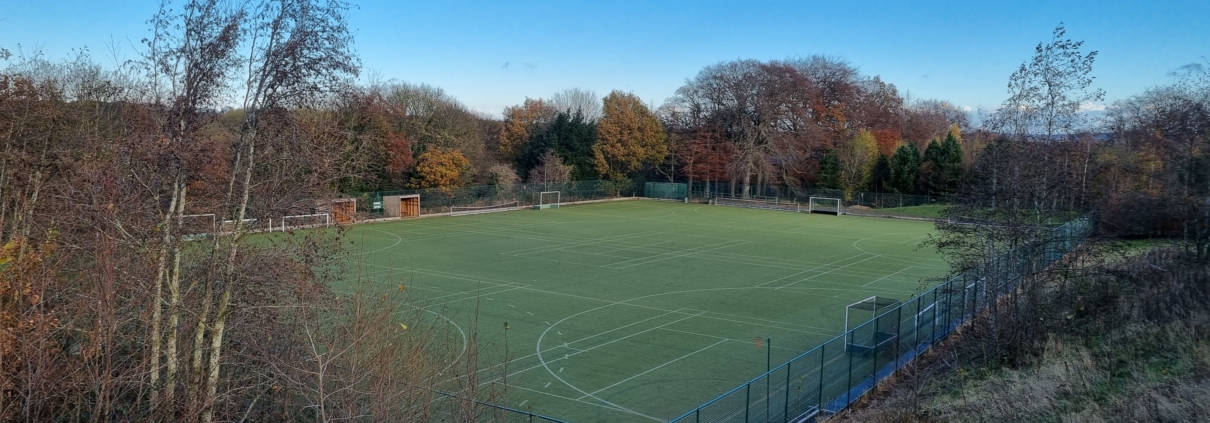
The other on-going issue, also tree related, is the school’s artificial hockey pitch, which sits in a lovely, secluded site surrounded by trees.

“Being surround by trees means that silt – dust or sap – has collected within the profile. Then when we get a heavy downpour the silt rises to the top and it gets very slippy – not something you would want on an artificial pitch.

“We’ve tried different brushing machines and it has improved slightly but we are going to see how this winter goes before we see what our next step is. We are using a SISIS Twinplay with stiff brushes and it seems to do a good job. Ideally, we’d like to do it twice a week but pressure of work means that we can only fit it in once a week. It’s an on-going problem.

“One solution would be to take out the existing sand and replace it but that is costly.”

With leaves taking up a significant part of the year it is grass cutting which occupies the rest and with cricket, in particular, it is an intense fixture list.

“We can have three or four fixtures a week and we have 12 match strips on our main cricket ground and three down on the bottom ground,” explained Barry, adding that the main cricket pitch shares its space with the first team rugby pitch – which boasts sets of posts which reach a remarkable 17 metres – the same height as those found at top grounds such as Twickenham.

To prepare the cricket wickets Barry and the team rely on a single Allett C20 wicket mower, which makes advanced planning an essential part of the job and leans heavily on the reliability of the mower.

“I get the fixtures in at the beginning of the season and then fit in the Cup fixtures as the teams progress through the tournament. I do have a good relationship with the Director of Cricket so he has a good idea of what we are capable of producing.

We can hold three fixtures at once – two on our upper field and one down in the other field.”

On the reliability? Well, that’s not always down to the machine itself.

“I did clip a stud and bent the bottom blade on our Allett,” confessed Barry.

“Fortunately, we do have a good relationship with the University. I started my career there and was at school with the Head Man, Paul Derek’s, kids, and we do help each other out. They helped me with a wicket mower after the bent bottom blade incident, and last summer they had a problem with their tractor, which they use to cut their big fields with gang mowers, so they were able to use our Kioti.”

That kind of mutual back scratching can help solve immediate problems, but also ease the budgetary strain on hire fees which can, with the now longer lead times on spare parts, mount up quickly.

If pushed, Barry would say that his first love is cricket and his aim is always to produce the best surface possible.

“I’m a big believer that a good cricketer will be able to react to any situation and while I do talk with the Director of Cricket I’m never under pressure to produce a wicket to suit our own team. What they see is what they get,” said Barry, who while he didn’t ever play the game, has a real passion for preparing cricket wickets.

So much so, in fact, that he spent a week with Vic Demain and his team at Chester-le-Street working at a Durham county match.

What is it about Durham?

What is it about Durham?

“The week I had was really good. I learned so much, mainly from seeing how the team all operate and come together to work towards the same goal. Vic and I are still in touch and he helps run the Durham Groundsman Association. He is a great communicator and having come from grass roots level has a real affinity with guys in our position – those working with one wicket mower!”

Barry’s arrival in the industry came about very much by chance. He’d begun a degree course in business management at Sunderland which involved a placement working for a year at a local council.

“It was working in the marketing department, but I soon learned that being stuck behind a computer just wasn’t for me. I left and found a position on a summer contract working on the grounds’ team at Durham University.

“When a full time contract came up I got the job and loved it.

They put me through my NVQs at Haughall College, which was just across the road. I did my NVQ 2 in sports turf and my NVQ 3 in sports turf management. I knew at that stage that it was the career for me,” said Barry, whose previous experience had amounted to cutting his dad’s lawn on a weekly basis!

After four and a half years the Durham School position came up and Barry got the job.

As he looks out at the fabulous view of the Cathedral, he has never had any doubts that he chose the right career and is very happy at Durham. Roger Whittaker on the other hand…

EQUIPMENT INVENTORY

JCB 354 tractor
JCB Workmax
Major tractor mounted
roller mower
Toro 6500d
Kioti WD 1260 ride
on mower
3 x STIHL battery
pack blowers
STIHLl BR 600 petrol blower
Billy Goat blower
2 x STIHL strimmers
2x Honda rotary mowers
Ferris FW25 mower
SISIS Twin play
SISIS Rotorake
Allett c20
Dennis 36inch cylinder mower
And my most important and favourite tool in the shed, says Barry, the SISIS Combi Rake.


Ravens rave about the Dennis G860

Ravens rave about the Dennis G860: Sean Kauffman, Head Groundskeeper for National Football League (NFL) side Baltimore Ravens has revealed how two Dennis G860 cylinder mowers have significantly helped the grounds crew to improve the standards of the pitch at the M&T Bank Stadium.

M&T Bank Stadium is a multi-purpose football stadium located in Baltimore, Maryland. It is the home of the Baltimore Ravens of the NFL, and Sean has been working for the organisation for seventeen years.

Ravens rave about the Dennis G860

Ravens rave about the Dennis G860

After originally starting as a First Assistant, Sean finds himself in the top position overseeing a busy schedule.

“In the average season we generally have twelve NFL games and training sessions,” he said. “On top of that we put on concerts, events, soccer games, NCAA college football, lacrosse and monster truck shows.”

It is safe to say that Sean and his two members of staff have their work cut out and so therefore he admits to always being on the lookout for equipment that can make his maintenance programme easier and better.

“We were previously using a ride-on mower on the stadium pitch, but I felt this was certainly one area where we could upgrade.

“I first saw Dennis Mowers at the Golf Industry Show (GIS), and we got a good look at the machines. We felt the G860 cylinder mowers would be a better option than what we had and knew that it would certainly help to keep some weight off the pitch.

“A demonstration was arranged, and we really liked what we saw. I also spoke to some people who had worked with the G860’s and they encouraged the purchase. We ended up purchasing two.”

Sports turf managers have relied on the G860 to provide the perfect cut; and the popularity of the machines in the States is growing all the time. Lightweight at just 166kg; it is easy to manoeuvre and comfortable to operate. The handlebar console houses the controls for – throttle, parking brake, roller drive and cutting cylinder drive.

The mower features a large diameter front roller with an adjustable scraper which has been designed for a precise height of cut control, giving an excellent finish on every occasion. The Dennis G860 also features an interchangeable cassette system to assist with a wide range of tasks such as including cutting, de-thatching, verticutting, brushing, spiking, and slitting.

Sean revealed that the spring tine cassette and the 8 bladed cutting cassette are the two that he most relies on.

“As one game ends, preparation for the next one begins immediately and this is where the G860 comes in,” he said. “Following games, both of the Dennis mowers will give the pitch a sweep to clean the debris off and then we will repeat the process a couple of days later.

Then we’ll use the 8 bladed cutting cassette to mow the pitch to prepare for matchday. We absolutely love the quality of cut and the presentation it offers. I also like how easy they are to manoeuvre; and it is very easy to switch the cassettes around.

“Our pitch has been better since using them,” continued Sean. “Everything has been great; the machines have been running brilliantly and hopefully that continues for a long time.”

For further information or a no obligation demonstration, please contact Dennis 01332 824 777 or visit www.dennisuk.com

For more news, reviews and insightful views, you can follow Dennis on Twitter @DennisMowers and like the company’s Facebook page – www.facebook.com/DennisMowersUK You can also view the latest Dennis videos by visiting www.youtube.com/DennisMowers

For the latest industry news visit turfmatters.co.uk/news

Get all of the big headlines, pictures, opinions and videos on stories that matter to you.

Follow us on Twitter and Instagram for fun, fresh and engaging content.

You can also find us on Facebook for more of your must-see news, features, videos and pictures from Turf Matters.

About COMPO EXPERT

About COMPO EXPERT: COMPO EXPERT, is a multi-national Fertiliser manufacturer with 700 employees world wide. We manufacture all of our products from raw materials and we are the market leaders in speciality fertiliser manufacture in Europe.

We have unique industry leading products like our surfactants; Kick & Kick LDS. Our SRF Floranid Twin range is unrivalled and utilizes the three forms of synthetic Nitrogen, providing an activity index of 95%. We also have our leading DMPP biological coating technology that stabilizes Nitrogen to an industry leading release pattern of eight weeks. Our. renowned Turf Research and Development facility is based in Wolbeck, near Munster and the state of the art factory is located in Krefeld near Dusseldorf, making COMPO EXPERT the leader in Turf throughout Europe.

About COMPO EXPERT

About COMPO EXPERT

This factory is the only one of its kind to be to be able to manufacture the three synthetic forms of Nitrogen; Methylene Urea. Isodur and Crotodur. Chemistry is at the heart of COMPO EXPERT manufacturing and we are proud that we sell the finest ‘Conservation Fertilisers’ in the Turf market.

All our products have a high activity index, low salt concentration, low volatisation and leaching, with good agronomic safety. The full product range includes innovative slow-release, special minerals, coated, nutrient salts, liquids, trace elements and soil treatments.

If your SRF Fertiliser does not have an Activity Index of 95%, then be responsible and talk to COMPO EXPERT. Our 25Kg bags contain 25Kg of chemistry: no fillers, padders, inert material or bulking products. Use the best, reduce application rates and talk to COMPO EXPERT at SALTEX on stand G100.

For the latest industry news visit turfmatters.co.uk/news

Get all of the big headlines, pictures, opinions and videos on stories that matter to you.

Follow us on Twitter and Instagram for fun, fresh and engaging content.

You can also find us on Facebook for more of your must-see news, features, videos and pictures from Turf Matters.

All you need to know about nematodes

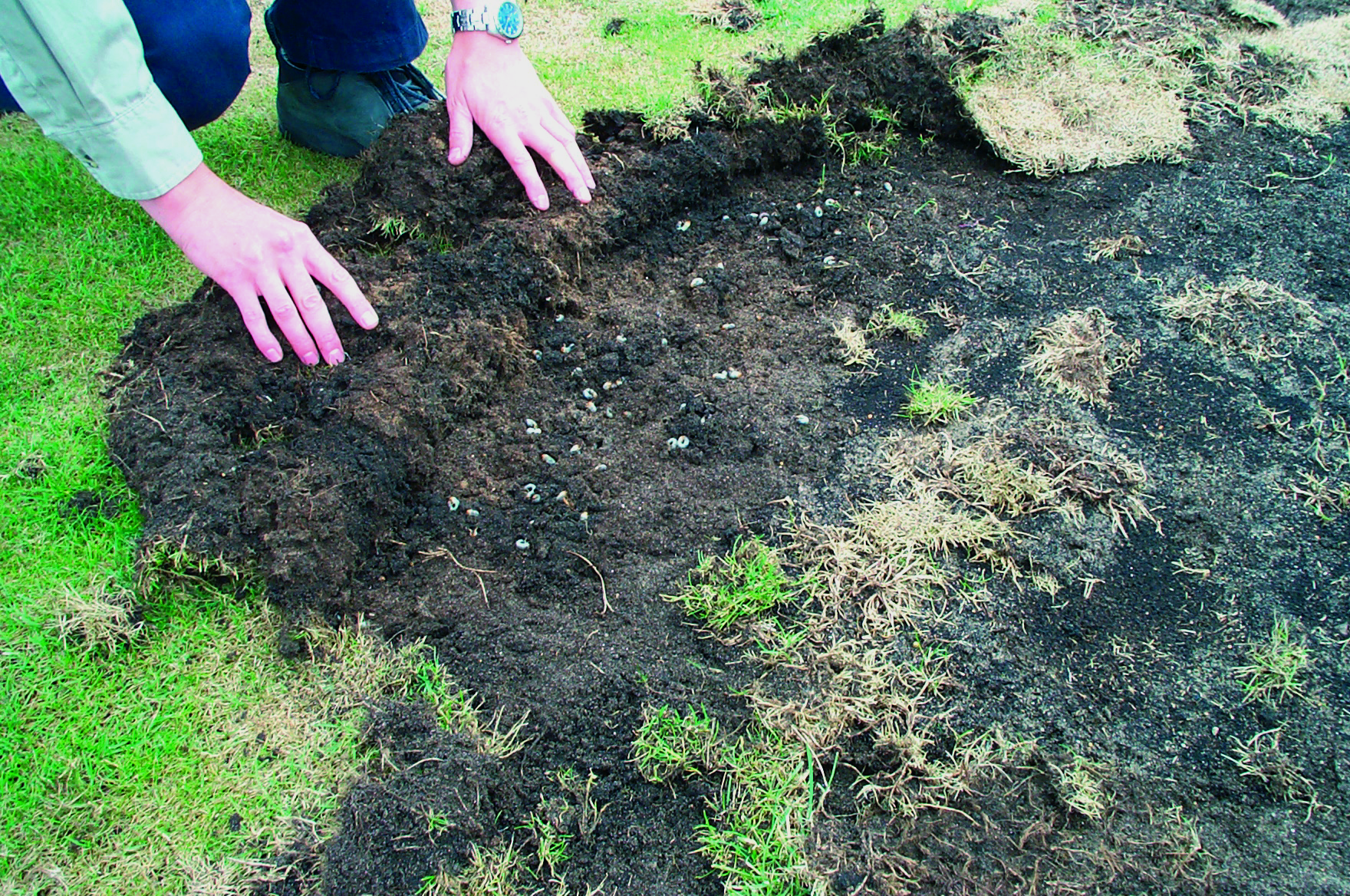
All you need to know about nematodes: Spring is an important time of year for turf management. As the weather warms and preparations are made for the busy summer season, everything must be one to ensure that the turf is healthy – protecting the grass from soil-dwelling pests such as chafer grubs. Helpfully, nematodes can be used to control these unwelcome golf course visitors, which feed on the grass plants’ roots. 

Dr Colin Mumford, Technical Support Manager at Bayer Environmental Science, answers greenkeepers’ questions on how nematode-based products work.

All you need to know about nematodes

All you need to know about nematodes

DON’T NEMATODES KILL GRASS?

It depends. There are two types of nematodes – the ‘bad guys’ and the ‘good guys’. The ‘bad guys’ are plant parasitic nematodes that feed on plant tissue, stress the turf and often make it visually unappealing.

The ‘good guys’ are the entomopathogenic nematodes (EPN) and these don’t harm humans, plants or vertebrates. They are, however, able to target and control turf pests such as chafer grubs and leatherjackets. In this article, I’ll refer to EPN (the ‘good guys’) simply as ‘nematodes’.

HOW DO NEMATODES CONTROL TURF PESTS?

When you apply the nematodes to turf, they travel down to the roots, where the chafer grubs and leatherjackets reside. These pests become the nematodes’ hosts and, once they’ve found them, each nematode enters its host through its natural openings. Once inside, they regurgitate a type of bacteria that paralyses the host and, ultimately, leads to its death.

The nematodes then produce offspring that feed on the inside of that host. Once they’ve exhausted all of the resources available to them, they exit the body. These new nematodes will then go off to seek a host for themselves to complete their lifecycle.

DO ALL EPN NEMATODES WORK IN THE SAME WAY?

This is one of those ‘yes’ and ‘no’ answers. ‘Yes’ once they are inside the host species, they all produce the bacteria, complete their lifecycle and control the pest. But ‘no’ in so far as different species use different strategies to target their host.

For example, Bayer’s Harmonix Tri-Nema product contains three different species. ‘The Hunter’ Heterorhabditis bacteriophora, is a ‘seek and destroy cruiser’ nematode that actively seeks out or hunts its prey before attaching itself to it. Meanwhile, Steinernema carpocapsae is known as ‘The Resident’ because it uses an ambushing strategy that sees it sitting and waiting for a host to come along before jumping onto it to complete its lifecycle. Furthermore, ‘The Explorer’, Steinernema feltiae, has an intermediate foraging strategy between the ‘ambusher’ and ‘cruiser’. It will actively seek out the host but, rather than attacking, it will wait for the host to come past and then it will ambush it.

Ideally, you want to use as many different species as possible so that you’re utilising those different modes of action and maximising the effectiveness of your nematode strategy to control chafer grubs.

HOW DO I STORE THEM?

Ideally, you should use the nematodes as soon as possible after receiving them. But if you can’t get to the golf course because the conditions aren’t right, then you’ll need to store them appropriately.

Don’t open the box in broad daylight/direct sunlight because this is extremely damaging to the nematodes and can kill them. What’s more, don’t expose the nematodes to extreme temperatures, so don’t freeze them or expose them to temperatures above 30°C.

The product will typically come in a cardboard box, but you will need to take the packets of nematodes out of that box and store them in the fridge at a temperature of 4-8°C. Otherwise, the cardboard box will act as insultation, meaning the product won’t be stored at the optimum temperature range.

You want to loosely distribute the packets in your fridge and don’t put them together in one big stack. This is because the weight of all the packs can cause crushing injuries on the nematodes in the bottom pack. Just loosely lay them out in your refrigerator and always use the nematodes before the end of the expiry date on the packet.

All you need to know about nematodes

All you need to know about nematodes

WHEN DO I APPLY THEM?

The timing of application should coincide with egg hatch, or soon after egg hatch. Chafer grubs are the larval stage of several adult beetle species, including Phyllopertha horticola. Therefore, you need to monitor the activity of the adult insects from mid-May until late June.

Leatherjackets are another grass root-loving pest that nematodes can target. These are the larvae of the cranefly, most commonly the European crane fly (Tipular paludosa) although the common cranefly (Tipular oleracea) can also be seen in turf.

Contrary to its name, it’s not the most common species but the difference between this and the European cranefly is that several generations can live throughout the year. So, if you spot a cranefly in springtime then it’s most likely the common cranefly.

You should apply nematodes three to four weeks after you observe a decline in the activity of the adult insects. That way, you know that the vast majority of eggs would have hatched by then. And any eggs that haven’t yet hatched will be attacked by future nematode generations.

DO I NEED TO PREPARE THE GROUND BEFORE APPLYING THEM?

Yes. If you’ve got high levels of thatch the nematodes can get held up in there. So, anything you can do to reduce this prior to applications is advisable.

Also, avoid using granular fertilisers for two weeks prior to, and post, the nematode application because granular fertilisers can do untold damage them.

Ideally, you want to aerate the surface of the turf before applying the product to improve surface infiltration rates and aid the efficiency of the nematodes getting into the soil or the rootzone. Irrigating the day before application should ensure that you have appropriate levels of water in your soil.

HOW DO I APPLY THEM?

Typically, you will be using a vehicle-mounted sprayer or a knapsack sprayer.

You may have to premix a solution if it’s a small capacity tank or a knapsack sprayer. But whichever system you use, try not to apply them using too great a pressure, keep the pressure below 5 bar. The more pressure you have the more force going through the nozzle which tends to produce a smaller droplet. The benefit of large droplets is that they bounce and roll off the turf canopy until they get to the rootzone itself and are able to transport the nematodes into the root system.

You’ll need to remove all filters from your sprayer because nematodes can get trapped. Also avoid using warm water as this could shock the nematodes.

The other point that’s really important to remember is that you don’t apply these nematodes prior to, or during, heavy rain.

In this type of weather, it’s possible for the nematodes to be flushed through the rootzone and down the drainage system.

Finally, avoid applying the nematodes in direct sunlight. The ideal timing is first thing in the morning when you’ve got low light levels.