

Tag Archive for: bunkers

Rapid ROI on Capillary Bunkers

Rapid ROI on Capillary Bunkers: Last year, the six-course Landings Club, in Savannah, Georgia, installed the Capillary Bunkers liner on its Magnolia course, as part of a large-scale renovation with Arnold Palmer Design architect Brandon Johnson. And director of ground and projects Chris Steigelman says the results are already showing the wisdom of that decision.

“We have dabbled with various bunker drainage techniques across our courses, though none of them apart from Magnolia have wall to wall liners,” he says. “But part of the goals of the renovation project was to reduce our bunker maintenance workload. Brandon’s designs called for the bunker surface area to be reduced by 50 per cent, and with the Capillary Bunkers liner, the amount of time we now spend on bunker sand maintenance has gone down dramatically.”

Rapid ROI on Capillary Bunkers

Rapid ROI on Capillary Bunkers

The new-look Magnolia has retained the steeply flashed bunker faces that the course previously had, and Steigelman says that the liner has played an important role in making the design work effectively. “We get around fifty inches of rain a year, and in the summertime we often get thunderstoms coming from out of nowhere and dumping a huge load of rain on us,” he explains. “Previously, every time we got a big rain, the bunkers were destroyed, and I had to put several guys on rebuilding them for several days. Now, that doesn’t happen.”

The club started the renovation project in March 2021, with the Capillary Bunkers installation starting in June. The bunkers were finished in August, and the course reopened – hosting a Korn Ferry Tour event in its first week – at the start of November. Georgia-based contractor Todd Godwin Construction handled the work.

Steigelman says the benefits of the Capillary Bunkers technology have already been made very clear. “We operate two golf courses out of the Magnolia maintenance facility, the Marshwood course as well as Magnolia,” he says. “We got hit by two tropical storms, one on a Sunday night at the end of June: seven inches of rain, four in an hour and a half. It trashed the bunkers on Marshwood, to the extent that we had to spend $25,000 dollars on new bunker sand. The bunkers on Magnolia were like nothing had ever happened. It was incredible. I took our board out there and said to them ‘This is what you’re paying for’.”

“I’m very grateful that we chose Capillary Bunkers, because of the ease of installation. During the build, it was raining every day, and so we wouldn’t have been able to install some of the competitor products. But the guys were just out there laying the concrete and then putting plastic sheeting over it to help it dry!”

For the latest industry news visit turfmatters.co.uk/news

Get all of the big headlines, pictures, opinions and videos on stories that matter to you.

Follow us on Twitter and Instagram for fun, fresh and engaging content.

You can also find us on Facebook for more of your must-see news, features, videos and pictures from Turf Matters.

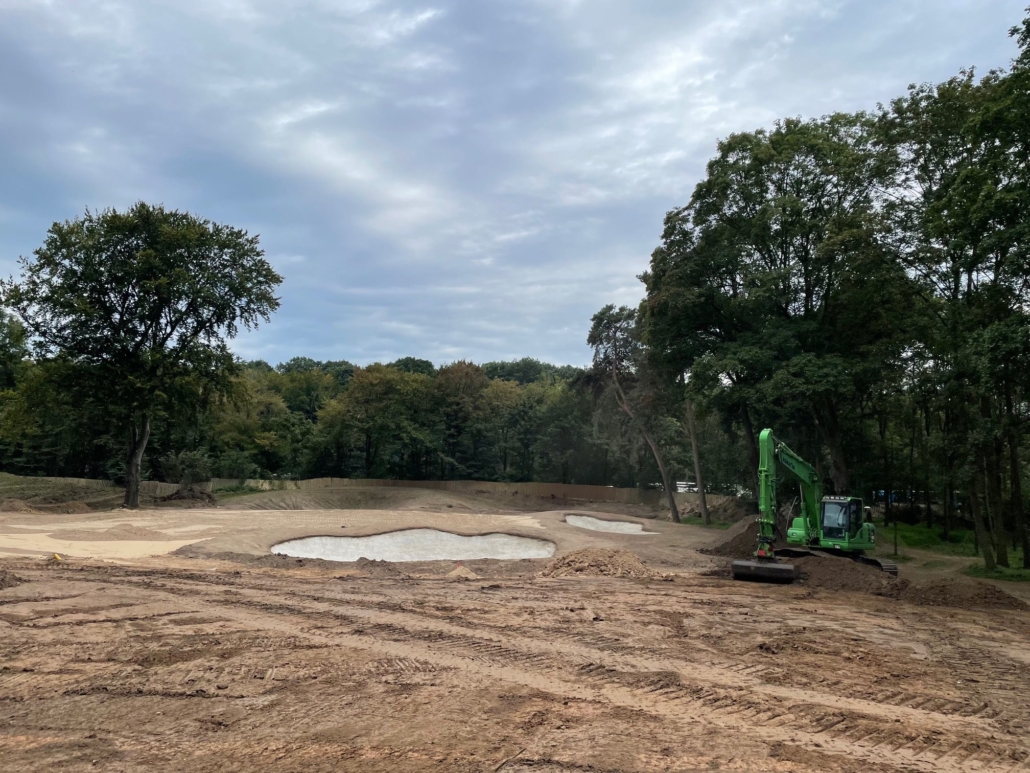
Capillary Bunkers project at Marienburger

Capillary Bunkers project at Marienburger: Germany’s largest Capillary Bunkers installation so far has just been completed at the Marienburger Golf Club in Cologne, by architect Christian Althaus and contractor Sommerfeld.

Founded as Cologne Golf Club in 1906, the club moved to its current site in Marienburg in 1909. The construction of an autobahn (motorway) to Aachen in the thirties saw the course reduced to nine holes, which it has remained ever since. The club called in architect Althaus to advise on course improvements several years ago, and in 2021, the upgrade project got underway, incoporating the reconstruction of all nine greens – which were not properly drained – as well as bunkers, and the regrading of fairways to provide better drainage and more interest.

Capillary Bunkers project at Marienburger

Capillary Bunkers project at Marienburger

“The course is within a kilometre of the Rhine River, and is thus partially sandy, but even so it was clear that we needed a bunker liner,” says Althaus. “Even on the parts of the site that have a sand base, the steep faces of the bunkers would erode quite badly without it, and also the sand of the sub-base and the bunker sand would intermingle and contaminate the bunkers.”

Althaus considered various liner options, but was led to select Capillary Bunkers on environmental grounds. “We considered various liner options, but I knew I needed a very strong and stable liner on environmental ground, which led us to choose Capillary Bunkers,” he explains. “The strength and neutrality of the Capillary Bunkers product made it the right choice.”

Construction work is complete, and the project is growing in – the course will reopen in spring 2022.

For the latest industry news visit turfmatters.co.uk/news

Get all of the big headlines, pictures, opinions and videos on stories that matter to you.

Follow us on Twitter and Instagram for fun, fresh and engaging content.

You can also find us on Facebook for more of your must-see news, features, videos and pictures from Turf Matters.
First tournament with synthetic bunkers

First tournament with synthetic bunkers: The Trust Golf Women’s Scottish Open, which takes place this week on the new Dumbarnie Links course in Fife, will be the first tier one professional event in Europe ever to be played at a venue with synthetic-edged bunkers.

Dumbarnie, which was designed by Clive Clark and opened last year will play host to its first major event as the Ladies European Tour descends on the course as part of a two-week links swing that will be completed by next week’s Women’s British Open at Carnoustie.

First tournament with synthetic bunkers

First tournament with synthetic bunkers

“Dumbarnie features some really impressive, bold revetted bunker walls, some of which are in the region eight to nine feet high,” says Richard Allen, CEO of EcoBunker Ltd. “Back in 2007 my original aim was to invent a resilient and affordable system for low edge bunkers, but soon I was designing solutions for higher and higher links style bunkers. The change in design parameters prompted me to invent a new construction method, which is now Patent Pending, using a cement modified backfill for increased stiffness and stability. It was the perfect solution for Dumbarnie, and the EcoBunker walls built by our team in 2018 are maturing naturally and beautifully.”

The course’s fairway bunkers are built in a naturalistic style, with a ragged fescue edge, but the majority of bunkers are hard against greens, or surrounded by short grass, and these are fully revetted using EcoBunkerʼs synthetic solution.

Dumbarnie, promoted OB Sports and Landscapes Unlimited, was one of EcoBunker’s first and largest contracting jobs. Construction manager Llewelyn Matthews – like architect Clark a former Walker Cup player – led a five-strong construction crew to build the bunkers, over a eighteen week period.

EcoBunker CEO Richard Allen, the inventor both of synthetic revetting and of the later Ecobunker Advanced method, says: “All our team look back with immense pride on the Dumbarnie job. It was truly the job on which Llew Matthews came of age as one of the world’s best bunker builders, and we are delighted to have played a part in the construction of such a stunning course. To see the world’s leading women professionals playing over the course this week will be wonderful, and I’m prepared to bet that course manager Grahame Taylor will spend less time worrying about his bunkers than most people who are hosting a tournament of this stature.”

Richard Allen, the inventor both of synthetic revetting and of the later Ecobunker Advanced method, adds: “All our team look back with immense pride on the Dumbarnie job. It was truly the job on which Llew Matthews came of age as one of the world’s best bunker builders, and we are delighted to have played a part in the construction of such a stunning course. To see the world’s leading women professionals playing over the course this week will be wonderful, and I’m prepared to bet that course manager Grahame Taylor will spend less time worrying about his bunkers than most people who are hosting a tournament of this stature.”

Architect Clive Clark says: “As the golf course matures, seeds fly into the tiny crevices in the bunker walls, and just like a natural sod bunker, you get grasses in the face that dominate. If 100 golfers played this course, I doubt if five would notice that the bunkers weren’t natural sod.”

For the latest industry news visit turfmatters.co.uk/news

Get all of the big headlines, pictures, opinions and videos on stories that matter to you.

Follow us on Twitter and Instagram for fun, fresh and engaging content.

You can also find us on Facebook for more of your must-see news, features, videos and pictures from Turf Matters

RainDance course features Capillary Bunkers

RainDance course features Capillary Bunkers: The new RainDance National golf course in Windsor, Colorado, should be finished this year and will open in July 2022. Part of a substantial housing development, the course, which is being designed by architect Harrison Minchew, along with former PGA Tour pro Fred Funk, is using Capillary Bunkers lining technology.

“I did a course with Ed Seay back in 1985, and I remember the contractor saying to me ‘You know, one day we’re going to put concrete in the bunkers to make them work better,” says Minchew. “Well, for me, that day has come.”

RainDance course features Capillary Bunkers

RainDance course features Capillary Bunkers

Originally announced back in 2014, the start of the RainDance build was delayed until last September, to allow developer Martin Lind to progress the associated residential community. Sales have been very strong, allowing the course to start last year. “I am running the job and am here 24/7,” says Minchew. “To get it all done this year is a really tight schedule, though we already haveRAINC around two thirds of the course seeded.”

Minchew first used the Capillary Bunkers product on a six hole First Tee course in Augusta. “Landscapes Unlimited were building that project, and wanted to install Capillary Bunkers,” he says. “That enabled me to see how effective the product was – I saw the water basically going straight through the bunkers – and I came to understand how it works, and to realise that it could be installed in conditions that would be impossible for competing products. So when it came to this job, I knew I wanted to use Capillary Bunkers.”

Minchew says that the golf course build, and all seeding, will be finished this year, despite an extremely wet spring. “We will have a total of about 75,000 square feet of Capillary Bunkers,” he says. “Capillary Bunkers’ Scott Grego has been working closely with us – he came in while we were installing the first few bunkers to make sure we were doing it correctly.”

For the latest industry news visit turfmatters.co.uk/news

Get all of the big headlines, pictures, opinions and videos on stories that matter to you.

Follow us on Twitter and Instagram for fun, fresh and engaging content.

You can also find us on Facebook for more of your must-see news, features, videos and pictures from Turf Matters.

Capillary Bunkers solve elk damage

Capillary Bunkers solve elk damage: Elk getting into bunkers has resulted in damage to them at Rock Creek Cattle Company in Montana, designed by architect Tom Doak. But lining the bunkers with the Capillary Bunker system is set to solve the problem.

“When the course was built, the bunkers were lined with a textile product,” says course superintendent Rick Hathaway. “Given the location, some sort of liner was essential. The clue is in the name: the soil here is full of rocks, from pebbles to big granite boulders. With frost heaves in winter, the rocks move up through the profile, and would penetrate unlined bunkers very easily.”

Capillary Bunkers solve elk damage

Capillary Bunkers solve elk damage

But the textile liner could not cope with another problem caused by Rock Creek’s location – wildlife. “We have a large herd of resident elk, about a thousand strong. And they really like our bunkers!” says Hathaway. “Their natural position is head up, so if they are down in a bunker, they have grass at head height. So it makes eating less work for them. Especially in the fall, when they come back out of the mountains, the elk spend a disproportionate amount of time in the bunkers. And they are big, heavy animals. Their hooves inevitably cause damage to a fabric liner, and once there is a little hole, the sand gets through and the situation starts to deteriorate. It got to the point where we couldn’t manage the amount of damage that was happening. I was using six or seven guys two days a week working on liners.”

And elk are not the only wildlife that caused Hathaway sleepless nights. “We have a lot of ground squirrels here and they burrow up through the bunkers. Then the badgers – which want to eat the ground squirrels – dig down after them, and the next morning we have huge holes in our bunkers,” he explains. “A couple of years ago, I went to my greens committee chairman – a committee of one! – and he asked me what keeps me awake at night. I told him and said ‘Let’s start thinking about redoing one day’. The course is a masterpiece and the bunkers weren’t doing it any favours. From a distance, they looked pretty but from a playability point of view they weren’t as good as the rest of the course. A couple of weeks later, he called me and said ‘It’s a go’.”

“I met the Capillary Bunkers rep and started having conversations with him, and I gave a couple of local superintendents a call. I went over to one that was doing a very large renovation of the course and went out for a day and watched them install the product. That gave me confidence in how it is installed and works. Last year, my greens chairman and I made the decision that Capillary Bunkers was the right choice. We did three test bunkers, evaluated different bunker sands, and made our decision.”

The project began in April, with construction being handled by contractor Ridgetop Golf, from Seattle, and the last bunkers were lined at the beginning of June. “We typically open the golf course on May 15, and April is the month I count on getting major course work done, so for the first six weeks of construction, there were no golfers around,” says Hathaway. “When we excavated the bunkers, I had the contractor scrape an inch or two out of the subgrade to make sure we didn’t change the depth.”

Hathaway is delighted with the results. “The bunkers are spectacular,” he says. “We have these jagged faces that have eroded in the thirteen years the course has been open, and that gives them even more character. There’s a little lip and the concrete fits in there. You’d never know there was concrete there.” Hopefully, the elk will concur!

For the latest industry news visit turfmatters.co.uk/news

Get all of the big headlines, pictures, opinions and videos on stories that matter to you.

Follow us on Twitter and Instagram for fun, fresh and engaging content.

You can also find us on Facebook for more of your must-see news, features, videos and pictures from Turf Matters.