
Tag Archive for: bunkers

Capillary Bunkers at Newnan CC

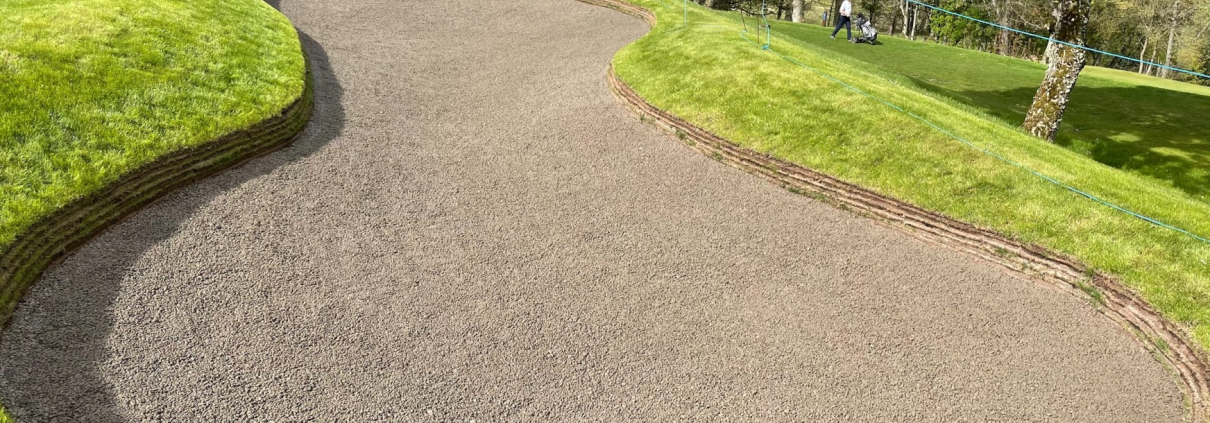
Capillary Bunkers at Newnan CC: It’s only two weeks since Newnan CC, about thirty five miles southwest of metro Atlanta in Georgia, completed the installation of the Capillary Bunkers liner product on its golf course. But superintendent Andy Scott already is already seeing major benefits.

“We’ve had three big rainstorms – three inches overnight – since we finished the installation, and we have come in the following morning and found little or no washouts in our new bunkers,” says Scott. “Member reaction has been great. I’m getting compliments every single day about how they look and play. It’s probably too early to say this is the best decision of my life, but I’m pretty close to it.”

Capillary Bunkers at Newnan CC

Capillary Bunkers at Newnan CC

Newnan was founded in 1919, though the golf course dates from later, but Scott says it was showing its age. “This project was a long time in the making,” he explains. “I have been here ten years, and I have been asking to do a bunker renovation ever since I joined the club! We are a fairly typical small town country club, so for us it was a significant long term investment. As such I was determined that when we did the bunkers, we were going to do them properly – not a half job. I wanted to go all-in.”

This determination to do the job properly, combined with Scott’s pre-existing relationship with business development manager Cory Blair, led him to select the Capillary Bunkers product. “I did look at other liners, but I felt certain I was making the right choice,” Scott says.

Lining the bunkers wasn’t the only component of Scott’s project. Decades of wear and tear had left many of them misshapen, and with surface water draining into them. Newnan hired contractor David Johnson of Florida-based JGCC Golf N Sports Turf to deliver the job. “We gave him a lot of input, but broadly we let David guide us in the right direction,” says Scott. “If he proposed something that we thought over the top, we discussed it between us, and reached agreement.”

Johnson broke ground late in January and finished construction in early May. “We kept the course open, closing holes as needed,” says Scott. “Our membership is quite small and close-knit, so communicating which holes were closing when was not too difficult.”

For the latest industry news visit turfmatters.co.uk/news

Get all of the big headlines, pictures, opinions and videos on stories that matter to you.

Follow us on Twitter and Instagram for fun, fresh and engaging content.

You can also find us on Facebook for more of your must-see news, features, videos and pictures from Turf Matters.
Busiest spring for Capillary Bunkers

Busiest spring for Capillary Bunkers: Bunker liner specialist Capillary Bunkers is in the midst of the busiest period in its history, since its foundation in 2010. April and May have seen the firm working on more than sixty projects around the world, and the rest of the year looks set to be just as busy.

Courses involved include Tom Doak’s much-acclaimed Rock Creek Cattle Company in Montana, the Tom Fazio-designed Contraband Bayou course in Louisiana, and RainDance National in Colorado, designed by architect Harrison Minchew with PGA Tour player Fred Funk. In Asia, Capillary Bunkers are being installed at the Discovery Bay course in Hong Kong, while in Europe, Golf Nazionale in Rome, Djursholm in Stockholm and Murrayshall in Perthshire, Scotland. And Africa is not being left out, as the Royal Golf de Marrakech in Morocco is also installing the product.

Busiest spring for Capillary Bunkers

Busiest spring for Capillary Bunkers

“Everyone in golf is aware that the industry is very lively as we emerge from the Covid-19 pandemic, with rounds up significantly across the world,” says Capillary Bunkers founder and CEO Martin Sternberg, CGCS. “That growth is being reflected in golf construction, as courses seek to improve their facilities and differentiate themselves from the competition. Because our product reduces bunker maintenance while simultaneously improving their condition, and because it is very easy to install in most weather conditions, it is ideal for busy courses – bunkers can be renovated and be back in play very quickly, to minimise disturbance to golfers.”

For the latest industry news visit turfmatters.co.uk/news

Get all of the big headlines, pictures, opinions and videos on stories that matter to you.

Follow us on Twitter and Instagram for fun, fresh and engaging content.

You can also find us on Facebook for more of your must-see news, features, videos and pictures from Turf Matters.

Bunkers ensure success at Marco Simone course

Bunkers ensure success at Marco Simone course: Although the Covid-19 pandemic means it will have to wait another year until it hosts the Ryder Cup, preparation of the Marco Simone course in Rome continue apace.

All eighteen holes of the new-look course, designed by European Golf Design, opened for member and guest play earlier this month. And Dave Sampson, of European Golf Design, says the course’s bunkers, which have been built using the Capillary Bunkers lining system, are performing particularly well.

Bunkers ensure success at Marco Simone course

Bunkers ensure success at Marco Simone course

“The first nine holes – actually the back nine of the course – started construction in August 2018, and were all grassed by the end of summer 2019,” says Sampson. “A couple of major storm events set those holes back a little, but they were all in play last summer. The second phase construction started in autumn 2019 and finished during summer 2020. Phase three, the practice greens, is currently being finished, though architect Sampson, prevented from visiting the site by the pandemic, has been approving the works via drone footage. The course is planned to make its public bow this September when it plays host to the European Tour’s Italian Open.

Sampson says: “We have been in daily contact with the guys from contractor SOL Golf who have been on site, so finishing the final greens remotely has been OK. Nothing of the original course has been retained – every hole except for the sixth plays in a new corridor.”

He adds that the choice of Capillary Bunkers as a liner was an easy one. “I have had really good success with Capillary on previous projects, including the Evian resort in France and Crans-sur-Sierre in Switzerland,” he explains. “Evian and Marco Simone have quite a lot in common, in terms of weather patterns, so it was a pretty good model. The amount of maintenance time post storms is minimal compared to what it was before.”

Designing a course for a Ryder Cup is rather different to building a normal course, Sampson says: “On a normal project, you’d be looking for the best eighteen holes, pure and simple. Here, you’re looking for the best eighteen holes that can deal with 50,000 spectators. So the routing is quite challenging, but that said, there are not long walks between greens and tees. This is a 27-hole project, so the extra nine gives us space for the range, the spectator village and the like. And you need to build the course to be extra resilient in terms of weather – there isn’t a lot of extra daylight to play with given the time of year a Ryder Cup is played, so the course needs to be playable quickly even in the event of severe weather. That’s one of the benefits of using a liner like Capillary Bunkers.”

For the latest industry news visit turfmatters.co.uk/news

Get all of the big headlines, pictures, opinions and videos on stories that matter to you.

Follow us on Twitter and Instagram for fun, fresh and engaging content.

You can also find us on Facebook for more of your must-see news, features, videos and pictures from Turf Matters.

Ecobunker enables Sandbelt style bunkers

Ecobunker enables Sandbelt style bunkers: The famous courses of the Melbourne Sandbelt, notably Royal Melbourne and Kingston Heath, are distinctive for many reasons, but one of the most important is the characteristic bunker style created by Dr Alister MacKenzie and his collaborators Alex Russell and Mick Morcom. 

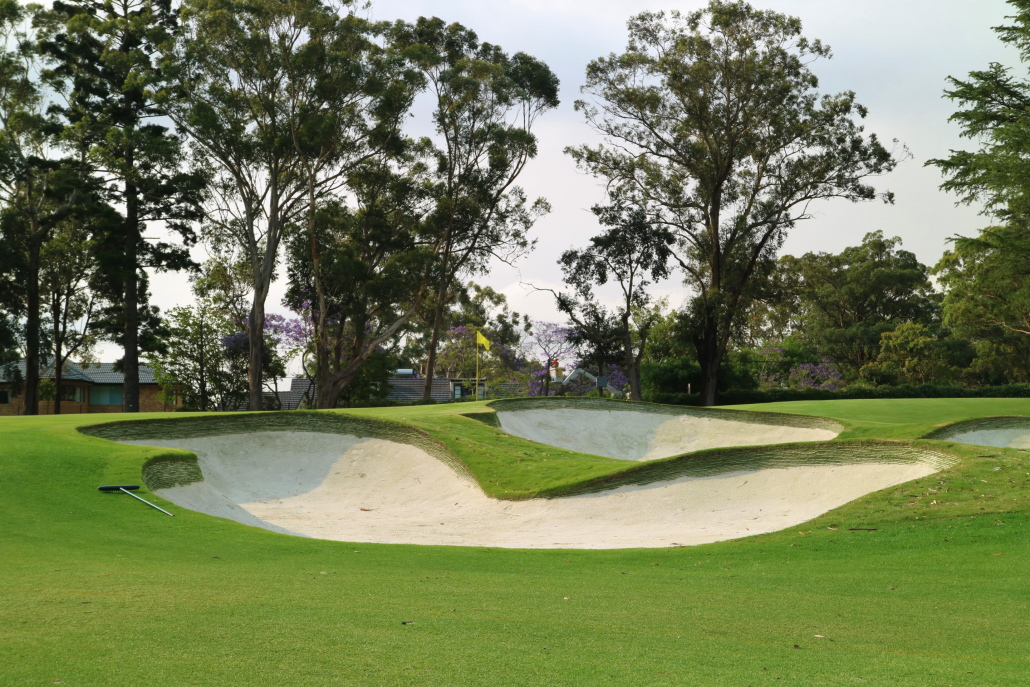
Sandbelt bunkers are characterised by their size, by their swooping shape, with capes and bays dividing them up into different compartments, by their flashed sand faces, and by the fact that they cut so deeply into fairways and greens – and are typically presented with short grass – fairway or even green cut – right up to the edge of the bunker, with no collar of longer grass that can interfere with the architect’s desired short game playability, and create visual interference in an otherwise extremely ‘clean’ look.

Ecobunker enables Sandbelt style bunkers

That look has been enormously influential around the world of golf. Gil Hanse’s Olympic course in Rio de Janerio and Tiger Woods’ first American design, Bluejack National in Texas, are only two in a long list of courses said by their designers to be influenced by the Sandbelt look. But replicating those trademark Melburnian bunkers is hard. The soil on the Melbourne courses, though sandy, contains a lot of fine particles and grey organic matter that mean it binds together to create a hard surface. Coarser sand – and even more so, clay soil – does not bind the same way, and creating that hard, vertical lip so characteristic of Melbourne is basically impossible; the soil gets wet and crumbles away.

The recent President’s Cup at Royal Melbourne showed very well how the Sandbelt bunkers work. As well as the clean edge, the sand packs down so hard that Melbourne clubs do not rake their bunker faces, rather using a ‘flat rake’ to create extremely firm conditions on the bunker faces, ensuring that all balls that enter the bunker run down to the prepared base, removing the problem of plugged lies.

So Sandbelt bunkers are desirable, but they depend completely on the particular conditions on the Sandbelt to make them possible. Sydney-based golf architect Harley Kruse has found a way round this problem. At Killara Golf Club, in the northern suburbs of Sydney, a successful 1800 member club whose golf course was basically untouched since the 1960s, Kruse was hired to do a significant course renovation. After careful planning, the works were agreed: reconstruction of all eighteen green complexes, reversing two holes, rebuilding some fairway bunkers and eliminating one par three while bringing a spare hole into the normal rotation.

“Greens were suffering; the rootzone wasn’t good and they were all poa,” Kruse says. “They were small, averaging 370 sq, and basically flat, with very limited strategic value. We have increased them to an average size of 500-550 sq m, with lots more interest; we’ve also taken out 300 big trees and opened up the vistas.”

Kruse and the club wanted sandbelt-inspired bunkers, but the clay soil at Killara meant that was going to be difficult. However, they found a solution via a good friend, Rod Hinwood, course manager at the exclusive Ellerston GC in rural New South Wales. Hinwood demonstrated the successful results that EcoBunker was delivering on his pronounced bunker edges, which had previously been vulnerable to erosion. “It occurred to me that we might be able to do something similar at Killara, and thus be able to get the edging treatment that we wanted,” said Kruse.

The new bunkers are lined with Capillary Concrete, and feature a 40cm high lip constructed using EcoBunker Advanced patented synthetic bunker edging system. The sand is then flashed up the EcoBunker wall – and is held in place by the Capillary Concrete – and the bunker surrounds can be mowed short right to the edge, because of the strength the EcoBunker and Capillary Concrete underpinnings provide.

“EcoBunker was designed from the outset to give architects the maximum freedom to create the bunker shapes they wanted,” says EcoBunker inventor and CEO Richard Allen. “The work that Harley has done at Killara is a classic example of that. When I first went to Melbourne last year, the principal reason was to see the Sandbelt bunkers up close; the fact that our product has allowed a great architect to create similar bunkers on unsuitable soil is fantastic. This style of bunker has long been something of a ‘holy grail’ for a lot of golf courses that simply haven’t been able to implement it because of their soil conditions. Now, they can see a proven solution that will allow them to do so.”

“If we had tried to do that edge using the site soils, it would crumble away,” says Kruse. “Getting that stable lip in clay soils is very difficult to achieve. But EcoBunker allows us to do it.”

For the latest industry news visit turfmatters.co.uk/news

Get all of the big headlines, pictures, opinions and videos on stories that matter to you.

Follow us on Twitter and Instagram for fun, fresh and engaging content.

You can also find us on Facebook for more of your must-see news, features, videos and pictures from Turf Matters.