Tag Archive for: Future

Polaris receives the Future Farming Award

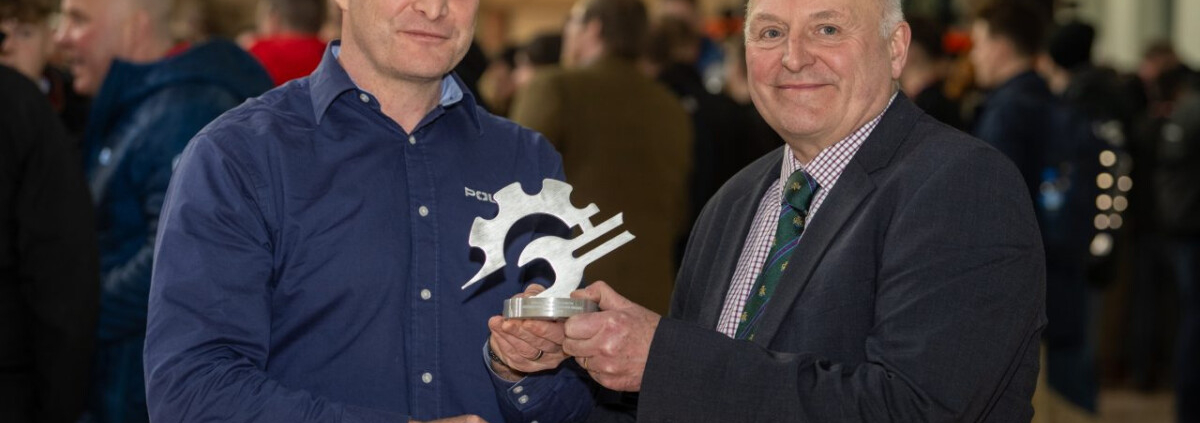
Polaris receives the Future Farming Award: Polaris is proud to be named the winner of the Future Farming award at the LAMMA Innovation Awards 2024 with its all-new, all-electric RANGER XP Kinetic UTV. The Ranger’s 80-mile range, electric engine and impressive cargo box capacity were key contributing factors to this achievement. 

Richard Coleby, National Sales Manager at Polaris UK and Ireland said: “Winning this award is something that we are really proud of, the Ranger XP Kinetic is a vehicle that has been highly anticipated by both new and existing customers and to now have the LAMMA Innovation Award is a credit to Polaris’ forward-thinking and innovative approach to product development.”

Polaris receives the Future Farming Award

Polaris receives the Future Farming Award

Relaunched in 2018, the LAMMA Innovation Awards are well respected amongst manufacturers, distributors and consumers alike, showcasing innovation and development specifically within the agricultural sector.

“We always look forward to attending LAMMA,” continued Richard, “It is consistently an exceptional event and this year we got to debut the Ranger XP Kinetic to the record-breaking agricultural audience in attendance, making it all the more special.”

Making its first UK debut at LAMMA 2024, the RANGER XP Kinetic provides unmatched horsepower and torque, pushing the industry forwards thanks to its all-electric powertrain which has been engineered for off road use through Polaris’ 10-year partnership with Zero Motorcycles. Featuring a towing capacity of 1,134kg and boasting an industry-best 680kg payload capacity, the Ranger XP Kinetic delivers uncompromised capability.  Thanks to being fully electric, the RANGER XP Kinetic also delivers smooth, precise control when operating at low speeds, especially useful in scenarios like towing or backing up to a trailer.

The Polaris RANGER XP Kinetic is available in a Premium and Ultimate trim. The Premium trim offers a 14.9 kWh Lithium-Ion Battery with up to 45 Miles Estimate Range whilst the  Ultimate trim delivers  29.8 kWh of battery capacity and offers an estimated range of 80 miles. Both the RANGER XP Kinetic Premium and RANGER XP Kinetic Ultimate are available in dealers now.

Until the 31st March 2024, customers can purchase the Ranger XP Kinetic with Polaris’ 0% Finance Hire Purchase offer to spread the cost over two years. For more information, please contact your local dealer.

For further media information on Polaris ORV products, please contact the Polaris ORV Media Office at +44 (0) 1525 270100 or email us at press@polaris-orv.media

For the latest industry news visit turfmatters.co.uk/news

Get all of the big headlines, pictures, opinions and videos on stories that matter to you.

Follow us on Twitter and Instagram for fun, fresh and engaging content.

You can also find us on Facebook for more of your must-see news, features, videos and pictures from Turf Matters.

The Future…

The Future…: With Turf Matters celebrating its 10th birthday thoughts go to 10 years down the line and what life will be like in the mid 2030s. Scott MacCallum was given a glimpse into the future by Husqvarna and JCB.

In many ways, 2014 seems like ancient history. Back then, we saw Scotland voting to remain as part of the United Kingdom; Brazil were tonked 7-1 in the semi-final of a World Cup… held on home turf in Brazil, and Conchita Worst, sporting a very fine gown and a very fine beard, won the Eurovision Song Contest for Austria.
The Future…

The Future…

It was also the year that Turf Matters was launched, and this issue represents the 10th anniversary of the magazine.

With so much, good and bad, occurring over the last 10 years, it led to me to ponder where we might be 10 years from now. Could we be being picked up from the pub in our driverless car; might we have all our mail and deliveries dropped down to us from drones, while might we all have chips inserted in our wrists, thus removing the need for all money, keys and forgettable passwords?

But what about our industry? What are some of the things that we might expect when the 20th anniversary Turf Matters drops to you from your friendly drone… Hang on… will we still have printed magazines in 10 years’ time?

Now I don’ t have a crystal ball but I have been lucky enough recently to attend two events which shed some considerable light on what developments are being made towards 2034 and beyond. A quote which is attributed to either science fiction writer Arthur C. Clarke or Bill Gates, and raised in Paris, and tweaked slightly for our needs is also worth re-stating.

“We tend to overestimate what can be achieved in two years but underestimate what can be achieved in 10.”

Husqvarna’s Living City 2023, held in the wonderfully nostalgic Jardin d’Acclimatation, in Paris, was a two day look into the future, while a couple of weeks later I was one of a select group of journalists invited to attend a briefing at JCB’s Headquarters, in Staffordshire, to look at the extraordinary progress they have made in hydrogen power.

What I discovered was that 10 years is well within the scope of some amazing advances in technology and thinking. Looks like Arthur or Bill might have been spot on.

Living City 2023, saw 160 people attend for 13 different countries and covered a range of topics from global change and how that was impacting cities – the temperature rise in northern hemisphere cities is four degrees against a global rise of one and a half degrees – to how biodiversity 10 years down the  line will be increasingly seen as the lifeline for the future of the planet.

Paris has a target to be the greenest city in the world by 2030 while London Mayor Sadiq Khan has promised to plant two million more trees in the city. New York has a policy of every missing tree having to be reported

One speaker was Douwe Snoek, a renowned Dutch landscape architect, who told the audience that we had been building our cities all wrong. Douwe will be featured in the next issue of our sister publication, Landscaping Matters, but in essence he said that too much influence had been given to the car and future cities should give limited access to the car.
The Future…

The Future…

Opening the Conference Yvette Hensall-Bell, President Global Professional for Husqvarna, revealed that more than one million species were at risk of extinction if the status quo was maintained and said that the company had set up a Biodiversity Advisory Board, pulling together some of the finest minds on the subject to work on finding solutions and lobbying Governments.

They also presented papers on how there will be a return to quietness, with the removal of the brute force of engines and all the toll that puts on the body.

Gent Simmons, Vice President Global Product Management & Development – Professional, spoke on the need for sustainability in all areas, even citing safety trousers which currently tangle in a chainsaw to bring it to a sharp stop, at the overall expense of the trousers. Building sensors into safety trousers would instantly bring the chainsaw to a halt and not damage the trousers.

“It is about encouraging customers to move from more of a business model approach to a more sustainable one and adding customer value is how this is achieved,” explained Gent, adding that no new project at Husqvarna progresses now, until it is proven to be fully sustainable.

“No project will be started without a plan to have fossil independence,” said Gent, who added that the philosophy at Husqvarna is to encouraged engineers not to make “new stuff” but to make “stuff better”.

Gent’s closing words were that his greatest wish was to return nature’s balance, something which we’d lost over recent years.

So what else?

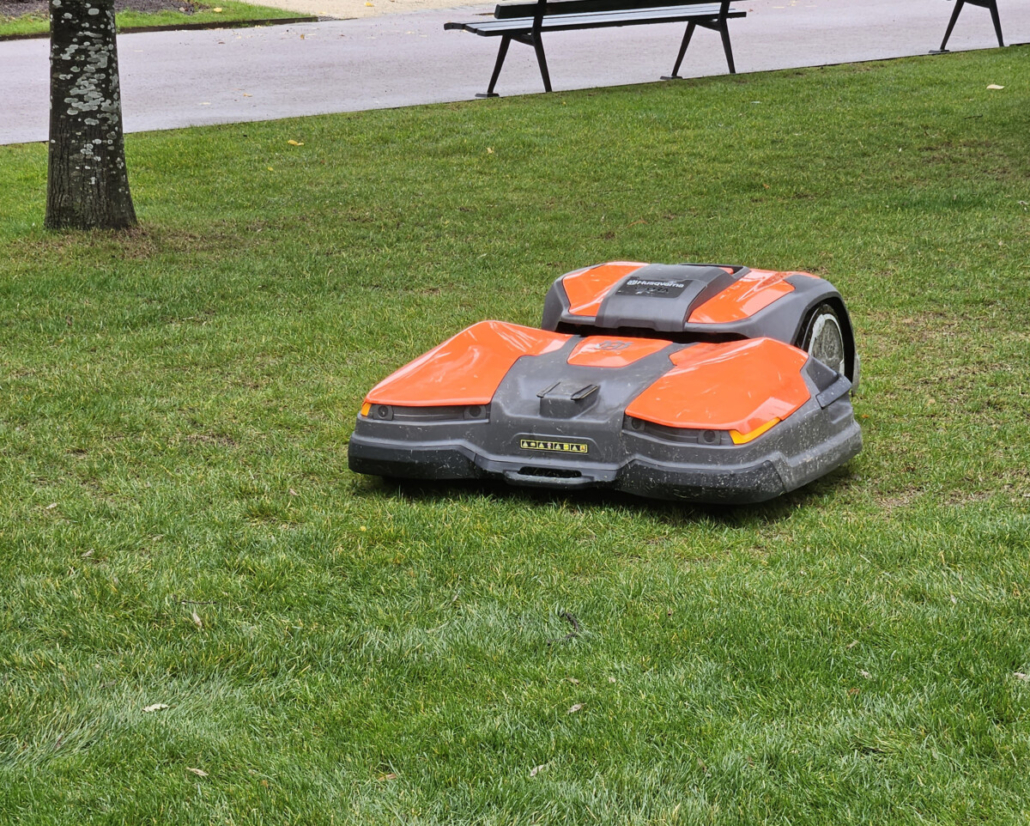
Well, we’ve had robots for a number of years now which have become adept at cutting lawns or amenity areas before heading back to their base to recharge.

Well how about, in 10 years’ time, a team of robots which will carry out a range of different turf management practices – aeration, chemical application etc – silently in the middle of the night?

And these robots won’t need to be guided by satellite or guide wires, they will be using AI to work autonomously able to identify where they can and cannot go and, in a golf environment, know the difference between fairway, greens and bunkers.

The robots will arrive in a mini vehicle which will act as their recharging base while they are on site.

With the current recruitment crisis within the industry, it will allow human staff to get on with important jobs during their regular working hours.

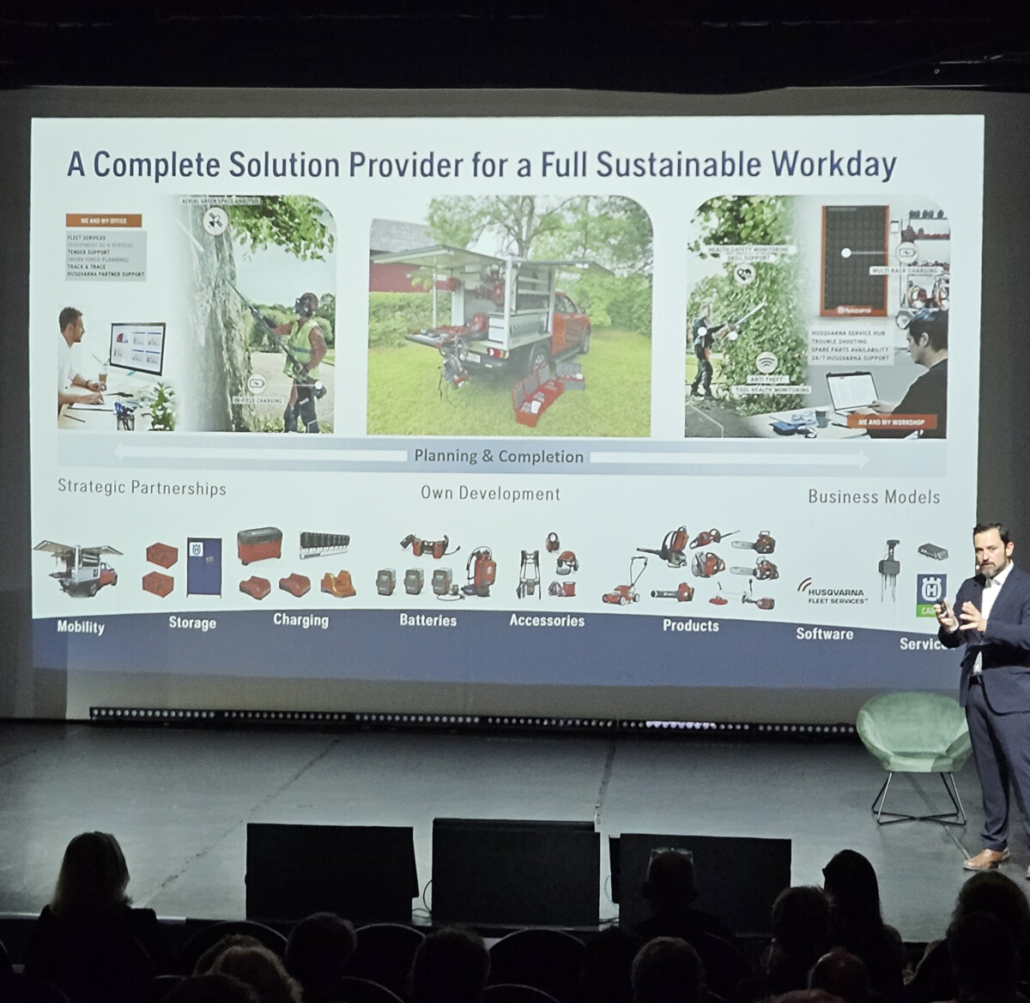
For more remote working Husqvarna’s R&D has given thought and provided solutions to the challenge of powering chainsaws and the like for a full working day. Among those was a fully kitted out vehicle with recharging points and storage for all manner of spare batteries and equipment itself.

Much of the pathway to progress revolves around battery power, something which Husqvarna believes will be essential for hand tools for the foreseeable future, and which is make more possible by innovative ways of recharging and supplying sufficient batteries for an entire day’s work. It is worked that is being mirrored at many of the most innovative hand tool companies in the world including Stihl and Pellenc, both of whom are well advanced with their own battery power development work.

Interestingly, however, they believe that hydrogen is the ultimate fuel to provide fossil independence. The problem for the hand tool industry is that currently a hydrogen powered hand tool would need to be six times larger than they are at present.

That obvious limiter to progress does not stand in the way of JCB, whose range of vehicles are sizeable enough to cope with a hydrogen engine.

The Future…

The Future…

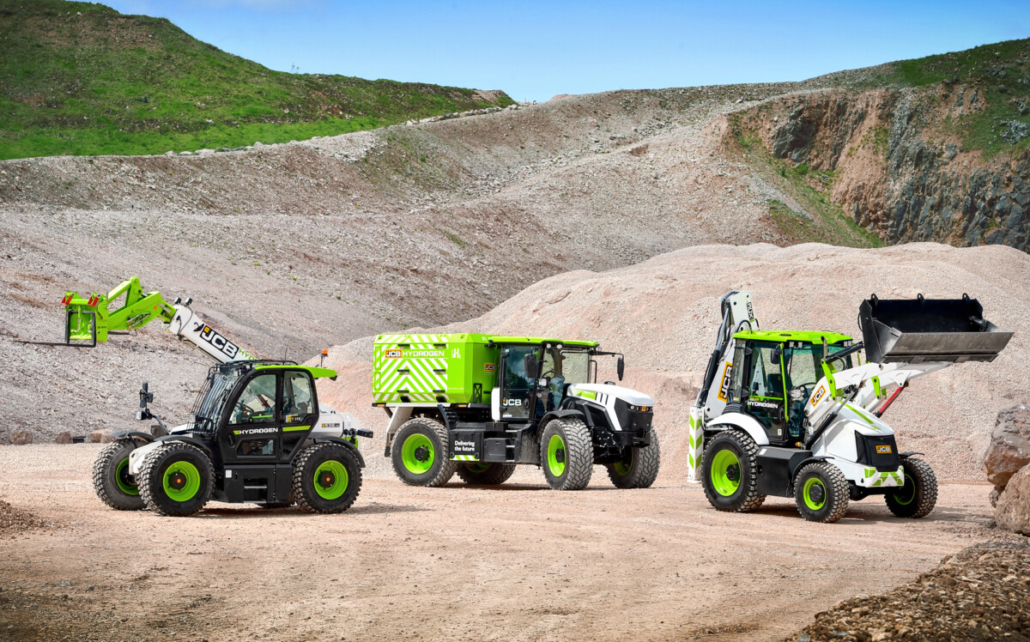
How do they know? Well they’ve built one and it is already powering prototype JCB’s at their testing quarry a few miles from their Headquarters.

In fact, a fully fledged hydrogen engine was not the first option considered when viable alternatives were being assessed by the JCB engineers. Further up that list were indeed, battery and hydrogen fuel cells, which initially ticked a lot of boxes and where thought be a quicker route to zero carbon fuel.

While extensive research determined that battery is still the optimum non-fossil option for smaller vehicles, including in that category, domestic cars, it is not practical for equipment with an operating weight of over six tonnes.

JCB’s chief innovation and growth officer, Tim Burnhope, one of the most decorated engineers in the country, explained that with domestic cars now averaging 8,000 miles a year, a drop from the pre Working from Home era of 12,000 miles, battery power remains more than a viable option.

“At JCB, we believe that it is important to use the right technology for the right application. For low power applications, close to built infrastructure, and potentially with additional demands on product such as noise, and where fume extraction is an issue, battery-electric technology is applicable,” said Tim

“These machines tend to be more compact, due to the nature of the work, and while are on-site all day, generally only work a couple of ‘power hours’ in a day. An example of this in the turf and landscaping industry would be electric ‘golf’ buggies, which have been commonplace for many years due to their low power application, low noise and proximity to charging infrastructure.”

For huge excavators, which in countries like India car run for 22 hours a day, lifting and emptying fully loaded buckets every 21 seconds, batteries wouldn’t cut the mustard.
The Future…

The Future…

“For larger machines and equipment, the job site tends to be more remote, building the infrastructure need (e.g. utilities, road, rail, and housing) for the first time. As such fuel needs to be mobile and fast to replenish to enable machines to operate whenever and wherever they are needed to. Hydrogen is a zero carbon fuel, which can be brought to machines and refuelled in a matter of minutes – making it an ideal future fuel for construction and agricultural machines.”

The example Tim gave was of a busy quarry with 100 excavators. The required recharging points would mean that power would require to be drawn from a considerable distance at a current installation cost of £1 million a mile. Of course, when the quarry was drained of resource the expensive recharging infrastructure would be redundant.

“Continuing down the battery power route would also mean that net zero by 2050 would not be achieved, as predictions suggest that it would stop at around 10%,” explained Tim.

The hydrogen fuel cells also had similar success-limiting deficiencies.

“We worked at developing a machine which would work for 16 hours a day, not even the 22 hours that is required in places like India. However, even that would require £400,000 worth of fuel cells – 4.3 times the cost of an existing excavator, and it would weigh 10,000 kilos.”

Machines must also have a resale value to make them viably options for customers and having been worked at such a rate they wouldn’t be an attractive proposition without a hugely expensive replacement battery pack.

“Hydrogen fuel cells were therefore too complicated, not robust and too expensive,” explained Tim.

And so it was that during a break in Covid lockdown in 2020 a team of JCB engineers  sat down with Lord Bamford, JCB’s Chairman

“It was July and Lord Bamford laid down his Chairman’s Challenge. He wanted us to produce a hydrogen engine by Christmas,” recalled Tim.

Now, rather than leave the meeting with spinning heads and a desire to find the nearest darkened room in which to lie down, the team of engineers got to work and met the Challenge. Not surprising when you appreciated the desire and ability of the JCB engineers to the push the envelope. The world’s fastest diesel vehicle, as driven by Andy Green, sits in the corner of the factory floor. It achieved a speed of 365 mph on in Utah, USA, in 2006,  if you are interested.

The engine they produced has the same dimensions as that used in fossil fuel-operated JCB machinery, so can be fitted into the same chassis while they have the same level of performance.

It is a huge breakthrough and JCB is now just the first of at least 130 hydrogen development programmes going on around the world at some of the biggest companies in a range of different usages so progress will undoubtedly intensive.

The one challenge which is still to be met satisfactorily is refueling.

An extensive nationwide set of hydrogen filling stations is a long way off so a solution for the early adopters of hydrogen powered machines had to be found.

JCB have come up with, and built, a mobile hydrogen filling vehicle which would travel around an area refilling hydrogen machines thus ensuring that down time for those valuable workhorses is minimised.

That may be a useful option for operators of a large fleet of machines or those who tap into a refilling service but the dream of freely available hydrogen filling stations is still a little time away.

So, that question of where will we be when Turf Matters celebrates its 20th birthday…

“The landscape in 10 years’ time will certainly be a growing mixture of both technologies; where the line is between the two will be highly dependent on application, location and cost,” predicted Tim.

Overall the glimpse into the future, as offered by both Husqvarna and JCB, is extremely interesting and shows that the landscape of our workplace, and life in general, will be markedly changed. Husqvarna’s work on battery development and holistic lifestyle changes and JCB’s progress on ensuring that large vehicles will emit steam rather than fumes should assist in achieving, or getting close to, nett zero

Many thanks to Husqvarna and JCB for inviting Turf Matters to two extremely interesting events

The Future of Sports Turf Higher Education Needs Your Opinion

The Future of Sports Turf Higher Education Needs Your Opinion: There is a proposed new Level 5 Sports Turf Technical Manager Apprenticeship on the horizon with the option of including a Sports Turf Foundation Degree.  What are your thoughts on this?

In October 2023, a new Level 3 Advanced Sports Turf Technician Apprenticeship was made available (for details please see Institute for Apprenticeship and Technical Education (IFATE) website).  This new progression route builds on the Level 2 Sports Turf Operatives or Level 2 Greenkeeping and/or supports those seeking to develop their supervisory skills, knowledge and behaviours in sports turf.

The Future of Sports Turf Higher Education Needs Your Opinion

The Future of Sports Turf Higher Education Needs Your Opinion

Based on the role and duties of a sports turf manager, IFATE have now recognised that a continued progression route to a higher level 5 apprenticeship qualification in sports turf may be needed.

To ascertain the taught knowledge, skills and behaviours for a level 5 sports turf manager, a new survey is now available to canvas industry opinion.   If you have a vested interest in sports turf, sports turf operatives (groundstaff/groundskeepers) and general management of sports turf (e.g. any sport that uses a predominantly natural grass surface), then please complete the survey

Survey: https://forms.office.com/e/iYyA7Y3L06

Further to this, the survey is seeking opinion for utilising an existing level 5 university sports turf qualification as an educational programme towards achieving a level 5 Sports Turf Technical Manager apprenticeship.  Specifically, utilising a ‘Foundation Degree in Sports Turf Management’.

Why a Foundation Degree?  The newly developed recommended ‘Duties’ of a level 5 Sports Turf Technical Manager indicated a role that is based on science, technology, engineering and maths (STEM).  The Foundation Degree in Sports Turf is a longstanding STEM-based higher education sports turf qualification.  The existence of the FD is potentially readymade to meet this need.  Over 200 sports turf professionals have completed the FD since 2013 and just over 50 have progressed further and graduated with a Bachelor of Science with honours (BSc. Hons).  It appears to be a successful qualification for technical sports turf professionals, however there may be barriers preventing more individuals from achieving this qualification, namely university tuition fees.

Why Apprenticeships? Completion of a formal apprenticeship is a recognised qualification that confirms that an individual has completed at least a year of training and education and has sat an independently assessed and regulated examination, known as an End-Point Assessment.  Arguably, the UK Government values Apprenticeships and generates funding to incentivise and meet the costs of this training for employers.

If the turf industry is of the opinion that the Foundation Degree in Sports Turf Management has a valuable part of Level 5 Apprenticeship for Sports Turf, then there is a good case to include this qualification.

How much will it cost?  In summary, a Level 5 apprentice’s employer could access about a 95-100% reduction in the fees.  An apprentice would have no fee.  An employer would need to facilitate an average of six hours a week for an apprentice’s off-the-job training.

Please complete the survey if you would like to contribute on the future of sports turf education and training for higher level apprenticeships

Survey: https://forms.office.com/e/iYyA7Y3L06

For the latest industry news visit turfmatters.co.uk/news

Get all of the big headlines, pictures, opinions and videos on stories that matter to you.

Follow us on Twitter and Instagram for fun, fresh and engaging content.

You can also find us on Facebook for more of your must-see news, features, videos and pictures from Turf Matters.

Prestwick GC futureproof their fairways

Prestwick GC futureproof their fairways: While only launched in the summer of 2023, the new hard fescue J Sustain-Fairway mixture from Johnsons Sports Seed is already making a strong first impression at the birthplace of The Open Championship.

Delivering quick germination and coping with the challenges of the undulating links course, Prestwick Golf Club have commended the blend of top-rated cultivars and the role they’ll play in futureproofing their fairways.

Prestwick GC futureproof their fairways

Prestwick GC futureproof their fairways

By name Dave Edmondson is Prestwick’s Head Greenkeeper, supported in his role by a team of 10, but by nature he considers himself merely ‘a guardian’ of the venue – rich in prestigious golfing history. “I very much follow the Old Tom Morris approach to maintenance, working with nature and continuing the methodologies of my predecessors to run the course in a minimalist way” says Dave. “We don’t use any pesticides, fungicides, hardly any fertilisers and very limited water.”

“My pursuit of traditional greenkeeping techniques led me to have a conversation with our golf course consultant about our fairways, and specifically any mixtures which could help to boost the hard fescue and sheep fescue populations which are proven to thrive in low-input and links conditions. That’s where I discovered Johnsons J Sustain-Fairway.”

J Sustain-Fairway, available from DLF, has been designed to suit golf clubs looking to significantly boost the population of resilient varieties, providing a foundation of quality and strength with an increased tolerance to a broad range of turf stresses. “A chat with my DLF Technical Manager Stuart Yarwood made it clear that this mix would tick a lot of boxes, so we opted for this for our main annual fairway overseed.”

Sown at a rate of 7g/m2 in early September, germination was visible in just over two weeks, with the seedlings then under the stewardship of Dave to thrive and establish. “So far it’s been so good! The natural undulations here at Prestwick have often seen certain species struggle, particularly with coverage on the tops of the hillocks, so we’ve sown some additional J Sustain-Fairway here to help and, to date, it’s all working brilliantly.”

“The hard and sheeps fescue like a nice, settled environment and that’s exactly what we can give them.” Dave adds, “If we can keep building those populations with top-rated cultivars, then we will be much better placed to withstand environmental challenges and safeguard the course for the future.”

For the latest industry news visit turfmatters.co.uk/news

Get all of the big headlines, pictures, opinions and videos on stories that matter to you.

Follow us on Twitter and Instagram for fun, fresh and engaging content.

You can also find us on Facebook for more of your must-see news, features, videos and pictures from Turf Matters.

Verti-Drain® proves past, present and future

Verti-Drain® proves past, present and future: While much has changed in the fine turf industry over the last 40 years, one thing that has remained a constant for greenkeeper Trevor Dennis is the presence of a Verti-Drain®.

As an early adopter of the technology in his position at Kings Lynn Golf Club in 1986, the original aerator has played a major role at all of Trevor’s clubs – including Heacham Manor Golf Club in Norfolk where, on his retirement, he hands over not only the Head Greenkeeper baton, but a pair of Redexim Verti-Drain’s.

Verti-Drain® proves past, present and future

Verti-Drain® proves past, present and future

Trevor was one of the first to see the Verti-Drain® used in a golf course environment during his apprenticeship training in 1986 and, impressed by the benefits, convinced his club at the time to invest. “I had to explain the technique and what this would do for course condition… Comparing it to an agricultural plough was the only way to get the committee of farmers to understand! I have only used a Redexim Verti-Drain® since and have complete faith in it” he explains.

Inheriting two Verti-Drain’s, including a 1513 and Redexim Carrier delivered just a few weeks ago by local dealer Ben Burgess, is Tom Brooks who became Heacham’s new Head Greenkeeper in October 2023. An American Links-style course, Heacham Manor features 18 USGA specification greens which was the reason for the club’s most recent purchase. “We have a Verti-Drain 7416 and wanted to complement this with something light enough for work on the greens throughout the winter months” explains Tom. “Our new Carrier and Verti-Drain® will give us enough depth and versatility to alleviate any compaction on the greens without applying any unnecessary weight, all while freeing the tractor up for other maintenance tasks.”

Tom continues, “Verti-draining is central to what we do and now we have two machines, the 7416 can focus on the fairways and walk-off areas while the Carrier and 1513 combination promises to deliver effective relief on the greens – particularly in this very wet start to the winter.” Lightweight and robust, the Redexim Carrier utilises a 31hp engine and hydrostatic transmission to power a range of high output implements while exerting minimal ground pressure.

Along with offering year-round versatility thanks to a range of tine options, the pair also work well alongside other maintenance machines – in particular, Tom notes their Rink DS800 topdresser. “We’ll be looking to use the Carrier and 1513 as part of spring and autumn green renovations, following with the Rink to effectively incorporate accurate amounts of sand dressing into the profile.” He concludes, “The results and reliability we get from Redexim has served us well in the past and will continue to do so long into the future.”

For the latest industry news visit turfmatters.co.uk/news

Get all of the big headlines, pictures, opinions and videos on stories that matter to you.

Follow us on Twitter and Instagram for fun, fresh and engaging content.

You can also find us on Facebook for more of your must-see news, features, videos and pictures from Turf Matters.