

Tag Archive for: Grass

The Grass is Greener in LaLiga

The Grass is Greener in LaLiga: From the rain of the north to the heat of the south, club greenkeepers in Spain are keeping their pitches in the same high conditions. Using LaLiga’s ‘Greenkeeper’ app, clubs are not only using the best techniques but sharing their data with other clubs.

In Spain, weather conditions can vary dramatically on a single match day, from torrential rain in northern territories to blazing heat in the south, to the tropical extremes of the Balearic or Canary Islands. These factors are beyond control but across LaLiga, the club’s greenkeepers have ensured that a football match will never be affected by adverse conditions.

Using a variety of maintenance techniques, while collaborating with the league’s very own greenkeeper, clubs have created world-class playing surfaces that can withstand all weathers and maintain a consistent visual style. This has become an essential part of Spanish football, both for protecting players from injury and for creating the best possible broadcast product.

LaLiga’s Regulation for Television Broadcasting ensures that every LaLiga match follows the same visual style. It covers camera positioning and graphics used by operators, but a unique element is the state of the grass. Among other requirements, clubs must ensure that the ball rolls perfectly, that the height of the grass cut is between 20 and 30 millimetres across its surface and that the pitch maintains the same shade of green.
Given Spain’s geography, the work required to meet these standards varies greatly. But no matter the club, the results are of the same quality.

“The need to maintain the pitch has changed a lot; in our case we have had to find more protective systems for the summer sun,” noted Vicente Alpuente, director of facilities and maintenance at Villarreal CF. “We are using new varieties of grass and have created new maintenance systems to make this possible.”
A similar level of effort can be seen up and down the country.

The north: Artificial light and unique pitch drainage
The temperate climate of Bilbao and the design of the San Mamés stadium make greenkeeping a distinct challenge for Athletic Club. “As sunlight is reduced in our stadium, it must be created artificially,” says Ángel Muñoyerro, head of the club’s pitch. As half of the playing field does not receive natural light, the club has installed solar lights that help the growth and maintenance of the lawn.

A further particularity of the San Mamés pitch is that it is made from hybrid grass, a popular plant for semi-closed stadiums that provides greater stability underfoot to reduce injuries to players. “A hybrid surface is essential for maintaining the same quality across the pitch and dealing with changing conditions,” added Muñoyerro.
The winters are particularly cold in northern Spain, nowhere more so than Pamplona. Therefore, thermal blankets are needed to help stimulate the grass in Osasuna’s El Sadar stadium. The renovations that are being carried out on the stadium have also restricted the entry of natural light in certain parts of the playing field, leading to the club installing artificial lights.

Another significant challenge in this region is rain, which can be consistent for many months of the year. To combat this, clubs have designed an intricate drainage system to ensure the pitch maintains acceptable levels. In the layer just below the pitch, there are around 30 centimetres of porous sand, allowing water to pass through. Beneath that is around 15 centimetres of gravel, through which the water passes and is funnelled into tubes that push the water away from the pitch.

“The current systems is nothing like it used to be,” said Osasuna’s grounds manager Juan Carlos Sanz. “Before, you’d finish working on one side of the pitch and the previous side you’d worked on would be a quagmire. Now, football can be quicker and more technical because the pitches don’t interfere with the play.”
Central Spain: Adding nutrients for harsh winters

As the highest capital city in Europe, Madrid has its own set of climate challenges including low winter temperatures, which are felt by the seven LaLiga clubs playing in the area.

Eduard Rovira, greenkeeper at Getafe CF’s Coliseum Alfonso Pérez, comments: “In winter it is difficult to maintain the pitch, because the soil temperature drops below 6 degrees. With the altitude of Madrid, the grass becomes dormant, meaning it doesn´t easily regain nutrients after being used.” It is there necessary to change plants before the cold arrives, growing a more durable grass that can survive the frost that settles over Madrid.

Just 5 kilometres from Getafe is the Butarque stadium of CD Leganés. Here, the control over the grass is exhaustive with the club taking daily measurements of soil moisture. The application of natural products, including algae, is also used to increase the natural d efences of the grass.
To maintain the colour, the club has had to find creative solutions, which include the application of nitrogen or iron. “In winter, maintaining a good colour is particularly difficult because the plant stops growing,” said Víctor Marín, communications manager at the club. “In this period add thermal blankets along with these nutrients as it reinforces the cells of the plant.”

The south: Summer heat demands fertigation and mowing
In Sevilla FC’s Ramón Sánchez-Pizjuán stadium, a more common problem is high temperatures. Carlos Benegas, greenkeeper at the club, noted: “Our work involves decreasing the density of grass to avoid the growth of fungi and increase oxygen flow. This improves the absorption of water and nutrients that the plant needs to survive here.”
An important phase begins in March, when temperatures increase and the grass begins to grow quickly. “We end up mowing the pitch more than once a week,” Benegas noted. Using a vertical cutting blade, the pitch is kept flat, enabling better grip for the players and ensuring a smoother roll of the ball.

At Granada CF, the introduction of the LaLiga’s guidelines has transformed the level of care applied at the Nuevo Los Cármenes stadium. “Maintenance has changed hugely in terms of investment, protection systems and tools used,” noted Javier Rodríguez, director of operations and infrastructure at the Andalusian club.

The club has employed a method of fertigation, recommended by LaLiga, which involves the injection of nutrients to help efficient and regular growth. “Because of the climate here, we use a hybrid of ryegrass and bluegrass which can deal with extreme temperatures,” said Javier Rodrígez, director of operations and infrastructure at the Andalusian club. “In the hottest months, we minimise impact by good mowing and watering, but we keep this at regular intervals so as not to not stress the grass too much.”

The islands: Varying nutrients to manage desert winds
Over 1,300km from the Spanish mainland, the conditions on the Canary Islands are entirely different from the rest of the country but the same requirements are still being met.

“In summer, we apply a product to the pitch that allows us to lower the temperature of the grass on the ground,” said Santiago Sosa, greenkeeper at LaLiga SmartBank side Las Palmas. “But when the months of September and October arrive, due to the influence we have of the Sahara, there is a dust that settles here.”

“We have to manage the impact of this to maintain grass quality, which involves a lot of mechanical labour” he continued. “We use a range of products and vary the percentages of nutrients we apply, depending on the temperature, to maintain the intensity of colour.”

Greenkeeper, the LaLiga app that helps improve lawn quality
Through the varied and difficult task of maintaining their pitches, LaLiga clubs have one advantage in common. Through the Greenkeeper application, developed by the league, staff can track and input all relevant information about the pitch, from local weather conditions to irrigation programmes being used.
Through generating digital reports and sharing them before a match, clubs can prepare adequately for any stadium visit.

“Greenkeeper helps me see what conditions the team will play when we travel around the country,” said Sosa. “There is also a database showing the conditions that other teams are playing in. We know about the hardness of the pitch, the height of the grass, or if there has been a recent planting. All of this means we are ready to play the best match possible.”

Overseeing all of this is Pedro Fernández-Bolaños, grounds quality manager at LaLiga, who has the unique job of managing 42 pitches at once. Working alongside all LaLiga clubs, Fernández-Bolaños is the point of contact that can advise on new techniques for maintaining the pitch or capturing relevant data, improving conditions for the league.
“With the reforms we have introduced, three key objectives have been met,” he says. “The first is to improve the safety of the players. In the last five years, the number of non-contact injuries has gone down significantly. Secondly, the quality of play has improved as the ball moves much better, even if it’s raining. Thirdly, the stadiums look better aesthetically, which is all important for our match broadcasts around the world.”

For Rodríguez, this collaboration with LaLiga puts Spanish clubs at an advantage. “The techniques we are using are industry-leading and the ability to share this data means we can always make the best decisions,” he added. “It’s a unique feature of LaLiga.”

Click here to read the original article

For the latest industry news visit turfmatters.co.uk/news

Get all of the big headlines, pictures, opinions and videos on stories that matter to you.

Follow us on Twitter and Instagram for fun, fresh and engaging content.

You can also find us on Facebook for more of your must-see news, features, videos and pictures from Turf Matters.

Vandals Cause Grass Pain

Vandals Cause Grass Pain: Volunteers at an East End football club have blasted vandals who repeatedly trash its pitch for five years.

Cosmos Football Academy, in Tollcross, which trains kids as young as four-years-old, raised concerns with Glasgow City Council about the repeated problems.

The club says that as well as smashing glass bottles on and near the pitch, teenagers have been ripping up the grass with their quad bikes.

There are also problems with dog fouling on the area which is leased to the club and is not public ground. The swing parks at either end remain public property.

Groundkeeper Billy McNaught said: “The park is subjected to vandalism from kids on motor and quad bikes who rip up the grass.

“We don’t have a problem with them using the park – we just ask that they respect it.

“We are asking the council for signs to be put up across the park telling people to look after it.”

Club secretary Claire Lindsay also highlighted problems with gangs of youths loitering during training and intimidating coaches and players.

Most of the issues seem to come with young people who are early to mid-teens.

She said: “We want the public to know that this is a leased park – it is not a public park.

“We train kids from four to 12-years-old but most of the problems we have are with 14 to 16-year-olds.

“When you are training the kids, you can hear the youths at the other end of the park. Their actions cause a lot of damage to the grounds – it isn’t fair.”

The club is currently on an annual lease from City Property, run by Glasgow City Council, but hopes to get at least a 10-year minimum lease which would help bosses apply for grant funding to maintain the facility.

Mr McNaught added: “If we do get a 10-year lease we can get the park fenced off and shower and changing units installed provided we were successful in getting a grant.”

Councillor Thomas Kerr visited the pitch to try and help find a solution for the club.

He said: “I got in touch with the officers to see if they could arrange a visit. There had been some email correspondence, but I thought it would be better to visit and see the issues first hand.”

A spokesman for the council said: “We had a very positive meeting with Cosmos and agreed to a number of actions that we hope will help them run football on their pitch. We will be putting up signage to make it clear the pitch is for the sole use of Cosmos to make it easier for them to manage the space.

“Nearby drainage gullies will be cleaned out to help protect the pitch from the risk of flooding and we will enhancing the cleansing operation around the

park.

“Community Enforcement will increase patrols to address anti-social behaviour in the area and also we’ll undertake some other bits of general maintenance that will help improve the overall environment.

“Cosmos deserve a lot of credit for the work they have done to improve their pitch and to encourage young people to get involved in football in the Tollcross area.

“This is the kind of community-driven initiative that can really make a difference to an area and we will be supporting their efforts as much as possible.”

Click here to read the original article

For the latest industry news visit turfmatters.co.uk/news

Get all of the big headlines, pictures, opinions and videos on stories that matter to you.

Follow us on Twitter and Instagram for fun, fresh and engaging content.

You can also find us on Facebook for more of your must-see news, features, videos and pictures from Turf Matters.

Countrywide Advances With Solutions For All Grass Professionals

Countrywide Advances With Solutions For All Grass Professionals: Further to the announcement made in October regarding Countrywide Farmers restructuring and subsequent exit from the Turf & Amenity market, we can now confirm the company has transferred the whole T&A division to an alternative provider, enabling the Turf and Amenity team to continue to service customers under new ownership.

From 1st November 2017 all current Countrywide T&A business will be managed through ADVANCE GRASS SOLUTIONS Ltd (AGS) based from their new HQ in Reading, Berkshire.

Countrywide Advances With Solutions For All Grass Professionals

Sam Honeyborne, Managing Director at AGS confirmed “We are all extremely excited by the opportunity that this new business presents and confident of a seamless transition from Countrywide, as we continue our growth plan in the UK amenity sector. The T&A team has made excellent progress in the past five years and has adapted to suit the evolution of the market, with the increased customer appetite for a high level of long term agronomic support. I would like to thank Countrywide for their help and guidance during this transition and assure our loyal customers and suppliers of service continuity throughout.”

AGS will provide a UK exclusive range of high quality turf maintenance products to include Sustane, Growth Products and Polyon in addition to established brands such as DLF Seeds, Farmura, Aquatrols and Bathgates. Technical support combined with exceptional customer service will be the company’s ethos. Sam offered an example of where he believes improvements can be made “Haulage and delivery has been problematic in recent years in the industry and most of our competitors presently outsource this requirement. Initially we are committed to delivering directly to our customers in the South but ultimately coverage nationally by 2020. Sam added “This will incur extra costs but will greatly improve our customer service and that is our number one priority”

Growth Products, who sponsored an award at the IOG dinner in November recently confirmed AGS as their UK exclusive distributor for amenity turf, horticulture and speciality agriculture. GP’s CEO, Clare Reinbergen was very confident about the future saying “We are extremely impressed with the AGS business plan and look forward to supporting Sam and the company’s key objectives. AGS’s field based technical team are undoubtedly one of the most comprehensively qualified and experienced units in the UK and will continue their reputation for sound advice and product recommendation.”

Sam Honeyborne was also pleased to announce that Sustane Natural Fertiliser market share in the UK continues to grow and has prompted the recent appointment of Russell Riley as Sustane’s UK Business Development Manager effective from November 2017. “Russell will do a fantastic job and I wish him all the best for the future” said Sam. “Our exclusive contract with Sustane means we will be working very closely with Russell to further increase customer awareness, at a time where chemical use is under growing regulatory pressure.”

AGS is presently developing a high quality web site and this, in addition to the AGS 2018 Product Guide, will be available in the very near future.

For the latest industry news visit turfnews.co.uk

Get all of the big headlines, pictures, opinions and videos on stories that matter to you.

Follow us on Twitter for fun, fresh and engaging content.

You can also find us on Facebook for more of your must-see news, features, videos and pictures from Turf Matters.

APEX Zero-turn Cuts Time As Well As Grass

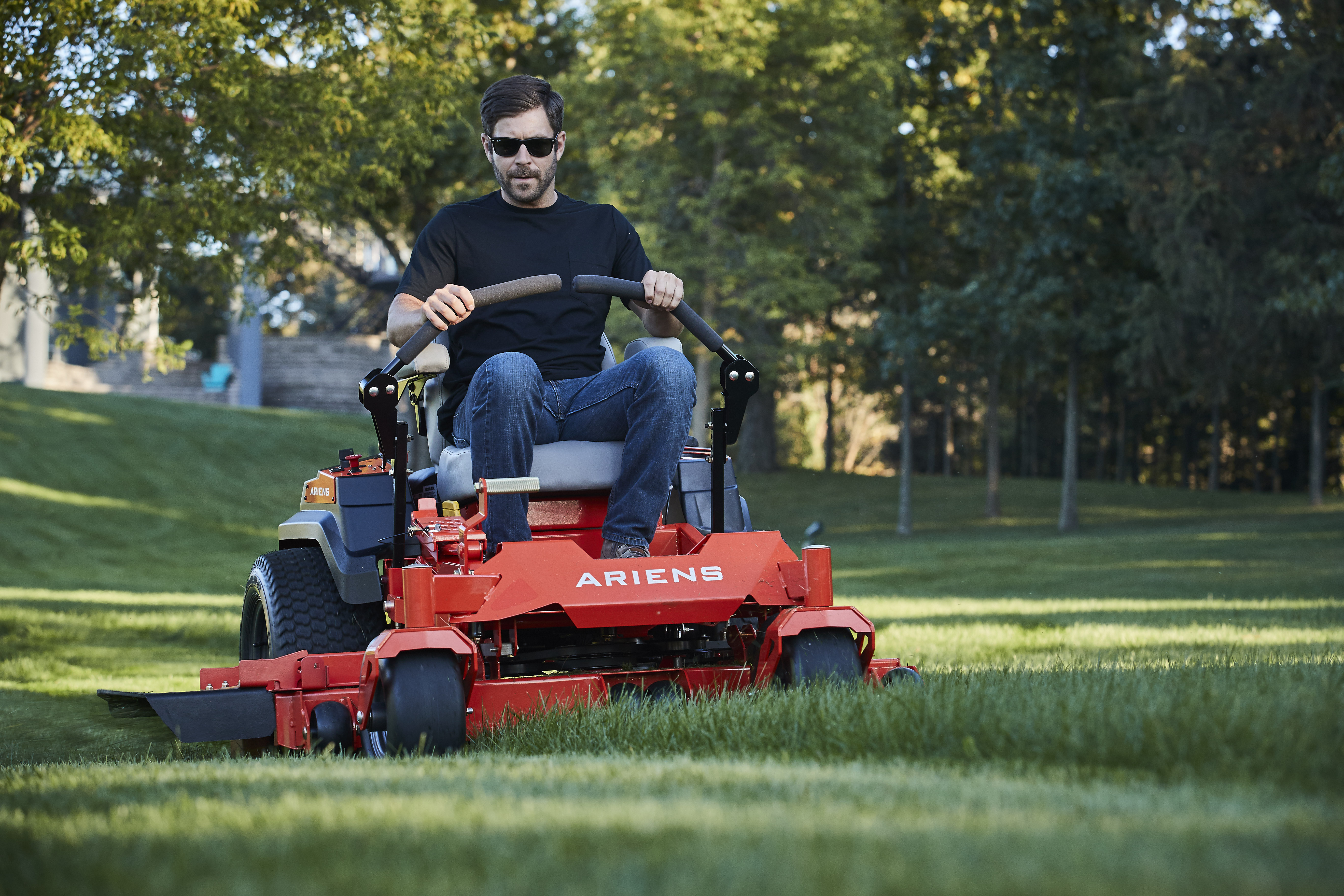
APEX Zero-turn Cuts Time As Well As Grass: Designed and built with the professional in mind, Ariens Company has recently introduced the new APEX zero-turn mower to the UK.

The Ariens name has been built on a reputation for engineering excellence and the APEX zero-turn continues this tradition with its ‘built to last’ quality. Well-crafted components, Hydro-Gear® transaxles and a robust 4-point cutting deck bring you commercial performance. The APEX features an industry-leading frame design, with large formed tubular rails serving as the backbone to support the loads of the machine.

APEX Zero-turn Cuts Time As Well As Grass

The highly durable 10-gauge steel deck is 14cm (5 ½”) deep with a reinforced leading edge providing the airflow needed to tackle tough mowing conditions. It boasts fifteen cutting positions in 0.6cm (¼”) increments. These are easily selected using a foot-operated deck lift and vertical pin system. There is a Constant Belt Tension System to ensure the belt is always at the right tension to minimise wear and heat, while providing enhanced belt life with minimal adjustments necessary. The category leading large tyres provide superior traction and ride quality.

The APEX is comfortable too, featuring an adjustable high-back seat with padded arm rests helping to reduce operator fatigue. The frame on the APEX can also be fitted with a Rollover Protection System (ROPS) for added protection. Powering you through the work is a reliable premium grade Kawasaki V-Twin (726cc) engine – ideal when you have a lot of ground to cover. The APEX zero-turn is available in two models: APEX 48 with a 122cm (48”) cutter deck and the APEX 52 with a 132cm (52”) cutter deck. With its commercial grade DNA, the APEX is a highly durable zero-turn and will outlast most other machines in its class.

The Ariens brand has been family owned for over 80 years and is rapidly growing in the UK with a large network of dealers. To find your local dealer visit www.ariens-uk.com, or for more information contact Ariens Company on 0800 597 7777

For the latest industry news visit turfnews.co.uk

Get all of the big headlines, pictures, opinions and videos on stories that matter to you.

Follow us on Twitter for fun, fresh and engaging content.

You can also find us on Facebook for more of your must-see news, features, videos and pictures from Turf Matters.
Oxford United Groundsman On A Career In Grass

Pitch perfect: Oxford United’s groundsman on a career in grass: There is a sign stuck to the whiteboard behind Paul Currier’s desk which reads ‘Every day is a holiday for a man who loves his job’.

Five minutes with the head groundsman at Oxford United is enough to know it is not a hollow statement.

Currier, 58, is in the 40th year of a career which has taken him from school pitches to a host of Football League clubs – including tomorrow’s opponents Northampton Town – via a spell tending the lawns at Northamptonshire Police’s headquarters.

For someone who is quick to admit he was not the most academic at school, it has been quite a journey.

“I’ve always had this philosophy that if you get up in the morning and can’t wait to get to work then you’re enjoying your job,” Currier says, leaning back on a desk chair in his office, tucked under the East Stand.

“You’ve got to be dedicated. It can be seven days a week, it can be 12 hours a day and it’s not one of the best paid jobs in the world.

“But I’m passionate about my football and I’m passionate about my grass.”

Those who look after pitches tend to have a gruff demeanour, forever barking at people to ‘keep off the pitch’.

 But then they have plenty to worry about.

Currier, who reckons he walks 15 miles on a matchday to prepare the pitch, said: “All groundsman are the same, we’re all classed as grumpy sods.

“You have to police it because otherwise everybody will go on.

“They’ll think ‘it looks all right, I’ll go on it’, but you don’t see the damage until Christmas, so you’ve got to keep the traffic to the minimum.

“I have a checklist that I do pre-match, everything’s done, but you’ve still got that worry at the back of your mind.

“You wince when players go into the back of the net and they pull themselves up with it. It just pings everything off.

“The worst nightmare for any groundsman is to be called on while the game is going on.”

Then there are pests and diseases to lose sleep over, but his main obsession is the weather.

Pitch technology has improved markedly in the last 20 years, with the Kassam Stadium among the increasing number of surfaces in the Football League to mix the grass with artificial fibres.

Currier, brought in when the pitch was completely relaid by GreenFields in 2015, checks the forecast every four hours in the winter months.

And here, the Kassam Stadium’s open western end can be either a benefit or a hindrance.

He said: “I’m pretty confident you won’t get a game called off here for waterlogging.

“Because the pitch is so wide open to wind, it can dry twice as quickly as anywhere else.

“You can get a downpour while you’re playing and it won’t affect it, barring the odd splash.

“Temperatures drop and there’s constant shade down one side – because of the South Stand – which is two degrees colder than the other side.”

While he is a West Bromwich Albion supporter, spending so much time at a club tends to create a bond.

But United have had a stronger pull than most, as the first club where he is invited into the manager’s office after games.

He said: “I’m lucky here at Oxford because they treat me as one of the team, there’s a good rapport with the managers.”

Given the expertise built up over four decades, you might presume Currier has a perfectly-tended lawn at home in Northamptonshire.

“No, mine’s artificial,” he grins.

“When I’m at work I’m constantly thinking about grass, so when I’m at home I just like to chill out and relax and go ‘I shan’t be cutting that today’.”

Even for a man who is always on holiday, there are limits.

Click here to read the original article

For the latest industry news visit turfnews.co.uk

Get all of the big headlines, pictures, opinions and videos on stories that matter to you.

Follow us on Twitter for fun, fresh and engaging content.

You can also find us on Facebook for more of your must-see news, features, videos and pictures from Turf Matters.