Tag Archive for: Than

Get more than before

Get more than before: Cylinder mower maintenance doesn’t have to be a chore and with Toro’s Reels+ there’s less time and labour needed on maintenance which means more time and labour for the mower. Plus, there are real savings to be made.

Michael Hampton, parts manager at Reesink Turfcare, and the exclusive distributor in the UK and Ireland of Toro Parts, says: “Never more so than now, there’s a focus in the marketplace for streamlining operations. By using Toro Reels+ customers can save up to 20 minutes of installation time per cylinder with the pre-installed flock seals and spacers.

Get more than before

Get more than before

“Not only does this means customers can get back into action a lot more quickly and efficiently, but there’s the added benefit of the peace of mind that comes with using professionally pre-assembled parts. It means there’s far less time and effort spent on maintenance and that means the machines are out mowing for longer.”

Toro invested in technology to ensure Reels+ guarantee a fit which matches the exact engineering specifications of the mower, as Michael explains: “As you might expect, a perfect fit produces a perfect cut. Will-fit parts have cylinders that can make tall grass short, but don’t account for the after-cut appearance and quality of cut. Toro prides itself on the quality of the cylinder, the job it performs, the time it saves for the operators and increasing the product life of the cutting units.”

Time isn’t just saved in maintenance though. Toro recommends replacing cylinders at the same interval to maintain the highest quality of cut, which is made easier by its distributor – Reesink Turfcare’s 24-hour delivery promise. Reesink also offers 48-hour delivery support, so you know you’re in good hands throughout the entire process.

To get a superior quality of cut, turn to the experts and make sure your business benefits from the multiple plus points of easier machinery maintenance with Toro Reels+ by visiting reesinkturfcare.co.uk today.

For the latest industry news visit turfmatters.co.uk/news

Get all of the big headlines, pictures, opinions and videos on stories that matter to you.

Follow us on Twitter and Instagram for fun, fresh and engaging content.

You can also find us on Facebook for more of your must-see news, features, videos and pictures from Turf Matters.

More than just sand

More than just sand: Colin James, Head Groundsman at Leyton Orient, claims that the products are just part of the overall package from Mansfield Sand.

“I’ve been at Orient for 14 years and have been using products from Mansfield Sand the whole time,” said Colin. “It is a product and a company that I can always rely on.”

More than just sand

More than just sand

Colin uses Mansfield Sand’s Fibre Reinforced rootzone for his end of season renovations which is an 80/20 sand soil rootzone blend and polypropylene fibre reinforcement product that is particularly advantageous when grass cover has been reduced due to heavy usage and wear during the winter period. It is incorporated into the existing fibre rootzone to compensate for any material removed during renovation, whilst maintaining the required pitch fibre content to provide a firm, stable divot-free environment.

“I like the fact that it is mixed together for me at the Mansfield Sand depot and comes straight to the stadium ready to use,” said Colin. “It is a mix which continues to work for us season after season.”

All the products are produced at the company’s Two Oaks Quarry, which has been in operation since 2015 and has the most up-to-date and advanced equipment currently in the industry. From winter sports pitches, golf courses, bowling greens and all amenity turf areas – Mansfield Sand has a solution for all no matter what the product.

How much Fibresand Colin uses can vary year to year as he explains.

“We went a couple of years where we had no renovation work on the pitch due to a change of club ownership – so during that period no fibre was put into the pitch,” he said. “That meant that the following season we had to top it up a considerable amount, so It does vary, but we very much take the advice from Mansfield Sand.

“Gary Cunningham and Sharon Morris from Mansfield Sand will come to the stadium throughout the course of the season to take some samples to see how much fibre is in there. When it comes to the renovation, myself, Gary and Sharon, and the contractor will all put our heads together to come up with a solution and work out how much Fibresand we need to apply.

More than just sand

More than just sand

“It is a great product and has never let me down in all this time. It’s essential for the pitch.”

Colin, who has been in the grounds management industry for just over 25 years, was also quick to praise the back-up he receives from Mansfield Sand.

“It is not just a case of buying sand from the company,” he said. “I find that I can always pick their brains – so if I’ve got a problem with my pitch, or just want to talk about any ideas then I find that they are people I can ring up and talk to and ask advice.

“They are knowledgeable and have a great amount of experience in the industry – you can certainly rely on Mansfield Sand.”

For more information visit www.mansfield-sand.co.uk

You can also follow the company on Twitter – @MansfieldSand and Facebook – https://www.facebook.com/MansfieldSandSportSurfaces/

For the latest industry news visit turfmatters.co.uk/news

Get all of the big headlines, pictures, opinions and videos on stories that matter to you.

Follow us on Twitter and Instagram for fun, fresh and engaging content.

You can also find us on Facebook for more of your must-see news, features, videos and pictures from Turf Matters.

Prevention better than cure

Prevention better than cure: Ian Robson Prosport UK & Ireland Importer/Distributor for Foley United, explains why relief grinding maximises the performance of reels by giving a factory finish every time.

Firstly, why is having sharp cylinders (reels) that are the correct shape so important anyway? The answer is obvious – unhealthy turf brings a whole host of other issues which are costly to correct. Therefore, prevention is a far more economic approach than a cure.

Prevention better than cure

A huge amount of research and development has gone into designing a cutting unit to produce the cleanest cut possible with the least amount of fraying and tissue damage to the plant.

The result is that all manufacturers of grass cutting equipment supply new units with relief ground edges.

Why Relief Grind?

Tests carried out by leading manufacturers have established that relief ground cylinders stay on cut up to three times longer than spun ground ones and require less horse power to drive the unit, resulting in greater fuel efficiency and less stress on the hydraulic power systems. In addition, a relief ground cylinder will withstand the abrasive effects of top dressing far better than one spun ground because the relief edge on both the bedknife and the cylinder allows the top dressing to clear the cutting blades easily, helping to prevent the dulling effect seen on spun only units.

Continual relief grinding also decreases the squeezing and tearing of the grass as the units get dull, and most importantly it allows the cylinder to be returned to a factory specification perfect cylinder as quickly as possible.

The overall cleaner cut achieved by relief grinding gives a better after-cut appearance, increased recovery rate due to the clean cut of the grass and reduces the stress on components because less horsepower is needed to drive the cylinder.

Horse Power Study

As a reel wears flat and loses shape (becomes coned), more stress and strain is put on the cutting systems.

Using the figures from the above study a 5-gang cutting unit with relief can require up to 4.5 HP (5 x 0.88HP = 4.5HP) to drive the cutting units therefore a 35HP engine has 30.5HP remaining to drive the rest of the traction system. A 5-gang unit which has been spun ground only, can require up to 13Hp (5 x 2.59HP = 13HP) leaving only 22HP to drive the rest of the traction system.

So, it has been established that relief grinding your cutting units saves you money not only by reducing workshop maintenance time with far fewer grinds but also through a reduction in fuel costs and replacement parts.

It is also important to acknowledge what relief grinding does for a reel. By removing metal from the trailing edge of the blade it forms a relief angle, which reduces the contact area of the cutting edges, resulting in less friction, longer wear life. Typically, when a new mower is delivered the reels will be a perfect cylindrical shape. Over time the blade naturally loses shape, and the sharp edge it arrives with becomes flat and dull, often meaning the reel is no longer a perfect cylinder from end to end. This is referred to as ‘coning’ and a natural point for grinding to take place.

The decision then sits between touch-up and spin grinding, or relief grinding. If there is sufficient relief still on the reel then a quick touch-up is fine but once more than 50% of the relief has gone my advice would be to relief grind again and remove any coning. Failure to remove the coning will eventually be seen in an uneven cut appearance of your turf.

But, the main question mentioned at the beginning comes back; how to get the most out of your workshop resources by choosing the most effective method to sharpen your cutting units. The answer is to trust the manufacturers judgement and return the reels as close to the original factory standard as possible, and for that, relief grinding is the best option. The bonus is this method also maximises performance and gives the best cut.

Green speed more than a number

Green speed more than a number: At The Open this year the green speeds measured at 10’1”, 10’2”, 10’3” and, with the threat of rain on the horizon, were slowed to 9’11” for the final day, with all 18 greens stimping within just 4 inches of each other. With that in mind, Golf Magic teamed up with BIGGA to learn more about green speeds…

BIGGA remains obsessed with the speed of our greens, with the implication for the golfer being that faster greens are saved for special occasions, such as club championships. As such, if you’re able to achieve those high speeds in everyday life, then yours must be a high-quality course, right?

Green speed more than a number

But how important are green speeds? Do they matter?

One of the most important innovations in golf course preparation since the 1970s was the stimpmeter. A stimpmeter is a simple device consisting of a long, narrow metal tray that enables greenkeepers to consistently replicate the roll of a ball across a green. It was introduced by the agronomy department of the USGA and is commonly quoted as an effective means of measuring speeds – you may have heard commentators at events discussing how fast the greens were “stimping” at.

However, measuring speed isn’t actually the stimpmeter’s true purpose. Tellingly, the device’s instruction manual reads: “the variations in speed, whether from one green to the next or on different parts of the same green, can do more to negate a player’s skill than ragged fairways or unkempt bunkers”.

That’s the leading authority for golf in the United States saying that consistent greens are more important than fairways, bunkers and even ‘fast’ greens. In fact, the pursuit of faster speeds by lower cutting heights often leads to the detriment of the putting surface, reducing consistency and “negating a players’ skill”.

The enjoyment of the average golfer also reduces as green speeds increase as nobody wants to keep three or four putting as their ball skids past the hole. In terms of pace of play, as little as a one-foot increase in speed can slow the pace of play by more than seven minutes per foursome.

If speed isn’t important, and consistency is, then what’s a ‘good’ standard of consistency across a golf course?

Well, like most things, that depends on the resources available to the greenkeeping team.

Dr Micah Woods is chief scientist at the Asian Turfgrass Center and he has undertaken a study to discover what the average differentiation is across golf courses. Taking 961 measurements at clubs in East Asia and America, he brought together a database of stimpmeter readings. He made three measurements on at least three different greens to come up with a ‘standard deviation’ of golf speed across each course.

Dr Woods said: “The ideal would be a standard deviation of zero, but that is only going to happen by accident because green speed will always vary, even slightly. But I wanted to find out what difference in speed was reasonable to expect? I discovered that 0.3 was the average, meaning that half of the data I gathered was below 0.3 and half was above it.”

He came up with a magic number of 0.3 feet or 3.6 inches. This means that if a greenkeeper reports a speed of 9 feet, the average speed on the course will actually be between 8.7 feet and 9.3 feet. And that’s just an average number for all 18 holes, so the actual spread will be wider than that.

And half of the golf courses Dr Woods measured had a standard deviation of more than 3.6 inches, with one measuring up to 1.5 feet. Consistency, it seems, takes incredible skill to achieve.

At the Ryder Cup in 2016 at Hazeltine, the green speeds for the three days of play were 12.4, 12.4 and 13.4. These are extreme tournament conditions at an American golf course prepared for one of the most televised sporting events in the world and as such there are an army of greenkeepers and volunteers working to get the course to incredibly high standards.

And yet as the green speed increased, Dr Woods discovered that the variability of speed across the greens also increased and the putting surfaces became less consistent. On the final day, with a reported speed of 13.4 feet, one green was even recorded as having an actual speed of 15 feet. That’s a difference of more than 19 inches!

So faster greens are also less consistent greens.

It was a trend that is echoed across every golf course, no matter the budget or resource. For consistency to be achieved, it’s Dr Woods’ opinion – and an opinion shared by the turf management industry – that we should stop obsessing with green speeds.

Rather than making a demand of your greenkeeper that you’d like to see greens ‘stimping’ at a certain amount ahead of the club championship, wouldn’t you rather see them concentrate on achieving greater consistency across the course?

“In visiting hundreds of golf courses, I’ve observed that green speeds are always given as a single number and I’m actually not going to advocate that we change that,” explained Dr Woods. “For the members and the guests who are coming to play a facility, it’s useful just to report a single number, that’s all they need to know.

“But I believe that turf managers should secretly keep the additional information to themselves. By making an explicit measurement of variability across their greens, they can identify problems and opportunities to improve that uniformity.”

If we’re to look at golfer enjoyment, what level of consistency can players actually perceive out on the course? A study by American professors Thomas Nikolai, Douglas Karcher and Ron Calhoun in 2001 concluded that the average golfer is unable to detect a six-inch variation in speed from one green to another and therefore that is “probably a fair definition of consistency on a golf course”. Anything less than six inches and your regular amateur golfer won’t be able to perceive the difference.

So which was the most important measurement at The Open? Was it the slower speed on the final day? In truth, the most important figure quoted is the 4” differentiation as it highlights an incredible degree of consistency. Across 18 holes on a links venue in changeable weather conditions, the greenkeeping team was able to achieve a margin of error of just four inches.

The greenkeepers at your course almost certainly won’t be able to achieve that level of consistency, and it’s unreasonable to even ask them to strive towards such levels. But the important thing to know is that they’ll have more chance of achieving consistency – and you’ll enjoy your round more – if unrealistic demands for ‘faster greens’ aren’t made.

Click here to read the original article

For the latest industry news visit turfmatters.co.uk/news

Get all of the big headlines, pictures, opinions and videos on stories that matter to you.

Follow us on Twitter and Instagram for fun, fresh and engaging content.

You can also find us on Facebook for more of your must-see news, features, videos and pictures from Turf Matters.

More Than Washing Golf Machinery

More Than Washing Golf Machinery: Fineturf, founded in 1995 by Simon Hutton, specialise in the construction, installation and maintenance of sports turf surfaces. The company started life providing deep tine aeration and top-dressing services to local golf courses, football and cricket clubs and went on to turf production in 1997. Since then, Fineturf has expanded and the company under Simon’s stewardship, has become established in the fine turf sector along with a good reputation.

Clients include football and rugby clubs, golf courses, bowling clubs, tennis clubs, racecourses and cricket grounds. Services offered include sports pitch and golf course construction, maintenance, drainage and irrigation along with bulk earthworks and contract spraying. Other companies in the group include Tillers Turf, a leading grower of golf, landscape and wildflower turf, throughout the UK and Europe and Fineturf Machinery, who specialise in the sale of new and used groundcare machinery and is a Toro dealer in Lincolnshire and North Nottinghamshire.

More Than Washing Golf Machinery

Simon Hutton, ever aware of current trends and developments in the sector Fineturf operate in, is keen to stay abreast. One such matter of concern was to ensure that, especially with the growing volume of plant and machinery requiring cleaning, compliance with legislative requirements relating to washpads was met. Simon believed that an efficient and effective recycling system was the answer. Having carried out some research on the subject and seen a system in operation locally at Sleaford golf club, Simon visited the ClearWater stand at BTME last year and was most impressed with the latest washpad water recycling system, its unique benefits and competitive price.

Simon was particularly interested to learn that a “self-install” option was available but explained that the site was not so straightforward. Not seen as an issue, ClearWater offered a free site inspection and this was carried out soon after the show. It was immediately clear that a ClearWater system could be easily installed and in the preferred location adjacent to the maintenance workshop. ClearWater provided a detailed plan and quotation and the order was placed.

The system was delivered and, with Jim Coleman acting as project manager, Simon Thorpe and the groundwork team carried out the installation following the detailed installation instructions provided by ClearWater. “It really was easy to do” said Simon.

More Than Washing Golf Machinery

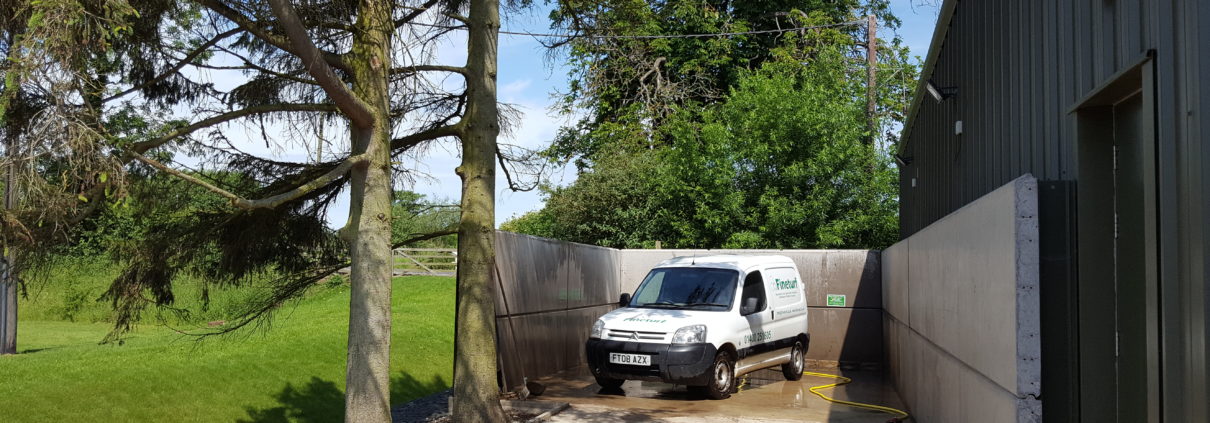
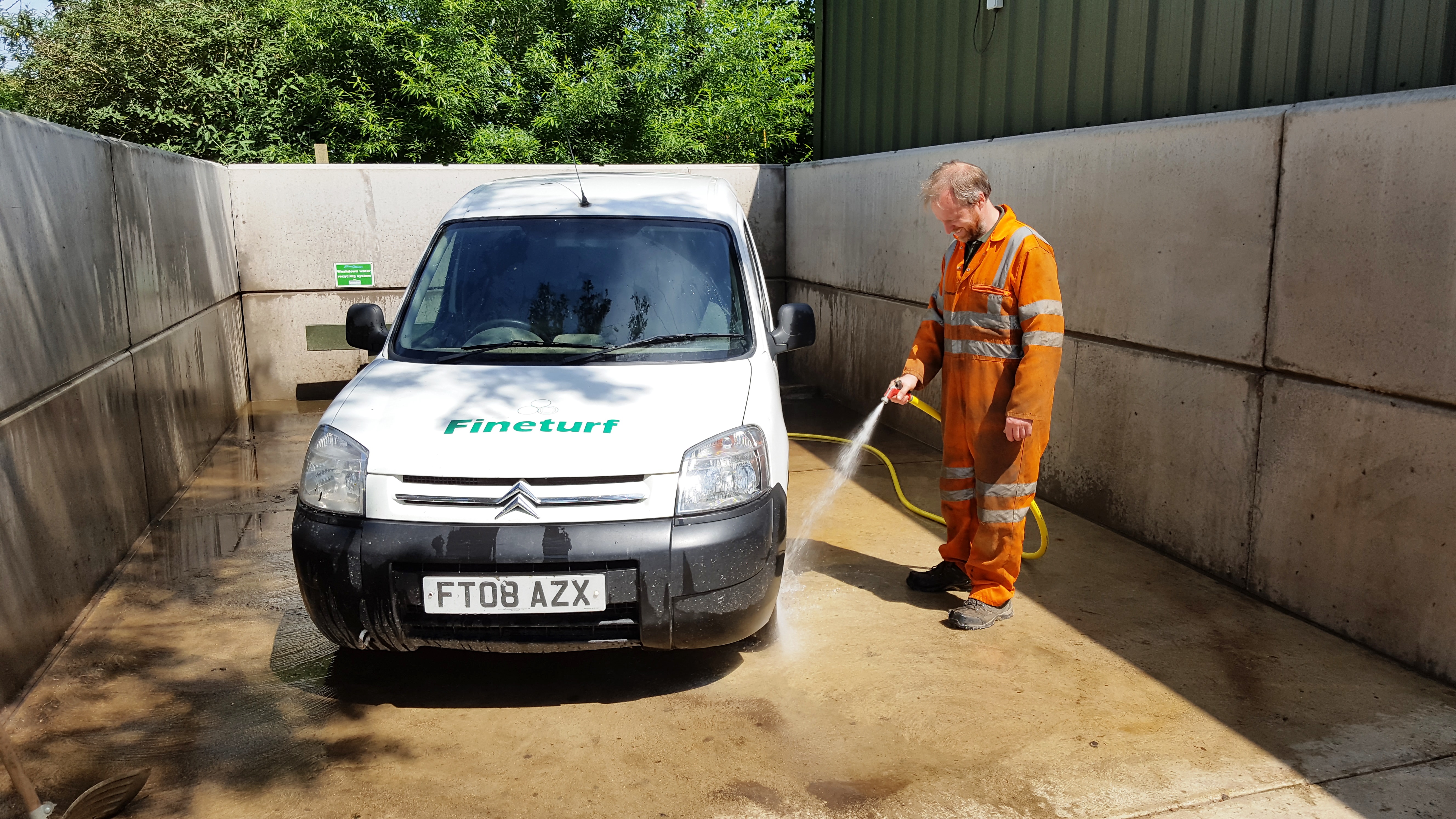
To make the installation as unobtrusive as possible, the below ground system tank was installed behind the workshop and, with the washpad screened from view by specially designed splash-backs, very little is evident as our pictures show!

The ClearWater system is certainly well utilised and washes not only machines used on their own golf course, but also customers machines being serviced, Fineturf’s work vehicles and their own course construction and maintenance machines. Michael Baxter, Head Mechanic uses and looks after the system which includes dosing the system with micro-organisms. He is most impressed with ClearWater’s performance and said; “It’s certainly made life easy. It is so close to the workshop and there’s more than enough water pressure!” One machine, in for maintenance when ClearWater’s post-installation visit was made, was a GKB Combinator (a multifunctional fraise mowing machine), recently back from a job at a Premiership football club. Michael enthused; “This was caked in 2 – 3inches of mud and ClearWater blasts it of; better than a jet wash!” Compliments indeed.

Asked about the maintenance regime, his comment was: “It’s a doddle”. He ensures that the grass trap is emptied regularly and the pad kept clear and clean. Once a week he doses the system with the ClearWater micro-organisms. These micro-organisms (specially formulated and supplied by ClearWater) ensure that any oils, grease, fuel, etc. is treated and the water cleaned for recycling.

More Than Washing Golf Machinery

A Water Technology List (WTL) officially approved ClearWater system not only provides effective wash-off but ensures futureproof legal compliance by preventing groundwater pollution. It also saves thousands of gallons of precious (and increasingly expensive!) water by recycling. An added bonus is that the cost of the project (system and installation) can be offset against taxable profits under the ECA scheme, enabling further cost savings.

Be it golf, sports facilities, public schools, heritage properties, service and machinery dealers, ClearWater offers cost effective and compliant wash-off.  ClearWater Commercial, with its dedicated rinse package, offers the same effective wash-off with a superior finish and is ideal for hi-end vehicles, motor homes, etc.

For the latest industry news visit turfmatters.co.uk/news

Get all of the big headlines, pictures, opinions and videos on stories that matter to you.

Follow us on Twitter for fun, fresh and engaging content.

You can also find us on Facebook for more of your must-see news, features, videos and pictures from Turf Matters.