Tag Archive for: The

Luke Perry Joins The IOG

Luke Perry Joins The IOG: The Institute of Groundsmanship (IOG) has appointed Luke Perry to the newly-created position of SALTEX & Events director, and he will be primarily responsible for the growth, development, management and delivery of the IOG’s annual SALTEX exhibition.

A batchelor in politics, Luke will be based at the IOG’s Milton Keynes HQ in a role that embraces full accountability for SALTEX sales, services, performance and profitability, as well as future strategy while maintaining a high level of client and team satisfaction.

Luke Perry Joins The IOG

Commenting on his new role, Luke – who has a wealth of experience gained through formulating sales strategies, creating partnerships, and determining and achieving business opportunities for a range of exhibition and media companies – says:

“I am excited to be joining the IOG with the aim of contributing to the ongoing success of such a flagship event. I look forward to utilising my experience of over 20 years in the exhibition industry, and to getting to know my colleagues at the IOG as well as IOG members and those throughout the groundscare industry.”

IOG chief executive, Geoff Webb, added: “Looking to build on the success of SALTEX, Luke’s appointment will considerably extend our in-house expertise – not only in delivering SALTEX but also with a view to providing a schedule of year-round events for members. His appointment also assists the development of other existing IOG products and services and will help us continue to deliver excellent benefits to our membership.”

Luke will report to Geoff Webb and will work alongside the IOG’s head of member services – communications & events, Karen Maxwell, who is a key conduit between the IOG and its existing contractors, Events For You and Fusion Media, which between them run SALTEX’s  sales, marketing and PR activities.

For the latest industry news visit turfmatters.co.uk/news

Get all of the big headlines, pictures, opinions and videos on stories that matter to you.

Follow us on Twitter and Instagram for fun, fresh and engaging content.

You can also find us on Facebook for more of your must-see news, features, videos and pictures from Turf Matters.

Ecoline+ The Choice For Watford

Ecoline+ The Choice For Watford: Pitchmark’s Ecoline+ has become the line marking paint of choice for FA Premier League club Watford FC.

The demand for using a premium paint at the Vicarage Road stadium led to trials last season, since when Pitchmark have been further developing Ecoline+. Watford FC became the first to use the improved formula at the opening game of the season against Brighton and Hove Albion in August this year.

Ecoline+The Choice For Watford

In 2018 Scott Tingley, Head Groundsman at Watford FC, set out on what was originally a cost exercise and to see if they could establish the use of one paint for all marking.

“We were using top end paint for the stadium and bottom end for the other pitches,” he says, “we wanted to make it one paint but of course the cost had to be taken into account. We looked at Pitchmark and what we found different was their specialisation solely in line marking products.”

The club had been using Pitchmark’s Direct at the Watford FC training ground and academy, located at the University College London Union Shenley Sports grounds in St Albans. Home to five full-size and two goalkeeping/warmup natural grass training pitches as well as a full-size artificial turf training pitch and fourteen college/academy natural grass pitches, there’s a sizeable amount of line marking required. In the stadium only premium quality is acceptable. Ecoline+ offered the ideal all-round solution.  Ecoline+ is one of the most advanced, low volume, ready-to-use line marking paints available, especially when used in combination with Pitchmark’s Eco and Hybrid markers and special nozzles.

Scott says: “we trialled Ecoline+ and we had no issues, only benefits. We use a Pitchmark Hybrid marker which gives us the quality of a spray marker, without compromising the precision and quality of a transfer marker. Fixture dependent, we can mark up to three times a week and with the traditional wheel to wheel and four-wheel spray markers you lose ground cover and it’s too easy to transfer paint.”

The Pitchmark Hybrid overcomes these problems with a three-wheeled spray design, which is easily manoeuvred over wet lines. The cone nozzles give perfect deep leaf coverage, so you only need one pass.

“It’s easy to use, it feels like a normal wheel marker and you get premium quality.” Scott adds, “it’s quite complex though and needs looking after but if we have any issues Olly Boys, the Turfix rep, gives us second to none service and back-up.” (Turfix is Pitchmark’s recently formed sole UK distribution arm). Using advanced Ecoline+ Watford FC join the many examples of Ecoline+ premium line marking seen every week on TV from the best leagues in the world, including the English Premier League and UEFA Champions League.

Pitchmark is a British company based in Bristol +44 (0)1454 776666 www.pitchmark.com

For the latest industry news visit turfmatters.co.uk/news

Get all of the big headlines, pictures, opinions and videos on stories that matter to you.

Follow us on Twitter and Instagram for fun, fresh and engaging content.

You can also find us on Facebook for more of your must-see news, features, videos and pictures from Turf Matters.

Talk of the Toon

Talk of the Toon: In meeting a host of people from the industry over the years, it’s not unusual to hear someone say they wished they’d moved into their role earlier in their career. So, when Duncan Toon uttered those very words during a visit to Warwick School it didn’t come as a complete surprise.

What was surprising, however, is that Duncan, who was appointed Grounds Manager at Warwick Independent Schools Foundation in June of last year, had come from an excellent job at one of the country’s top football clubs – and he is yet to dip his toe into his 30s!

Talk of the Toon

As Deputy Head Groundsman at Birmingham City’s Training Ground, Duncan was dealing with highly skilled footballers, managers and coaches, and experiencing the buzz of Saturday afternoon home games or midweek matches under the lights at St Andrews. But it is the challenge of preparing eight hectares of natural turf and a brand new 3G rugby pitch for children of all ages which is now really getting his juices flowing.

The Foundation comprises King’s High School for girls aged 11-18 (incorporating Warwick Preparatory School for boys and girls aged 3-7 and girls aged 7-11) and Warwick School for boys aged 7-18. I met with Duncan at Warwick School, which is reputed to be the oldest boys’ public school in the world, having a history stretching, remarkably, back to 914. The focal point of the Warwick School’s sporting facilities is the truly magnificent sports pavilion, one that would do credit to many a County Cricket Ground.

The Halse Pavilion was revamped and modernised in 2013 and was opened by Lord Coe, just year after being Mr London Olympics.

“Working for top end football, at the elite end of sport, was rewarding but the focus was always football. The challenges and the rewards of moving to a multi-sport environment are massive,” said Duncan, as he showed me round his impressive place of work.

“Also, the investment levels schools now make in their maintenance facilities means there are fewer differences to football clubs than you might expect.”

In that regard, Duncan found himself to be very much the right man at the right time because his appointment coincided with a decision by the Foundation to invest significantly in its sports facilities. As a result, Duncan has benefited from being given the freedom to restructure and expand the team and to purchase a range of new machinery to enable the highest standards to be achieved.

Prior to Duncan’s arrival the small team was battling gamely, with minimal and aging machinery, to prepare pitches and keep the grounds under control. The schools were achieving huge successes in sport and winning national competitions, but the strain on resources was beginning to show and investment was needed to ensure pupils could continue to enjoy high quality sporting provision in the long term.

“When I first started, time frames for preparing pitches were tight, making us hugely vulnerable to weather disruption,” recalled Duncan.

Talk of the Toon

“I came for my interview during, last year’s heatwave and the grounds were burnt up and not in the best of shape. The team was doing a great job, but it was clear additional resources were going to be needed. If it had been a wetter summer, with the grass growing, it would have been a real challenge to keep on top of it.”

That heatwave did, however, prove to be the silver lining around the rainless clouds – it’s a stupid meteorologically- based metaphor, I know, but run with it – as it was the catalyst for the first of the School’s major investments at the start of Duncan’s time at the school.

“The first thing we did was put in a borehole – it basically sold itself. I got in a specialist to advise us and within two months it had been approved and then drilled and it has helped us enormously. We have a license for 20,000 litres a day and we are no longer running static sprinklers off taps. That was expensive, so in the long run our borehole will save us money as well as make our lives so much easier.”

With that solution in place, next in line was the machinery.

“The school had invested in a Toro Sidewinder which is great, but we still needed bigger machines and our tractors were very old. I sat down with the Deputy Head of Estates & Operations, Sam Hanson in early March 2019 and we prepared a presentation to ask the Governors for additional investment, which they agreed. It has allowed us to purchase a number of carefully-selected machines to ensure we are fully resourced going into the future,” revealed Duncan.

Among them is the Dennis PRO 34R which has been a huge benefit on both presentation and clean-ups.

“We use it to clean the pitch up after rugby matches and also after training sessions and the brush on the front is a big bonus as it enables you to really get into the sward.

“You’re achieving two key maintenance tasks with it – you are cleaning up all the debris and you are also getting that amazing finish.

I’m really impressed with it.

“They have been arriving over the last few months and everything should be here in time for the start of the next academic year in September.”

With the machines coming on stream, Duncan then had to ensure that there was a quality team to utilise them. His first recruit was Scott Danter, who came from West Warwickshire Sports Centre and started at the same time as Duncan.

“He’s a brilliant worker with a real work ethic and bought into everything we were doing here,” said Duncan, who seems to have a magic touch when it comes to building a strong team, with both existing staff and the new staff recruited over the last 12 months being fully committed to the new regime.

Duncan’s new Deputy, Matt Barnes, was the second appointment, bringing experience in the independent schools sector. He was enticed by the Foundation’s “Project One Campus” which will bring all its schools together in one location by building a new home for King’s High, currently located in the town centre, on the same site as Warwick School and Warwick Preparatory School. King’s High is moving across this summer, with the final elements of the project delivered in September 2020.

Talk of the Toon

Warwick School has historically been a noted rugby school, having produced many fine players in its time, but in reality offers outstanding opportunities in a range of other sports, as does King’s High. The site’s sporting provision allows for cricket, hockey, netball, athletics, rounders and more. It has meant a significant learning curve for Duncan, but he is making full use of the wonderful knowledge-sharing opportunities across the industry.

“I’ve been asking questions of everyone – left, right and centre – and having taken on staff with experience has been important too.”

Those whom Duncan has been grateful to learn from include Gary Barwell, of Edgbaston, current Groundsman of the Year, and Andy Richards, Head Groundsman of Shrewsbury School.

“Before getting the job and starting, I did a lot of reading up and Andy Lee, Head Groundsman at Birmingham Training Ground, helped me to get in touch with various people which was extremely helpful.”

Since taking over, Duncan has brought some of the approaches adopted for a regular match days at a top football club into life at the Foundation.

“Working at the training ground involved a busy schedule; there was a non-stop nature to the job and an awareness that you have to finish your job before someone else can start. That approach really helps a team to thrive and is one the revitalised team here has fully embraced.” he explained.

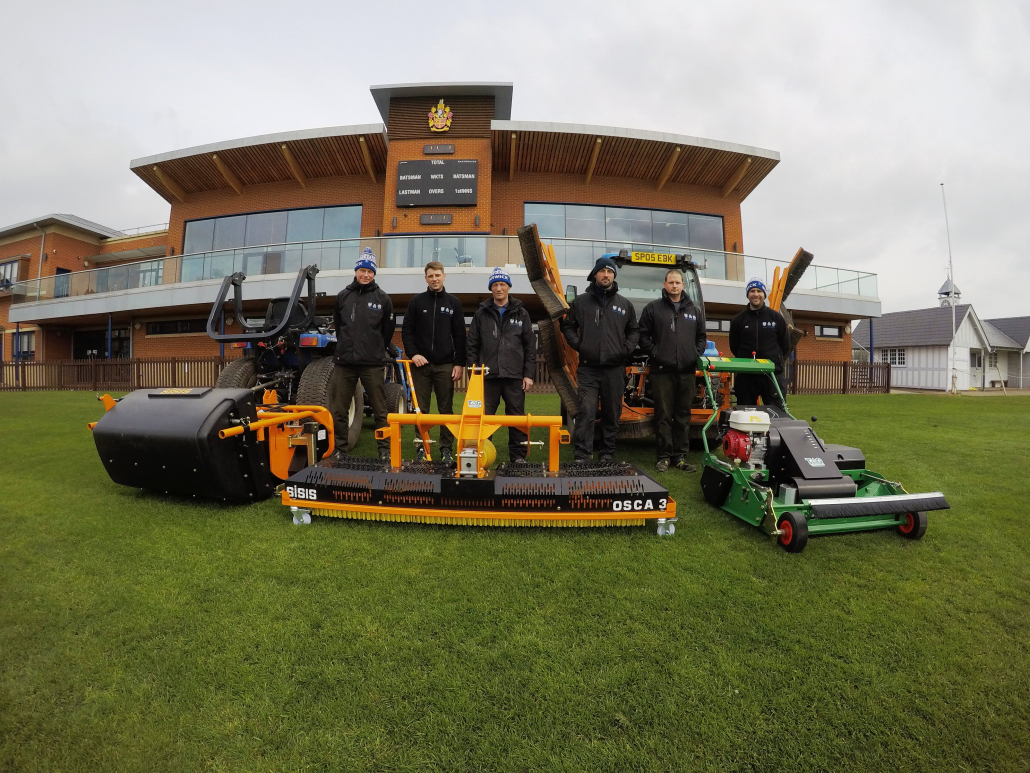
Ah, that team. It has doubled in size and is now six strong: it says much for the endeavours of the team before Duncan’s arrival that even now they have to work flat out to maintain a site measuring 11 hectares all in.

Having received everything he has asked for over the first year of his time in the job, Duncan has put himself under pressure to deliver on all fronts.

“A healthy sense of expectation is what we all need to give of our best. The whole team wants better, and we have been empowered to achieve it. We’ve got a fantastic team and some great machines. The only way I can see us going is up.”

The 3G rugby pitch, with its bright blue border, sits at the heart of the facility and Duncan has ensured that some of the new machines purchased were made to ensure that expensive  new pitch was cared for throughout its lifespan. “You must invest in machines to maintain the 3G because they aren’t maintenance free. A lot of hours go into keeping it up to a top standard.”

“With the industry growing so fast, I like to take advantage of the new technologies coming out. Our initial athletic and rugby markings are done by GPS, saving time and making  sure the markings are perfect.”

Listening to Duncan, he comes over as unflappable and organised and when he says that his ambition for where the school will be in five year is to have standards as high as is possible – “I really think we will be up there” – you can’t help but believe him.

The good news for Duncan is that when it comes to ambition – being on the desirable side of 30 – he will have plenty of time to fulfil them.

The Agronomic Elephant In The Room

The Agronomic Elephant In The Room: Dr Minshad Ansari, left, discusses the Leatherjacket and Chafer Grub problem with Scott MacCallum.

The agronomic elephant in the room over the last 15 years has been what on earth will we do when chemicals we’ve relied upon for decades to ensure our turf can fight back against attacks from pests and diseases are removed from the authorised lists.

The Agronomic Elephant In The Room

We have benefited from the great work being carried out in laboratories across the world to replace those active ingredients, which are no longer with us, with alternatives which have often been more effective and better than what they have replaced.

However, there is one area in which the loss of the recognised chemical has had a major impact on the quality of turf greenkeepers and groundsmen have been able to prepare.

Leatherjackets and Chafer Grubs are relishing the freedom that a chemical-free playground has given them and the damage they are inflicting on turf is enough to reduce the most stoic of turf managers to tears.

It has got so bad in recent times that an Emergency Summit was held by Dr Minshad Ansari, Founder and CEO of Biomena, to pool all necessary expertise and look at what could be done to counter the Leatherjack and Chafer Grubs infestations.

The Agronomic Elephant In The Room

“I’ve been in the industry for 10 years now and seen the widening problem of Leatherjackets and Chafer Grubs but even I was surprised when I saw the damage caused by Leatherjackets at a golf club in Kent. Five greens were completely destroyed as a result of the damage,” Dr Ansari, told Turf Matters.

“Whereas it was very easy to put the chemical pesticide into a tank and go off and spray the recognised active ingredients came off the lists in 2016 and there has been no alternative. The problem is going to accelerate if few don’t do anything,” he explained, of the imidacloprid and chlorpyrifos which have now been banned.

A short term sticking plaster solution has been found with Syngenta receiving emergency authorisation for Acelepryn reapproved for turf for the 2019 season. It has been permitted for use in situations where there is an acknowledged instance of economic damage, or risk of bird strike on airfields and where the product has been recommended by a BASIS qualified agronomist.

The approval will be in place until September 30 of this year.

The Emergency Summit has a host of influential speakers including Professor John Moverley, of the Amenity Forum; Dr Kate Entwistle, and Dr Colin Fleming, and covered topics including Major turf pests and disjeases; the rising threats of plant parasitic nematodes in turf; the biology of Chafers and Leatherjackets; the role of Biostimulants in turf management and root development. Dr Ansari is working closely with Swansea University on biological solutions using nematodes and ensuring that they are utilised to best effect to bring about the most effective outcomes.

“Nematodes do produce results but we have to learn how to use them properly otherwise people will be dissatisfied with the results. There is a way to apply them to get the best results. We are looking at the Leatherjacket and Chafer Grub lifecycle, at which stage they cause damage and at which stage are they most susceptible to nematodes. Learning about the pest is important in order to get the control we are looking for,” said Dr Asari.

The Agronomic Elephant In The Room

“The nematodes can do the job if they are applied in the proper manner – without a problem.”

If there was a key headline to have come out of the Emergency Summit it was that Integrated Pest Management was the solution going forward.

“Whether you have a chemical or biological product you have to use it in such a way that you can get the best control of the pest. There is no single solution,” explained Dr Ansari, who added that better results are achieved by using a wetting agent in conjunction with the use of the nematodes.

Should the status quo remain, more golf courses will be rendered unplayable, or less enjoyable to play, and the work being carried out to find means to resolve the problem is welcome and necessary.

Cromer Courts Among The Best

Cromer Courts Among The Best: Cromer’s tennis players have always boasted that their 10 grass courts are amongst the best in the country – and now it is official.

Following a visit and inspection by an official from the LTA, the sport’s governing body, and an inspector from the Sports Turf Research Institute they have produced their official report which concludes that: “The grass courts at Cromer are some of the best grass courts in the UK. They are well managed, dominated by perennial ryegrass and are open for play for six months of the year. The courts and surrounds are always beautifully presented and are a credit to the grounds team.”

The LTA consider grass court venues such as Cromer to be very important for British tennis and believe it to be vital that events are played on grass throughout the summer and that all players, but especially juniors, have the opportunity to play on grass.

The objective of the Cromer site visit was to assess the quality of the playing surfaces and suitability for holding grass court tennis competitions. The inspectors conducted agronomic assessments of the playing surfaces as well as evaluating the maintenance regimes, staff levels and available machinery and equipment. They carried out a botanical analysis, a soil analysis, which involved soil samples being analysed in the Institute’s soils laboratory, and measured both the surface hardness and the soil moisture.

Amongst the many positive comments were that “live grass cover on courts at Cromer was excellent” and they were very complimentary on the work that is done out of season by way of scarifying, over seeding and top dressing.

The association’s treasurer Martin Braybrook said: “This was a very thorough inspection and the results reflect great credit on our groundsman, Matthew Jordan and his assistant, Peter Cooper. Over the years we have had a succession of excellent groundsmen and we are delighted for Matthew to have received such a positive report.”

Click here to read the original article

For the latest industry news visit turfmatters.co.uk/news

Get all of the big headlines, pictures, opinions and videos on stories that matter to you.

Follow us on Twitter and Instagram for fun, fresh and engaging content.

You can also find us on Facebook for more of your must-see news, features, videos and pictures from Turf Matters.