
Tag Archive for: To

All you need to know about nematodes

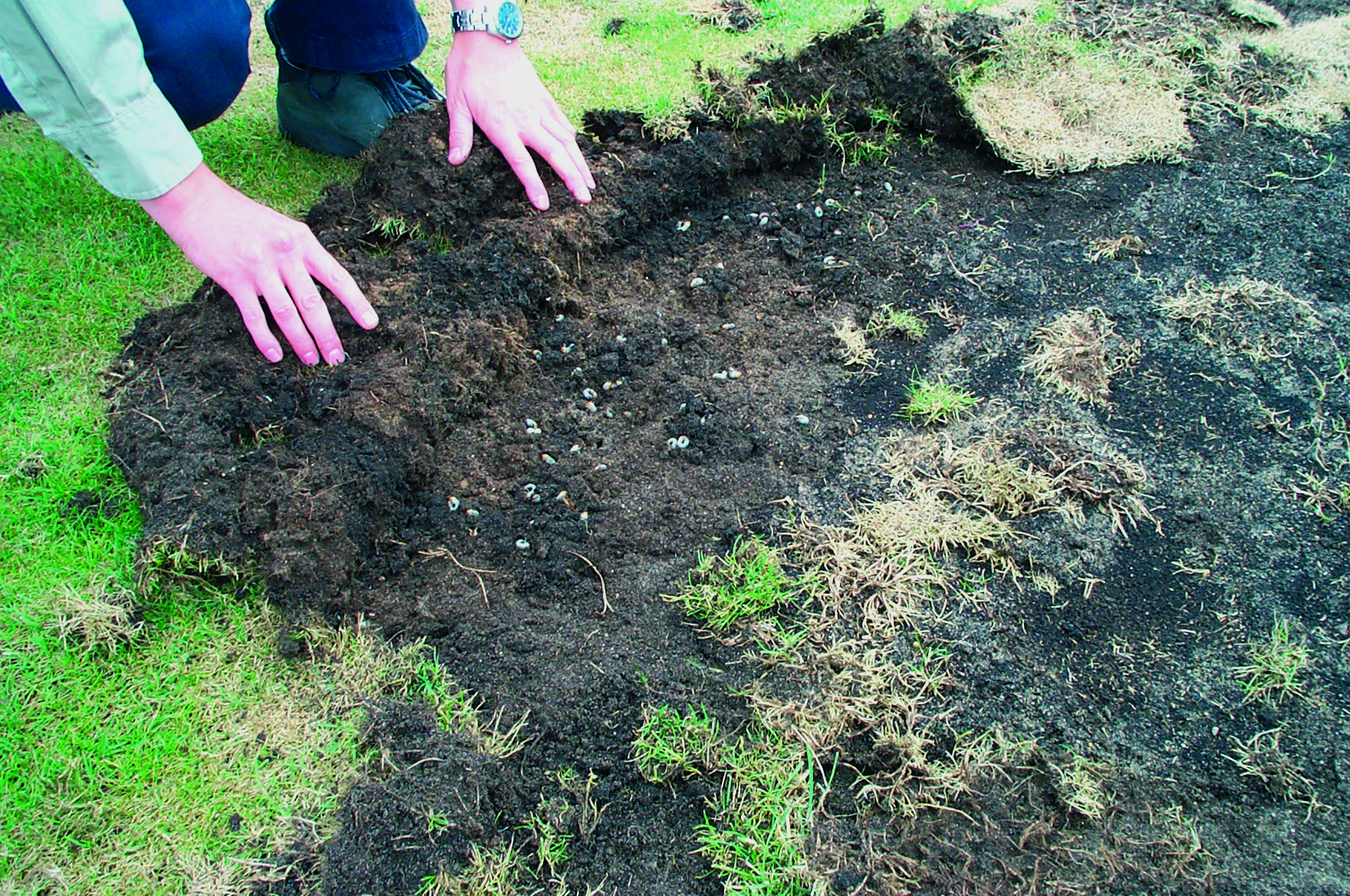
All you need to know about nematodes: Spring is an important time of year for turf management. As the weather warms and preparations are made for the busy summer season, everything must be one to ensure that the turf is healthy – protecting the grass from soil-dwelling pests such as chafer grubs. Helpfully, nematodes can be used to control these unwelcome golf course visitors, which feed on the grass plants’ roots. 

Dr Colin Mumford, Technical Support Manager at Bayer Environmental Science, answers greenkeepers’ questions on how nematode-based products work.

All you need to know about nematodes

All you need to know about nematodes

DON’T NEMATODES KILL GRASS?

It depends. There are two types of nematodes – the ‘bad guys’ and the ‘good guys’. The ‘bad guys’ are plant parasitic nematodes that feed on plant tissue, stress the turf and often make it visually unappealing.

The ‘good guys’ are the entomopathogenic nematodes (EPN) and these don’t harm humans, plants or vertebrates. They are, however, able to target and control turf pests such as chafer grubs and leatherjackets. In this article, I’ll refer to EPN (the ‘good guys’) simply as ‘nematodes’.

HOW DO NEMATODES CONTROL TURF PESTS?

When you apply the nematodes to turf, they travel down to the roots, where the chafer grubs and leatherjackets reside. These pests become the nematodes’ hosts and, once they’ve found them, each nematode enters its host through its natural openings. Once inside, they regurgitate a type of bacteria that paralyses the host and, ultimately, leads to its death.

The nematodes then produce offspring that feed on the inside of that host. Once they’ve exhausted all of the resources available to them, they exit the body. These new nematodes will then go off to seek a host for themselves to complete their lifecycle.

DO ALL EPN NEMATODES WORK IN THE SAME WAY?

This is one of those ‘yes’ and ‘no’ answers. ‘Yes’ once they are inside the host species, they all produce the bacteria, complete their lifecycle and control the pest. But ‘no’ in so far as different species use different strategies to target their host.

For example, Bayer’s Harmonix Tri-Nema product contains three different species. ‘The Hunter’ Heterorhabditis bacteriophora, is a ‘seek and destroy cruiser’ nematode that actively seeks out or hunts its prey before attaching itself to it. Meanwhile, Steinernema carpocapsae is known as ‘The Resident’ because it uses an ambushing strategy that sees it sitting and waiting for a host to come along before jumping onto it to complete its lifecycle. Furthermore, ‘The Explorer’, Steinernema feltiae, has an intermediate foraging strategy between the ‘ambusher’ and ‘cruiser’. It will actively seek out the host but, rather than attacking, it will wait for the host to come past and then it will ambush it.

Ideally, you want to use as many different species as possible so that you’re utilising those different modes of action and maximising the effectiveness of your nematode strategy to control chafer grubs.
HOW DO I STORE THEM?

Ideally, you should use the nematodes as soon as possible after receiving them. But if you can’t get to the golf course because the conditions aren’t right, then you’ll need to store them appropriately.

Don’t open the box in broad daylight/direct sunlight because this is extremely damaging to the nematodes and can kill them. What’s more, don’t expose the nematodes to extreme temperatures, so don’t freeze them or expose them to temperatures above 30°C.

The product will typically come in a cardboard box, but you will need to take the packets of nematodes out of that box and store them in the fridge at a temperature of 4-8°C. Otherwise, the cardboard box will act as insultation, meaning the product won’t be stored at the optimum temperature range.

You want to loosely distribute the packets in your fridge and don’t put them together in one big stack. This is because the weight of all the packs can cause crushing injuries on the nematodes in the bottom pack. Just loosely lay them out in your refrigerator and always use the nematodes before the end of the expiry date on the packet.

All you need to know about nematodes

All you need to know about nematodes

WHEN DO I APPLY THEM?

The timing of application should coincide with egg hatch, or soon after egg hatch. Chafer grubs are the larval stage of several adult beetle species, including Phyllopertha horticola. Therefore, you need to monitor the activity of the adult insects from mid-May until late June.

Leatherjackets are another grass root-loving pest that nematodes can target. These are the larvae of the cranefly, most commonly the European crane fly (Tipular paludosa) although the common cranefly (Tipular oleracea) can also be seen in turf.

Contrary to its name, it’s not the most common species but the difference between this and the European cranefly is that several generations can live throughout the year. So, if you spot a cranefly in springtime then it’s most likely the common cranefly.

You should apply nematodes three to four weeks after you observe a decline in the activity of the adult insects. That way, you know that the vast majority of eggs would have hatched by then. And any eggs that haven’t yet hatched will be attacked by future nematode generations.

DO I NEED TO PREPARE THE GROUND BEFORE APPLYING THEM?

Yes. If you’ve got high levels of thatch the nematodes can get held up in there. So, anything you can do to reduce this prior to applications is advisable.

Also, avoid using granular fertilisers for two weeks prior to, and post, the nematode application because granular fertilisers can do untold damage them.

Ideally, you want to aerate the surface of the turf before applying the product to improve surface infiltration rates and aid the efficiency of the nematodes getting into the soil or the rootzone. Irrigating the day before application should ensure that you have appropriate levels of water in your soil.

HOW DO I APPLY THEM?

Typically, you will be using a vehicle-mounted sprayer or a knapsack sprayer.

You may have to premix a solution if it’s a small capacity tank or a knapsack sprayer. But whichever system you use, try not to apply them using too great a pressure, keep the pressure below 5 bar. The more pressure you have the more force going through the nozzle which tends to produce a smaller droplet. The benefit of large droplets is that they bounce and roll off the turf canopy until they get to the rootzone itself and are able to transport the nematodes into the root system.

You’ll need to remove all filters from your sprayer because nematodes can get trapped. Also avoid using warm water as this could shock the nematodes.

The other point that’s really important to remember is that you don’t apply these nematodes prior to, or during, heavy rain.

In this type of weather, it’s possible for the nematodes to be flushed through the rootzone and down the drainage system.

Finally, avoid applying the nematodes in direct sunlight. The ideal timing is first thing in the morning when you’ve got low light levels.

Fairways GM brings Jacobsen GP400 to Pitlochry GC

Fairways GM brings Jacobsen GP400 to Pitlochry GC: A busy course manager to two golf courses in the central Highlands has raised over £9,000 in his spare time for Scotland’s Charity Air Ambulance Service.

Almost a year ago, a helicopter rescued Stuart Griffiths after an on-course accident left him trapped for nearly two hours under a machine. Emergency surgery and thirteen nights in hospital followed, with Stuart happily making a full recovery and back to work in October.

Fairways GM brings Jacobsen GP400 to Pitlochry GC

Fairways GM brings Jacobsen GP400 to Pitlochry GC

Stuart’s day job is split across two glorious Perthshire courses, eight miles apart. Pitlochry GC has 18 dramatic and scenic holes plus a tricky six-hole Pitch & Putt course while near neighbour, Blair Atholl GC has nine holes, also with stunning backdrops of the Cairngorms’ National Park.  Both courses are owned by Pitlochry contractors, RW Bell Electrical, which in the last five years has successfully harnessed positive community momentum and a resurgence of visitors from near and far, to win some prestigious tourism accolades.

“I joined Blair Atholl in 2010 as head greenkeeper. In 2015, when Stephen Carruthers, owner of Pitlochry, decided to merge the two, he asked me to manage them together, which frankly, took a lot of heat off me, as I was caring for a nine-hole course with a large expenditure,” explained Stuart.

“So, I became course manager of both; the first couple of seasons took a little bit of sorting, in respect of taking staff and machinery between two places, but soon we were in a better routine than before. We are very lucky.  Blair Atholl had a decent set of machinery prior to Pitlochry taking over, so actually, there is very little machinery swapping, only say, when we are spraying or top dressing.

“Staff wise, we work it out, essentially, everyone’s at both. We’re a team of five – full timers Billy Hoggins, Douglas Black, Sean Menzies, and Rob Coughlan, plus our long standing volunteer mechanic, and cutter of rough, Frank Brennan. Traditionally, there’s a big weekly Wednesday competition for visitors at Pitlochry, so on Wednesdays after set up, we all come to Blair Atholl.

To boost their fleet, in April, Stuart purchased a Jacobsen GP400 ride on greens mower, exclusively for Pitlochry’s greens. Mike Lindsay, Area Sales Manager, from local dealer, Fairways GM at Kinross, was on hand to provide sales support and demonstration know how.

“It’s May, there’s snow on the hills and we’ve been out cutting with it twice,” laughed Stuart. “That sorts of says it all for the season so far, but we’re extremely positive and excited for warmer temperatures. Feedback from the team on the GP400 is very good. The overall cutting experience is great. Technology-wise, it is a big step up from what we’ve had; it’s got great design, is precise and clean and we’ll be able to cut the greens so much quicker.”

Fairways GM’s, Mike Lindsay, said: “It’s such an all-rounder when you’re against time and got greens to prepare. The swing-out centre cutting unit allows easy access for changing height of cut and routine inspection.  For access, there’s a neat step behind the front wheel and for visibility, the angle of the curved steering arm gives the best view of the right-hand cutting unit. Also a steering arm clamp, lets your arm take up a really comfy position.  It’s a machine that makes life easier.”

For the latest industry news visit turfmatters.co.uk/news

Get all of the big headlines, pictures, opinions and videos on stories that matter to you.

Follow us on Twitter and Instagram for fun, fresh and engaging content.

You can also find us on Facebook for more of your must-see news, features, videos and pictures from Turf Matters.

Otterbine restores fountain to former glory

Otterbine restores fountain to former glory: After the installation of a new Otterbine, the fountain at the centre of Newquay’s Boating Lake has been restored to its former glory, providing a stunning centrepiece for the whole community to enjoy.

Having served the lake for over a decade, the previous Otterbine Giant Fountain was sent by Newquay Council to Pump Supplies, a leading supplier of electric submersible pumps in the UK, for servicing and repairs.

Otterbine restores fountain to former glory

Otterbine restores fountain to former glory

Steve Impett from Pump Supplies explains: “The previous Otterbine Giant Fountain had been in use for such a long time, and had suffered some damage from vandalism, that while we could have made repairs it was more economical to replace the fountain with a new model, particularly due to the loyalty programme available with Otterbine.”

Showcasing Otterbine’s appreciation for both new and loyal customers, when replacing an existing Otterbine system that’s at least five years old, or replacing other manufacturer equipment with an Otterbine, customers can claim a discount of up to 10 percent of the original purchase price. Combined with Otterbine’s comprehensive four-year warranty for Giant Fountains, the decision to replace like-for-like with Otterbine was easily justified to Newquay Council.

“The whole process with Otterbine and its distributor Reesink Turfcare has been great,” says Steve. “We don’t usually supply or repair  fountains at Pump Supplies but in essence it’s still a submersible pump and we wanted to help the customer in whatever way we could. Otterbine and Reesink were very helpful and knowledgeable so really aided us with that, and we had no problems throughout the process, even with the fact that the fountain had to come from the states in the middle of a lockdown, it still made it across the pond with no issues!

“The new fountain has now been safely installed,” continues Steve. “We’ve placed lights inside rather than outside to help protect them from vandals and now the lake has a great fountain centrepiece during the day and a beautiful light show after dark. Another massive bonus is the fountain keeps the water in the lake clean, clear and healthy too.

“It’s been great working with Otterbine and Reesink, and I would hope to see this develop into more of a relationship in the future,” says Steve. “It’s brilliant to have another offering for our customers that we can confidently recommend.”

To find out more about the Otterbine range of aerators and fountains, contact Reesink on 01480 226800, email info@reesinkturfcare.co.uk or visit reesinkturfcare.co.uk

For the latest industry news visit turfmatters.co.uk/news

Get all of the big headlines, pictures, opinions and videos on stories that matter to you.

Follow us on Twitter and Instagram for fun, fresh and engaging content.

You can also find us on Facebook for more of your must-see news, features, videos and pictures from Turf Matters.

Colour Boost brings conservation closer to home

Colour Boost brings conservation closer to home: Providing a new home, rest and rehabilitation for rescued animals from across the globe, the Wildheart Animal Sanctuary (formally the Isle of Wight Zoo) have, for the last twelve months, been working on a project to support species much closer to home.

With flower mixtures and support from DLF Seeds, the work at the sanctuary and at local schools has been hailed a great success – with Chief Operating Officer Lawrence Bates noting both the improvements in bio-diversity and awareness of the issues affecting our native habitats.

Colour Boost brings conservation closer to home

Colour Boost brings conservation closer to home

Lawrence began planning the habitat creation with the help of DLF’s Paul Hadley in a previous role a few years ago and saw the opportunity to resurrect it upon joining the Wildheart Animal Sanctuary in July 2019. “It can be difficult for people to understand how important our behaviour and efforts are for supporting our own native species that are under threat, when a lot of the media focus is on animals on the other side of the globe. Our vision with this project is to look at spaces closer to home, increase the bio-diversity to provide habitats, shelter and food for invertebrates which, in turn, helps animals further up the food chain.”

“Paul visited the island and advised on the most suitable species for our new flower meadow on site, but also what would work for projects at some local schools, which weren’t going to be maintained by experts!” Selected were Colour Boost 1, a mixture containing quick-to-establish, high impact annuals and Colour Boost 6, comprising of over 40 different species and subspecies, the appearance of which is constantly changing throughout the growing season.

Four flower meadows were sown at the schools on the island prior to the lockdown in March 2020, with the Sanctuary’s own meadow then planted in June 2020. “The result from these two Colour Boost mixtures was phenomenal! Not only did the students benefit from the educational programme around wildflowers and conservation, but it completely transformed previously neglected areas of the school sites, and our own site, with hardy blooms that created a dazzling, long-lasting display of colour.”

“We received so many lovely comments from Head Teachers with numerous other schools now wanting to get involved. We’re also talking to local churches and a number of businesses through the Green Impact Group about new sponsored plots of land.” Lawrence concludes, “The programme is growing fast and the impact this will have on the wildlife is exponential! Without DLF and their ongoing support, the project wouldn’t have got off the ground.”

For the latest industry news visit turfmatters.co.uk/news

Get all of the big headlines, pictures, opinions and videos on stories that matter to you.

Follow us on Twitter and Instagram for fun, fresh and engaging content.

You can also find us on Facebook for more of your must-see news, features, videos and pictures from Turf Matters.

Velvit to sponsor Exeter Chiefs

Velvit to sponsor Exeter Chiefs: South West premium turf care specialists, Velvit, have entered into a sponsorship deal with Premiership Rugby Club the Exeter Chiefs.

Velvit, who are based in South Somerset, have been supplying fertiliser to the Exeter Chiefs through local distributer Tim Wakeham of Wakeham Groundcare for seven years, watching the club go from success to success in that time.

Velvit to sponsor Exeter Chiefs

Velvit to sponsor Exeter Chiefs

James Whittick, Sales & Marketing Director at Velvit explained “We have been supplying Exeter Chiefs for a number of years and have been following their impressive trajectory in that time. We are aware that the live sports industry has been widely affected by the COVID restrictions, and in light of the Chiefs being a local club who have done so much for the region we were proud to be in a position to be able to offer sponsorship for the upcoming season.”

Through the sponsorship deal, Velvit are sponsoring up-and-coming player Alfie Petch who has already had an impressive run of appearances with the England age-graded teams. A Cornish boy by birth, Alfie signed a three-year contract with the Chiefs at the start of the 2018/2019 season and made his debut in November of that year.

Max Sandford who leads the grounds team at Sandy Park said “The overall partnership is vital to ensuring we keep the playing surfaces in the best possible condition and we would like to thank Greenbest for their support they have shown over the last few years!”

For the latest industry news visit turfmatters.co.uk/news

Get all of the big headlines, pictures, opinions and videos on stories that matter to you.

Follow us on Twitter and Instagram for fun, fresh and engaging content.

You can also find us on Facebook for more of your must-see news, features, videos and pictures from Turf Matters.