
Tag Archive for: What

What is it about Durham?

What is it about Durham?:Scott MacCallum talks cricket with Durham School’s Head of Grounds Barry Boustead, learns how a merger with the city’s Chorister School has brought together 600 years of heritage, and muses about THAT song…

One of renowned singer song-writer (and whistler) Roger Whittaker’s most famous pieces of work was Durham Town, in which he sang “I’m going to leave old Durham town.” It’s a lovely song, but having been to Durham recently, I can’t see any reason why anyone would wish to leave.

What is it about Durham?

What is it about Durham?

There can be few more beautiful places in the country in which to earn a crust than Durham – named a UNESCO World Heritage Site in 1986. The sheer beauty of the famous cathedral, which sits majestically above the historic buildings, give it a mystic which would be hard to replicate anywhere. Oh, and it’s a City despite what Roger says. Probably “city” didn’t scan as well as “town”!

One man who has no intention of leaving Durham any time soon is Barry Boustead, Head of Grounds at Durham School, for whom gazing over his view after a full day’s graft is very much balm for the soul.

“My place of work really is quite spectacular. There are not many better settings than this,” said Barry.

“Like many jobs you can occasionally get a bit fed up, but then I just look out over our main rugby pitch to the cathedral and everything seems a little bit better.”

But the fact that Barry has been at the school for 13 years suggests that those days when a “fix” of the view is very much required are few and far between.

“It is a good place to work. I wouldn’t have stayed so long otherwise,” he said, before admitting that his original Plan A had been to remain for around four years and then emigrate to New Zealand!

The job Barry started out with has changed since he began as Head of Grounds, however. He has added the Gardens portfolio too, while a merger with The Chorister School in the city, just last September, bringing together a shared heritage of over 600 years, has increased the number of children using his beautifully prepared pitches and grounds, while adding to the complexity of his role.

“We have inherited two playing fields, one of which has three junior rugby pitches, while I don’t know what the plans are for the other as yet. Personally, I’d like to be a training area to keep them off my rugby pitch, but it will bedown to the sports department at the end of the day,” he laughed.

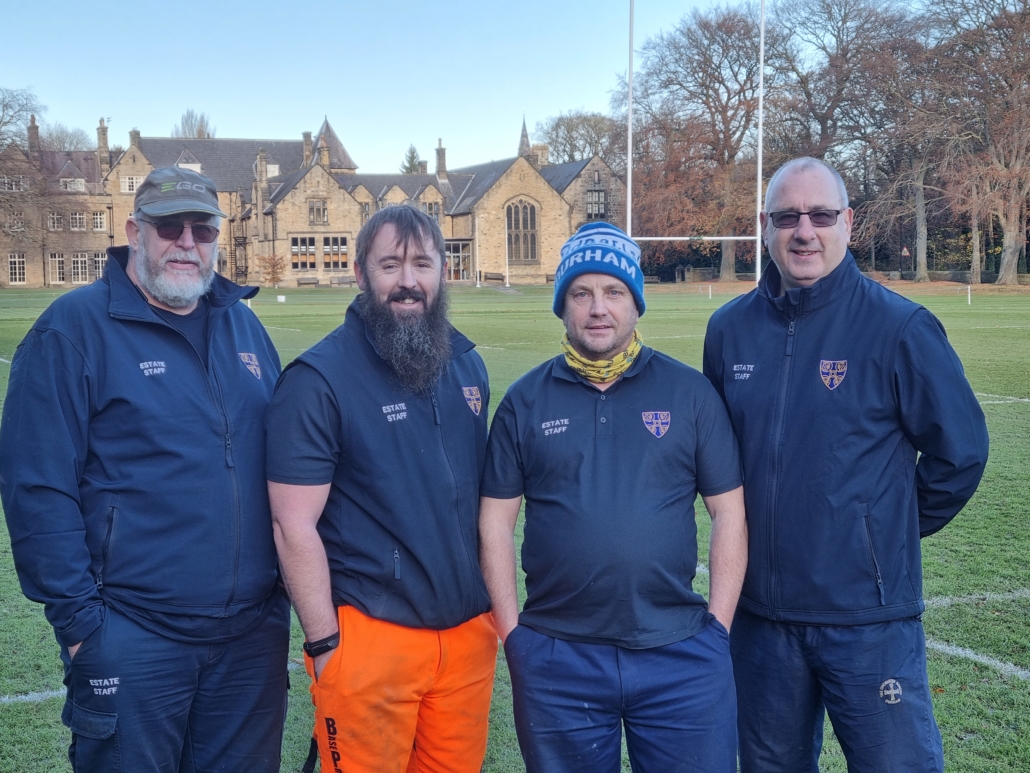
As part of the merger Barry has acquired one new part-time member of staff, Jon Bland, who had been working at The Chorister School, but with Barry himself and two other staff, Damian Merrigan and Darren Keeler, they are certainly kept extremely busy.

“Even visiting the new fields can be a challenge as they are on a busy road and at peak times, or as was recently the case, when a bridge was closed and traffic diverted, it can take 10 to 15 minutes just to make the right turn before we can get back. That sort of time can add up and over a week can be quite significant.”
What is it about Durham?

What is it about Durham?

And time is one thing the team can’t really afford to lose. Particularly over the autumn period when, on a site with so many mature trees, clearing leaves is the Durham School equivalent of painting the Forth Rail Bridge.

“It’s a daily job from October through to January and we clear every leaf off the site pretty much.

We collect them and put them in a pile behind our shed which just builds up and then rots down.”

How many man hours a week are devoted to the task?

“This week for example two of us have been on the job and all we have done is leaves so it’s anywhere upwards of 50 hours a week. Other jobs do take priority but so much time is devoted to leaf clearance. I always have a target of getting every leaf cleared by Christmas, but I’ve not done it yet!”

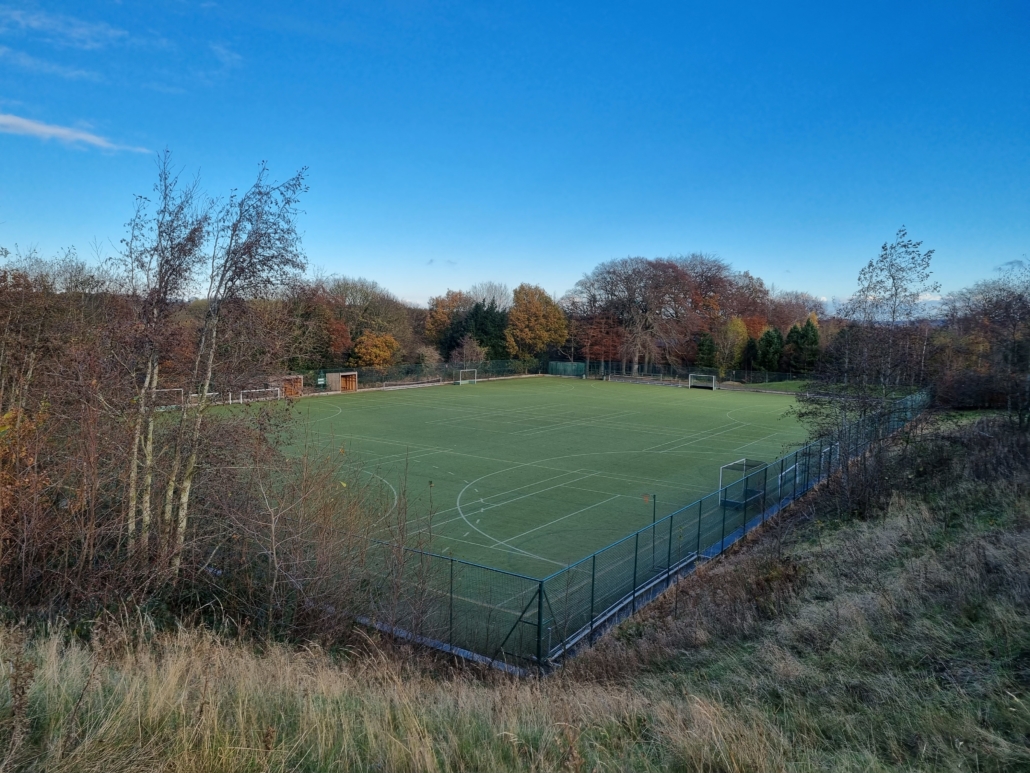
The other on-going issue, also tree related, is the school’s artificial hockey pitch, which sits in a lovely, secluded site surrounded by trees.

“Being surround by trees means that silt – dust or sap – has collected within the profile. Then when we get a heavy downpour the silt rises to the top and it gets very slippy – not something you would want on an artificial pitch.

“We’ve tried different brushing machines and it has improved slightly but we are going to see how this winter goes before we see what our next step is. We are using a SISIS Twinplay with stiff brushes and it seems to do a good job. Ideally, we’d like to do it twice a week but pressure of work means that we can only fit it in once a week. It’s an on-going problem.

“One solution would be to take out the existing sand and replace it but that is costly.”

With leaves taking up a significant part of the year it is grass cutting which occupies the rest and with cricket, in particular, it is an intense fixture list.

“We can have three or four fixtures a week and we have 12 match strips on our main cricket ground and three down on the bottom ground,” explained Barry, adding that the main cricket pitch shares its space with the first team rugby pitch – which boasts sets of posts which reach a remarkable 17 metres – the same height as those found at top grounds such as Twickenham.

To prepare the cricket wickets Barry and the team rely on a single Allett C20 wicket mower, which makes advanced planning an essential part of the job and leans heavily on the reliability of the mower.

“I get the fixtures in at the beginning of the season and then fit in the Cup fixtures as the teams progress through the tournament. I do have a good relationship with the Director of Cricket so he has a good idea of what we are capable of producing.

We can hold three fixtures at once – two on our upper field and one down in the other field.”

On the reliability? Well, that’s not always down to the machine itself.

“I did clip a stud and bent the bottom blade on our Allett,” confessed Barry.

“Fortunately, we do have a good relationship with the University. I started my career there and was at school with the Head Man, Paul Derek’s, kids, and we do help each other out. They helped me with a wicket mower after the bent bottom blade incident, and last summer they had a problem with their tractor, which they use to cut their big fields with gang mowers, so they were able to use our Kioti.”

That kind of mutual back scratching can help solve immediate problems, but also ease the budgetary strain on hire fees which can, with the now longer lead times on spare parts, mount up quickly.

If pushed, Barry would say that his first love is cricket and his aim is always to produce the best surface possible.

“I’m a big believer that a good cricketer will be able to react to any situation and while I do talk with the Director of Cricket I’m never under pressure to produce a wicket to suit our own team. What they see is what they get,” said Barry, who while he didn’t ever play the game, has a real passion for preparing cricket wickets.

So much so, in fact, that he spent a week with Vic Demain and his team at Chester-le-Street working at a Durham county match.
What is it about Durham?

What is it about Durham?

“The week I had was really good. I learned so much, mainly from seeing how the team all operate and come together to work towards the same goal. Vic and I are still in touch and he helps run the Durham Groundsman Association. He is a great communicator and having come from grass roots level has a real affinity with guys in our position – those working with one wicket mower!”

Barry’s arrival in the industry came about very much by chance. He’d begun a degree course in business management at Sunderland which involved a placement working for a year at a local council.

“It was working in the marketing department, but I soon learned that being stuck behind a computer just wasn’t for me. I left and found a position on a summer contract working on the grounds’ team at Durham University.

“When a full time contract came up I got the job and loved it.

They put me through my NVQs at Haughall College, which was just across the road. I did my NVQ 2 in sports turf and my NVQ 3 in sports turf management. I knew at that stage that it was the career for me,” said Barry, whose previous experience had amounted to cutting his dad’s lawn on a weekly basis!

After four and a half years the Durham School position came up and Barry got the job.

As he looks out at the fabulous view of the Cathedral, he has never had any doubts that he chose the right career and is very happy at Durham. Roger Whittaker on the other hand…

EQUIPMENT INVENTORY

JCB 354 tractor
JCB Workmax
Major tractor mounted
roller mower
Toro 6500d
Kioti WD 1260 ride
on mower
3 x STIHL battery
pack blowers
STIHLl BR 600 petrol blower
Billy Goat blower
2 x STIHL strimmers
2x Honda rotary mowers
Ferris FW25 mower
SISIS Twin play
SISIS Rotorake
Allett c20
Dennis 36inch cylinder mower
And my most important and favourite tool in the shed, says Barry, the SISIS Combi Rake.

Ride-on mowers – what to look for

Ride-on mowers – what to look for: When it comes to purchasing a new ride-on mower, there are many manufacturers and models currently available. Whether you require 2wd or 4wd, petrol or diesel, ground-tip or high-tip, there are lots of options. But, what should you be looking at? Les Malin, Managing Director of Etesia UK answers some common questions.

WILL A RIDE-ON MOWER CUT AND COLLECT IN THE WET AND LEAVE A CUT COMPARABLE TO A PEDESTRIAN MACHINE?

The obvious answer is some will, while some will not, but the ones that can will be far quicker over a large area compared to a pedestrian mower. However, there is still a need for smaller pedestrian machines, due to access and transport etc. When it comes to cut and collect systems, Etesia is the innovator of every other machine you see on the market today.

Ride-on mowers - what to look for

Ride-on mowers – what to look for

The French based company created a patented system in the late 1980’s and quite simply, the system is unrivalled. Where models such as our Hydro 80 or Bahia ride-on mowers are useful, is small access points such as gates etc. The British climate is notoriously wet, and on most days when it hasn’t rained, the grass may still be damp, so it’s important to have a machine that is up to the job of cutting and collecting in the wet.

The Etesia Professional ride-on mower range have been designed and developed especially for these conditions. They will pick up wet grass clippings and even leaves in the autumn and have been designed to never clog and everything is fully automated.

CAN YOU EMPTY THE GRASS BOX EASILY WITHOUT LEAVING THE SEAT?

All Etesia ride-on mowers have the option of emptying the grass box directly from the driver’s seat, without ever having to leave the machine. In our larger Buffalo, H100 andH124 models, you can empty the grass box up to 1.24m above the ground which is very useful if you need to empty grass clippings into a skip or hi-tip vehicle for recycling.

Unlike competitor machines, they are designed to be able to tip the heaviest of loads without needing additional counterweights to aid stability. This reduces the overall weight of the machine. The most notable benefit is the fact that Etesia machines do not require any additional accessories to unblock them when emptying the machines.

Everything is automatic so no accessories or rattling of levers are required – you can simply cut, collect and empty the grass box all while sitting on the machine.

CAN I CUT AND COLLECT AND MULCH WITH THE SAME MACHINE?

Mulch cutting has become very popular over the years. Predominately, it’s used as a time-saving form of grass cutting as there is no need to collect clippings or debris and empty. There are also other benefits as mulching can often mean ‘greener’ grass, particularly in times of drought, as the nutrients are put back into the soil after a cut.

Most of the Etesia machines have the option of being able to cut and collect or mulch – it really depends on the users’ preference. Just remember the golden rule when mulch cutting and only cut a third of the grass height in a single cut.

WILL A RIDE-ON MOWER CUT HIGH GRASS?

We do sell a range of Attila brushcutters which have been specifically designed to cut rough grass or brambles and have been known for ‘whatever’ they can push over, they can cut’, however our ride-on mowers are an affordable solution for taming high grass paddocks and fields, meaning that one machine can be used for a multiple of different tasks.

WILL I BE ABLE TO FIT ATTACHMENTS TO A RIDE-ON MOWER OR WILL I NEED A TRACTOR?

That really depends on the type of attachments you would like to fit. However, Etesia also sell a range of attachments from scarifiers, snow plough, sand spreader, weeding brush and also a street sweeper which means that one ride-on mower really can be a 365-days-a-year workhorse.

WILL A RIDE-ON MOWER EFFECTIVELY COLLECT FALLEN LEAVES?

Autumn is a busy time in the garden and collecting and disposing of fallen leaves can be a big job. There is no faster or better way to collect those fallen leaves than with a Etesia ride-on mower.

Another benefit of using a ride-on mower is that the leaves will be shredded which means you will get more leaves in the grass box and composting will be accelerated.

ARE RIDE-ON MOWERS SAFE TO USE?

When choosing a ride-on mower, ensure it has added safety benefits for the user. You need to consider if you are working on slopes, then it will be worth looking at a model with a differential lock for extra stability on slopes or uneven ground. Etesia is the only manufacturer to offer 4wd and or differential lock across the whole range of ride-on’s with mid mount cutting decks.

Vibration is also a big consideration. Etesia machines are rigorously tested in our state-of-the-art factory in France to meet all EU regulations. We also publish all of these figures on our website.

It’s also worth noting that vibration isn’t just a health hazard for the user, but also an indicator of machine efficiency and design. Etesia avoids vibration by fitting correctly balanced components which also has the added benefit of lasting longer.

We still have users of our first generation H100 model that is over 30 years old!

WILL THE MANUFACTURER ARRANGE A FREE, NO OBLIGATION DEMONSTRATION ON OUR OWN SITE?

For the past 30 years, the Etesia slogan has always been ‘Seeing is believing’. For That reason, we also recommend a free, no obligation demonstration to put our machines to the test on your own site. This can be organised by contacting us directly or speaking to one of dealers local to you.

WILL I BE ABLE TO BUY SPARE PARTS EASILY?

Etesia UK holds vast stocks of spare parts for machines dating back to the 1980’s. Selling to the professional market means obtaining spare parts, which is very important to the end user. Consumables are normally off the shelf and we pick 98% of orders consistently. It is only usually obscure items that may catch us out.

Blades and belts are consumable items and will always need to be replaced from time-to-time. If your local dealer hasn’t got the spare part you require, we can usually get it direct from France in no time at all.

In addition to here in the UK, we also work with Kramp who stock many of the faster moving items and can supply dealers on their fantastic overnight service, which benefits from longer opening hours during harvest periods.

The battery that knows what it’s doing

The battery that knows what it’s doing: Intelligent Lithium-Ion batteries are the heart of the new Mountfield cordless range. Batteries that recognise the mower or tool that they are fitted to and tune the power appropriately to maximise battery life and deliver the right amount of power to get the job done.

These new intelligent batteries – believed to be a world first – will help British gardeners roll out the Quiet Revolution of Mountfield battery powered equipment that focusses on ease of use.

The battery that knows what it's doing

The battery that knows what it’s doing

Battery power is rapidly replacing petrol and electric cables as a lifestyle trend in gardening. In the UK in 2020, 12.5% of lawn mower sales were battery and this trend is projected to increase to 23% by 2025. At Mountfield the focus is on delivering cleaner, safer and more reliable energy supply.

All the battery lawnmowers and hand-held tools in the Mountfield range, new for 2021, are built from lightweight, robust materials. Whether mowing, cutting, trimming or clearing, they are as powerful and long-lasting as their petrol equivalents but with none of the noise, fumes and hassle of engine maintenance.

This cut away of the STIGA 48V battery clearly shows how cooling air can freely circulate around the battery cells to help prolong operating and shorten recharge times.

E-Power works ‘smart’ in both the 20V and 48V battery systems. In the freedom100 Series of lawnmowers and hand-held tools, the 20V battery has a microchip. The Smart Tool Recognition System recognises the type of tool and tunes the power appropriately to maximise battery life and performance of the machine being used. This cost-effective, adaptive battery performance is unique to Mountfield and none of the main competitors in this price segment offer this. The 48V battery has an internal memory that registers all working parameters and communicates any issues between the battery, the tool and even the charger. The self-propelled mowers in this range are powered by two 48V batteries that work as a synchro pair – the powertrain balancing the energy load and synchronising the discharge for maximum efficiency and cutting performance.

Mountfield batteries are tested at a full, “real-life” usage current that goes far beyond the test widely used in the industry, that is less demanding. Industry Standard tests only 300 charges at 20% of the “real-life” usage current. The Mountfield E-Power batteries, developed, tested and produced at STIGA’s Italian plant, were still gong strong after 600 charges. That is the equivalent of an owner running down and recharging the battery twice a week for six years.

From the family-friendly simplicity of the Freedom100 series to the longer-lasting power of the Freedom500 series, E-Power can drive the smallest tool or the biggest lawnmower including Mountfield’s first ever battery-powered garden tractor range.

“Our new battery is a real game changer,” says Gary Tully, sales and marketing director of STIGA UK. “For the first time there is a battery powered lawnmower suited to small gardens with pocket handkerchief sizes lawns and significantly areas of grass in country houses. This is a first for British gardeners.”

Mountfield is owned by STIGA UK Limited and the lawnmowers and hand-held gardening tools being launched this year are all produced at the company’s Italian plant.

For the latest industry news visit turfmatters.co.uk/news

Get all of the big headlines, pictures, opinions and videos on stories that matter to you.

Follow us on Twitter and Instagram for fun, fresh and engaging content.

You can also find us on Facebook for more of your must-see news, features, videos and pictures from Turf Matters.

Lawn Care Legends – Who, What and Why

Lawn Care Legends – Who, What and Why: John Ryan, Founder of Lawn Care Legends, gives Turf Matters an insight to the thinking behind one of the fastest growing groups in the industry.

I’m John Ryan and I am a self-employed lawn care contractor based in Bangor, Northern Ireland and the founder of Lawn Care Legends, who grew from an idea formed back in July, 2017.

Lawn Care Legends - Who, What and Why

Lawn Care Legends – Who, What and Why

My thinking was that the lawn care community has expanded on social media across the world from YouTube to Facebook and Instagram particularly.

However, an unfortunate aspect of social media in this day and age, is that it creates a platform often with little accountability and, depending on an individual’s position, perhaps anonymity. This makes it easy for those who would choose to belittle or criticise anyone wanting to learn more about their trade, craft or industry to do so without any consequences.

This can typically be seen in Facebook groups across a range of industries. Where someone will ask a question, in the hope that someone with experience and knowledge would be willing to share their knowledge to help a peer achieve better results either in their current project or self-development, but be met with mocking and abuse. (Sometimes as banter, but mostly in criticism).

These prevalent negative attitudes see people holding back from asking questions, or not feeling comfortable to share their views perspectives or to ask questions for fear of being ridiculed.

Lawn Care Legends - Who, What and Why

Lawn Care Legends – Who, What and Why

This prompted me to create Lawn Care Legends, the Facebook group.

Our aims are simple. To create a Facebook group where we try to operate on the basis of respect, encouragement and passion for what we do in a professional environment on social media. An international collective.

One aspect of the lawn care community online is the difference that can be seen across the globe with varying styles and approaches to our respective trades.

Although each country has its own standards for operation in our industry, I felt Lawn Care Legends could benefit from the various perspectives that people from different countries could add as valuable content. In an industry that has a lot of service providers, it can be difficult to stand out and so with the ability to access information shared by people from other countries as well as our own we can gain inspiration and drive for our businesses.

So, Lawn Care Legends allowed the development of a new addition to the community we are all a part of in one way or another. We enjoy members contributions mainly from the UK, Ireland but we have members who contribute from the USA, Norway, France, Australia, Canada, Serbia and more which makes for a lot of variety.

To run a Facebook group is not an easy task and the people behind the scenes that make this possible are the admin team of LCL. A friendly bunch with a wide variety of skills, qualifications and knowledge in all aspects of the lawn care industry.

From the basics of grass cutting, shrub/tree cutting, to treatments, landscaping, pond installations and maintenance, and also insight from the dealers side of the industry.

The admin team is currently made up of: Alan Adams from (NI); Paul McGill (Scot); Ryan Powala Higgins (Eng); Richard Jones (Eng); Kaz Dunsmore (Scot); Robert Ross (Scot); Tom Duchesne (Eng); Jay Chillingworth (Eng); Danny Clegg (Eng); Ben Morrison (Scot), and Di Dodds (Aus).

Lawn Care Legends - Who, What and Why

Lawn Care Legends – Who, What and Why

There have been many people who have contributed to the success of LCL during their time on the admin team before moving onto other projects or priorities. One key individual who really helped LCL become more connected with manufacturers and reps, is Ashley Bevan, from Weston Garden Machinery. His amazing support really played a huge role in get the industry to support the LCL Awards.

As we encountered more and more people on-line, I think we’ll agree that we still enjoy a good meet up with people in the real world. It is hard to replace the benefits of shaking someone’s hand and getting to know others better without giving your thumbs or fingers an ache from typing.

So, one thing that we have tried to do is organise LCL meet ups where possible. We started doing this in early 2018, with our first meet up at Rochford’s Garden Machinery, in Wincanton, and we have gone on to host meet ups in Scotland, Northern Ireland and the Republic of Ireland, with the intention to organise and host more events in the future.

We hope to organise an LCL business training event in 2021 as well as an LCL demo day, then we will combine those events into one event in 2022 for England, Scotland and Northern Ireland. If it proves successful we will look to more locations, with the aim of helping more people.

The purpose is simple really. Everyone loves a good meet up and it is a great way to network, training and education. It allows people, who otherwise wouldn’t get the chance, to demo machinery and get a feel for different brands and their equipment.

Back in January of 2020 we had organised a factory tour and LCL meet up at the Ariens factory, in Oxford, where we were greeted with amazing hospitality and open arms by another manufacturer that wanted to support our community and the desire to connect people better. We had demos of Ariens zero turns as these are now made at the facility.

We also took part in a zero turn challenge with prizes awarded, while Ariens collaborated with Kawasaki Engines Europe to conduct a workshop class on engine maintenance on xero turns. We even had our own pizza van on the day and topped off with a swag bag with gifts and discount vouchers to buy some products.

It took around five months from the time Lawn Care Legends was created, to start gaining traction and membership started to increase. From that point it has grown to over 5,000 members representing.

To make the group stand out and to try and bring value to the members, the idea of LCL awards was floated, with the aim of creating our own event within the industry to celebrate the small business owner.

And so the Lawn Care Legends Awards were created. Of course, they would be operated online, in the spirit that this new digital age that has benefited so many in different ways. However, there is still a lot to be said for face-to-face contact and discussions with people.

I then set out to see if it was possible to collaborate with an industry event that would allow us to host our Awards’ presentation.

An obvious choice was to reach out to the IOG, so named at the time, and Saltex. I pitched the idea of a little Awards’ event, that would celebrate the average business owner in our trade. I believe if you don’t ask, you are guaranteed the answer is “No”.

Lawn Care Legends - Who, What and Why

Lawn Care Legends – Who, What and Why

Well, I got an amazing reply that displayed a real desire to work with us.

From originally asking if it was possible to use a little corner of the show, we were being allocated the use of a large private room. Fusion Media also produced a press release about our awards, which got our name out to industry magazines and online media platforms.

In addition, we were featured in the opening letter by the IOG CEO Geoff Webb. So, in 2018, we held our first LCL Saltex Awards. We had an amazing turn out of over 100 members. We had started with a little vision and pitched the idea to just a few companies to gain support on which we could build.

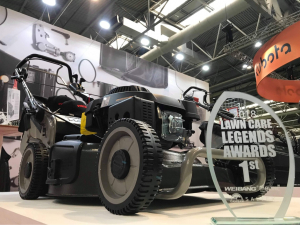
The first company to see the potential of a positive contribution to our community, came from Weibang Ireland. They were so excited about the idea and wanted to be a part of it and offered a lawn mower as the first prize.

Those first Awards began with just three sponsors: The IOG, Weibang Ireland and Blinc NI. By the time we came back a year later we had grown our sponsors to 12: Weibang Ireland and Weibang UK, ECHO, EGO, Hendon Ladders, Kawasaki Engines Europe, Ferris Mowers UK, Wright Mowers UK, Cub Cadet, Jobber, Green Touch Industries and the IOG.

Despite so many things having been disrupted in 2020, we already have over 20 sponsors lined up for the LCL Saltex Awards 2021, with around £10,000 worth of prizes.

We just want to be able to give the average guy in our industry the opportunity to have his picture taken, be praised for his high standard of work, be presented with a trophy and win awesome equipment which will contribute to his business and service for the better.

It is all part of our dream, and with the support and recognition from industry manufacturers, to spur our community on to do better and take pride, we can come together in a positive manner… and that includes everyone from the end user; landscapers; greenkeepers; groundsmen; gardeners; business owners/operators; dealers; distributors and manufacturers.

Some might think that we are just a little Facebook group, but we are determined to be so much more, and have already come a long way.

Perhaps we might see you guys around some day, either in our group or at one of our events – something positive for us all to look forward to.

What your lawn needs to eat

What your lawn needs to eat: The Lawn Association team know that you will be wishing for a lawn like the one pictured this summer!  But to get this result, you need to plan now!

Our latest guest blog is from a specialist who knows exactly what your lawn needs to eat to ensure it is happy, healthy and green.

What your lawn needs to eat

What your lawn needs to eat

Rhys Norville, UK Sales Manager for Terralift UK, has offered his advice below.

We all need food but which is the correct food for your lawn?

Lawn fertilisers contain three main elements to aid grass growth: Nitrogen (N), Phosphate, (P) and Potassium (K). These elements will be listed on the fertiliser container in a way that describes the percentage of each element contained in the mix. For example 6-2-8 contains 6% Nitrogen 2% Phosphorous and 8% Potassium.

There are different mixes for different times of the year, and to understand why we need to consider what each of the three elements actually does.

What are the major nutrients for grass growth?

Nitrogen: the main role is to improve the grass’s growth, but nitrogen also enhances the green colour. More Nitrogen is needed when growth rates are high, so in Spring and Summer, you need a fertiliser with a higher nitrogen content than in Autumn & Winter.

There are different forms of Nitrogen which release at different rates. For example, the readily-available Nitrate form can be absorbed instantly by the plant to boost growth as soon as it is applied. Urea, by contrast, has to break down before the plants can absorb it, taking up to twelve weeks but providing a slower and steadier feed to the plant.

Phosphate: Phosphate helps to maximise the development of new shoots after mowing. Similarly, it is important for helping new seedlings to establish good roots, and so is a useful application after any overseeding.

Potassium: This toughens up the plant’s cell-wall structure and increases its resistance to wear. It does this by keeping the grass blades ridged and upright. As with Nitrogen, Potassium can also boost the colour of the plant. Potassium applications are most common in Spring and Autumn.

What else is in your fertiliser?

It might contain Magnesium for colour hold, and to help the leaves convert nitrate into protein.

You might also find Iron as this helps the grass to develop a dark green. Iron is also used to reduce the impact of moss in grassland areas. However, iron is a trace element and the plant only requires small amounts to grow. Be careful not to over-apply iron as it can cause stress to the plant and reduce the soil’s pH which, in turn, can encourage disease and weed infestation.

Microbial activity

Microbes play a vital role in maintaining healthy soil for your grass. When the microbes within the soil are working well, they help with chelation of nutrients, natural disease suppression and regulating growth rates, so we should aim to support them as much as we possibly can. You need an organic granular fertiliser (more on this below) which contains carbon and humus.

Different types of granular fertiliser

Granular lawn fertiliser is sold as three main types:

1. Mineral-Based;
2. Organic;
3. Coated Mineral Fertiliser.

Mineral-based: This is the most common fertiliser in which different percentages of NPK are bound to an ‘inherit’ carrier such as clay or zeolite. This material helps to distribute the nutrients evenly across the lawn when spread.

Organic fertiliser: This will contain a composted organic material which may be manure or food waste, to which mineral fertiliser is mixed and bound. This creates a two-in-one application as the mineral fertiliser is being applied to support plant growth whilst the organic portion will serve as a soil conditioner to boost root development and to support healthy microbes within the soil.

Coated fertilisers: These are mineral fertilisers which are coated in a polymer to slow down the release of the fertiliser. The advantage is that you don’t have to apply fertiliser quite as often, some lasting up to six months. But of course, that makes it harder to tailor your fertiliser mix to each seasonal requirement – and the polymer may be plastic and pollute the land too.

Liquid fertiliser

There are forms of liquid fertilisers which are applied by spraying, using a knapsack or boom sprayer. The benefit of a liquid fertiliser is that it is absorbed almost immediately by the plant and so can increase growth rates within a few hours. This makes it an instant pick-me-up but of course, the benefit does not last as long as granular fertilisers which go into the soil. Every time you cut your lawn you will be removing some of the liquid fertiliser that was applied, whereas a granular will stay in the soil pool for the plant to absorb it.

Longevity of fertilisers

Typically the effects of a mineral granular fertiliser will last for around 6 weeks whereas an organic can last up to 12 weeks and as mentioned above some coated fertilisers will last up to 6 months. Liquid fertiliser will need to be reapplied after 3-4 weeks for consistent growth patterns.

However, longevity will also depend on factors such as rainfall, temperature, soil type and frequency of cutting. If you live in an area with lots of rainfall, this rain will leach the soil of nutrients, so you may need to apply fertiliser more frequently. And the warmer the soil, the quicker the fertilisers will be broken down (hence summer applications will not last as long as winter applications). Sandy soil will leach nutrients quicker than clay soil.

So these factors also need to be considered when selecting which fertiliser to use.

What does the Terralift expert use? 

Rhys tell us that he only applies Organic Granular Fertilisers, and he uses:

6.2.8+Mg in Spring Time
10.2.4 in Summer
6.2.8+Mg in the autumn usually after scarification and overseeding
3.0.6 as an over-wintering fertiliser.

Our core mission is to make accurate lawn care information freely and readily available via our website and through our Free Membership Scheme for gardening enthusiasts. Go to the @LawnAssociation Facebook page to join the Lawn Enthusiasts Group, and get free association membership via the website, www.lawnassociation.org.uk 

For the latest industry news visit turfmatters.co.uk/news

Get all of the big headlines, pictures, opinions and videos on stories that matter to you.

Follow us on Twitter and Instagram for fun, fresh and engaging content.

You can also find us on Facebook for more of your must-see news, features, videos and pictures from Turf Matters.