Tag Archive for: Change

Charterhouse announce corporate name change

Charterhouse announce corporate name change: Effective from the 1st July 2021, Charterhouse Turf Machinery will officially re-brand to become Redexim. While the product portfolio, premises and personnel will be unaffected, the change of name brings the UK into line with the Redexim corporate strategy adopted throughout Europe and the rest of the world.

The relationship between Charterhouse and Redexim has been ongoing for more than 35 years, when Charterhouse were appointed to distribute the now iconic Redexim Verti-Drain®. The success of this partnership then saw Charterhouse become a wholly owned subsidiary of Redexim bv in 1997. With the Verti-Drain® firmly setting the standard for professional aeration, the product portfolio has expanded significantly over the years to incorporate overseeders, topdressers, scarifiers and renovation equipment for natural surfaces, as well as a range of machinery options for artificial playing surfaces, that meet the exacting standards of today’s turf managers.

Charterhouse announce corporate name change

Charterhouse announce corporate name change

Commenting on the re-brand in the UK, Redexim Chief Operating Officer Herman de Bree said “The team at Charterhouse have done a fantastic job over the years at cementing the place of the Redexim natural and artificial ranges with leading turf managers throughout the UK. The time is now right to unify the approach with that adopted throughout the world by delivering sales, service and support under the Redexim banner. This will help to strengthen our brand awareness and global corporate identity and streamline our communication with customers around the world.”

For the latest industry news visit turfmatters.co.uk/news

Get all of the big headlines, pictures, opinions and videos on stories that matter to you.

Follow us on Twitter and Instagram for fun, fresh and engaging content.

You can also find us on Facebook for more of your must-see news, features, videos and pictures from Turf Matters.

Sea change for Greg Harris

Sea change for Greg Harris: Ex-Royal Navy weapons engineer Greg Harris from Fife in Scotland has won SRUC Elmwood’s annual John Deere HNC Golf Course Management Student of the Year Award, sponsored by John Deere and Scottish turf dealer Double A.

Greg was chosen particularly for the leadership and mentoring skills he displayed during the 2018/2019 academic year.

Sea change for Greg Harris

Born in Dundee and brought up in Kirkcaldy, Greg took up an apprenticeship with the Royal Navy at the age of 19 and spent 12 years with the service until he was medically discharged in 2016 with knee problems. However, this paved the way for his next career move into greenkeeping and golf club management, as he was still encouraged and able to play golf.

While deciding what to do next, Greg was playing regularly at The Duke’s Course at St Andrews as well as his father’s local club at Glenrothes, where the pro mentioned the SRUC course.

“I realised I was never going to be a good enough golfer to turn pro, but taking up the greenkeeping option meant I could still be active and involved in the industry,” he says. “I attended an open day at the college, where I spoke to course tutors Paul Miller and Ian Butcher who outlined the opportunities and were very supportive, so I put in my application and was accepted.

“I thoroughly enjoyed the course and the people I met. I think my Royal Navy background prepared me well for many aspects such as planning and teamwork, which are key skills for any greenkeeper. The academic side of things was never a problem, and I also enjoyed the hands-on time spent as part of the tournament support team at Kingsbarns Golf Links during the Alfred Dunhill Links Championship.

“Everyone there was really accepting of me, considering my relative lack of practical skills. They recognised that I was there to learn and it was a great experience, apart from my least favourite job, swishing the dew off the greens!

“The John Deere award was mentioned at the beginning of the course, but I never gave it another thought. When Ian told me towards the end of the academic year that they were going to nominate me and I then found out that I’d won, I was really surprised but also very proud of the achievement.

“Since graduating I’ve ended up away from greenkeeping, and moved more towards golf operations – I worked in the pro shop at The Duke’s Course for the season following the course, and currently I’m assistant store manager for American Golf in Dundee. I did plan to return to Elmwood and do the HND course, but as that isn’t running this year we’ll see what happens next. If it runs again it would be a really good opportunity to go back and see how I can progress in my second career.”

Course tutor Ian Butcher, who is based at the Elmwood campus in Cupar, Fife, adds: “Throughout his time at SRUC Greg was a positive influence on the student group. He was a natural leader, and many times supported both individuals and the HNC team as a whole to meet various challenges. He consistently showed initiative, enthusiasm and a capacity for mentoring which is rare. This is of real value to us as an organisation, as we seek to involve our students more in the development of the SRUC programmes.

“Greg is one of a new breed of graduates who are open-minded as to their career paths, and is enthusiastic about gaining experience beyond the golf course maintenance shed. Taking advantage of workplace experience in customer services at The Duke’s clubhouse within the Old Course Hotel Golf Resort at St Andrews is an example of Greg having a more varied role in golf operations during last summer.

“His passion for the game combined with a long-term career perspective opens more doors for Greg, and we trust he finds the right opportunity to progress in his chosen profession. We look forward to him being a great ambassador for us.”

For the latest industry news visit turfmatters.co.uk/news

Get all of the big headlines, pictures, opinions and videos on stories that matter to you.

Follow us on Twitter and Instagram for fun, fresh and engaging content.

You can also find us on Facebook for more of your must-see news, features, videos and pictures from Turf Matters.

Time Of Change At Woking GC

Time Of Change At Woking GC: It’s been a time of change for Woking Golf Club in Surrey culminating in the recent signing of a machinery agreement plan with Toro and Reesink Turfcare.

It all started a couple of years ago and has seen the appointment of Andy Ewence as course manager, major works to restore the course to its fast running heathland roots and the undertaking of some modern initiatives in preparation for the milestone 125th anniversary in 2018. The result is a club that has risen 22 places in the Golf World Top 100 Golf Courses in Britain and Ireland ranking in 2018, now ranked 17th in England, and the delivery of a new Toro fleet is the icing on the cake says Andy.

Time Of Change At Woking GC

For 125 years golfers have been playing at Woking Golf Club, Surrey’s oldest heathland golf course, and it was this milestone moment that sparked a period of change, confirms Andy: “My appointment in 2017 coincided with progressive plans for the club. There have been major works to the course and the pressure is always on to maintain and improve.”

Andy has long been a Toro customer so is very aware of the quality of the machinery and the advice and service provided by Reesink Turfcare. At The Buckinghamshire, where he spent five years before joining Woking Golf Club, there was a five-year leasing plan for machinery in place and Andy had just finished overseeing the installation of a new irrigation system across the 226 acre course.

He says: “I knew from experience that Toro was well ahead of the competition, but it’s like chalk and cheese when you compare Toro to what we had here before. The quality of machinery and the service is just unbeatable. However, we made sure to explore all the options when the last lease ended. We trialed machines from several different brands, but it proved quickly that Toro was the right way to go.”

Now with a comprehensive Toro fleet which includes a Greensmaster TriFlex 3400, Groundsmaster 4000-D, ProCore 1298 and a Workman HDX-D to name a few, Andy is thrilled with how the new machines are meeting the needs of the club as it enters its 126th year.

“We have undulating greens, so having pedestrian mowers that provide precision and a high quality of cut is really important,” says Andy. “In particular, the Toro Greensmaster eFlex 2120 is great. The Lithium-ion battery technology reduces noise so we can get out and start work earlier, plus it saves fuel.”

And, as mentioned, it’s not only the machines that have impressed Andy, but the advice and service from Reesink, too. “The whole process with Reesink has been great,” he says. “They didn’t try to sell us anything the club didn’t need – they listened to what we wanted and came back with the best possible solution. They’ve also come in and given a day long training course to the team on how to use the machines. Nothing has been too much trouble.”

Woking Golf Club is a prime example of golf course architecture. Designed by Tom Dunn and further improved by former members John Low and Stuart Paton, it has long been regarded as an essential place to study for aspiring and existing golf architects and with keen eyes on the club, Andy is confident that with Toro on board the course will go above and beyond expectations.

“I’m sure the playing surface is only going to improve massively with Toro now at the club,” he says. “It’s definitely going to bring the already high standard of the course up a notch, which we’re all really excited to see.”

For more information, visit: reesinkturfcare.co.uk

For the latest industry news visit turfmatters.co.uk/news

Get all of the big headlines, pictures, opinions and videos on stories that matter to you.

Follow us on Twitter for fun, fresh and engaging content.

You can also find us on Facebook for more of your must-see news, features, videos and pictures from Turf Matters.

Climate Change In Cricket

Climate Change In Cricket: Cricket has always been a sport at the mercy of the weather.

In the 1930s, county cricket clubs in England were headed for financial ruin after a succession of wet summers. Twenty years later, persistent rain saw desperate clubs experiment with blankets, rubber mats and suction machines.

As recently as the summer of 2012, three of England’s 13 ODIs were abandoned due to rain, while no result was possible in two of their seven Test matches with West Indies and South Africa.

That’s why the sport must take notice of a report published by Climate Coalition, the UK’s largest climate change action group, in February.

The document names cricket as the sport that will be hardest hit by climate change in England, stating that “wetter winters and more intense summer downpours are disrupting the game at every level”.

That was reiterated by Glamorgan Head of Operations Dan Cherry, who warned that climate change could “fundamentally change the game”.

“The less cricket we play, the fewer people will watch it, the less they will come to the ground and pay to enter, the less chance there is for young people to be inspired,” said Cherry.

This change, it seems, has already begun.

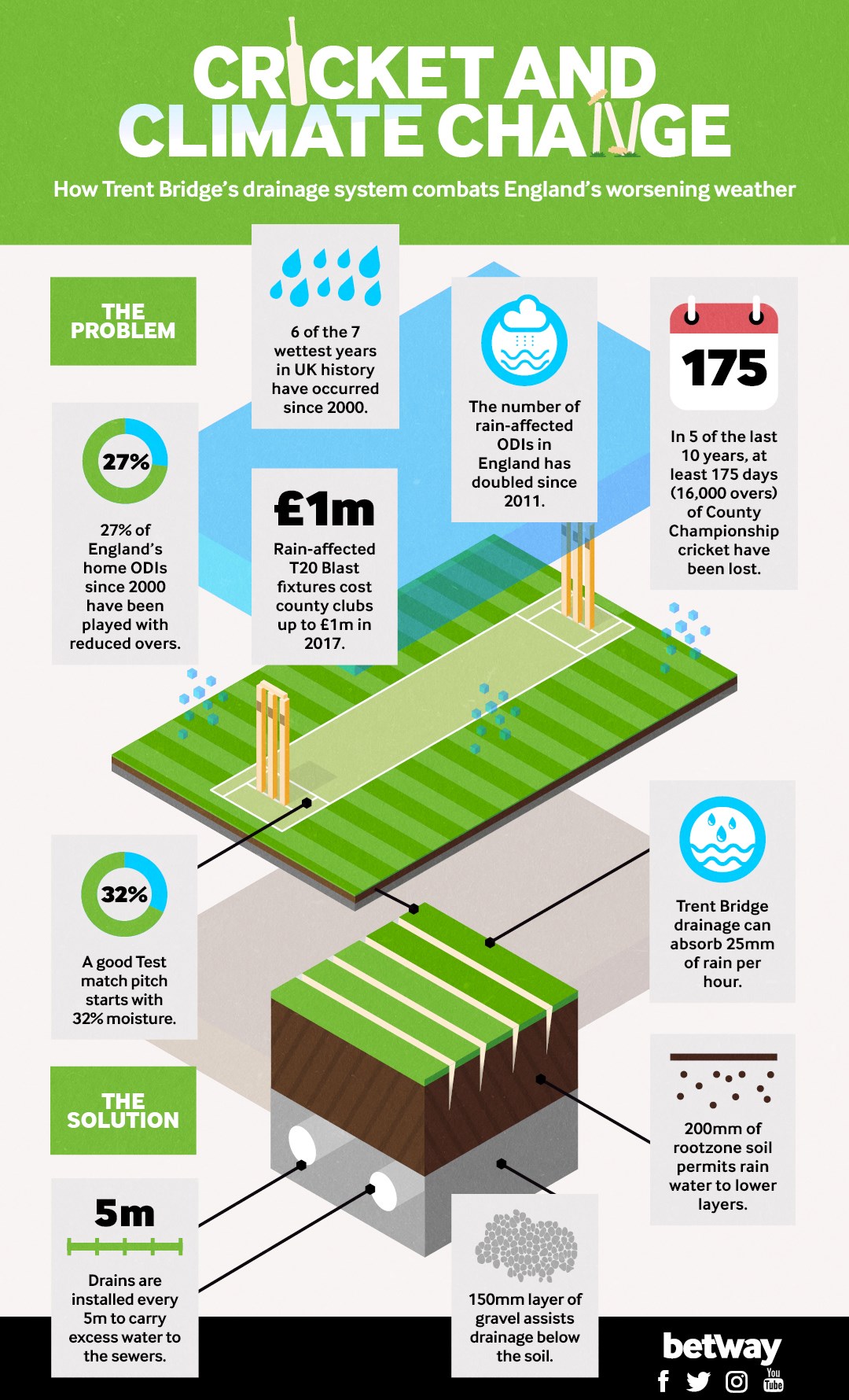
In international cricket, 27 per cent of England’s home one-day internationals since 2000 have been played with reduced overs because of rain delays. The rate of rain-affected matches has more than doubled since 2011, with five per cent of matches abandoned completely.

Part of the problem with climate change in England, though, is that it’s not always straightforward to identify.

“In this country, you’re relying on the weather,” says Steve Birks, head groundsman at Nottinghamshire, who are available at 5/2  to win the 2018 County Championship in the latest cricket betting.
Climate Change In Cricket

“One week it’s 27 degrees, and the next its central-heating weather again. You can’t rely on it being red hot for a week.”

British weather has always been famously unpredictable. Yet Birks, who will prepare the Trent Bridge pitch for England’s Test match with India in August, reveals there are subtle differences now.

“The rain is getting tropical, it is getting heavier,” he says. “We’re getting thunderstorms more often when it rains – I think that’s when you can tell the difference. But then that’s when the new outfield comes into its own.

The new outfield Birks is referring to is the product of a £600,000 grant from the ECB to Trent Bridge – plus the Swalec Stadium and Headingley – to renovate its outfield in 2008, including a new turf surface, drainage and sprinklers.

“The drainage at Trent Bridge is now second only to Lord’s,” he says. “It can take up to 25mm per hour in most places on the square.

“Beforehand, it was just a clay-based outfield with land drains in. Now it’s got a root zone up to 150mm, drains every five metres, and pop-up sprinklers in between drainage. It really takes it away.”

The new drainage system is too efficient, according to ex-England captain Kevin Pietersen, who claimed in 2014 that it resulted in the pitch for England’s Test match with India becoming “dry and lifeless”. He was not the only one, either, with other players and pundits declaring the surface to be slow and unfavourable to entertaining cricket.

Birks apologised at the time but says it had nothing to do with the drainage, which allows the surface to retain as much moisture as is required.

“We knew the 2014 pitch was coming to the end of its life, but it’s trying to fit in when you’re going to dig it up,” he says. “When you dig it up and take it away, you can’t play on it for two years.

“They deal with it in Australia, where the temperatures are twice as hot as here. Last year we mowed the square slightly longer, so that plenty of moisture stays in it.

“Our pitches start with maybe 32 per cent moisture in. That’s plenty.”

Birks understands, however, the extra scrutiny that comes when the national team is in town. “There is a lot more pressure when you’re dealing with England,” he says. “You want the pitch to be fair. Whatever England ask for you try and give them.”

The importance of delivering the right pitch is as much financial as it is tactical. Weather swings have the power to cruelly impact on a country’s finances, while international cricket – especially Test matches – must entertain if it is not to be squeezed out of the cricketing public’s consciousness.

“We lost our first ODI last year because it rained all day,” says Birk. “It’s a massive financial hit, particularly if it’s an ODI.”

Birks says that measures against climate change are likely to increase in years to come, but – for now at least – he is confident that Trent Bridge’s infrastructure can withstand the elements.

“Our new drainage system can take most of the storms we’ve had so far,” he says. “Whatever gets thrown at us, it’s our job to deal with it.”

Click here to read the original article

For the latest industry news visit turfmatters.co.uk/news

Get all of the big headlines, pictures, opinions and videos on stories that matter to you.

Follow us on Twitter for fun, fresh and engaging content.

You can also find us on Facebook for more of your must-see news, features, videos and pictures from Turf Matters.