Tag Archive for: Its

Dumbarnie: It’s worth the wait

Dumbarnie: It’s worth the wait: Scott MacCallum celebrates the opening – at last – of a fine addition to the long list of magnificent Scottish golf courses, uncovering American connections along the way…

There is a beach in Fife which is only really known by locals. Shell Bay, on the East Neuk of the Kingdom, doesn’t have the iconic status of the West Sands at St Andrews, but it does have all you would ever want from a beach.

Dumbarnie: It’s worth the wait

Dumbarnie: It’s worth the wait

I know this because I was brought up not 15 miles away and spent the occasional sunny Sunday afternoon enjoying the delights of the beach.

But just between Shell Bay and the village of Lower Largo is a stretch of land, at one time unassuming fields occupied by cattle and sheep, which has just been turned into Scotland’s newest and most talked about golf course – a wonderful addition to the unbeatable stable of courses the Home of Golf has to offer.

Dumbarnie Links opened to the public in May and there can be noone prouder than Grahame Taylor, who has been with the project from the turning of the first sod. He was appointed Course Manager, initially being in charge of the “Seed in the Ground” contract, before taking on the day-to-day maintenance.

A born and bred Fifer, Grahame already had a stellar CV, containing the names Leven Links, Polaris WorldSpain, Gleneagles and The Old Course St Andrews. Then came along the amazing opportunity to be involved in a fantastic new project that could not be overlooked at Dumbarnie Links.

It was while at Leven that the jungle drums about a new course near Shell Bay started to beat a little louder, reaffirming a plan which had its origins back in the 1920s, and which had it come to fruition would have changed the landscape of Scotland’s hospitality and golfing sector.

The story goes that the Directors of Caledonian Railways were travelling through Scotland looking to identify a location for a fabulous new hotel they hoped to add to their property portfolio. They came up with two places, Dumbarnie and Gleneagles. It was the Perthshire site that was chosen and the iconic Gleneagles Hotel, with its wonderful Scottish Open, Ryder and Solheim Cup courses, was the result.

It may have taken a full century to do so but Dumbarnie is now fulfilling that potential.

Dumbarnie: It’s worth the wait

Dumbarnie: It’s worth the wait

“I first learned that a golf course was being planned over 10 years ago when I heard that the land had potential for golf,” explained Grahame, as we spoke in his superb new maintenance facility, full of brand new John Deere kit, supplied by Double A, based not far away in Cupar.

What had put the spark back in the plan was down to an old boss of mine. Malcolm Campbell, a former Editor of Golf Monthly magazine and a highly respected golf writer, lives close by and had, like Caledonian Railways, known for some time of the golfing potential of the land. Close friends with former Ryder Cup player, Clive Clark, now golf course architect, based in the United States, Malcolm tipped Clive off about the site, and he became equally enamoured.

A consortium was put together and the land, part of the 5,000 acre Balcarres Estate, was purchased from Lord Balniel. Planning for the new course was approved in 2017.

Remarkably, the construction and overall management was and is conducted by American companies – Nebraska-based Landscapes Unlimited constructed the course and it is operated by OB Sports Golf Management, which is based in Scottsdale, Arizona. It was designed by Clive Clark who was on site for the construction phase and had Paul Kimber also on site throughout as Project Manager.

“I think they wanted someone with a lot of Links golf experience and ideally a local guy to manage the course and I’d been at Leven for 10 years, had Open and Ryder Cup experience and was also very experienced in irrigation,” explained Grahame.

His boss is Luke Beardmore, Senior Vice President of Agronomy, Construction and Landscape with OB Sports Golf Management.

“Luke interviewed me on site, and we have built a great working relationship, even though he is 5,000 miles away. We speak every day, either by phone, Zoom or Facetime.

I feel really privileged to have such a great working relationship. Luke is an agronomist and has grown-in around 30 golf courses. OB Sports have been a fantastic support for me on site.”

Turning bland fields into a characterful golf course is no mean feat but in the case of Dumbarnie, in part due to the dry summer of 2018, it was constructed in a remarkable 12 weeks – the first sod was turned on June 1, 2018 with the final green seeded on October 8th.

“Shapers, four of them, were brought in from the States and the site was swarming with 30 tonne dumper trucks and dozers. They moved 600,000 cubic tones of dirt and in doing so created a dune-scape indistinguishable from the land which previously existed,” revealed Grahame.

Dumbarnie: It’s worth the wait

Dumbarnie: It’s worth the wait

With the construction moving at such a pace it would have been easy for Grahame to lose focus, however taking one day at a time and staying organised was key to a successful day.

“To be on site from day one was very important to see where everything from drainage to irrigation is going in the ground.

Working as one team with Clive and Paul was a good opportunity to put forward my views on any contours that would affect the maintenance of the course moving forward, Clive would sometimes ask me ‘Is it maintainable?’” said Grahame.

“If they perhaps needed a slight tweak they could be softened off a little. It was quite straightforward and the consultation worked well.”

The areas in which Grahame’s views were considered most valuable where in ensuring there were sufficient pin positions on greens and would fairway mowers cope with some of the undulations the shapers had created.

When it came to the seeding of the greens and surrounds Grahame and his team took it upon themselves to complete the job and were delighted with the results.

“It is important that you get it right the first time as you get one shot at it.” Barenbrug supplied the seed. The greens and surrounds were fescue – chewings and slender with a very small percentage of Charles bent.

“I asked for some bent as it gives us a little more scope as there would otherwise be a greater risk of balls oscillating in high winds. In terms of wear having a bit of bent in there gives you more options.”

Those winds were such that they did cause issues during the grow in, a problem caused by the fact that the dunes were brand new and initially didn’t have anything to bind them together.

“The dunes were all hydro seeded but had no irrigation, so you were left hoping that nature would provide some rain to germinate the seed before the winds arrive in the spring,” revealed Grahame, adding that the course had wall-to-wall Toro irrigation, which offers him excellent control.

Unfortunately some winds did prove to be an issue in the spring of 2019 and, despite miles of fences, and piles of pallets, acting as wind breaks, Grahame and the team would come in and discover entire fairways were buried in up to four inches of sand.

In his own words, “It was a like a war zone out there at times” sums up the scene after the winds had done their damage.

“The fescue was at a young stage and any amount of brushing the sand off was not ideal.”

This was the toughest spell during the grow-in phase for the agronomy team. “I have a fantastic team who I work alongside with who gave everything to the course during that difficult spell.”

“Take one day at a time and feel like you have won the battle when you head home. The next day is a new set of challenges to overcome. There is always a solution, you just have to find it.” His philosophy during the growin period was to be aggressive from the start in terms of agronomy.

“There is no point in pussy-footing around. You have to take control right from the beginning, or you will get beaten up. I always went with my gut instinct and stuck to that, if you are second guessing yourself you are not going to win the battle.”

The course itself is stunning. Designed to be an enjoyable round for most standards of golfer the length is a spread from 5,334 yards, off the front tees, to an eye-watering 7,620 yards from the Championship tips. That would even have Bryson DeChambeau reaching for a mid-iron occasionally and perhaps hints at longer term ambitions for the course.

One of the features of the course, which is already adding to the flora and fauna on the site, is the bunkers. Half of them are beautifully revetted, while the other half are described as natural. “The revetted bunkers, 72 of them, are actually Eco Bunker, with layers of astroturf. You’d never know and they have turned out magnificently and Richard Allen has told us that they will stand for 25 years.

“We keep the natural bunkers clear by hand weeding them,” explained Grahame, whose team has grown from 11 during the grow-in to 18 now, including South African Deputy Course Manager, Era van Zyl, who joined Grahame from the Castle Course, in St Andrews.

Dumbarnie: It’s worth the wait

Dumbarnie: It’s worth the wait

Covid-19 has had an impact on Dumbarnie, although the opening only slid by a fortnight from the original date of May 16.

“At that point we were still aiming to have the course ready and, while we knew it was struggle for some of our suppliers, we were working towards that date without easing off.

“The thing that sticks in my mind about lockdown was that we were on a hectic schedule to get the clubhouse finished and we thought it was achievable. There were 40 to 50 people working on the clubhouse pushing hard… and the next day everyone left. It was a very eerie feeling. All my guys had cut back on their hours and it was just Era and myself sometimes. I cannot thank Era enough for his dedication. It was a very strange feeling. We just did not know what was going to happen,” recalled Grahame.

“My main concern was the guys’ health. You have to look after your team. When we started to come back, I split them into smaller groups and they were doing essential maintenance and then going home for the day.”

Speaking in September with a temporary car park packed, a clubhouse, which has been designed to look like two converted barns due for completion within a few weeks, and rave reviews for the course, Grahame could not be more pleased.

“I’m incredibly proud. Our international bookings have understandably been cancelled but many have rescheduled, while we have been full with Scottish residents playing, many of them coming back two three or even four times.

“I am honoured to be Course Manager at Dumbarnie Links. It has been a joy to be involved here from the start and I haven’t looked back. I never planned out my career. If a chance comes along you just have to have the courage to take it.”

And take it he has. You can be sure that now that Shell Bay shares its space with a world class golf course it will no longer be just the guilty secret of the Fife locals.
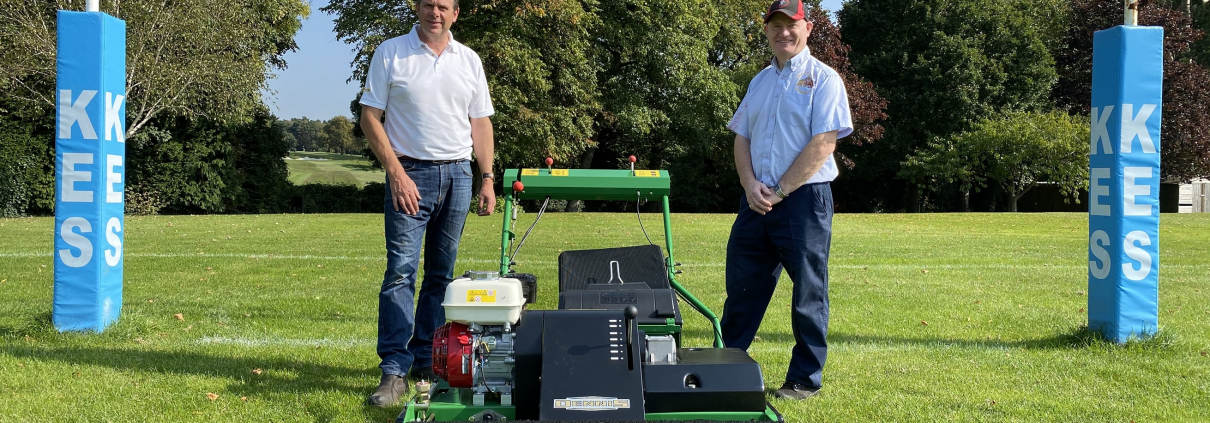
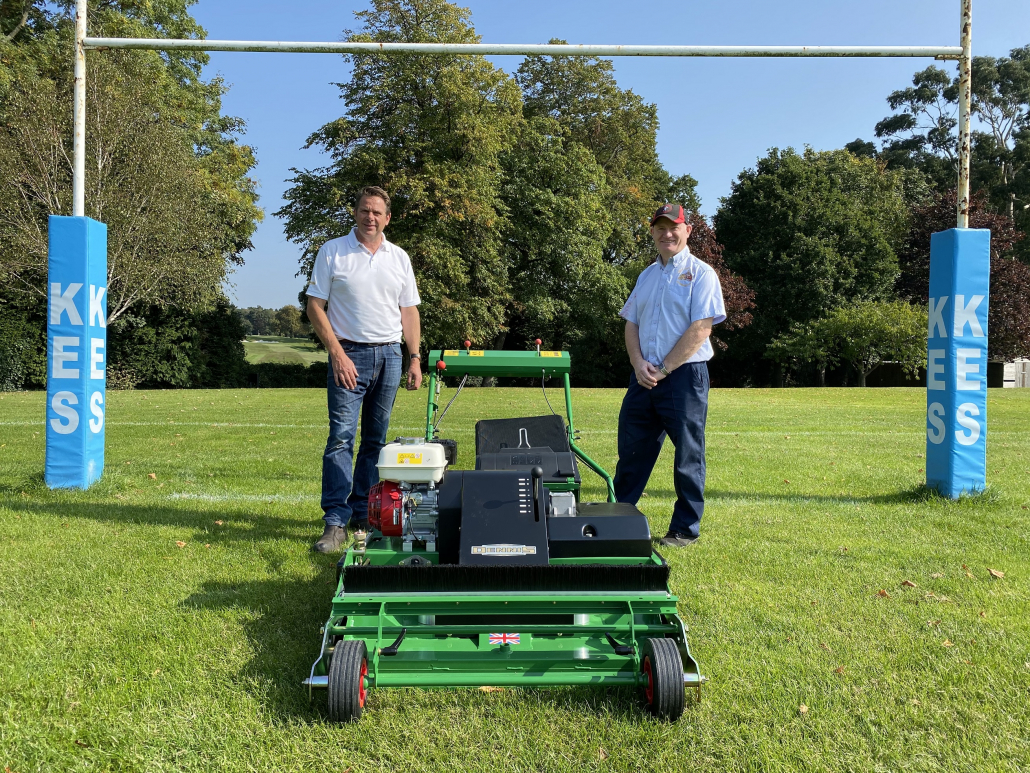
It’s elementary with the Dennis PRO 34R

It’s elementary with the Dennis PRO 34R: Head groundsman Garry Watson and his deputy John Holmes have praised the Dennis PRO 34R rotary mower for keeping several grass areas in fantastic condition at the King Edward’s School in Edgbaston, Birmingham.

Founded in 1552, King Edward’s School is one of the most successful boys’ schools in this country. For nearly 400 years the school stood in New Street at the heart of the city. In 1936 the school moved to its present 50-acre site in Edgbaston, shared with King Edward VI High School for Girls, which provides extensive space and facilities matched by few day schools in the country.

It’s elementary with the Dennis PRO 34R

It’s elementary with the Dennis PRO 34R

The school’s academic performance places it amongst the very best in the country and King Edward’s has a long list of notable alumni including two Nobel Prize-winners, JRR Tolkien, Edward Burne-Jones, Lord Willetts and Lee Child.

The grounds department is overseen by Garry, who has been working at the school for an incredible 35 years. Alongside his trusty deputy John Holmes, the duo recently began searching for a new rotary mower.

“We were previously using 20-inch mowers and we wanted something bigger so we could cut more regularly and more quickly,” said Garry. “We also wanted an alternative to that of putting tractors or triple mowers on the pitches – something that would keep the weight off the pitch.”

The case was solved as soon as they saw the Dennis PRO 34R in action: “As soon as we had the demonstration, John said this is it – this is the machine we need to have. Yes, there are other rotary mowers on the market, but we made a decision there and then based on how good it was.”

The Dennis PRO 34R is a 34” (860mm) rotary mower which has been designed to help groundsmen achieve an aesthetically pleasing appearance and desired playing surface. It is ideal for sports pitches and lawns producing the enviable ‘Dennis Stripes’ while a powerful vacuum flow collects debris quickly and efficiently.

The angle of the cutting deck and twin blades can be easily adjusted using a single ‘click adjuster’ ensuring the mower is suitable for changing conditions and meeting groundsmen’s requirements.

“The PRO 34R offers a fantastic cut,” continued Garry. “It is predominately used on the rugby pitches for presentation and to also clean-up after matches.

“After about a week of having the PRO 34R, we made the decision to purchase another one – it was that good. It is absolutely fantastic for sports pitches, but we also have a large number of big lawns – which must be kept in good condition. Therefore, the second PRO 34R is all about presentation on these lawns. We use it for cutting and striping.”

Garry also said that the decision to purchase the PRO 34R was based on his experience of using Dennis in the past.

“We’ve had Dennis before, and I’ve never had any issues, so I tend to stick with what I know works. Plus, the service is all part of the overall package with Dennis.

“I like to deal with personalities and Jason Briggs from Dennis and SISIS is fantastic. I know what I like – and Dennis Mowers have never let me down.”

For further information or a no obligation demonstration, please contact Dennis 01332 824 777 or visit www.dennisuk.com

For more news, reviews and insightful views, you can follow Dennis on Twitter and Instagram @DennisMowers and like the company’s Facebook page – www.facebook.com/DennisMowersUK. You can also view the latest Dennis videos by visiting www.youtube.com/DennisMowers

For the latest industry news visit turfmatters.co.uk/news

Get all of the big headlines, pictures, opinions and videos on stories that matter to you.

Follow us on Twitter and Instagram for fun, fresh and engaging content.

You can also find us on Facebook for more of your must-see news, features, videos and pictures from Turf Matters.

It’s all about Grass Seed

It’s all about Grass Seed: Stronger germination and faster establishment are key.

DLF Seed’s ProNitro Coating Technology has been helping greenkeepers and groundsmen achieve stronger germination, faster establishment and lower input costs.

It’s all about Grass Seed

It’s all about Grass Seed

Four years on from its launch, the next generation of ProNitro is now available, featuring DLF’s new Hydroactive Water Management Technology. ProNitro’s targeted combination of controlled release nitrogen and sustainable water distribution optimises the delivery of essential nutrients and moisture to the developing seedling.

With sustainability an everincreasing priority for turf managers around the world, the ProNitro coating ensures available water is used more efficiently.

“The new ProNitro formulation has been conceived and developed as a direct action for input optimization on grasses, improving water distribution in the field. Making the best of every drop of water gives both the grass seed and the fertiliser the optimum conditions for establishment, strong root development and healthy, vigorous
growth,” explained Giovanny Lopez, Lead Seed Coat Technologist for DLF.

In trials, the coated seed contributed to a 34% increase in establishing plants and a 30% improvement in root growth. In addition, the targeted nitrogen application system reduces the leaching of unutilised fertiliser into the environment by more than 50% when compared to traditional chemical applications.

ProNitro combines sources of both fast-acting and slow release nitrogen with water management technology, encapsulated in a smooth outer coating for improved seed flow and accurate delivery. This ensures the new seed receives the full benefit of the available water and nutrition, encouraging the roots and shoots to grow rapidly – particularly important when overseeding into a competitive sward.

It is suitable for use on all types of playing surfaces and is available on a selection of popular mixtures from across the Johnsons Sports Seed range. On golf greens and football pitches, even those with low-fertility, sandy soils, ProNitro provides faster establishment, bringing surfaces back into play quicker. The improved uniformity and sward density also make it ideal for turf producers by reducing the invasion of Poa annua and broad-leaved weeds. Replacing the need for seedbed fertiliser, ProNitro saves both time and money.

It’s Always Terrain When It Pours

It’s Always Terrain When It Pours: Enable Leisure and Culture (ELC) is a registered charity, contracted by Wandsworth Council to manage and develop the council’s parks, commons and playgrounds. Working in conjunction with sub-contractors such as idverde.

ELC takes responsibility for monitoring the grounds maintenance across a total of 200 sites. Enable also advises Wandsworth Council on its responsibilities with respect to legislation relating to biodiversity and best practice in the ecological maintenance of parks. Among the sites under their watchful eye are the sports pitches, of which there are 95 football pitches, 10 cricket squares, bowling greens and running tracks.

It’s Always Terrain When It Pours

“A lot of the sites are on made up ground and experience major problems with drainage,” says Andrew Green, Enable’s Parks Officer, Sports Provisions. “We have carried out aeration down to 300mm but it’s not enough to get to the pans.”

Andrew called on the services of Terrain Aeration whom he has used for around 20 years to deal with waterlogging problems, most recently for Tooting Common, with its six senior football pitches which became waterlogged in the winter season; along with Garratt Park and Fishponds Playing Fields. Terrain Aeration’s Terralift was brought in to apply deep penetration aeration to relieve the problem. The machine uses a JCB road breaker hammer to drive a hollow probe one metre into the soil. This is needed, especially on made up ground, because it is usually so compact at depth it requires the hammer to get through. Once the probe reaches the optimum depth, compressed air is released up to a maximum of 20Bar (280psi). This blast fractures the compacted soil to allow drainage and deep aeration.

It’s Always Terrain When It Pours

The probe is withdrawn and, in the case of the work for Wandsworth, the process repeated using one and a half metre spacings on a staggered grid pattern. This means each shot interconnects the fissures. On the tail end of the blast, dried seaweed is injected which sticks to the walls of the fractures and fissures. Over time, this expands and contracts with the moisture content in the soil to effectively keep the ground drained. At Wandsworth the 1½” probe holes created by the Terralift machine were backfilled with Lytag aggregate to provide a semi-permanent aeration/ventilation shaft, helping to keep the whole aeration process working. Put simply, Andy Green says: “We wouldn’t do it if it didn’t work. We find the Terrain Aeration process is a cost-effective solution, without the need to dig up pitches and lay drainage.

For the latest industry news visit turfmatters.co.uk/news

Get all of the big headlines, pictures, opinions and videos on stories that matter to you.

Follow us on Twitter and Instagram for fun, fresh and engaging content.

You can also find us on Facebook for more of your must-see news, features, videos and pictures from Turf Matters.

Sentosa Golf Club Loses Its Bottle

Sentosa Golf Club Loses Its Bottle: Sentosa Golf Club is reaffirming its commitment to the environment and its ‘Keep it Green’ agenda by announcing that it will no longer permit the use of plastic water bottles on its golf carts, instead favouring the installation of a number of water stations on course.

The reduction of its plastic footprint, which is expected to equate to 150,000 water bottles each year, is a continuation of the world Top 100 club’s pioneering efforts to drive environmental awareness and build upon already established eco-friendly agronomic and operational practices.

“Every little helps,” commented Andy Johnston, General Manager and Director of Agronomy. “We are continually monitoring every aspect of our agronomy programs and operations to ensure we are doing all we can to work in harmony with the environment. The decision to remove all plastic bottles from golf carts will allow us to considerably reduce our plastic usage and take another positive step in demonstrating what is possible if golf clubs commit to simple measures.”

Sentosa’s agronomic practice has long been considered at the forefront of the golf industry. Continual efforts have been made in developing the most sustainable methodologies and maintenance programmes, demonstrated best in the reconstruction of the New Tanjong course.

Over the course of an extensive redesign, Sentosa took a number of steps to reduce the environmental impact, including the creation of a temporary nursery to facilitate the relocation and replanting of more than 260 palm trees, the installation of six reservoirs-cum-water features to ensure self-sufficient irrigation and the re-use of concrete from old cart paths as the basis of all new paths.

“The future of the golf industry requires clubs, owners and managers to understand more about what can be done to neutralise and enhance the environment,” continued Johnston. “I hope that Sentosa serves as inspiration in this respect as we continue to find new ways to benefit the environment. From taking food wastage and working it back into the ecosystem to introducing bees into the community, there is a long list of small changes we are implementing and we hope other clubs can make that, when combined, can have a lasting and sustainable impact.”

Sentosa introduced its ‘Keep it Green’ campaign at the SMBC Singapore Open, where stars of world golf voiced their praise of Sentosa’s approach to sustainability. Further activity at the inaugural Women’s Asia-Pacific Amateur Championship and the LPGA Tour’s HSBC Women’s Champions provided opportunities for the club to promote its practice to a global audience and campaign messaging has so far been viewed by over 500,000 golfers.

The golf club is home to the renowned Serapong Course and the New Tanjong Course, and will host the 10th Asia-Pacific Amateur Championship in October 2018; the culmination of a landmark year of major events.

Sentosa Golf Club lies at the heart of the Singapore golf and leisure community. Located on the famed Sentosa Island, which attracts millions of visitors each year, the club is home to the R&A’s Asia Pacific office and is the Official Headquarters of the Asian Tour.

For the latest industry news visit turfmatters.co.uk/news

Get all of the big headlines, pictures, opinions and videos on stories that matter to you.

Follow us on Twitter for fun, fresh and engaging content.

You can also find us on Facebook for more of your must-see news, features, videos and pictures from Turf Matters.