
Tag Archive for: To

GMA education programme continues to grow

GMA education programme continues to grow: The Grounds Management Association (GMA) reaches a significant milestone in its online training with more than 2,000 enrolling for its courses since the pandemic began.

Now, the not-for-profit member organisation adds two new courses to its training offering; Online Level 2 Cricket Surfaces (Applied Turf Culture) and the first face-to-face training course since the Covid-19 pandemic began, Level 2 Racecourse: Turf Management.

GMA education programme continues to grow

GMA education programme continues to grow

Taking around 6 hours to complete, Online Level 2 Cricket Surfaces (Applied Turf Culture) is ideal for volunteers or new additions to grounds teams seeking to develop their skills and learn about the importance of preparing a playing surface with the implementation of an annual maintenance plan.

Students who successfully complete the end of course assessment gain valuable knowledge and applicable skills for day-to-day maintenance activities and a certificate of achievement, whilst the course’s specialist content will be crucial for all aspiring cricket grounds staff or volunteers.

Whilst expanding its online training suite, the GMA also announces the return of face-to-face training with a 5-day training course at the British Racing School. Taking place from 14 – 19 November 2021, Level 2 Racecourse: Turf Management teaches students how to apply the theory required to understand the science of racecourse grounds maintenance and will be equally relevant for individual grounds staff as well as Clerks of the course.

Developed in conjunction with the Racecourse Association and the British Horseracing Authority, the 5-day course will be delivered by industry experts, Alan Lewis NDT, Adrian Kay, Head Groundsman at York Racecourse and Richard Linley, Senior Inspector of Courses at the British Horseracing Authority, with accommodation and food covered in the package.

Dan Prest, Head of Technical and Learning, said:

“It has been an incredibly challenging 18 months, but one thing that hasn’t changed is the drive from so many in the industry to continue in their professional journey and development working in the turf-care sector. Whilst we’ve all had to adapt to a more online-orientated work and study life, we know how valuable practical face-to-face training courses are.

We’re also pleased to be developing more content than ever to align with our Pitch Advisory Service objectives to help volunteers get the most of their local natural and artificial surfaces.”

You can sign-up to online Level 2 Cricket Surfaces (Applied Turf Culture) by clicking here.

Or to find out more about Level 2 Racecourse: Turf Management, click here.

More details on the Pitch Advisory Service can be found on the GMA’s website.

For the latest industry news visit turfmatters.co.uk/news

Get all of the big headlines, pictures, opinions and videos on stories that matter to you.

Follow us on Twitter and Instagram for fun, fresh and engaging content.

You can also find us on Facebook for more of your must-see news, features, videos and pictures from Turf Matters.

Change in approach to managing amenity spaces

Change in approach to managing amenity spaces: Withdrawal from the European community, and the consequences of a pandemic, are already substantially impacting on all who manage amenity and sports spaces.

The pandemic has highlighted just how important these areas are to all and especially in the urban and sporting environment. BREXIT has heralded new requirements in trading, changes in resource sourcing and more. For those charged with maintaining areas, those involved operationally and indeed anyone with an interest in amenity, these are times when it can be difficult to keep up with policy announcements and new innovations and approaches.

Change in approach to managing amenity spaces

Change in approach to managing amenity spaces

All this means that the timing of the 2021 Amenity Forum conference, to be held on October 21st, could not be better and its title ‘Facing the Future’ very apt indeed. The conference will focus on policy change and its impact. The event will commence with keynote senior speakers from Defra, the Chemicals Regulation Department of HSE (CRD) and the Environment Agency. Defra will address change resulting from the recent review of the UK National Action Plan relating to weed, pest and disease management. The CRD speaker will address changes in pesticide regulation and enforcement approaches. The Environment Agency will look at the ever tightening of regulation relating to water and its quality. Each area is crucially important and reason in itself for conference attendance.

These will be followed by some eminent speakers involved operationally who will look at what more integrated approaches might mean including a specific contractor and a distributor view. There will then be a focus on the vitally important area of education and training. Policy change will bring more requirements for both training and CPD and increased innovation in how this can be delivered. The conference programme will conclude with some individual perspectives on the future for amenity and sports space management. This will include a focus on parks, on the environmental impact of various management approaches and what is involved in creating and maintaining surfaces at an international sporting venue.

To complement all of this will be an exhibition area where supporters will be on hand to showcase and describe what they do and new developments. There will be the announcement of the category winners for the Amenity Sprayer Operator of the Year and John Moverley will provide a presentation of his thoughts looking forward.

A day not to be missed and, given the support from organisations, very competitively priced at £95 per delegate. For further information, please contact Kate at admin@amenityforum.net

Some comments from participants at last year’s event were:

‘’I would just like to say a huge thank you for putting on a great conference, along with some excellent speakers in their various fields of expertise from across the sector. The whole conference was well organised, fast moving and held my attention throughout’’

’Congratulations on such a successful and well run event.  As usual the standard of presenters and presentations was incredibly high, although we’ve come to expect that. .  It was an incredibly worthwhile day, very enjoyable and I learnt new things’’

’Just to let you know that I thought the conference yesterday was really excellent – the content and speakers were very good and their topics were very relevant.  Very well managed making great use of the time, an event not to be missed’’

For the latest industry news visit turfmatters.co.uk/news

Get all of the big headlines, pictures, opinions and videos on stories that matter to you.

Follow us on Twitter and Instagram for fun, fresh and engaging content.

You can also find us on Facebook for more of your must-see news, features, videos and pictures from Turf Matters.

Getting to the roots of sustainability

Getting to the roots of sustainability: Back in April, users of ‘turf Twitter’ bore witness to the effect extreme weather has on the sports turf industry.

A combination of 22 days of ground frost, record levels of sunshine and the fourth driest April on record made the preparing playing surfaces exceptionally challenging. Predictably, May was a washout with relentless heavy rain falling across most of the country.

Getting to the roots of sustainability

Getting to the roots of sustainability

Weather extremes add additional pressures and keep sustainability and climate change issues high on the industry’s agenda. The most commonly described approach to sustainability in turfgrass management is a reduction in inputs, such as fertiliser, fungicides and water, but grass breeders at Barenbrug have given turf managers the ability to underpin their sustainability strategy with Sustainable Grass Technology.

The result of years of specialist breeding, significant investment from the global leader in turfgrass seed production, and numerous independent and in-house trials, grasses in SGT blends have been bred to excel in one or more of four key areas of research;

  • nitrogen use efficiency to reduce fertiliser use and cost
  • drought tolerance to increase survival and reduce the need for irrigation in stress periods
  • increased disease tolerance to reduce fungicide use
  • lower clippings yield to reduce mowing frequency, labour and fuel consumption

“Our breeders had the foresight to anticipate the industry’s needs. These grasses have, in some instances, been decades in the making,” explained Dr David Greenshields, Barenbrug UK’s Amenity Commercial Manager.

“Our aim is to give turf managers all the desirable characteristics that help them meet the demands of the modern game, with minimal inputs, and for surfaces to retain their health, vibrancy and resilience under extreme conditions, such as drought or heavy wear. For turf managers looking to reduce their inputs and all the associated costs without compromising turf quality, using grasses specifically bred for that purpose and proven through independent testing is the ideal starting point.”

SGT’s breeding objectives led to the development of Barprium, a perennial ryegrass cultivar that has set a new benchmark for nitrogen efficiency.

Trials conducted at the STRI from 2016 to 2018 focused on identifying which perennial ryegrass varieties use lower levels of nitrogen most efficiently to deliver acceptable turf quality.

It compared the performance of seven of Barenbrug’s existing high performing perennial ryegrass cultivars against the new cultivar.

When low levels of nitrogen were applied to all cultivars, all performed to a good standard throughout the trials, but Barprium showed greater quality and coverage, even with a 50% nitrogen input. The other seven cultivars all ranked highly in the BSPB Turfgrass Seed Listings, making Barprium’s performance even more impressive.

Strong summer colour in Barprium has also proved an asset to the blend for low input golf fairways.

“SGT Rye Fairway is a great example of our global breeding and trials resource delivering excellent regional solutions. The fi ne fescue cultivars in the mix were selected for their sustainable performance characteristics,” explained David.

“Hardtop hard fescue and Barjessica strong creeping red fescue performed particularly well in periods of heat and drought.

Data from fi ne fescue performance trials conducted in 2018 showed that turf quality of hard fescue was unrivalled during the intense heat and drought of a memorable summer, and the recovery capacity of Barjessica was exceptional. The selected cultivars also provide excellent resistance to Red Thread – perfect for low nutrition fairways.”

David is urging Course Managers to consider the significant benefits of hard fescue on fairways.

“The summer of 2018 bought into sharp focus the situation turf managers face during lengthy periods without rainfall. Hard fescue has been used successfully on the continent, in the US and in Australia where summers are hotter and drier than ‘typical’ ones in the UK.

“It is the default species where there is no irrigation, which demonstrates its natural drought tolerance. It is also resilient and more nitrogen efficient than red fescue, and modern cultivars produce high quality turf.

“It currently makes up 50% and 20% of our two SGT mixtures, and I believe it will play a greater role in the long-term management of medium-fi ne turf with low maintenance requirements.

For new constructions and full renovations, sustainability starts with sowing the right cultivars. For established turf, overseeding with these new cultivars can enable the sward to adapt over time to provide additional resilience when and where it’s needed most.”

A Mezmerising pitch thanks to Mansfield Sand

A Mezmerising pitch thanks to Mansfield Sand: Mansfield Town FC Head Groundsman Michael Merriman, known to most in the industry as Mez, has revealed how products from Mansfield Sand have signalled a ‘massive improvement’ to the pitch at the One Call Stadium.

Mez might be a Liverpool fan but there is no team closer to his heart than Mansfield Town FC after working at the club for an incredible 24 years. It all started after seeing a job advert for the role of a trainee community football coach for Mansfield Town. From there he moved into the role of an assistant groundsman but also adopted the duties of kitman and a self-proclaimed ‘bath filler’. His hard work and dedication to the club paid off in 2004 when he was promoted to the role of Head Groundsman.

A Mezmerising pitch thanks to Mansfield Sand

A Mezmerising pitch thanks to Mansfield Sand

He now oversees the stadium and the training ground and manages a grounds team which is very much a family affair – his two assistants are his son Scott and Lewis Sprigg – who is the son of previous Head Groundsman Rob Sprigg.

It’s safe to say that Mez has become a part of the club’s fabric who has endured and enjoyed both difficult and prosperous times in the club’s recent history. It was perhaps during the more difficult times that he was particularly grateful of the help he received from Mansfield Sand.

“We’ve been working with Mansfield Sand for the entire time I have been at the club,” he said. “Before the new chairman came in, we had some hard times when we didn’t have any money and Mansfield Sand really showed their support for us. It is things like that which will never be forgotten, and I’d like to say a huge thank you.”

Support aside, there is a reason why the club has been relying on products from Mansfield Sand for so long, and Mez explained how they have been just so beneficial.

“We’ve been using MM40 (predominantly used in the construction and maintenance of a wide range of sports surfaces) for as long as I have been here,” he said. “We used to use it every year during the May renovation and even when we weren’t able to turn the pitch over due to lack of funding, we would still put about 50 tonnes of the MM40 over the top, followed by a verti-drain to get a bit of drainage in the pitch.

“We’ll also very often follow up with a light coating of the MM40 in October – just to get us through winter; and I would say that over the past couple of years we have applied about 200 tonnes, if not more, of MM40 at the training ground.”

In 2017, Mez used a pure sand and polypropylene fibre reinforcement product that is particularly advantageous when grass cover has been reduced due to heavy usage and wear during the winter period. It is incorporated into an upper sand soil rootzone and consolidated to provide a stable divot-free environment.

A Mezmerising pitch thanks to Mansfield Sand

A Mezmerising pitch thanks to Mansfield Sand

“We applied 300 tonnes of the Fibresand mixed to a depth of 100mm and it transformed the way the pitch played,” he said. “It has signalled a massive improvement; we no longer get the sloppy surface and providing you do your renovations and prepare your pitch in the correct way then you won’t have a better surface. Fibresand is a great product, and I would recommend it to everybody.”

In further praise of Mansfield Sand, Mez commended the customer service he receives.

“I work with Sharon Morris from Mansfield Sand who is an absolute diamond,” he said.

“There have often been times when I have put orders on her late and she always pulls it out the bag for me. With Mansfield Sand it is not just a case of providing you with products and then off they go. Sharon will come in and take samples, makes sure it is at the right depth and ensure that the contractors applying it are doing a good job. The delivery drivers are also extremely helpful and courteous.

“It is a great service all round.”

For more information visit www.mansfield-sand.co.uk

You can also follow the company on Twitter – @MansfieldSand and Facebook – https://www.facebook.com/MansfieldSandSportSurfaces/

For the latest industry news visit turfmatters.co.uk/news

Get all of the big headlines, pictures, opinions and videos on stories that matter to you.

Follow us on Twitter and Instagram for fun, fresh and engaging content.

You can also find us on Facebook for more of your must-see news, features, videos and pictures from Turf Matters.
Versatile Variseeder key to overseeding

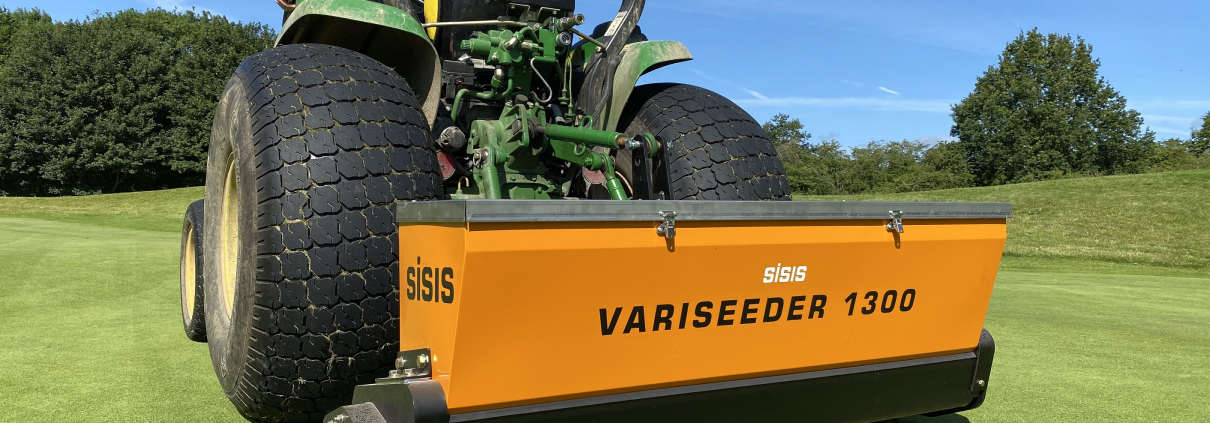
Versatile Variseeder key to overseeding: The versatile SISIS Variseeder 1300 has been key to overseeding without disruption according to Simon Marshall, Head Greenkeeper at Wishaw Golf Club.

Simon has been working at the golf club in the West Midlands for an impressive 26 years. It could, however, have been a vastly different story as rather interestingly, he used to be a candle maker and delivered them to churches all over the country. As a keen golfer, and already a member of Wishaw Golf Club, there was only one job he wanted.

Versatile Variseeder key to overseeding

Versatile Variseeder key to overseeding

“I have been a member at Wishaw since the age of 27 and I was so keen to get into greenkeeping that I spent the first summer helping out around the course, raking bunkers, cutting tees, and slowly learning the business.”

His willingness and work ethic were rewarded when he was offered a full-time role at the 18-hole parkland course. Simon is now the Head Greenkeeper, and even though he admits that there is still a lot of work to do, the course is progressing nicely.

He explained that one such improvement was to start to incorporate more bent grass into the greens and to do this they needed to look at new equipment.

“Our aim is to try and get as much bent grass into the greens as possible and we thought that we could really do with a seeder,” he said. “The first one we tried was a slit seeder but it just caused too much disruption. It was at this point that our attentions turned to the SISIS Variseeder.

“I spoke to a few other greenkeepers from other courses, and they all recommended the Variseeder – it just seemed a no-brainer.”

The SISIS Variseeder is a versatile easy to use tractor mounted seeder with a variable seeding rate ideal for golf course maintenance and for use on lawns and amenity areas. It has a fast work rate, is low maintenance with few wearing parts and enables overseeding to be undertaken without taking ground out of play. Complete with a studded roller, the Variseeder prepares the seedbed by creating thousands of little “plant pots” to receive the seed without linear grooves that can disturb play.

Versatile Variseeder key to overseeding

Versatile Variseeder key to overseeding

“I like the fact that the Variseeder is light and very easy to use,” said Simon. “We are quite a wet course in the winter and our tees experience a lot of wear. Therefore, the lighter the machine the better and the Variseeder is brilliant in that respect.

“Its versatility is its best feature. We overseed with it three times a year on the greens, overseed on the tees as much as we can, and the surrounds too. I also like how you can use it with different types of seed. If you can buy one machine that can do multiple jobs, then it is a bonus in my opinion.”

For further information or a no obligation demonstration, please contact SISIS on 01332 824 777 or visit www.sisis.com

For more news, reviews and insightful views, you can follow SISIS on Twitter or Instagram @SISISMachinery and like the company’s Facebook page – www.facebook.com/SISISMachinery You can also view the latest SISIS videos by visiting www.youtube.com/SISISMachinery

For the latest industry news visit turfmatters.co.uk/news

Get all of the big headlines, pictures, opinions and videos on stories that matter to you.

Follow us on Twitter and Instagram for fun, fresh and engaging content.

You can also find us on Facebook for more of your must-see news, features, videos and pictures from Turf Matters