Tag Archive for: To

Turf diseases to be aware of

Turf diseases to be aware of: Summer is here and with it are several turf diseases to be aware of.  Here’s a guide to dealing with a few of them.

Anthracnose is a stress disease, so combining any 2 or 3 of several potential stresses can encourage the disease.  Common stresses include lowering of height of cut, low N inputs, heat, extremes of soil moisture, high thatch, aggressive verticutting, high wear, etc.

Turf diseases to be aware of

Turf diseases to be aware of

Symptoms within a sward are patches of irregular, yellow/brown/bronze-coloured patches and a loss of turf density. Foliar blight-affected leaves lose colour to become a yellow colour and black spots containing fruiting bodies (acervuli) can be seen on the leaves.

The three biggest factors in anthracnose development are mowing height, deficiencies of N or K (mainly N) and poor control over soil moisture.  Avoid these three and your chances of avoiding anthracnose are greatly increased.  Keep green speeds up by applying slow-release N to maintain turf health without excess growth.  I recommend high potassium liquids in nearly all my golf green recommendations throughout summer to help keep anthracnose at bay as higher levels of K in the leaf reduce anthracnose.  It’s also a good idea to add in phosphite and salicylic acid with your foliar mixes.  Both work in a similar fashion by ‘tricking’ the plant into thinking it’s under attack from a pathogen and increasing its defences.

Consistent moisture levels across the whole surface are important in preventing Localised Dry Spots and anthracnose, so use of a soil moisture meter and hand watering is crucial.  Maintain a good wetting agent programme to maintain consistent soil moisture across your site.

Take-All Patch affects golf greens and you probably won’t see symptoms until later in the summer, but you can prevent it now.  For those on Take-All prone sites:  get a good programme of biostimulants in place employing seaweeds, amino acids and humic acids.

Light straw-coloured circular patches become visible that have a well-defined edge between healthy and infected turf.  They may have a bronze tinge around the edge when the disease is active.  These may be slightly depressed and contain unaffected species or weeds in the centre

Low soil manganese levels are often associated with this disease as the pathogen oxidizes available Mn2+ to Mn3+ or Mn4+, making it unavailable to the plant; extra manganese inputs have been shown to be effective in reducing symptoms.  High pH soils are also more vulnerable.

On sites who traditionally suffer badly, two applications of azoxystrobin 2 weeks apart in early summer, and then again in late August will help.  Combine applications of azoxystrobin with a wetting agent to get the active ingredient down into the soil where it’s needed.

Be aware of Waitea Patch during a hot spell.  Hydrophobic layers are a factor with this disease, therefore moisture and thatch management are key.  With modern moisture meters you can really track soil moisture levels very accurately and watch the VMC% drop and then treating with a hand water and surfactant hose end pellets to keep moisture consistent.

With a Poa annua sward, turf shows symptoms of coalescing yellow rings around 20-40cm in diameter.  There is often (but not always) darker green turf in the centre of the ring.  The disease affects the leaves, stem, crown and upper roots and if it gets to advanced stages will turn leaves a brown/red colour and kill plants.  Very similar in appearance to Superficial Fairy Rings, but Waitea does not have the mushroom smell or mycelium below the surface associated with Superficial Fairy Rings.  Waitea Patch can develop mycelium on the leaves, crown and soil surface, but not sub-surface.

The big difference between Waitea and Superficial Fairy Ring is smell: fairy rings give off a distinct mushroom smell when you take out a core and have good sniff.  Waitea Patch does not smell anywhere close as strong of mushrooms, if at all.  Mycelium can develop on the surface with Waitea Patch, but below the surface with Superficial Fairy Rings and is usually reasonably easy to spot with Fairy Rings (take a core and put it into a ziplocked, soil sampling bag to incubate for 24 hours to see where mycelium develops if uncertain).

Superficial Fairy Ring always have some element of hydrophobic soil associated with them – Waitea CAN have hydrophobic soil too, but it will be likely be completely unrelated to the disease.

With Waitea Patch you need to try to reduce surface moisture (i.e. don’t hand water it!) and with Superficial Fairy Rings you’ll need to break that hydrophobicity with a wetter and get moisture back into the soil (i.e. hand water it with a hose and wetting agent pellet!).

Geoff Fenn BSc (Hons)

For the latest industry news visit turfmatters.co.uk/news

Get all of the big headlines, pictures, opinions and videos on stories that matter to you.

Follow us on Twitter and Instagram for fun, fresh and engaging content.

You can also find us on Facebook for more of your must-see news, features, videos and pictures from Turf Matters.

EVO 205D to revolutionise chipper market

EVO 205D to revolutionise chipper market: Having cemented their position in the 6” market with the revolutionary EVO 165 series, GreenMech are introducing its ‘big brother’ in the shape of the 8” EVO 205D, which promises to set the new standard for large capacity woodchippers.

Extending the EVO concept of more powerful bite, torque and throughput, the 205D delivers even greater performance to tackle the biggest tasks with reliability and ease.

EVO 205D to revolutionise chipper market

EVO 205D to revolutionise chipper market

At the heart of the 205D’s design is a Stage V compliant 50hp Kubota Diesel engine which can process up to 25 cubic metres of material per hour, making it one of the most productive machines in its category. GreenMech’s new ‘Smart Sense’ controller provides ‘no-stress’ overload protection and automatic load detection to ensure optimised performance and fuel consumption. A new, generous in-feed hopper measuring 1250mm x 700mm allows for the free-flow of bulky brash and timber, gathered and gripped by the twin horizontal hydraulic rollers and fed to the heavy, six-disc blade flywheel, which offers unparalleled processing power.

Strength and durability in construction is provided by the deep beam, high tensile steel chassis, together with an all-steel hinged and lined bonnet which not only offers all-important protection to the engine but makes the EVO one of the quietest chippers on the market. All major grease points have also been centralised on the EVO series to make the ongoing maintenance of the machine quick and convenient. Available at launch in road-tow format, SAFE-Trak and SURE-Trak versions of the EVO 205D are due to follow later in the year as replacements for the legendary 19-28 models.

As standard, the EVO 205D comes with GreenMech’s Disc-Blade chipping technology, a three year, no-quibble parts and labour warranty and the unrivalled support of their nationwide dealer network.

For the latest industry news visit turfmatters.co.uk/news

Get all of the big headlines, pictures, opinions and videos on stories that matter to you.

Follow us on Twitter and Instagram for fun, fresh and engaging content.

You can also find us on Facebook for more of your must-see news, features, videos and pictures from Turf Matters.

Agrovista Amenity Academy continues to grow

Agrovista Amenity Academy continues to grow: Agrovista Amenity’s online Academy has shown significant growth with over 9,000 CPD points awarded so far, and the company believes that it is just the start of something special.

The Agrovista Amenity Academy is an online learning resource with courses and lessons created on a range of areas of turf management and for all products sold by Agrovista Amenity.

Agrovista Amenity Academy continues to grow

Agrovista Amenity Academy continues to grow

“It has grown bigger than we ever expected it to,” said Karl Parry, the founder of the education platform. “The amount of CPD points we have awarded really is quite phenomenal.”

The portal consists of videos, case studies, MSDS, labels and technical specifications which have been designed so that turf managers can fully understand and get maximum benefits from the products they use. This will, in turn, lead to healthier, better performing turf.

Furthermore, the Academy website boasts a highly sophisticated weather system which helps people make better decisions for the week ahead.

Launched in 2017, the Academy was the result of a need to provide a platform which suited both the learner and the employer – according to Neil Pullen, Agrovista Amenity Business Development Manager.

“The thinking behind the Academy was to provide education that was open to everybody,” he said. “Not just for those at the top, but more a vehicle for people who were new to the industry or part qualified, to further their education with a desire to become a course manager, or a head groundsperson for example.

“It progressed from there and then two years ago we sat down with BIGGA to discuss their education programme. It was apparent that golf clubs were paying for their staff to complete BIGGA courses, but it meant that the staff would need days off to do them. There was also an issue with the employers paying for their staff to be educated only for the staff to leave once they were qualified.

“So, you had a frustrated employee wanting to further their CPD education with BIGGA but struggling to do it because nobody wanted to pay for it, and nobody wanted to give them the time off. This was where the Academy really progressed because individuals can get the CPD points they need without it having an impact on their employers. Each course can be done at home and there is no cost. Now, a lot of BIGGA members come directly through the Academy.”

The Agrovista Amenity Academy, which is free to sign-up to, provides in-depth knowledge on Agrovista Amenity’s market leading products (Product Courses), as well as a wide range of areas in turf management such as turf disease, chemical, product application, seed and turf pests (Knowledge Courses).

The Product Courses have been designed so that the individual can fully understand and get maximum benefits from the products they purchase. With Product Courses and Knowledge courses being added on a regular basis, Academy students are guaranteed to have a wide variety to choose from.

“I think that the Product and Knowledge portfolios that we can build is endless,” said Karl. “Agrovista has an incredible number of resources combined with highly knowledgeable and experienced professionals. Both sections will continue to expand and will push the amenity standard forward.”

BIGGA allocates up to 4 points for all successfully completed Knowledge and Product Courses and can vary depending on content and length. To date, the Academy has awarded 9,499 CPD points to over 3,000 individuals. While it is evident that the wider industry is indeed seeing the benefits from using the Academy, so too is Agrovista Amenity.

“Internally, having that platform to train the team has been invaluable and we have seen improved sales results,” said Neil. “We now insist that all members of staff pass the courses because it teaches them about the products – how it works, why it works, how to apply it, what rates – absolutely everything.

“At the end of the day, we feel that we have a responsibility to make sure that customers understand everything they need to know about the products – so stewardship wise it is important too.”

The Academy has inevitably seen an increase during the pandemic with more people either being furloughed or working from home, but both Karl and Neil are confident that it will continue to grow, especially with the plans that are already in place.

“I would like to see a deeper integration with BASIS and FACTS and we have already spoken about some exciting new content for best practice,” said Karl. “We are also looking forward to continuing to support BIGGA and I feel that is a partnership which will develop even further. We have so many more courses to publish and I would just like to see the Academy continue to grow.”

“Further down the line I would like to see the Academy spilt into different sections to cater for individual sports,” added Neil. “At some point we are planning on having a golf academy, a football academy, a cricket academy, and a rugby academy, for example, to make it even more specific.

“We would also like to have courses for different abilities – so a foundation, intermediate and a professional course. We’ve got so much planned and while we are not quite there yet – we certainly are not far away.”

For more information, please visit www.amenityacademy.co.uk

For the latest industry news visit turfmatters.co.uk/news

Get all of the big headlines, pictures, opinions and videos on stories that matter to you.

Follow us on Twitter and Instagram for fun, fresh and engaging content.

You can also find us on Facebook for more of your must-see news, features, videos and pictures from Turf Matters.

Ride-on mowers – what to look for

Ride-on mowers – what to look for: When it comes to purchasing a new ride-on mower, there are many manufacturers and models currently available. Whether you require 2wd or 4wd, petrol or diesel, ground-tip or high-tip, there are lots of options. But, what should you be looking at? Les Malin, Managing Director of Etesia UK answers some common questions.

WILL A RIDE-ON MOWER CUT AND COLLECT IN THE WET AND LEAVE A CUT COMPARABLE TO A PEDESTRIAN MACHINE?

The obvious answer is some will, while some will not, but the ones that can will be far quicker over a large area compared to a pedestrian mower. However, there is still a need for smaller pedestrian machines, due to access and transport etc. When it comes to cut and collect systems, Etesia is the innovator of every other machine you see on the market today.

Ride-on mowers - what to look for

Ride-on mowers – what to look for

The French based company created a patented system in the late 1980’s and quite simply, the system is unrivalled. Where models such as our Hydro 80 or Bahia ride-on mowers are useful, is small access points such as gates etc. The British climate is notoriously wet, and on most days when it hasn’t rained, the grass may still be damp, so it’s important to have a machine that is up to the job of cutting and collecting in the wet.

The Etesia Professional ride-on mower range have been designed and developed especially for these conditions. They will pick up wet grass clippings and even leaves in the autumn and have been designed to never clog and everything is fully automated.

CAN YOU EMPTY THE GRASS BOX EASILY WITHOUT LEAVING THE SEAT?

All Etesia ride-on mowers have the option of emptying the grass box directly from the driver’s seat, without ever having to leave the machine. In our larger Buffalo, H100 andH124 models, you can empty the grass box up to 1.24m above the ground which is very useful if you need to empty grass clippings into a skip or hi-tip vehicle for recycling.

Unlike competitor machines, they are designed to be able to tip the heaviest of loads without needing additional counterweights to aid stability. This reduces the overall weight of the machine. The most notable benefit is the fact that Etesia machines do not require any additional accessories to unblock them when emptying the machines.

Everything is automatic so no accessories or rattling of levers are required – you can simply cut, collect and empty the grass box all while sitting on the machine.

CAN I CUT AND COLLECT AND MULCH WITH THE SAME MACHINE?

Mulch cutting has become very popular over the years. Predominately, it’s used as a time-saving form of grass cutting as there is no need to collect clippings or debris and empty. There are also other benefits as mulching can often mean ‘greener’ grass, particularly in times of drought, as the nutrients are put back into the soil after a cut.

Most of the Etesia machines have the option of being able to cut and collect or mulch – it really depends on the users’ preference. Just remember the golden rule when mulch cutting and only cut a third of the grass height in a single cut.

WILL A RIDE-ON MOWER CUT HIGH GRASS?

We do sell a range of Attila brushcutters which have been specifically designed to cut rough grass or brambles and have been known for ‘whatever’ they can push over, they can cut’, however our ride-on mowers are an affordable solution for taming high grass paddocks and fields, meaning that one machine can be used for a multiple of different tasks.

WILL I BE ABLE TO FIT ATTACHMENTS TO A RIDE-ON MOWER OR WILL I NEED A TRACTOR?

That really depends on the type of attachments you would like to fit. However, Etesia also sell a range of attachments from scarifiers, snow plough, sand spreader, weeding brush and also a street sweeper which means that one ride-on mower really can be a 365-days-a-year workhorse.

WILL A RIDE-ON MOWER EFFECTIVELY COLLECT FALLEN LEAVES?

Autumn is a busy time in the garden and collecting and disposing of fallen leaves can be a big job. There is no faster or better way to collect those fallen leaves than with a Etesia ride-on mower.

Another benefit of using a ride-on mower is that the leaves will be shredded which means you will get more leaves in the grass box and composting will be accelerated.

ARE RIDE-ON MOWERS SAFE TO USE?

When choosing a ride-on mower, ensure it has added safety benefits for the user. You need to consider if you are working on slopes, then it will be worth looking at a model with a differential lock for extra stability on slopes or uneven ground. Etesia is the only manufacturer to offer 4wd and or differential lock across the whole range of ride-on’s with mid mount cutting decks.

Vibration is also a big consideration. Etesia machines are rigorously tested in our state-of-the-art factory in France to meet all EU regulations. We also publish all of these figures on our website.

It’s also worth noting that vibration isn’t just a health hazard for the user, but also an indicator of machine efficiency and design. Etesia avoids vibration by fitting correctly balanced components which also has the added benefit of lasting longer.

We still have users of our first generation H100 model that is over 30 years old!

WILL THE MANUFACTURER ARRANGE A FREE, NO OBLIGATION DEMONSTRATION ON OUR OWN SITE?

For the past 30 years, the Etesia slogan has always been ‘Seeing is believing’. For That reason, we also recommend a free, no obligation demonstration to put our machines to the test on your own site. This can be organised by contacting us directly or speaking to one of dealers local to you.

WILL I BE ABLE TO BUY SPARE PARTS EASILY?

Etesia UK holds vast stocks of spare parts for machines dating back to the 1980’s. Selling to the professional market means obtaining spare parts, which is very important to the end user. Consumables are normally off the shelf and we pick 98% of orders consistently. It is only usually obscure items that may catch us out.

Blades and belts are consumable items and will always need to be replaced from time-to-time. If your local dealer hasn’t got the spare part you require, we can usually get it direct from France in no time at all.

In addition to here in the UK, we also work with Kramp who stock many of the faster moving items and can supply dealers on their fantastic overnight service, which benefits from longer opening hours during harvest periods.

All you need to know about nematodes

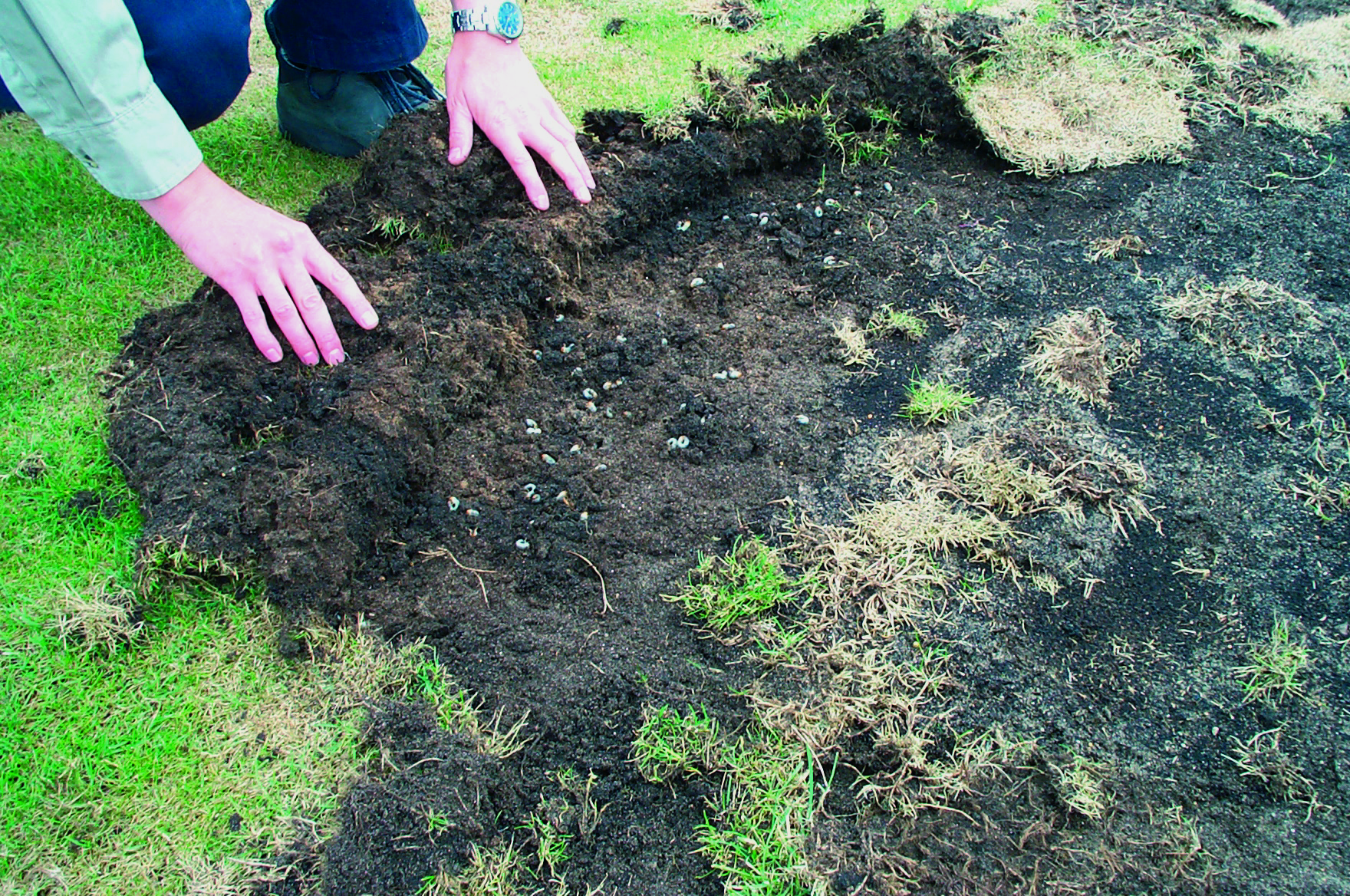
All you need to know about nematodes: Spring is an important time of year for turf management. As the weather warms and preparations are made for the busy summer season, everything must be one to ensure that the turf is healthy – protecting the grass from soil-dwelling pests such as chafer grubs. Helpfully, nematodes can be used to control these unwelcome golf course visitors, which feed on the grass plants’ roots. 

Dr Colin Mumford, Technical Support Manager at Bayer Environmental Science, answers greenkeepers’ questions on how nematode-based products work.

All you need to know about nematodes

All you need to know about nematodes

DON’T NEMATODES KILL GRASS?

It depends. There are two types of nematodes – the ‘bad guys’ and the ‘good guys’. The ‘bad guys’ are plant parasitic nematodes that feed on plant tissue, stress the turf and often make it visually unappealing.

The ‘good guys’ are the entomopathogenic nematodes (EPN) and these don’t harm humans, plants or vertebrates. They are, however, able to target and control turf pests such as chafer grubs and leatherjackets. In this article, I’ll refer to EPN (the ‘good guys’) simply as ‘nematodes’.

HOW DO NEMATODES CONTROL TURF PESTS?

When you apply the nematodes to turf, they travel down to the roots, where the chafer grubs and leatherjackets reside. These pests become the nematodes’ hosts and, once they’ve found them, each nematode enters its host through its natural openings. Once inside, they regurgitate a type of bacteria that paralyses the host and, ultimately, leads to its death.

The nematodes then produce offspring that feed on the inside of that host. Once they’ve exhausted all of the resources available to them, they exit the body. These new nematodes will then go off to seek a host for themselves to complete their lifecycle.

DO ALL EPN NEMATODES WORK IN THE SAME WAY?

This is one of those ‘yes’ and ‘no’ answers. ‘Yes’ once they are inside the host species, they all produce the bacteria, complete their lifecycle and control the pest. But ‘no’ in so far as different species use different strategies to target their host.

For example, Bayer’s Harmonix Tri-Nema product contains three different species. ‘The Hunter’ Heterorhabditis bacteriophora, is a ‘seek and destroy cruiser’ nematode that actively seeks out or hunts its prey before attaching itself to it. Meanwhile, Steinernema carpocapsae is known as ‘The Resident’ because it uses an ambushing strategy that sees it sitting and waiting for a host to come along before jumping onto it to complete its lifecycle. Furthermore, ‘The Explorer’, Steinernema feltiae, has an intermediate foraging strategy between the ‘ambusher’ and ‘cruiser’. It will actively seek out the host but, rather than attacking, it will wait for the host to come past and then it will ambush it.

Ideally, you want to use as many different species as possible so that you’re utilising those different modes of action and maximising the effectiveness of your nematode strategy to control chafer grubs.

HOW DO I STORE THEM?

Ideally, you should use the nematodes as soon as possible after receiving them. But if you can’t get to the golf course because the conditions aren’t right, then you’ll need to store them appropriately.

Don’t open the box in broad daylight/direct sunlight because this is extremely damaging to the nematodes and can kill them. What’s more, don’t expose the nematodes to extreme temperatures, so don’t freeze them or expose them to temperatures above 30°C.

The product will typically come in a cardboard box, but you will need to take the packets of nematodes out of that box and store them in the fridge at a temperature of 4-8°C. Otherwise, the cardboard box will act as insultation, meaning the product won’t be stored at the optimum temperature range.

You want to loosely distribute the packets in your fridge and don’t put them together in one big stack. This is because the weight of all the packs can cause crushing injuries on the nematodes in the bottom pack. Just loosely lay them out in your refrigerator and always use the nematodes before the end of the expiry date on the packet.

All you need to know about nematodes

All you need to know about nematodes

WHEN DO I APPLY THEM?

The timing of application should coincide with egg hatch, or soon after egg hatch. Chafer grubs are the larval stage of several adult beetle species, including Phyllopertha horticola. Therefore, you need to monitor the activity of the adult insects from mid-May until late June.

Leatherjackets are another grass root-loving pest that nematodes can target. These are the larvae of the cranefly, most commonly the European crane fly (Tipular paludosa) although the common cranefly (Tipular oleracea) can also be seen in turf.

Contrary to its name, it’s not the most common species but the difference between this and the European cranefly is that several generations can live throughout the year. So, if you spot a cranefly in springtime then it’s most likely the common cranefly.

You should apply nematodes three to four weeks after you observe a decline in the activity of the adult insects. That way, you know that the vast majority of eggs would have hatched by then. And any eggs that haven’t yet hatched will be attacked by future nematode generations.

DO I NEED TO PREPARE THE GROUND BEFORE APPLYING THEM?

Yes. If you’ve got high levels of thatch the nematodes can get held up in there. So, anything you can do to reduce this prior to applications is advisable.

Also, avoid using granular fertilisers for two weeks prior to, and post, the nematode application because granular fertilisers can do untold damage them.

Ideally, you want to aerate the surface of the turf before applying the product to improve surface infiltration rates and aid the efficiency of the nematodes getting into the soil or the rootzone. Irrigating the day before application should ensure that you have appropriate levels of water in your soil.

HOW DO I APPLY THEM?

Typically, you will be using a vehicle-mounted sprayer or a knapsack sprayer.

You may have to premix a solution if it’s a small capacity tank or a knapsack sprayer. But whichever system you use, try not to apply them using too great a pressure, keep the pressure below 5 bar. The more pressure you have the more force going through the nozzle which tends to produce a smaller droplet. The benefit of large droplets is that they bounce and roll off the turf canopy until they get to the rootzone itself and are able to transport the nematodes into the root system.

You’ll need to remove all filters from your sprayer because nematodes can get trapped. Also avoid using warm water as this could shock the nematodes.

The other point that’s really important to remember is that you don’t apply these nematodes prior to, or during, heavy rain.

In this type of weather, it’s possible for the nematodes to be flushed through the rootzone and down the drainage system.

Finally, avoid applying the nematodes in direct sunlight. The ideal timing is first thing in the morning when you’ve got low light levels.